
BuddhistCatholicContemplativeEvangelicalGeneral ChristianHinduJewishLatter-day SaintMuslimNew VisionsProgressive Christian
Beliefs
- Buddhist
- Catholic
- Contemplative
- Evangelical
- General Christian
- Hindu
- Jewish
- Latter-day Saint
- More Voices
- Muslim
- New Visions
- Pagan
- Progressive Christian
Topics
- Religion News
- Food and Religion
- Sports and Religion
- Religious Art
- Religious Music and Entertainment
- Religious Events
- History and Religion
- Style and Religion
- Politics and Religion
- Women in Religion
- Recreation Outdoors and Religion
- Business Finance and Religion
- Careers Workplace and Religion
- Education and Religion
- Family Parenting and Religion
- Health Fitness and Religion
- Home and Religion
- Relationships and Religion
- Technology and Religion
- Travel and Religion
Columnists
- Buddhist Columnists
- Business Finance and Religion Columnists
- Careers Workplace and Religion Columnists
- Catholic Columnists
- Contemplative Columnists
- Education and Religion Columnists
- Evangelists Columnists
- Family Parenting and Religion Columnists
- General Christian Columnists
- Health Fitness and Religion Columnists
- Hindu Columnists
- History and Religion Columnists
- Home and Religion Columnists
- Jewish Columnists
- More Voices Columnists
- Latter Day Columnists
- Muslim Columnists
- New Visions Columnists
- Nonreligious Columnists
- Pagan Columnists
- Politics and Religion Columnists
- Progressive Columnists
- Recreation Outdoors and Religion Columnists
- Relationships and Religion Columnists
- Religion News Columnists
- Religious Art Columnists
- Religious Events Columnists
- Religious Music and Entertainment Columnists
- Sports and Religion Columnists
- Style and Religion Columnists
- Technology and Religion Columnists
- Travel and Religion Columnists
- Women in Religion Columnists
Resource Library
- 2026 Calendar
- Library of World Religions
- The 100 Most Holy Places on Earth
- Patheos Answers
- Podcasts
- Videos
- Faith Leaders Database
- Anglican Episcopalian
- Bahai
- Baptist
- Buddhism
- Christianity
- Confucianism
- Eastern Orthodoxy
- Hinduism
- Holiness and Pentecostal
- ISKCON
- Islam
- Judaism
- Lutheran
- Methodist
- The Church of Jesus Christ of Latter-day Saints
- New Age
- Paganism
- Presbytarian and Reformed
- Protestantism
- Religion Behind the Scenes
- Roman Catholic
- Scientology
- Shia Islam
- Sikhism
- Sufism
- Sunni Islam
- Taoism
- Zen
- See all religions
Research Tools
 Ad-Free & Subscriber Log-In Subscription Support
Ad-Free & Subscriber Log-In Subscription Support
Follow Patheos 

- Trending:
- Forgiveness
- |
- Marriage
- |
- Consciousness
- |
- Death Penalty
- |
- Election
- |
- Halloween

- Home
- More Voices
- Politics and Religion
- Is There An Antidote to Bad Faith? How Minds Change & Deep Canvassing
Is There An Antidote to Bad Faith? How Minds Change & Deep Canvassing
Last updated on: November 3, 2022 at 10:37 am by Carl Gregg
Is There An Antidote to Bad Faith? How Minds Change & Deep Canvassing 2022-11-03T10:37:40-04:00 Carl Gregg
Patheos Explore the world's faith through different perspectives on religion and spirituality! Patheos has the views of the prevalent religions and spiritualities of the world.
A congregant said to me recently, “Many of us would like to love our neighbors without exception, but we know there are people who regularly deal in bad faith.” And with election denial continuing as Election Day rapidly approaches on Tuesday, November 8, it can be especially consequential when anti-democratic, authoritarian politicians act in bad faith.
So let me submit for your consideration that one significant antidote to bad faith is raising people’s awareness that bad faith actors exist, and that we need to adjust our strategy accordingly. To that end, let’s briefly explore what “bad faith” means.
In modern parlance, bad faith typically doesn’t have anything to do with heretical religious beliefs. Instead, it’s about giving lip service to acting honorable and respectful—while actually behaving in deceitful, hypocritical, self-serving ways. A classic example of bad faith is waving a white flag of surrender, then firing when your enemy approaches. (If anyone is watching the TV show House of the Dragon, an early episode this season has a scene of just that happening.) Other classic examples of bad faith include negotiating with someone to solicit more information or advantages from them — with no actual intent of compromising your original position — or manipulating language and reasoning to deliberately mislead others (Wikipedia).
One of my favorite books about bad faith is titled The Cynic & the Fool by Tad DeLay, a philosophy professor who writes at the intersection of religion, politics, and psychoanalysis. If you find yourself disagreeing with someone, DeLay urges you to notice what is underneath your disagreement. To use DeLay’s categories, are you dialoguing with a “misinformed but honest fool”? Or are you dealing with a nihilistic cynic, who does not care about the truth—only about saying or doing what it takes to spin-doctor perception and win at any cost (3)?
It really matters—and you should proceed differently—if your interlocutor is acting in good faith (“with honesty and sincerity of intention”) or in bad faith (“with an intent to deceive”). And we know there have been a lot of bad faith actors over time, because we have lots of words to describe them: con-man, demagogue, snake-oil salesman, huckster, charlatan, cheat, fraud, sham, swindler. I could go on (4).
At least in my current view, I am not particularly hopeful about the potential to reform the worst and most prominent bad faith actors in politics today. Rather, the best strategy may be to remove bad faith actors from power — that is, to do our best to leverage power and win.
It is also important to acknowledge that while many of us are making lots of good faith efforts to advocate for our values in the public square, many bad faith actors are busy with as many underhanded methods as they can muster: gerrymandering, propaganda, lying, and more.
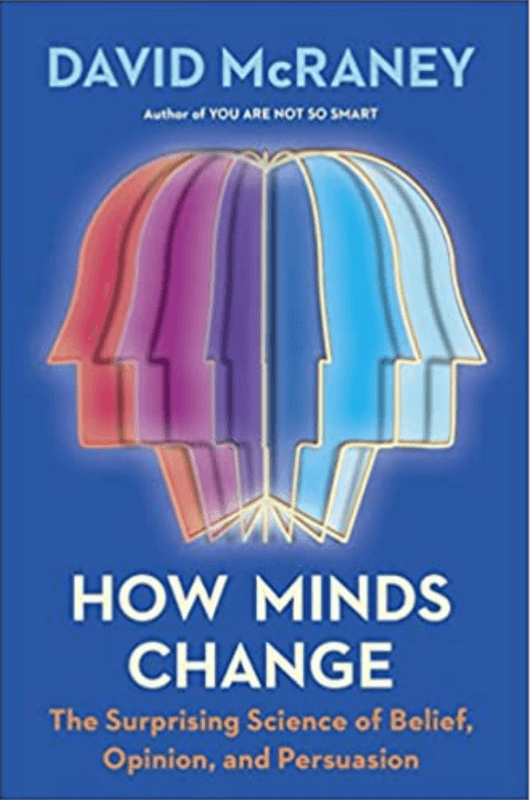 As an antidote to people being misled by bad faith actors, I want to invite us to explore a related technique called Deep Canvassing. I’ll be drawing from a recent book titled How Minds Change: The Surprising Science of Belief, Opinion, and Persuasion by David McRaney, a journalist who hosts a podcast with the provocative title You Are Not So Smart: Why You Have Too Many Friends on Facebook, Why Your Memory Is Mostly Fiction, and 46 Other Ways You’re Deluding Yourself. One of his areas of interest is the ways that we human beings frequently fall into the traps of cognitive biases and logical fallacies. In other words, even when we consciously have good intentions, our unconscious biases and motivating reasoning can lead us to be less smart that we perceive ourselves to be — a sort of unconscious bad faith (xiii).
When his book was published about a decade ago in 2012, McRaney confesses that he was in a pretty pessimistic place regarding the hope of changing people’s minds. About a year later his own mind had surprisingly changed. What happened? He watched in real-time the stunning shift in public opinion toward supporting same-sex marriage.
McRaney had spend many years as a journalist “moderating daily arguments about how same-sex marriage would ruin America” (xiv). Then around the time his book was published in 2012, we finally reached a majority of U.S. citizens supporting same-sex marriage, and a strange thing happened: “When the majority flipped, the arguments (mostly) evaporated,” especially compared to the vitriolic level they had been at before (ibid).
As he began to investigate this phenomenon more closely, it turns out that there are a number of precedents:
Since polling began in the early twentieth century, nearly half of the significant opinion shifts in the United States have been abrupt. Opinions about abortion, the war in Vietnam, attitudes about race and women and voting rights and smoking and marijuana and many others were stable for years…. [But] when the tide of public opinion turned on these issues, it shifted so quickly that if people could step into a time machine and go back just a few years, many would likely argue with themselves with the same fervor they argue about wedge issues today. (xv)
There’s a lot to say about all of this—including the importance of building momentum over time locally and at the state-level to help catalyze change at the national-level—and McRaney’s book is fascinating and accessible if you want the full details. But in our limited time, I want to invite us to focus on deep canvassing since there are some takeaways that you can experiment with in your own life.
Deep canvassing is a relatively new practice with an impressive track record: “Not every time, but often, people using this technique can get a person to give up a long-held opinion and change their position, especially about a contentious social issue, in less than twenty minutes” (15). Even more importantly, the changes have staying power over time (45).
You may have heard about deep canvassing a few years ago when an article was published in the prestigious, peer-reviewed journal Science. That success was then picked up by The Atlantic in an article titled, “No, Wait, Short Conversations Really Can Reduce Prejudice,” and in The New York Times in an article on “How Do You Change Voters’ Minds? Have a Conversation” (45). Importantly, though, not just any conversation works. Some conversational methods are far more effective than others.
In the spirit of full transparency, let me be clear about the scale we are talking about. In one recent experiment with deep canvassing,
One in ten people opposed to transgender rights changed their views, and on average, they changed that view by 10 points on a 101-point “feelings thermometer”…. If one in ten doesn’t sound like much, you’re neither a politician nor a political scientist. It is huge…after a single conversation…. A change of much less than that could easily rewrite laws, flip a swing state, or turn the tide of an election. More than that, a shift of 1 percent had the potential to set in motion a cascade of attuned change that could change public opinion in less than a generation.” (44)
Keep in mind that these impressive results were from a crew of people with little previous experience in deep canvassing having conversations that were approximately ten minutes in length (ibid).
As a point of comparison, how many of you have spent countless hours debating with someone—only to feel like, in retrospect, nothing changed for either of you—except that perhaps you both now resent one another more than when you began? I argue with people a lot less than I used to, but I can remember many times when debating with someone felt like banging my head against a brick wall: the brick wall seemed unfazed, but my head sure did start to hurt!
If you want to be formally trained in deep canvassing, some light googling will turn up lots of opportunities, but for now, let me give you two tricks to have in your back pocket for when the timing feels right. Either of them can be effective in isolation, but deep canvassing at its best uses both in a strategic way to shape the flow of a 10-20 minute conversation.
First, shift from what to why. The “what” refers to debating facts. Arguing about different interpretations of the evidence keeps people up in their head, and it tends to be both endless and ineffective. It’s like battling a hydra or playing “whack a mole.” No sooner have you struck down one head of your opponents argument than another has sprung up to take its place (31-32, 35).
Shifting from what to why means making that all important eighteen-inch journey from your head to your heart. Instead of focusing on what you respectively believe, notice why you feel that way.
This is where the magic can begin to happen. When we are stuck in cognitively debating facts, we tend to act like defense attorneys, charged with endlessly innovating new defense strategies. But if you ask about the why, curiosity might unexpectedly open people up as they consider: “Why do I feel this way?”
In the words of one deep canvassing trainer, “a newfound ambivalence washes over them.” Instead of debating back and forth from entrenched positions, it can suddenly feel like “we are solving a mystery together” (36). (“Why do I feel this way?”) Even more fascinating is when this philosophical contemplation results in people “producing their own counter arguments” and persuading themselves to change their own minds far more effectively than a debating partner would have been able to (36).
Now, this doesn’t always happen, but you can increase the likelihood of success with our second trick: sharing emotionally vulnerable stories. Are you willing to tell a personal story about why you feel this way? For instance, if you were deep canvassing around reproductive justice, you might share how you first heard about abortion or your own or a close friend’s abortion story. That can open up a similar level of deep sharing on the other’s part (37).
Emotionally vulnerable personal stories really are a key ingredient. We could contrast their impact with what is sometimes called the “fact checker’s fallacy,” which mistakenly holds that most people will change their minds based on facts alone. Social scientists have tested many different methods for deep canvassing, and the results consistently show that if you “Remove the non-judgmental listening and story-sharing, no effect. Put them back in and the effect returns” (248).
Let me hasten to add that this brief overview can by no means replace actual training in deep canvassing where you go in depth and have a chance to practice. But to tie it all together, the following is a very brief distillation of the process:
- Establish rapport. Assure the other person you aren’t out to shame them, and then ask for consent to explore their reasoning.
- Ask how strongly they feel about an issue on a scale of one to ten.
- Share a story about someone affected by the issue.
- Ask a second time how strongly they feel. If the number moved, ask why.
- Once they’ve settled, ask, “Why does that number feel right to you?”
- Once they’ve offered their reasons, repeat them back in your own words. Ask if you’ve done a good job summarizing. Repeat until they are satisfied.
- Ask if there was a time in their life before they felt that way, and if so, what led to their current attitude?
- Listen, summarize, repeat.
- Briefly share your personal story of how you reached your position, but do not argue.
- Ask for their rating a final time, then wrap up and wish them well. (246)
Keep in mind that it can be hugely significant to shift someone even from a “10” to even a “7” or “8” in one short conversation. I will also again readily concede that there are a lot of bad faith actors out there. But practices like deep canvassing give me hope that there are ways of changing people’s minds.
The Rev. Dr. Carl Gregg is a certified spiritual director, a D.Min. graduate of San Francisco Theological Seminary, and the minister of the Unitarian Universalist Congregation of Frederick, Maryland. Follow him on Facebook (facebook.com/carlgregg) and Twitter (@carlgregg).
Learn more about Unitarian Universalism: http://www.uua.org/beliefs/principles
Politics and Religion
Previous Post

August 23, 2022
"Four Pivots: Reimagining Justice, Reimagining Ourselves"
Next Post
November 9, 2022 A Brief History of Equality: Reflections on the State of Our Democracy
Browse Our Archives
Select a Category Advent Anti-Racism Archaeology Atheism Baptism Best of the Year List Book Reviews Buddhism Catholicism Christian Education Church and State Church Planting Climate Change Conscientious Objection to War Creation Spirituality Death Penalty Didache Disability Rights Discernment Easter Ecology Emergent Church Movement Empire-Critical Ethics Evolution Feminist Theology Film Reviews Gandhi Gospel of Mark Gun Control Hinduism Immigration Reform Interfaith Islam JFK Judaism Jungian Spirituality Lectionary Commentary Lent Letters to the Editor LGBT Marriage MLK Multiculturalism Mysticism Nonviolent Activism Occupy Paganism (Earth-centered Religions) Parables Paul Pluralism Politics Process Theology Quantum Physics Requiescat In Pace Seminary and Divinity School Sermon Series Retrospective Sermons Spiritual Direction Spiritual Practices Stewardship (Fundraising) The Book of J The Wheel of the Year (Paganism) Theoblogger Challenge Triathlon Uncategorized Unitarian Universalism Worship Resources Youth Ministry
Select a Month July 2026 May 2026 March 2026 November 2025 October 2025 August 2025 February 2025 December 2024 October 2024 March 2024 January 2024 December 2023 November 2023 March 2023 February 2023 January 2023 December 2022 November 2022 August 2022 March 2022 February 2022 January 2022 December 2021 September 2021 August 2021 July 2021 June 2021 May 2021 February 2021 January 2021 December 2020 August 2020 June 2020 May 2020 April 2020 March 2020 February 2020 January 2020 December 2019 November 2019 October 2019 September 2019 July 2019 June 2019 March 2019 February 2019 January 2019 December 2018 November 2018 October 2018 September 2018 June 2018 May 2018 April 2018 March 2018 February 2018 January 2018 December 2017 November 2017 October 2017 September 2017 August 2017 July 2017 June 2017 May 2017 April 2017 March 2017 February 2017 January 2017 December 2016 November 2016 October 2016 September 2016 August 2016 June 2016 May 2016 April 2016 March 2016 February 2016 January 2016 December 2015 November 2015 October 2015 September 2015 August 2015 July 2015 June 2015 May 2015 April 2015 March 2015 February 2015 January 2015 December 2014 November 2014 October 2014 August 2014 July 2014 June 2014 May 2014 April 2014 March 2014 February 2014 January 2014 December 2013 November 2013 October 2013 September 2013 August 2013 July 2013 June 2013 May 2013 April 2013 March 2013 February 2013 January 2013 December 2012 November 2012 October 2012 September 2012 August 2012 July 2012 June 2012 May 2012 April 2012 March 2012 February 2012 January 2012 December 2011 November 2011 October 2011 September 2011 August 2011 July 2011 June 2011 May 2011 April 2011 March 2011 February 2011 January 2011 December 2010 November 2010 October 2010 August 2009 July 2009 May 2009
Follow Us!
TAKE THE
Religious Wisdom Quiz
How many days and nights did it rain during the flood?
Select your answer to see how you score.
7 12 10 40
Related posts from Carl Gregg

Reading America at 250: A Nation Wrestles With...


Andrew Holocek on the Power of Darkness

The Stories That Shape Us: Myths, Archetypes, &...
TRENDING AT PATHEOS More Voices

Reading America at 250: A Nation Wrestles With...
As part of my own reflection on the 250th anniversary of the...

Whenever I am reading a book or listening to an argument, I...

President Trump Ban Animal Torture Videos on Facebook
Call for Stricter Regulations of Animal Abuse Content on Facebook Although President...

Draft Amendments to Address Ritual Abuse in New...
The proposed changes would make it illegal for individuals in domestic partnerships...

How Bans on LGBTQ+ Student Clubs Threaten Religious...
On June 20, 2025, the State of Texas passed Senate Bill 12....

The Truth About the Gen Z Revival
This past year, there has been a lot of media buzz surrounding...
view all More Voices blogs
Ad-Free & Subscriber Log-In Subscription Support
- About Us
- 2026 Calendar
- Videos
- Podcasts
- Library of World Religions
- Faith In Media Tracker
- Advertise With Us
- Write for Us
- Privacy Policy
- Terms of Service
- Do Not Sell My Data
- Contact Us
- Radiant Digital
- Manage Newsletter Subscriptions
- Unsubscribe From Notifications
- Sitemap
Copyright 2008-2026, Patheos. All rights reserved.
Subscription Support Ad-Free & Subscriber Log-In
Follow Patheos