
BuddhistCatholicContemplativeEvangelicalGeneral ChristianHinduJewishLatter-day SaintMuslimNew VisionsProgressive Christian
Beliefs
- Buddhist
- Catholic
- Contemplative
- Evangelical
- General Christian
- Hindu
- Jewish
- Latter-day Saint
- More Voices
- Muslim
- New Visions
- Pagan
- Progressive Christian
Topics
- Religion News
- Food and Religion
- Sports and Religion
- Religious Art
- Religious Music and Entertainment
- Religious Events
- History and Religion
- Style and Religion
- Politics and Religion
- Women in Religion
- Recreation Outdoors and Religion
- Business Finance and Religion
- Careers Workplace and Religion
- Education and Religion
- Family Parenting and Religion
- Health Fitness and Religion
- Home and Religion
- Relationships and Religion
- Technology and Religion
- Travel and Religion
Columnists
- Buddhist Columnists
- Business Finance and Religion Columnists
- Careers Workplace and Religion Columnists
- Catholic Columnists
- Contemplative Columnists
- Education and Religion Columnists
- Evangelists Columnists
- Family Parenting and Religion Columnists
- General Christian Columnists
- Health Fitness and Religion Columnists
- Hindu Columnists
- History and Religion Columnists
- Home and Religion Columnists
- Jewish Columnists
- More Voices Columnists
- Latter Day Columnists
- Muslim Columnists
- New Visions Columnists
- Nonreligious Columnists
- Pagan Columnists
- Politics and Religion Columnists
- Progressive Columnists
- Recreation Outdoors and Religion Columnists
- Relationships and Religion Columnists
- Religion News Columnists
- Religious Art Columnists
- Religious Events Columnists
- Religious Music and Entertainment Columnists
- Sports and Religion Columnists
- Style and Religion Columnists
- Technology and Religion Columnists
- Travel and Religion Columnists
- Women in Religion Columnists
Resource Library
- 2026 Calendar
- Library of World Religions
- The 100 Most Holy Places on Earth
- Patheos Answers
- Podcasts
- Videos
- Faith Leaders Database
- Anglican Episcopalian
- Bahai
- Baptist
- Buddhism
- Christianity
- Confucianism
- Eastern Orthodoxy
- Hinduism
- Holiness and Pentecostal
- ISKCON
- Islam
- Judaism
- Lutheran
- Methodist
- The Church of Jesus Christ of Latter-day Saints
- New Age
- Paganism
- Presbytarian and Reformed
- Protestantism
- Religion Behind the Scenes
- Roman Catholic
- Scientology
- Shia Islam
- Sikhism
- Sufism
- Sunni Islam
- Taoism
- Zen
- See all religions
Research Tools
 Ad-Free & Subscriber Log-In Subscription Support
Ad-Free & Subscriber Log-In Subscription Support
Follow Patheos 

- Trending:
- Forgiveness
- |
- Marriage
- |
- Consciousness
- |
- Death Penalty
- |
- Election
- |
- Halloween

- Home
- More Voices
- Imaginable: How To See the Future Coming
Imaginable: How To See the Future Coming
Last updated on: November 16, 2022 at 10:37 am by Carl Gregg
Imaginable: How To See the Future Coming 2022-11-16T10:37:17-05:00 Carl Gregg
Patheos Explore the world's faith through different perspectives on religion and spirituality! Patheos has the views of the prevalent religions and spiritualities of the world.
There is a scene in Shakespeare’s Macbeth in which a character approaches the three witches, asking them to foretell his future. He implores,
If you can look into the seeds of time,
And say which grain will grow and which will not,
Speak then to me…. (Act 1, Scene 5)
There are so many ways to spend our finite time and resources, but which seeds are most likely to ripen and which are more likely to wither? Should I quit my job and go back to school? Should I pursue this relationship, take that opportunity, or invest in this stock?
As the election results emerging over the past few days have reminded us, predicting the future is a tricky business. But one of the best guides to the future I have found is Dr. Jane McGonigal. She has one of the most interesting job titles I have ever heard: Director of Games Research and Development at the Institute for the Future, a nonprofit organization in California. Her team develops simulations to help solve future global problems.
She’s qu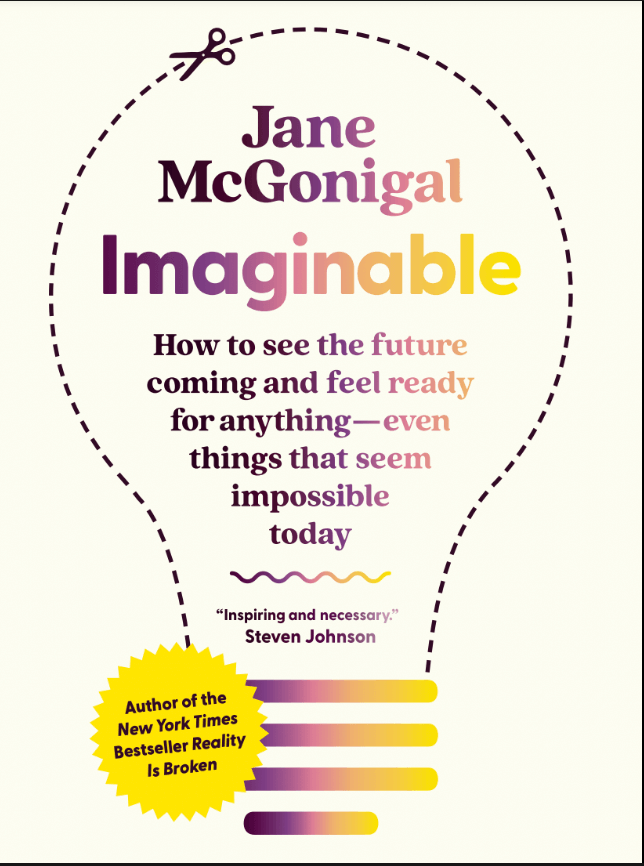 ite good at her job: she was named one of Fast Company’s “Top 100 Creative People in Business” and one of the “Top 35 Innovators Changing the World Through Technology” by MIT Technology Review. And she’s written a number of books. One accessible place to start investigating is her latest book titled Imaginable: How to See the Future Coming and Feel Ready for Anything―Even Things That Seem Impossible Today.
That title is a play on the word unimaginable. And McGonigal has been attracting an increasing amount of attention because some simulations she ran a decade ago have been uncannily accurate in predicting real headlines about what really did happen in recent years in response to the pandemic, wildfires in the West, social media-fueled conspiracy theories, and more. It turns out that many world events that may seem unthinkable before they happen are actually quite imaginable in advance if we learn some of the practices at the core of the field of futurism (xx).
It is also significant that many of the people involved in Dr. McGonigal’s simulations report that when their imagined events ended up happening, they found themselves better prepared psychologically than many other people. Imagining a difficult future can help inoculate you against the most traumatizing aspects of future shock, similar to what psychologists call pre-exposure therapy (xviii, 84).
Events may still be hard to deal with, but instead of feeling overwhelmed, you may feel more like, “I’ve seen this before and am equipped to deal with it (83).” So I invite us to spend a few minutes exploring some highlights from McGonigal’s work to help make the unimaginable more imaginable and easier to deal with if it comes.
One of McGonigal’s core practices is trying to imagine the world a decade from now. She calls this practice “taking a ten-year trip” (22). So, what do you think? What will the world be like in 2032? As the saying goes, “We often overestimate what we can get done in a year, and we often underestimate what we can get done in a decade.”
One way we can open our minds to what might be the case a decade from now is go the opposite direction: what was your life like ten years ago, in 2012 (37)? What were some of the most surprising changes that happened between then and now (38)? A decade is enough time for fledgling trends to develop and become mainstream. In the words of one science fiction writer, “The future is already here. It’s just not evenly distributed” (110).
One of McGonigal’s tricks for learning about emerging trends is to pick an area you are personally interested in forecasting, and then google that topic along with words like “advances,” “breakthroughs,” “opportunities,” “forecast,” “prediction” “surprising,” or “strange” (127, 154). Suddenly you’ll find a whole world of possibilities that may be forthcoming in the next decade or more.
Let’s look at two specific examples: drones and facial recognition software. Drones are those mini, remote-controlled aircraft you may have seen flying around your neighborhood park. Maybe you own a drone, or know someone who does? From the growing popularity and affordability of drones, we can extrapolate that they may have an increasing impact in the future (111).
Here’s one possible prediction: widespread deliveries-by-drone may be coming in the near future. Such drone deliveries could reduce theft by delivering to your backyard, an upstairs balcony, or other locations safer than your front porch. On the flip side, we will also need to consider drone flight paths and how we might prevent a future in which the sky is filled with a sea of drones.
As a second example, how many of you have a phone that “unlocks” itself using facial recognition software, which is a pretty cool trick. But as we imagine our ten-year trip into the future, how might our facial recognition data be misused? A quite imaginable future might include a facial recognition feature many of us have already grown accustomed to using on ourselves—being reversed to enable us to “face search” others or be face searched in return.
You can already do this in a limited way on Google right now. The next time you are on Google’s home screen, notice the camera button on the right-hand side of the search field. In order to get more information, you can click on that camera icon, upload an image, and search for other places that photo appears.
It’s probably already technically feasible to add an upgraded version of this feature, enabling you to subtly wave your phone in front of a stranger and get back a significant amount of information about them from social media and other databases. It’s easy to imagine a future in which you might overhear people saying, “Dude, did you just face search me?!” (150).
Here’s the thing: companies such as Facebook and Clearview AI already have billions of facially-identified photos in their databases. “And accuracy rates for facial recognition range from 90 percent at the low end to 99.98 percent at the high end.” Furthermore, due to the pandemic, software has already been developed that is “99.9 percent accurate for mask wearers, using just the eyes and forehead for recognition” (152). Hopefully, imagining the future will embolden us to call for government regulation to protect our privacy and limit who has access to facial recognition databases (153).
Let me give you a few more quick examples, using a game Dr. McGonigal invented called “Stump the Futurist.” To play, you start with everyday pieces of conventional wisdom that most people would assume will always be the same. The challenge is to brainstorm a way that this seeming truism might change in the future.
When McGonigal has played this game with her students over the years, one of the most common assertions is that it will always “take a man and a woman to make a baby” (67). It turns out that stopped being true six years ago, in 2016. Here’s the headline: “World’s first baby born with new ‘3 parent’ technique.” To avoid passing along a genetic disease, fertility specialists in England were able to “combine genetic material from two women and one man to make one baby” (67).
But, wait, there’s more! Four years ago in 2018, some of you may have seen this National Geographic headline: “Same-sex mouse parents give birth via gene editing”: No male mouse was involved, and the offspring of the two moms have since had healthy babies themselves. Amazing! And scientists speculate that within a decade, human same-sex couples may be able to make an embryo using stem cells and gene editing with “no opposite-sex genetic material required” (69). The future is coming, ya’ll. Get ready.
Now that that we are well over two years into this pandemic, there is growing clarity that there’s no going back to a pre-pandemic ‘normal’ on a whole confluence of levels (129). At the congregation I serve as minister, for example, we don’t want to be an “in-person only congregation” in the age of Zoom, right?! We may eventually return to two in-person services, but we actually already have two Sunday Services; it’s just that one of them in online. We have approximately the same number of people attending services both in-person and online. (Yes, it’s a whole new world.)
There are also many parallel examples in the world of business giving evidence that the future is here, such as these:
- No one wants to be Blockbuster in the age of Netflix.
- No one wants to be Tower Records in the age of Spotify.
- No one wants to be Kodak in the age of Instagram.
These are just the beginnings of a much longer list of how current paradigms might radically change. Our invitation and challenge is to remain agile: to grow, flex, and adapt, even while remaining committed to our core missions and values, which remain unchanged even as our methods evolve.
So, what’s coming next that can give us more hope in the face of change? Here’s Dr. McGonigal’s current best guess of “ten future forces that could make a better world in the next decade” (146-149):
- mRNA vaccines – The same incredible technology that brought us COVID-19 vaccines on an unbelievably fast timetable also has the potential “to prevent or cure cancer, malaria, tuberculosis, and HIV, among other diseases.” There are, of course, no guarantees, but it’s exciting that scientists are actively pursuing the potentially life-changing possibilities.
- Super-inexpensive solar/wind energy – Green energy is on track to be “cheaper than fossil fuels everywhere on the planet,” an advance which would significantly decrease air pollution and the carbon emissions causing climate change.
- Prioritizing social safety nets – Younger generations are more in favor of prioritizing the “triple-bottom line” of people, planet, and profit—rather than solely focusing on the alleged bottom line that values profit over people and planet.
- “Bio-printing” technology – “3-D printers may be capable of producing human organs out of biocompatible plastics” That’s very cool, and could become a game-changer that resolves the long organ donation waiting list.
- Living concrete – Formed from bacteria, gelatin, and sand, living concrete “absorbs carbon dioxide and releases oxygen.” It also “self-regenerates: one brick cut in half heals and forms two bricks; those two can be cut in half to create four, and so on.” Widespread use could be transformative for the future of the global construction industry.
- Direct cash transfers – Pandemic stimulus checks gave us a glimpse into a future where a universal basic income may be more viable than many people previously considered.
- Cultured meat – Meat grown in a laboratory is on course to be “more commonly sold worldwide than meat grown inside animals’ bodies.” Cultured meat is much better for the environment, significantly decreases cruelty to animals, and can be a sustainable global protein source.
- Increasing social connections – To combat the adverse health and social impacts of isolation, there are fascinating experiments in the UK and Japan that other countries may soon emulate, in which “doctors prescribe cooking classes, walking clubs, art groups” and more—as well as government-funded communal living opportunities.
- Free or low-cost learning for a lifetime – To expand our current commitment to funding public education through the high school years, support is growing for free community college and vocational training—in addition to widespread access to and support for online education.
- Anti-aging biotech – New technologies have also already reversed the effects of aging in animal lab experiments, and have the potential to “start lengthening the healthy, active human lifespan by decades” (146-149).
We could also make a list of forthcoming major potential future threats. And I readily concede that we always have to account for the law of unintended consequences. But I don’t want us to miss that there are some genuinely positive trends that seem to be emerging in the near future.
Perhaps the most import takeaway from the field of future studies is to free your mind. The way things are is neither the way they have always been nor the way they will always be. People in the past imagined the ways our society is structured today, which means we can collectively imagine better ways in the future—for all of us.
So as we peer through a glass darkly and seek to discern what the future may bring, let us also be honest that on many levels, we humans are still in our collective adolescence—with all the promise and peril those teenage years can bring. But there is still much reason to hope that we will continue to grow up and live into our potential as a species.
Along those lines, I’ll give the last words to Dr. McGonigal: “The future is a place where anything, or one hundred things, or everything, can be different—even things that seem impossible to change today.”
The Rev. Dr. Carl Gregg is a certified spiritual director, a D.Min. graduate of San Francisco Theological Seminary, and the minister of the Unitarian Universalist Congregation of Frederick, Maryland. Follow him on Facebook (facebook.com/carlgregg) and Twitter (@carlgregg).
Learn more about Unitarian Universalism: http://www.uua.org/beliefs/principles
Next Post

December 5, 2022 Peak Spiritual Experiences, Psychedelics, & Consciousness Research
Browse Our Archives
Select a Category Advent Anti-Racism Archaeology Atheism Baptism Best of the Year List Book Reviews Buddhism Catholicism Christian Education Church and State Church Planting Climate Change Conscientious Objection to War Creation Spirituality Death Penalty Didache Disability Rights Discernment Easter Ecology Emergent Church Movement Empire-Critical Ethics Evolution Feminist Theology Film Reviews Gandhi Gospel of Mark Gun Control Hinduism Immigration Reform Interfaith Islam JFK Judaism Jungian Spirituality Lectionary Commentary Lent Letters to the Editor LGBT Marriage MLK Multiculturalism Mysticism Nonviolent Activism Occupy Paganism (Earth-centered Religions) Parables Paul Pluralism Politics Process Theology Quantum Physics Requiescat In Pace Seminary and Divinity School Sermon Series Retrospective Sermons Spiritual Direction Spiritual Practices Stewardship (Fundraising) The Book of J The Wheel of the Year (Paganism) Theoblogger Challenge Triathlon Uncategorized Unitarian Universalism Worship Resources Youth Ministry
Select a Month July 2026 May 2026 March 2026 November 2025 October 2025 August 2025 February 2025 December 2024 October 2024 March 2024 January 2024 December 2023 November 2023 March 2023 February 2023 January 2023 December 2022 November 2022 August 2022 March 2022 February 2022 January 2022 December 2021 September 2021 August 2021 July 2021 June 2021 May 2021 February 2021 January 2021 December 2020 August 2020 June 2020 May 2020 April 2020 March 2020 February 2020 January 2020 December 2019 November 2019 October 2019 September 2019 July 2019 June 2019 March 2019 February 2019 January 2019 December 2018 November 2018 October 2018 September 2018 June 2018 May 2018 April 2018 March 2018 February 2018 January 2018 December 2017 November 2017 October 2017 September 2017 August 2017 July 2017 June 2017 May 2017 April 2017 March 2017 February 2017 January 2017 December 2016 November 2016 October 2016 September 2016 August 2016 June 2016 May 2016 April 2016 March 2016 February 2016 January 2016 December 2015 November 2015 October 2015 September 2015 August 2015 July 2015 June 2015 May 2015 April 2015 March 2015 February 2015 January 2015 December 2014 November 2014 October 2014 August 2014 July 2014 June 2014 May 2014 April 2014 March 2014 February 2014 January 2014 December 2013 November 2013 October 2013 September 2013 August 2013 July 2013 June 2013 May 2013 April 2013 March 2013 February 2013 January 2013 December 2012 November 2012 October 2012 September 2012 August 2012 July 2012 June 2012 May 2012 April 2012 March 2012 February 2012 January 2012 December 2011 November 2011 October 2011 September 2011 August 2011 July 2011 June 2011 May 2011 April 2011 March 2011 February 2011 January 2011 December 2010 November 2010 October 2010 August 2009 July 2009 May 2009
Follow Us!
TAKE THE
Religious Wisdom Quiz
Who was the strongest man mentioned in the Bible?
Select your answer to see how you score.
David Saul Samson Goliath
Related posts from Carl Gregg

Reading America at 250: A Nation Wrestles With...


Andrew Holocek on the Power of Darkness

The Stories That Shape Us: Myths, Archetypes, &...
TRENDING AT PATHEOS More Voices

Reading America at 250: A Nation Wrestles With...
As part of my own reflection on the 250th anniversary of the...

Whenever I am reading a book or listening to an argument, I...

President Trump Ban Animal Torture Videos on Facebook
Call for Stricter Regulations of Animal Abuse Content on Facebook Although President...

Draft Amendments to Address Ritual Abuse in New...
The proposed changes would make it illegal for individuals in domestic partnerships...

How Bans on LGBTQ+ Student Clubs Threaten Religious...
On June 20, 2025, the State of Texas passed Senate Bill 12....

The Truth About the Gen Z Revival
This past year, there has been a lot of media buzz surrounding...
view all More Voices blogs
Ad-Free & Subscriber Log-In Subscription Support
- About Us
- 2026 Calendar
- Videos
- Podcasts
- Library of World Religions
- Faith In Media Tracker
- Advertise With Us
- Write for Us
- Privacy Policy
- Terms of Service
- Do Not Sell My Data
- Contact Us
- Radiant Digital
- Manage Newsletter Subscriptions
- Unsubscribe From Notifications
- Sitemap
Copyright 2008-2026, Patheos. All rights reserved.
Subscription Support Ad-Free & Subscriber Log-In
Follow Patheos