
BuddhistCatholicContemplativeEvangelicalGeneral ChristianHinduJewishLatter-day SaintMuslimNew VisionsProgressive Christian
Beliefs
- Buddhist
- Catholic
- Contemplative
- Evangelical
- General Christian
- Hindu
- Jewish
- Latter-day Saint
- More Voices
- Muslim
- New Visions
- Pagan
- Progressive Christian
Topics
- Religion News
- Food and Religion
- Sports and Religion
- Religious Art
- Religious Music and Entertainment
- Religious Events
- History and Religion
- Style and Religion
- Politics and Religion
- Women in Religion
- Recreation Outdoors and Religion
- Business Finance and Religion
- Careers Workplace and Religion
- Education and Religion
- Family Parenting and Religion
- Health Fitness and Religion
- Home and Religion
- Relationships and Religion
- Technology and Religion
- Travel and Religion
Columnists
- Buddhist Columnists
- Business Finance and Religion Columnists
- Careers Workplace and Religion Columnists
- Catholic Columnists
- Contemplative Columnists
- Education and Religion Columnists
- Evangelists Columnists
- Family Parenting and Religion Columnists
- General Christian Columnists
- Health Fitness and Religion Columnists
- Hindu Columnists
- History and Religion Columnists
- Home and Religion Columnists
- Jewish Columnists
- More Voices Columnists
- Latter Day Columnists
- Muslim Columnists
- New Visions Columnists
- Nonreligious Columnists
- Pagan Columnists
- Politics and Religion Columnists
- Progressive Columnists
- Recreation Outdoors and Religion Columnists
- Relationships and Religion Columnists
- Religion News Columnists
- Religious Art Columnists
- Religious Events Columnists
- Religious Music and Entertainment Columnists
- Sports and Religion Columnists
- Style and Religion Columnists
- Technology and Religion Columnists
- Travel and Religion Columnists
- Women in Religion Columnists
Resource Library
- 2026 Calendar
- Library of World Religions
- The 100 Most Holy Places on Earth
- Patheos Answers
- Podcasts
- Videos
- Faith Leaders Database
- Anglican Episcopalian
- Bahai
- Baptist
- Buddhism
- Christianity
- Confucianism
- Eastern Orthodoxy
- Hinduism
- Holiness and Pentecostal
- ISKCON
- Islam
- Judaism
- Lutheran
- Methodist
- The Church of Jesus Christ of Latter-day Saints
- New Age
- Paganism
- Presbytarian and Reformed
- Protestantism
- Religion Behind the Scenes
- Roman Catholic
- Scientology
- Shia Islam
- Sikhism
- Sufism
- Sunni Islam
- Taoism
- Zen
- See all religions
Research Tools
 Ad-Free & Subscriber Log-In Subscription Support
Ad-Free & Subscriber Log-In Subscription Support
Follow Patheos 

- Trending:
- Forgiveness
- |
- Marriage
- |
- Consciousness
- |
- Death Penalty
- |
- Election
- |
- Halloween

- Home
- More Voices
- A Brief History of Equality: Reflections on the State of Our Democracy
A Brief History of Equality: Reflections on the State of Our Democracy
Last updated on: November 9, 2022 at 9:26 am by Carl Gregg
A Brief History of Equality: Reflections on the State of Our Democracy 2022-11-09T09:26:15-05:00 Carl Gregg
Patheos Explore the world's faith through different perspectives on religion and spirituality! Patheos has the views of the prevalent religions and spiritualities of the world.
On this day after the Election, I want to invite us to reflect on the state of our democracy. Democracy, after all, is a valuable method for governance, but it’s not a guarantee of good outcomes (Gershberg and Illing, Paradox of Democracy, 2). In a democracy, the people are free to choose, and sometimes their choices are out of alignment with progressive values.
And we need to be honest that globally today, there are a number of corrupt authoritarians in power who either reject or seek to undermine the established rule of law, separation of powers, and current electoral processes. Some of the most prominent examples include Orbán in Hungary, Erdoğan in Turkey, Kaczyński in Poland, Putin in Russia, Modi in India, former President Trump here in the U.S., and the recently elected Italian Prime Minister Giorgia Meloni (Müller, Democracy Rules, 3).
But it’s important not to miss the good news. Despite desperate and dangerous attempts at election denial—including the horrifying and treasonous January 6th attack on the U.S. Capital—our forty-fifth president lost the election in 2016 and was forced to leave office. And recently, the Brazilian authoritarian Bolsonaro lost the presidential election. His opponent, Lula, barely won with 50.9% of the votes, but it was nonetheless a notable defeat for authoritarianism (Reuters).
For now, I want to invite us to focus on two ways of protecting our democracy by preventing some of the causes and conditions that often allow authoritarians to come to power: (1) decreasing wealth inequality and (2) increasing voter turnout (Gershberg and Illing 250).
Let’s start with closing the wealth gap, which allows the ultra-rich who financially support both parties to have undue influence on politics, and to create resentment among the poor, marginalized, and undereducated, whom cynical politicians easily manipulate.
As our guide, I will be drawing from the incredible work of the French economist Thomas Piketty. Over the past two decades, Piketty has written three vast tomes that weigh in at around a thousand pages each. Picketty’s most well known volume is Capital in the Twenty-First Century, an allusion to Marx’s famous book Das Kapital.
Piketty wisely decided to distill these more than three thousand pages into a more accessible two-hundred page summary titled A Brief History of Inequality. Unfortunately, I don’t think this book is quite as accessible as he intended it to be (vii). I mean, I am a really big nerd—one who has waded through one of Picketty’s earlier thousand-page tomes—and in researching today’s summary, I was still, at a few points, like, dude, bring it down a few notches. Seriously, though, please do check it out if you are interested, but I give you permission to skim through the boring parts.
At the same time, let me underscore that the less-technical parts of this book are really interesting and really important, and I want to share a few highlights with you. To start out with good news, even though there are many serious threats to democracy today, we humans have also made remarkable progress of late in taking care of “we the people.”
If we look at the history of change over the past two centuries, there is, overall, significant movement around the world in terms of race, gender, equitable distribution of wealth, access to education, health care, life expectancy, and more (10).
I’ll limit myself to two representative examples of progress mentioned by Picketty: health and education. Over the past two centuries, average life expectancy worldwide has increased by a remarkable 46 years from 26 years in 1820 to 72 years in 2020. During that same two hundred year period, literacy rates for adults worldwide have increased sevenfold, from 12 percent to 85 percent (Piketty, slide 6).
Next, since Piketty is an economist, let’s tighten our focus to the twentieth century and switch to one of Piketty’s favorite topics: show me the money! Between 1914 and 1980, in both the U.S. and in Europe, there was a tremendous redistribution of wealth that significantly increased equality (Figure 29).
This great redistribution happened for two major reasons. First, we significantly strengthened the social safety net—to catch people, and to prevent them from falling down too far. Second, we paid for this social safety net through a progressive tax on both income and inheritance (Piketty 120). At the risk of being too flippant, he recommends a pretty basic strategy of “tax the rich because that’s the where the extra money is!”
Let me hasten to add that no one—or at least not me—is saying we all need to be absolutely equal. There is convincing value in the profit motive: money and prestige can motivate people to work harder. And people who work harder and bring unique value to society should be compensated accordingly. But profit should not be the only bottom line in the decisions made by good governance.
We need what is sometimes called the “triple bottom line,” that adds people and planet to the equation. Focusing on profit alone has led to cruel exploitation of people, as well as the destruction of our planet, both of which often lead to dangerous political backlash and revolutionary conditions which often bring populist authoritarians to power. To have a more sustainable future for all, we need to factor into our economic calculus both the wellbeing of all human beings and the impact of all people on the environment.
And despite the allusion to Marx in Piketty’s most famous book title, neither he nor I is proposing a communist revolution. No one—certainly not me—is saying that we should become Bolsheviks. And I’m definitely not interested in any form of totalitarianism. But I am saying that both in this country and around the world, we might all be a lot better off if we started trending our politics much more toward the social democratic models of, for instance, the Nordic countries.
So how do we get there? The thing is, we already know the way: the way we—and many other countries—once created greater citizen wealth equality during a significant portion of the twentieth century was through progressive taxation. Specifically, here in the U.S, “The top tax rate for federal income tax—that is, the rate applicable to the highest incomes—rose from 7 percent in 1913 to 77 percent in 1918. From 1932 to 1980, nearly half a century, the average top rate was 81 percent” (Piketty 131, Figure 20).
Starting in 1980, however, we began eliminating progressive tax policies that targeted the rich, and predictably, the wealth gap between rich and poor began widening with the same vigor with which it had previously been closing (Piketty 152-153).
Some of you may be wondering, what would the ideal wealth gap be? I don’t know exactly, but we humans have been asking that question for a long time. In ancient Greece, the birthplace of democracy, the philosopher Plato was deeply concerned about the potential for demagogues to manipulate people’s emotions and prejudices.
To prevent the unequal, unfair conditions in which demagogues often have the most influence, Plato thought the wealth gap should be no more than 1:4—that is, the richest person in society should be no more than four times wealthier than the poorest person. Or—if we had a minimum wage of $15/hour in the U.S., then we would also need to have a maximum wage of $60/hour (Piketty 4).
Today in the U.S., the average CEO rate is around $387/hour, which is more than fifty times our federal minimum wage of $7.25/hour. That’s more than thirteen times the maximum threshold that Plato thought wise. If he were alive today, Plato would be unsurprised by the anti-democratic and inequitable results this wealth gap has wrought. Mix in some racism and xenophobia, and the many desperate people become powder kegs primed to explode.
Along these lines, a recent New York Times article invited readers to reflect on just how much money is controlled by billionaire Jeff Bezos, founder of Amazon. Here’s a few comparative examples: for an Amazon warehouse worker to reach Bezos’s level of wealth, they “would have had to start working in the Pliocene Epoch (4.5 million years ago, when hominids had just started standing on two feet!).” Or—if we were to compare the median U.S. household net worth of $118,200 to Bezos’ net worth of $172 billion, that comparison would be equivalent to the difference between:
- The weight of a single peanut and almost one ton of peanut butter
- The size of a single white blood cell and the length of a finback whale
- The size of a speck of fingernail dust and the size of a man who is 5’7” (The New York Times)
There is a mind-bogglingly vast wealth gap between the richest in our society and the rest of us. And it is truly a cancer on our body politic. And we haven’t even gotten into billionaire Elon Musk buying Twitter.
One possible takeaway of all this uncomfortable data is: sharpen your pitchforks! There are even serious calls for a movement to ban billionaires. Again, no one is saying we all have to be equal, but maybe there is a point at which the tax rate should be 100%, such that no small set of wealthy individuals can amass an unfair influence on our democracy. (I promise Jeff Bezos and his fellow billionaire could get along just fine with a few hundred million.)
The reason Piketty has taken the time to explicate the historical data is to remind us that the way things are is not the way they always have been, nor the way that they always have to be. We humans made remarkable strides toward equity on multiple fronts over the past few decades, and although that progress has been rapidly reversing in recent decades, we the people have the power to reverse it back again—toward creating a more level playing field for everyone.
Responsibly, regulated, democratically-planned capitalism can be a healthy part of the economy. But as many of you have heard me quote before from the science fiction writer Ursula K. Le Guin, “We live in capitalism; its power seems inescapable—but then, so did the divine right of kings. Any human power can be resisted and changed by human beings.” And it’s not a coincidence that the two hundred years of progress toward equality for we the people began around the time of the American and French Revolutions—which explicitly rejected the divine right of kings. And we don’t need billionaires who act functionally as monarchs to take their place.
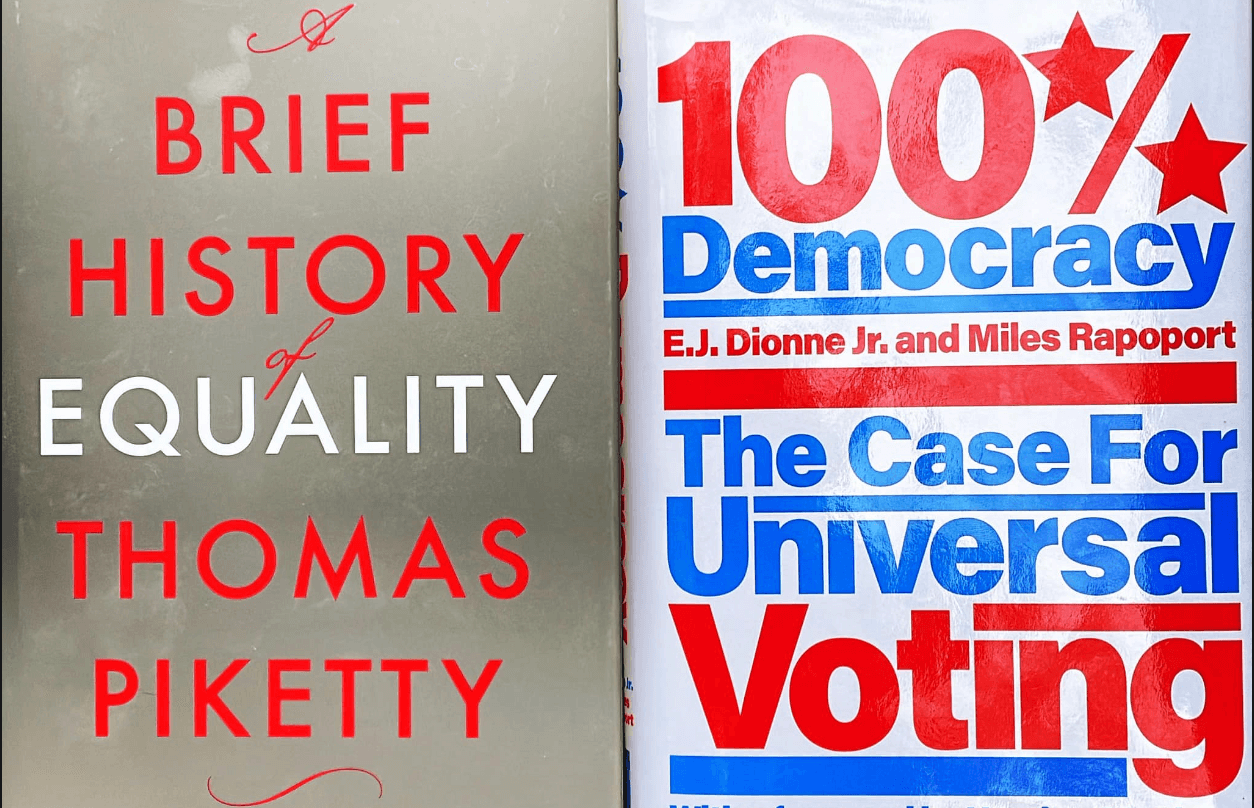 For now, I want to invite you to imagine one other social change that could help we the people enjoy more accountable and representative governance as a result of our efforts toward increasing our democratic processes—especially since far too many politicians are currently seeking to undermine many citizens’s access to voting. If you are curious to learn more, I recommend the short and accessible book 100% Democracy: The Case for Universal Voting by E. J. Dionne and Miles Rappaport. Dionne is a longtime Washington Post columnist and Georgetown University professor, and Rappaport is a fellow at Harvard University’s Kennedy School of Government.
In the 2020 election, voter turnout was 67% of eligible voters, “the highest in 120 years” (xviii). In anticipation of this week’s Election Day, many groups across the country, including many members of the congregation where I serve as minister, have been engaged in “get out the vote” efforts for months. I’m really proud of what we’ve accomplished, but we really shouldn’t have had to work so hard to secure good, democratic governance for ourselves. Dionne and Rappaport invite us to consider a paradigm shift. **What if voting were a civic duty like “jury duty, registration for Selective Service, the census, schooling for minors, and paying taxes” (**68). To protect individual liberty, an option to vote for “none of the above” could be added to the ballot (69).
If this proposal sounds vaguely familiar, in 2015, President Obama proposed that we consider voting to be our civic duty (99). Importantly, this ideal isn’t theoretical. Civic duty voting has already been practiced for years in more than two dozen countries, most prominently in Australia. In most of these countries, voter turnout is in the 90 percent range (53). That’s impressive, especially since the penalty for not voting is the equivalent of $20 (52).
Instead of being a burden, most Australians have found that universal civic duty votes have made Election Day a can’t-miss event. In the words of one New York Times article on civic duty voting in Australia, it’s “like a party. There’s a BBQ at the local school. Everyone turns up. Everyone votes. There’s a sense that: We’re all in this together. We’re all affected by the decision we make today” (39).
Regardless of the ultimate election results, our work to build a more perfect union must continue. In the words of Michelle Alexander, author of A New Jim Crow:
A new nation is struggling to be born, a multiracial, multiethnic, multifaith, egalitarian democracy in which every life and every voice truly matters. In recent years, we’ve seen glimpses of this new nation at Standing Rock, in the streets of Ferguson, in the eyes of the Dreamers, in the voices of teenagers from Parkland and Chicago, as well as at L.G.B.T. pride celebrations, the Women’s March and the camps of Occupy Wall Street. Confederate statues are coming down as new memorials and statutes are going up … honoring victims of lynching as well as the courageous souls who fought for the abolition of slavery and the end of Jim Crow. (The New York Times).
Good results from the democratic experiment were never guaranteed, but I am grateful to be on this journey with all of you, this shared journey of working together to build the better world we dream about: a world of peace, liberty, and justice—not merely for an elite few—but truly for all.
The Rev. Dr. Carl Gregg is a certified spiritual director, a D.Min. graduate of San Francisco Theological Seminary, and the minister of the Unitarian Universalist Congregation of Frederick, Maryland. Follow him on Facebook (facebook.com/carlgregg) and Twitter (@carlgregg).
Learn more about Unitarian Universalism: http://www.uua.org/beliefs/principles
Previous Post

November 3, 2022
Is There An Antidote to Bad Faith? How Minds Change & Deep Canvassing
Next Post
November 16, 2022 Imaginable: How To See the Future Coming
Browse Our Archives
Select a Category Advent Anti-Racism Archaeology Atheism Baptism Best of the Year List Book Reviews Buddhism Catholicism Christian Education Church and State Church Planting Climate Change Conscientious Objection to War Creation Spirituality Death Penalty Didache Disability Rights Discernment Easter Ecology Emergent Church Movement Empire-Critical Ethics Evolution Feminist Theology Film Reviews Gandhi Gospel of Mark Gun Control Hinduism Immigration Reform Interfaith Islam JFK Judaism Jungian Spirituality Lectionary Commentary Lent Letters to the Editor LGBT Marriage MLK Multiculturalism Mysticism Nonviolent Activism Occupy Paganism (Earth-centered Religions) Parables Paul Pluralism Politics Process Theology Quantum Physics Requiescat In Pace Seminary and Divinity School Sermon Series Retrospective Sermons Spiritual Direction Spiritual Practices Stewardship (Fundraising) The Book of J The Wheel of the Year (Paganism) Theoblogger Challenge Triathlon Uncategorized Unitarian Universalism Worship Resources Youth Ministry
Select a Month July 2026 May 2026 March 2026 November 2025 October 2025 August 2025 February 2025 December 2024 October 2024 March 2024 January 2024 December 2023 November 2023 March 2023 February 2023 January 2023 December 2022 November 2022 August 2022 March 2022 February 2022 January 2022 December 2021 September 2021 August 2021 July 2021 June 2021 May 2021 February 2021 January 2021 December 2020 August 2020 June 2020 May 2020 April 2020 March 2020 February 2020 January 2020 December 2019 November 2019 October 2019 September 2019 July 2019 June 2019 March 2019 February 2019 January 2019 December 2018 November 2018 October 2018 September 2018 June 2018 May 2018 April 2018 March 2018 February 2018 January 2018 December 2017 November 2017 October 2017 September 2017 August 2017 July 2017 June 2017 May 2017 April 2017 March 2017 February 2017 January 2017 December 2016 November 2016 October 2016 September 2016 August 2016 June 2016 May 2016 April 2016 March 2016 February 2016 January 2016 December 2015 November 2015 October 2015 September 2015 August 2015 July 2015 June 2015 May 2015 April 2015 March 2015 February 2015 January 2015 December 2014 November 2014 October 2014 August 2014 July 2014 June 2014 May 2014 April 2014 March 2014 February 2014 January 2014 December 2013 November 2013 October 2013 September 2013 August 2013 July 2013 June 2013 May 2013 April 2013 March 2013 February 2013 January 2013 December 2012 November 2012 October 2012 September 2012 August 2012 July 2012 June 2012 May 2012 April 2012 March 2012 February 2012 January 2012 December 2011 November 2011 October 2011 September 2011 August 2011 July 2011 June 2011 May 2011 April 2011 March 2011 February 2011 January 2011 December 2010 November 2010 October 2010 August 2009 July 2009 May 2009
Follow Us!
TAKE THE
Religious Wisdom Quiz
Who found Moses' basket in the Nile?
Select your answer to see how you score.
Zipporah Miriam Jochebed Pharaoh's daughter
Related posts from Carl Gregg

Reading America at 250: A Nation Wrestles With...


Andrew Holocek on the Power of Darkness

The Stories That Shape Us: Myths, Archetypes, &...
TRENDING AT PATHEOS More Voices

Reading America at 250: A Nation Wrestles With...
As part of my own reflection on the 250th anniversary of the...

Whenever I am reading a book or listening to an argument, I...

President Trump Ban Animal Torture Videos on Facebook
Call for Stricter Regulations of Animal Abuse Content on Facebook Although President...

Draft Amendments to Address Ritual Abuse in New...
The proposed changes would make it illegal for individuals in domestic partnerships...

How Bans on LGBTQ+ Student Clubs Threaten Religious...
On June 20, 2025, the State of Texas passed Senate Bill 12....

The Truth About the Gen Z Revival
This past year, there has been a lot of media buzz surrounding...
view all More Voices blogs
Ad-Free & Subscriber Log-In Subscription Support
- About Us
- 2026 Calendar
- Videos
- Podcasts
- Library of World Religions
- Faith In Media Tracker
- Advertise With Us
- Write for Us
- Privacy Policy
- Terms of Service
- Do Not Sell My Data
- Contact Us
- Radiant Digital
- Manage Newsletter Subscriptions
- Unsubscribe From Notifications
- Sitemap
Copyright 2008-2026, Patheos. All rights reserved.
Subscription Support Ad-Free & Subscriber Log-In
Follow Patheos