
BuddhistCatholicContemplativeEvangelicalGeneral ChristianHinduJewishLatter-day SaintMuslimNew VisionsProgressive Christian
Beliefs
- Buddhist
- Catholic
- Contemplative
- Evangelical
- General Christian
- Hindu
- Jewish
- Latter-day Saint
- More Voices
- Muslim
- New Visions
- Pagan
- Progressive Christian
Topics
- Religion News
- Food and Religion
- Sports and Religion
- Religious Art
- Religious Music and Entertainment
- Religious Events
- History and Religion
- Style and Religion
- Politics and Religion
- Women in Religion
- Recreation Outdoors and Religion
- Business Finance and Religion
- Careers Workplace and Religion
- Education and Religion
- Family Parenting and Religion
- Health Fitness and Religion
- Home and Religion
- Relationships and Religion
- Technology and Religion
- Travel and Religion
Columnists
- Buddhist Columnists
- Business Finance and Religion Columnists
- Careers Workplace and Religion Columnists
- Catholic Columnists
- Contemplative Columnists
- Education and Religion Columnists
- Evangelists Columnists
- Family Parenting and Religion Columnists
- General Christian Columnists
- Health Fitness and Religion Columnists
- Hindu Columnists
- History and Religion Columnists
- Home and Religion Columnists
- Jewish Columnists
- More Voices Columnists
- Latter Day Columnists
- Muslim Columnists
- New Visions Columnists
- Nonreligious Columnists
- Pagan Columnists
- Politics and Religion Columnists
- Progressive Columnists
- Recreation Outdoors and Religion Columnists
- Relationships and Religion Columnists
- Religion News Columnists
- Religious Art Columnists
- Religious Events Columnists
- Religious Music and Entertainment Columnists
- Sports and Religion Columnists
- Style and Religion Columnists
- Technology and Religion Columnists
- Travel and Religion Columnists
- Women in Religion Columnists
Resource Library
- 2026 Calendar
- Library of World Religions
- The 100 Most Holy Places on Earth
- Patheos Answers
- Podcasts
- Videos
- Faith Leaders Database
- Anglican Episcopalian
- Bahai
- Baptist
- Buddhism
- Christianity
- Confucianism
- Eastern Orthodoxy
- Hinduism
- Holiness and Pentecostal
- ISKCON
- Islam
- Judaism
- Lutheran
- Methodist
- The Church of Jesus Christ of Latter-day Saints
- New Age
- Paganism
- Presbytarian and Reformed
- Protestantism
- Religion Behind the Scenes
- Roman Catholic
- Scientology
- Shia Islam
- Sikhism
- Sufism
- Sunni Islam
- Taoism
- Zen
- See all religions
Research Tools
 Ad-Free & Subscriber Log-In Subscription Support
Ad-Free & Subscriber Log-In Subscription Support
Follow Patheos 

- Trending:
- Forgiveness
- |
- Marriage
- |
- Consciousness
- |
- Death Penalty
- |
- Election
- |
- Halloween

- Home
- More Voices
- Politics and Religion
- “Four Pivots: Reimagining Justice, Reimagining Ourselves”
“Four Pivots: Reimagining Justice, Reimagining Ourselves”
Last updated on: August 23, 2022 at 1:36 pm by Carl Gregg
“Four Pivots: Reimagining Justice, Reimagining Ourselves” 2022-08-23T13:36:58-04:00 Carl Gregg
Patheos Explore the world's faith through different perspectives on religion and spirituality! Patheos has the views of the prevalent religions and spiritualities of the world.
I suspect we could all make a long list of the major problems facing us today—from threats to democracy at home, to global climate change, and so much more. As the author and activist Grace Lee Boggs used to say, “Another world is necessary.” But she didn’t stop there. She would add, “Another world is possible.” Then she would go one step further: “Another world is happening.”
What do you think about that three-part claim? Is a better world not only necessary and possible, but also happening? The Indian author and activist Arundhati Roy has similarly said, “Another world is not only possible, she is on her way. On a quiet day, I can hear her breathing.” If we pause for a moment, can you feel that right now, in real time, in this moment?
Maybe you can. Maybe you can’t. I’d like to believe that it is so, but given the very real problems and threats facing our society, is that hope merely wishful thinking? What I know for sure is that the better world we dream about will definitely not emerge if we do nothing. To have any chance of “turning our dreams into deeds,” we must each do what we can within our various spheres of influence.
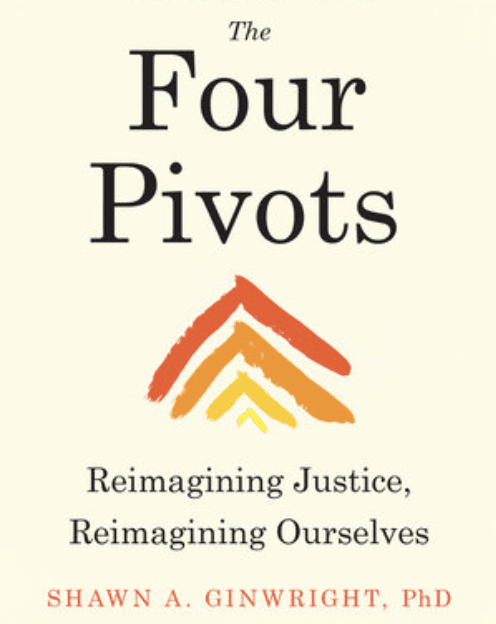 In that spirit, I would like to equip us with some tools that may be able to help, from a book titled The Four Pivots: Reimagining Justice, Reimagining Ourselves by Shawn Ginwright. Dr. Ginwright is a professor of education in the Africana Studies Department at San Francisco State University. He is also the founder and CEO of Flourish Agenda, whose mission is to design strategies that unlock the power of healing to transform schools and communities (249).
After spending many years researching what does and doesn’t work at the intersection of personal and social change, Ginwright identified the importance of four pivots:
- From lens to mirror
- From transactional to transformative
- From problem to possibility
- From hustle to flow
I would like to invite us to spend a few minutes with each in turn. I should emphasize that you needn’t feel any pressure to do all four pivots at once. Instead, notice if there are one or more of these pivots that particularly resonate with you in this season of your life.
Let’s begin with the first pivot, from lens to mirror. Like in a pair of eye glasses — a lens is an optical device we look through to view objects in the world. With this pivot, Dr. Ginwright is challenging us to reverse our focus, from looking through a lens to focus on all the problems “out there,” to risking looking deeply into a mirror at our own reflection?
If any of you are wondering, we should stipulate that there are real problems out there in the world, irrespective of what is happening internally within us. And Dr. Ginwright is all for making systemic change. But he also has become convinced that every individual can benefit from periodically taking a hard look in the mirror to own the responsibility we each have to change ourselves.
Let me give you a story from Dr. Ginwright’s research about what it can look like to pivot from lens to mirror. He was attending a community meeting filled with conflict about lack of funding, insufficient volunteers, and various interpersonal disputes. In the midst of this chaos, a longtime member of the community stood up, and named how familiar this dynamic felt. He said, “Twenty years ago, we had a meeting like this one, where we blamed a local business for not providing us with enough funding. Ten years ago we had a community meeting about how the government needed to do more in our community. I wonder who we will be pointing a finger at twenty years from now!” For Ginwright, this was a classic moment—when a shift from lens to mirror interrupted a pattern when individuals and communities felt stuck.
Again, let me be clear: there may well also be real external problems: genuine need for help from local businesses, the government, or other sources. But this longtime community member is making a critical observation: that external help may or may not be coming anytime soon. In the meantime, if we want to do everything in our power to avoid repeating this same conversation for another twenty years, what can we do differently? He suggests that one option is to look in a mirror, and “hold ourselves accountable for working better together” (33).
There’s an old saying that, “We don’t see the world as it is; we see it as we are.” Mirrors challenge us to start with ourselves. And on the other side of personal growth work, we may find ourselves showing up in the world differently. “We don’t see the world as it is; we see it as we are.” And as we change, we may find our experience of the world changing as well. Previously unforeseen possibilities may being to emerge.
Some of you may recall Jon Kabat-Zinn’s bestselling book titled Wherever You Go, There You Are. Now, don’t get me wrong: if you are in a uniquely toxic relationship or situation, sometimes the grass really is greener somewhere else. Other times, we are challenged to ask: what patterns am I bringing with me? What am I replicating, wherever I go? What might open up if I spent some serious time looking in a mirror at myself, my habits, and my motivations?
This first pivot of shifting from an external focus (lens) to an internal focus (mirror) is directly connected to the second pivot: from transactional to transformational. If I am only interested in you because of what you can do for me, that’s a transactional relationship. It’s what lawyers call a quid pro quo, “something for something.” I’ll do something for you, but only if you do something for me.
The pivot from transactional to transformational is about a radically different way of being in the world. To say more, Ginwright uses a provocative quote: “The wrong first question is, ‘What do we need to do?’ The right first question is, who do we need to become” (91). That’s really worth thinking about. I will confess that I’ve spent a lot of time over the years on that so-called “wrong” first question: What do I need to do? What do you need to do? What do we need to do? We UUs and other social progressives who want to take action and change the world are understandably drawn to this question of what should we do.
And as with our first pivot, it’s not that a lens looking out on the world is never useful or that we never need to take action to change things there. Rather, Ginwright is inviting us first to consider that when we find ourselves stuck or endlessly repeating the same old ineffectual patterns, these four pivots can help us reimagine both ourselves and our ways of seeking justice.
So what would it look like to begin with what Ginwright calls the “right first question—who do we need to become”? This particular pivot echoes a spiritual awakening in many traditions. A lot of what awakening is about is the realization that we are not — and never have been — isolated separate egos. All of reality, including us, is less a noun than a verb. Reality is process and relationship—all the way down. And beginning the work of justice from a shared, felt sense of interdependence can be a powerful starting point.
I should clarify, however, that Ginwright’s primary point of reference is not Buddhism. Instead, he grounds his worldview in the related African philosophy of ubuntu, “I am because we are” (124). Can you feel the difference that particular pivot can make—from the two of us as separate egos negotiating with each other in a transactional way, to a sense that whatever happens, we are interdependent? From this perspective, even if I cheat you or you cheat me — and even when one of us comes out on top in the short run — we are still both caught up in the ramifications.
The Rev. Dr. Martin Luther King, Jr. said it this way, “Injustice anywhere is a threat to justice everywhere. We are caught in an inescapable network of mutuality, tied in a single garment of destiny. Whatever affects one directly affects all indirectly.”
Here’s an even sharper way of making this point from an Indigenous perspective: “If you have come here to help me, you are wasting your time. But if you have come because your liberation is bound up with mine, then let us work together.” Can you feel that pivot—from “what do we need to do” to “what do we need to become?” But we may well not be ready to do the work of justice in an authentic way if we haven’t done the transformational work of reimagining ourselves as deeply connected — what the Unitarian Universalist 7th Principle calls “the interdependent web of all existence.”
Listen to that passage of Indigenous wisdom one more time: “If you have come here to help me, you are wasting your time. But if you have come because your liberation is bound up with mine, then let us work together.” In many ways, that quote embodies the second pivot, from transactional to transformational.
The third pivot is the move from problem to possibility. This junction connects back to where we began, with the sense that another world is possible. When the depressing headlines keep piling up, it can be easy to feel like the ways things are is the way they will always be. But that’s just not so. As the science fiction writer Ursula K. Le Guin once said, “We live in capitalism. Its power seems inescapable. So did the divine right of kings.” That’s the pivot Ginwright is talking about, the move from problem to possibility.
In particular, I appreciate Ginwright’s thought exercise, the one he often challenges his graduate students to experiment with. He asks them first to pick the social problem that they feel most passionate about: racism, sexism, classism, homophobia, climate change, etc. Then he asks them to write about creating social change without using words like resist, defend, disrupt, demand, fight, struggle, confront, destroy, deconstruct, or related synonyms. Instead, he invites them to move from problem to possibility by centering words like reimagine, dream, discover, create, design, play, invent, visualize, and build (176).
If you, like me, are an unabashed social justice warrior, I invite you to give this practice a try in the coming days or weeks. How might your work for social justice shift from problem to possibility through letting go — if only temporarily — of a focus on all that you are against; what might emerge if you focus instead on all that you are for — giving yourself time and space for reimagining, dreaming, discovering, creating, designing, playing, inventing, visualizing, and building?
In working with groups to implement these pivots, Ginwright particularly remembers one participant’s comment:
When I began this journey, I was only walking by faith, not by sight, because I just couldn’t see where we were going. Now it’s like the fog is clearing, and I can see through the foggy mist in the distance a mountain. That’s where we are headed, but even though I don’t know how the hell we are going to climb that mountain, I know that I won’t be climbing it alone. (185)
I appreciate the amazing power of the shared perspective of “possibility” in that sentiment.
These pivots will not give us all the answers. Even if we use them, we may still not know how the heck we’re going to summit the peak of all these massive interlocking social problems. But the fog may begin to clear a little. Even more importantly, we can move ahead knowing that we aren’t climbing alone. As you have heard me say before, quoting a line from the climate justice movement, “If you are feeling overwhelmed as one person, stop being one person.” Join a network of activists oriented toward positive, creative—possible—perspectives. We are stronger together!
The fourth and final pivot is from hustle to flow. This shift is about getting really honest about our finitude. As some of you will recall from a previous post around New Year’s, for us humans who are around long enough to blow out candles on our 80th birthday cake, we will have lived just over four thousand weeks. Our time on this earth is short and precious; nevertheless, we humans — individually and collectively — can and have accomplished incredible, mind-blowing feats of social change. We can and must continue to do so in the present and the future. None of us can do all of the ten thousand things that needs to be done. Alone, we don’t have the time, skills, or interest. The shift from hustle to flow is about discerning where you are most authentically called to focus.
To say more, I have been holding in my heart that last week, the influential writer, preacher, and minister Frederick Buechner died at the age of 96. His career spanned more than six decades and he published thirty-nine books. His novel Godric was a finalist for the 1981 Pulitzer Prize. Related to pivoting from hustle to flow, I invite you to hear perhaps Buechner’s most famous quote, which is a definition of the word, “calling” — that place where we can best find our flow. He wrote, “Neither the hair shirt nor the soft berth will do. [You are called to] the place where your deep gladness and the world’s deep hunger meet.” What might that look like for you? Where is that place where your deep gladness and the world’s deep hunger meet?
There is much more to say about each of these pivots, but as I move toward my conclusion, I invite you to consider if one or more of the four is particularly resonating with you in this season of your life. In the coming days, are you feeling led to move from lens to mirror, from transactional to transformative, from problem to possibility, or from hustle to flow?
For now, I’ll give the last words to Dr. Ginwright from the conclusion to his book, The Four Pivots:
In our journey to create a more just world, all of us must learn to be more human and lean into the courage to create a world based in love and justice. Now let’s go into the wild, together without fear, knowing that collectively we are destined to find that there was never a wilderness at all. (234-235)
The Rev. Dr. Carl Gregg is a certified spiritual director, a D.Min. graduate of San Francisco Theological Seminary, and the minister of the Unitarian Universalist Congregation of Frederick, Maryland. Follow him on Facebook (facebook.com/carlgregg) and Twitter (@carlgregg).
Learn more about Unitarian Universalism: http://www.uua.org/beliefs/principles
Politics and Religion
Next Post

November 3, 2022 Is There An Antidote to Bad Faith? How Minds Change & Deep Canvassing
Browse Our Archives
Select a Category Advent Anti-Racism Archaeology Atheism Baptism Best of the Year List Book Reviews Buddhism Catholicism Christian Education Church and State Church Planting Climate Change Conscientious Objection to War Creation Spirituality Death Penalty Didache Disability Rights Discernment Easter Ecology Emergent Church Movement Empire-Critical Ethics Evolution Feminist Theology Film Reviews Gandhi Gospel of Mark Gun Control Hinduism Immigration Reform Interfaith Islam JFK Judaism Jungian Spirituality Lectionary Commentary Lent Letters to the Editor LGBT Marriage MLK Multiculturalism Mysticism Nonviolent Activism Occupy Paganism (Earth-centered Religions) Parables Paul Pluralism Politics Process Theology Quantum Physics Requiescat In Pace Seminary and Divinity School Sermon Series Retrospective Sermons Spiritual Direction Spiritual Practices Stewardship (Fundraising) The Book of J The Wheel of the Year (Paganism) Theoblogger Challenge Triathlon Uncategorized Unitarian Universalism Worship Resources Youth Ministry
Select a Month July 2026 May 2026 March 2026 November 2025 October 2025 August 2025 February 2025 December 2024 October 2024 March 2024 January 2024 December 2023 November 2023 March 2023 February 2023 January 2023 December 2022 November 2022 August 2022 March 2022 February 2022 January 2022 December 2021 September 2021 August 2021 July 2021 June 2021 May 2021 February 2021 January 2021 December 2020 August 2020 June 2020 May 2020 April 2020 March 2020 February 2020 January 2020 December 2019 November 2019 October 2019 September 2019 July 2019 June 2019 March 2019 February 2019 January 2019 December 2018 November 2018 October 2018 September 2018 June 2018 May 2018 April 2018 March 2018 February 2018 January 2018 December 2017 November 2017 October 2017 September 2017 August 2017 July 2017 June 2017 May 2017 April 2017 March 2017 February 2017 January 2017 December 2016 November 2016 October 2016 September 2016 August 2016 June 2016 May 2016 April 2016 March 2016 February 2016 January 2016 December 2015 November 2015 October 2015 September 2015 August 2015 July 2015 June 2015 May 2015 April 2015 March 2015 February 2015 January 2015 December 2014 November 2014 October 2014 August 2014 July 2014 June 2014 May 2014 April 2014 March 2014 February 2014 January 2014 December 2013 November 2013 October 2013 September 2013 August 2013 July 2013 June 2013 May 2013 April 2013 March 2013 February 2013 January 2013 December 2012 November 2012 October 2012 September 2012 August 2012 July 2012 June 2012 May 2012 April 2012 March 2012 February 2012 January 2012 December 2011 November 2011 October 2011 September 2011 August 2011 July 2011 June 2011 May 2011 April 2011 March 2011 February 2011 January 2011 December 2010 November 2010 October 2010 August 2009 July 2009 May 2009
Follow Us!
TAKE THE
Religious Wisdom Quiz
Which woman was the judge and prophetess who led Israel?
Select your answer to see how you score.
Miriam Esther Deborah Jael
Related posts from Carl Gregg

Reading America at 250: A Nation Wrestles With...


Andrew Holocek on the Power of Darkness

The Stories That Shape Us: Myths, Archetypes, &...
TRENDING AT PATHEOS More Voices

Reading America at 250: A Nation Wrestles With...
As part of my own reflection on the 250th anniversary of the...

Whenever I am reading a book or listening to an argument, I...

President Trump Ban Animal Torture Videos on Facebook
Call for Stricter Regulations of Animal Abuse Content on Facebook Although President...

Draft Amendments to Address Ritual Abuse in New...
The proposed changes would make it illegal for individuals in domestic partnerships...

How Bans on LGBTQ+ Student Clubs Threaten Religious...
On June 20, 2025, the State of Texas passed Senate Bill 12....

The Truth About the Gen Z Revival
This past year, there has been a lot of media buzz surrounding...
view all More Voices blogs
Ad-Free & Subscriber Log-In Subscription Support
- About Us
- 2026 Calendar
- Videos
- Podcasts
- Library of World Religions
- Faith In Media Tracker
- Advertise With Us
- Write for Us
- Privacy Policy
- Terms of Service
- Do Not Sell My Data
- Contact Us
- Radiant Digital
- Manage Newsletter Subscriptions
- Unsubscribe From Notifications
- Sitemap
Copyright 2008-2026, Patheos. All rights reserved.
Subscription Support Ad-Free & Subscriber Log-In
Follow Patheos