
BuddhistCatholicContemplativeEvangelicalGeneral ChristianHinduJewishLatter-day SaintMuslimNew VisionsProgressive Christian
Beliefs
- Buddhist
- Catholic
- Contemplative
- Evangelical
- General Christian
- Hindu
- Jewish
- Latter-day Saint
- More Voices
- Muslim
- New Visions
- Pagan
- Progressive Christian
Topics
- Religion News
- Food and Religion
- Sports and Religion
- Religious Art
- Religious Music and Entertainment
- Religious Events
- History and Religion
- Style and Religion
- Politics and Religion
- Women in Religion
- Recreation Outdoors and Religion
- Business Finance and Religion
- Careers Workplace and Religion
- Education and Religion
- Family Parenting and Religion
- Health Fitness and Religion
- Home and Religion
- Relationships and Religion
- Technology and Religion
- Travel and Religion
Columnists
- Buddhist Columnists
- Business Finance and Religion Columnists
- Careers Workplace and Religion Columnists
- Catholic Columnists
- Contemplative Columnists
- Education and Religion Columnists
- Evangelists Columnists
- Family Parenting and Religion Columnists
- General Christian Columnists
- Health Fitness and Religion Columnists
- Hindu Columnists
- History and Religion Columnists
- Home and Religion Columnists
- Jewish Columnists
- More Voices Columnists
- Latter Day Columnists
- Muslim Columnists
- New Visions Columnists
- Nonreligious Columnists
- Pagan Columnists
- Politics and Religion Columnists
- Progressive Columnists
- Recreation Outdoors and Religion Columnists
- Relationships and Religion Columnists
- Religion News Columnists
- Religious Art Columnists
- Religious Events Columnists
- Religious Music and Entertainment Columnists
- Sports and Religion Columnists
- Style and Religion Columnists
- Technology and Religion Columnists
- Travel and Religion Columnists
- Women in Religion Columnists
Resource Library
- 2026 Calendar
- Library of World Religions
- The 100 Most Holy Places on Earth
- Patheos Answers
- Podcasts
- Videos
- Faith Leaders Database
- Anglican Episcopalian
- Bahai
- Baptist
- Buddhism
- Christianity
- Confucianism
- Eastern Orthodoxy
- Hinduism
- Holiness and Pentecostal
- ISKCON
- Islam
- Judaism
- Lutheran
- Methodist
- The Church of Jesus Christ of Latter-day Saints
- New Age
- Paganism
- Presbytarian and Reformed
- Protestantism
- Religion Behind the Scenes
- Roman Catholic
- Scientology
- Shia Islam
- Sikhism
- Sufism
- Sunni Islam
- Taoism
- Zen
- See all religions
Research Tools
 Ad-Free & Subscriber Log-In Subscription Support
Ad-Free & Subscriber Log-In Subscription Support
Follow Patheos 

- Trending:
- Forgiveness
- |
- Marriage
- |
- Consciousness
- |
- Death Penalty
- |
- Election
- |
- Halloween

- Home
- More Voices
- “Survival Is Insufficient”: What Will You Do with Your Four Thousand Weeks?
“Survival Is Insufficient”: What Will You Do with Your Four Thousand Weeks?
Last updated on: January 6, 2022 at 6:45 pm by Carl Gregg
“Survival Is Insufficient”: What Will You Do with Your Four Thousand Weeks? 2022-01-06T18:45:47-05:00 Carl Gregg
Patheos Explore the world's faith through different perspectives on religion and spirituality! Patheos has the views of the prevalent religions and spiritualities of the world.
Have you been watching the Station Eleven tv series on HBO? Or did you read the novel Station Eleven by Emily St. John Mandel? I read the book when it was published in 2014 because so many people were recommending it. And the tv series, which is a little over halfway through at this point, is arguably one of those rare cases where the television version is even better than the book.
To avoid any spoilers, I will limit myself to sharing only the basic premise. Station Eleven is a post-apocalyptic tale set twenty years after a flu pandemic has caused the deaths of 99 percent of the world’s population. Interestingly, the book was published years before anyone had ever heard of COVID-19, and the mini-series had already filmed two episodes prior to the beginning of our real-life pandemic.
Now, I would certainly understand if watching or reading about a fictionalized pandemic sounds like the opposite of how you want to spend your free time these days; if so, fair enough. But for what it’s worth, Station Eleven skips quite rapidly over the illness part of the pandemic to explore what life is like two decades into the future. And one of the most compelling aspects is the Traveling Symphony. This troupe of actors and musicians have built a new life for themselves by making a never-ending circuit around the 1000-mile shoreline of Lake Michigan. Year after year they continue traveling around and around, stopping at various points to perform. To quote from the novel:
The Symphony performed music—classical, jazz, orchestral arrangements of pre-collapse pop songs—and Shakespeare. They’d performed more modern plays sometimes in the first few years, but what was startling, what no one would have anticipated, was that audiences seemed to prefer Shakespeare to their other theatrical offerings. “People want what was best about the world.”
What a fascinating example of what it could look like to construct a meaningful life in the face of extreme circumstances: after spending a few years focusing only on the most basic necessities of life, choosing to lean in to the humanities and the arts, into literature, theater, and music.
I’ll share just one more passage along those lines, to give you a sense of Emily St. John Mandel’s subtle humor that is woven throughout the novel. Here’s how she describes the humanity and day-in-and-day-out reality of the Traveling Symphony:
this collection of petty jealousies, neuroses, undiagnosed PTSD cases, and simmering resentments lived together, traveled together, rehearsed together, performed together 365 days of the year, permanent company, permanent tour. But what made it bearable were the friendships, of course, the camaraderie and the music and the Shakespeare, the moments of transcendent beauty and joy when it didn’t matter who’d used the last of the rosin on their bow or who anyone had slept with, although someone—probably Sayid—had written “Sarte, Hell is other people” in a pen inside one of the caravans, and someone else had scratched out “other people” and substituted “flutes” (47).
Perhaps the most memorable line in the novel is the motto of the Traveling Symphony that gets to the heart of why they keep going on their thousand-mile circuit year after year performing Shakespeare, more than two decades after society has collapsed from a pandemic. Emblazoned on the front of their horse-drawn caravan is this motto: “Because survival is insufficient.”
I love that, and it’s really worth thinking about: because survival is insufficient. Although Shakespeare may or may not be your jam, as we find ourselves on the second day of a new year—and still frustratingly embedded in a pandemic—what is it that makes life sufficient (or more than sufficient) for you, for me, for us?
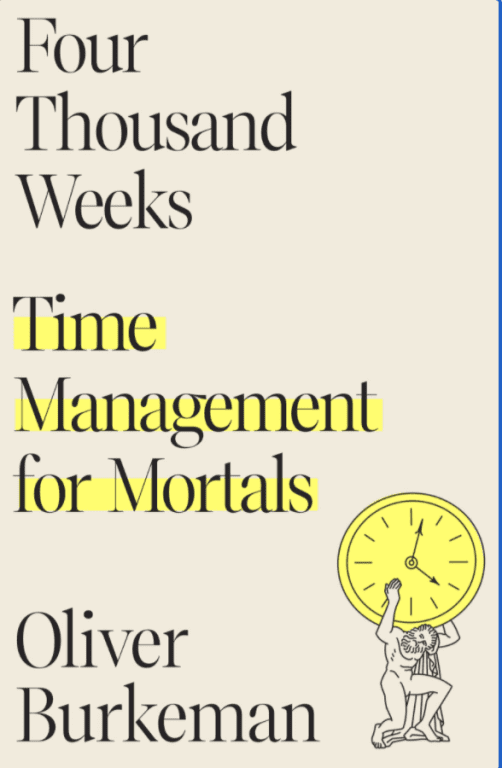 I’ve been thinking about that motto—“Because survival is insufficient”—as I have been watching the Station Eleven miniseries over the past few weeks and also reading a very interesting book titled Four Thousand Weeks: Time Management for Mortals by the journalist and writer Oliver Burkeman.
As alluded to in the title, Four Thousand Weeks, the book starts with a helluva first sentence: “The average human lifespan is absurdly, terrifyingly, insultingly short.” Here in the U.S. at least, the average life expectancy is close to eighty. And for us humans who are around long enough to blow out candles on our 80th birthday cake, we will have lived just over four thousand weeks (3).
Reflecting on our human lifespan through the lens of weeks is an interesting and provocative way to think about it. Often for me, and I suspect sometimes for many of you, weeks can just fly by one after another. And the passing days, weeks and years just keep adding up.
We all spend our days doing something, and as Annie Dillard has written, “How we spend our days is, of course, how we spend our lives. What we do with this hour, and that one, is what we are doing.”
So how should we spend our finite number of weeks upon this earth? Well, another interesting aspect of Burkeman’s book is that he is makes the case that, “time management as we know it has failed miserably, and … we need to stop pretending otherwise” (4-5).
Burkeman challenges us to consider that a hyper focus on “productivity” is always doomed—for at least two reasons. The first reason that extreme productivity is self-defeating is that being super-efficient tends to have the ironic effect of generating more work in response.
With our endless to-do lists, we can find ourselves reenacting the ancient Greek myth of Sisyphus: spending all day rolling a boulder uphill only to have it roll back down to the bottom, at which point he must roll it back up. This dynamic is perhaps most obvious with email inboxes. The more email you send, the more emails you end up generating (43).
Burkeman’s second reason that productivity culture is self-defeating is that, “There will always be too much to do” (10). Instead, Burkman invites us to consider a paradigm shift: what might change if we started by accepting that it is impossible to get everything done? As you have heard me quote before, “We are saved from perfection.” We will never perfectly complete our to-do list because the goal posts keep getting moved farther and farther away. It’s like Lucy and Charlie Brown: that football is always going to keep being pulled away at the last second—but we can choose to start playing a different game.
So, paradoxically, it can be liberating to accept that we will never get it all done (14). We have a limited number of weeks in this life, so how might we live them in a more life-giving way?
I should add that I am also an advocate for systemic changes to make our lives more sustainable —universal health care, universal childcare, universal college and/or vocational training, and a universal basic income (34)—and we’ve explored all of those issues in previous posts. But for now near the beginning of this new year, I want to invite us to consider some more immediate changes we can make at the individual level.
If you want the full details, I recommend Burkeman’s short, fascinating, and accessible book, Four Thousand Weeks, but for our purposes, I will limit myself to a New Year’s Top Ten list of some of the highlights from the book that stood out most to me. These aren’t in any particular order, but I’ll still count down from ten to one because it’s a little more exciting that way.
#10 in our list of how to make the most of the limited weeks in our human lifespan: Get out of your comfort zone in one or more areas of your life where you feel curious to grow and explore (220-221). On one end of the spectrum, we don’t want to burn out by being way out of our comfort zone in too many areas. On the other end of the spectrum, we don’t want to become listless. So in this new year, is there one or more areas of your life in which you feel led to grow, stretch, and experiment physically, emotionally, intellectually, aesthetically, financially, socially, vocationally, spiritually, etc.
#9 Let go of impossible standards (221-333). Meaningful growth can be as simple as keeping one promise to yourself each day or week related to whatever you want more of in your life: it could be as simple as five more minutes of exercise than you have been doing, reading one chapter of a book, emailing or texting someone to meet for coffee once a week—or whatever feels right to you.
#8: Accept the particularities of who you are as an individual. To use myself as an example, I need to give up all hope of being a professional football player. That just isn’t in the cards for me. I’m too scrawny. Another example is that a few years ago I spent a year taking guitar lessons and practicing regularly, but my progress was frustratingly slow. In contrast, I found training for a marathon challenging, but also vastly easier and more natural. I’ve come to accept that, for better or worse, I peaked on the guitar at age sixteen. As a wise story from the Jewish tradition relates, Rabbi Zusya of Hanipol (1718–1800) said on his death bed that, “In the coming world they will not ask me—Why were you not Moses? They will ask me—Why were you not Zusya?” So too are we each called to be nothing more than our unique best selves.
#7 is one of the suggestions that I’m going to try to prioritize myself in this new year: “Adopt a ‘fixed volume’ approach to productivity.” In 2022, I aspire to be more realistic about what I can reasonably get done. And when my schedule is full. I am setting an intention to improve at gently saying no and setting boundaries around what I don’t sustainably have time for (235-236).
#6 is another one I may try: keep a “done list” of what you have accomplished that day. Although I find it satisfying to delete items from my to-do list at the end of the day, I’m left with only the remaining list of all the thing I wish I had done. I think it would be more motivating at the of the day to spend just a moment or two savoring a short bullet list of all the things I did get done.
#5: Make your technology more boring. Our devices and apps are designed to keep us hooked, and using them as much as possible. And Burkeman suggests a fairly hardcore way of making them more boring: switching your screen color to grayscale (240). I’m not sure I’m up for that since it would make taking color photos difficult. But I do think adjusting the settings to have fewer notifications would be worthwhile.
#4: “Pay more attention to every moment, however mundane.” The invitation here is to sink more deeply into the life you already have (213). Each moment, no matter how ordinary, can become extraordinary if we begin to notice the fullness of our senses (241-242). Practicing mindfulness helps with this!
#3: Be continually curious in every relationship (242). Every human being in our lives is complex and always changing. Be open to being surprised by everyone in your life no matter how well you know them. You may find your relationships evolving in unexpected ways as a result.
#2: Act on generous impulses immediately. This idea is from the meditation teacher Joseph Goldstein, who was the focus of the recent 13-week Tuesday evening class I led here at UUCF. For many years Goldstein has practiced the habit of following through on small acts of kindness that occur to him. If you feel an inner prompting to make a donation (or give someone money), check-in on a friend, or email or text someone to compliment something they have done, don’t wait—just do it in that moment if it is something quick and easy (243). This small practice can create a virtuous cycle both for you and for others in your life.
#1: “Practice doing nothing” (244). To the extent possible, carve out more unstructured downtime in your life. As you sometimes hear in meditation communities: “Don’t just do something, sit there!”
At the beginning of this new year, is there one or more items on that top ten list that particularly resonate with you? Don’t feel like you need to embrace all ten. Choosing one or two to focus on may be more than enough. But experimenting with at least something in this new year may be worthwhile. The motto of the Traveling Symphony reminds us to make the most of our four thousand weeks, “because survival is insufficient”
So, in this new year, what do you feel called to move toward with a greater level of commitment? Or what are you feeling led to let go of that has been a distraction or a detriment?
Reflecting on how 2021 went for you, is there a person, place, or habit that has consistently been a hindrance to your well-being? Is there something or someone that you feel called to let go of, or say no to in the new year? What has been life-negating, a hindrance to your well-being—leaving you regularly feeling drained of energy, alienated, or resentful? Either now or later this week, I invite you to write down whatever you want to let go of, and mentally set an intention to let go of it.
And while burning a slip of paper does not necessarily mean that the process of “letting go” is complete, I invite you to experience this ritual as one step in the process of saying no to a part of your life that has been life-negating for you. You are also invited to light a candle sometime, in order to set an intention for something—perhaps a person, place, or habit—that you want to do, affirm, or say yes to in the new year.
What has regularly left you feeling energized, connected, grateful, and more fully alive? What do you feel led to say yes or no to in 2022?
The Rev. Dr. Carl Gregg is a certified spiritual director, a D.Min. graduate of San Francisco Theological Seminary, and the minister of the Unitarian Universalist Congregation of Frederick, Maryland. Follow him on Facebook (facebook.com/carlgregg) and Twitter (@carlgregg).
Learn more about Unitarian Universalism: http://www.uua.org/beliefs/principles
Previous Post

December 31, 2021
Top 10 Best Books Read in 2021
Next Post
February 23, 2022 An Afro-Indigenous History of the US — Past, Present, & Future
Browse Our Archives
Select a Category Advent Anti-Racism Archaeology Atheism Baptism Best of the Year List Book Reviews Buddhism Catholicism Christian Education Church and State Church Planting Climate Change Conscientious Objection to War Creation Spirituality Death Penalty Didache Disability Rights Discernment Easter Ecology Emergent Church Movement Empire-Critical Ethics Evolution Feminist Theology Film Reviews Gandhi Gospel of Mark Gun Control Hinduism Immigration Reform Interfaith Islam JFK Judaism Jungian Spirituality Lectionary Commentary Lent Letters to the Editor LGBT Marriage MLK Multiculturalism Mysticism Nonviolent Activism Occupy Paganism (Earth-centered Religions) Parables Paul Pluralism Politics Process Theology Quantum Physics Requiescat In Pace Seminary and Divinity School Sermon Series Retrospective Sermons Spiritual Direction Spiritual Practices Stewardship (Fundraising) The Book of J The Wheel of the Year (Paganism) Theoblogger Challenge Triathlon Uncategorized Unitarian Universalism Worship Resources Youth Ministry
Select a Month July 2026 May 2026 March 2026 November 2025 October 2025 August 2025 February 2025 December 2024 October 2024 March 2024 January 2024 December 2023 November 2023 March 2023 February 2023 January 2023 December 2022 November 2022 August 2022 March 2022 February 2022 January 2022 December 2021 September 2021 August 2021 July 2021 June 2021 May 2021 February 2021 January 2021 December 2020 August 2020 June 2020 May 2020 April 2020 March 2020 February 2020 January 2020 December 2019 November 2019 October 2019 September 2019 July 2019 June 2019 March 2019 February 2019 January 2019 December 2018 November 2018 October 2018 September 2018 June 2018 May 2018 April 2018 March 2018 February 2018 January 2018 December 2017 November 2017 October 2017 September 2017 August 2017 July 2017 June 2017 May 2017 April 2017 March 2017 February 2017 January 2017 December 2016 November 2016 October 2016 September 2016 August 2016 June 2016 May 2016 April 2016 March 2016 February 2016 January 2016 December 2015 November 2015 October 2015 September 2015 August 2015 July 2015 June 2015 May 2015 April 2015 March 2015 February 2015 January 2015 December 2014 November 2014 October 2014 August 2014 July 2014 June 2014 May 2014 April 2014 March 2014 February 2014 January 2014 December 2013 November 2013 October 2013 September 2013 August 2013 July 2013 June 2013 May 2013 April 2013 March 2013 February 2013 January 2013 December 2012 November 2012 October 2012 September 2012 August 2012 July 2012 June 2012 May 2012 April 2012 March 2012 February 2012 January 2012 December 2011 November 2011 October 2011 September 2011 August 2011 July 2011 June 2011 May 2011 April 2011 March 2011 February 2011 January 2011 December 2010 November 2010 October 2010 August 2009 July 2009 May 2009
Follow Us!
TAKE THE
Religious Wisdom Quiz
Nahum describes the Lord as riding in the whirlwind and storms. What does he say are the clouds?
Select your answer to see how you score.
His chariot His glory His covering The dust of his feet
Related posts from Carl Gregg

Reading America at 250: A Nation Wrestles With...


Andrew Holocek on the Power of Darkness

The Stories That Shape Us: Myths, Archetypes, &...
TRENDING AT PATHEOS More Voices

Reading America at 250: A Nation Wrestles With...
As part of my own reflection on the 250th anniversary of the...

Whenever I am reading a book or listening to an argument, I...

President Trump Ban Animal Torture Videos on Facebook
Call for Stricter Regulations of Animal Abuse Content on Facebook Although President...

Draft Amendments to Address Ritual Abuse in New...
The proposed changes would make it illegal for individuals in domestic partnerships...

How Bans on LGBTQ+ Student Clubs Threaten Religious...
On June 20, 2025, the State of Texas passed Senate Bill 12....

The Truth About the Gen Z Revival
This past year, there has been a lot of media buzz surrounding...
view all More Voices blogs
Ad-Free & Subscriber Log-In Subscription Support
- About Us
- 2026 Calendar
- Videos
- Podcasts
- Library of World Religions
- Faith In Media Tracker
- Advertise With Us
- Write for Us
- Privacy Policy
- Terms of Service
- Do Not Sell My Data
- Contact Us
- Radiant Digital
- Manage Newsletter Subscriptions
- Unsubscribe From Notifications
- Sitemap
Copyright 2008-2026, Patheos. All rights reserved.
Subscription Support Ad-Free & Subscriber Log-In
Follow Patheos