
BuddhistCatholicContemplativeEvangelicalGeneral ChristianHinduJewishLatter-day SaintMuslimNew VisionsProgressive Christian
Beliefs
- Buddhist
- Catholic
- Contemplative
- Evangelical
- General Christian
- Hindu
- Jewish
- Latter-day Saint
- More Voices
- Muslim
- New Visions
- Pagan
- Progressive Christian
Topics
- Religion News
- Food and Religion
- Sports and Religion
- Religious Art
- Religious Music and Entertainment
- Religious Events
- History and Religion
- Style and Religion
- Politics and Religion
- Women in Religion
- Recreation Outdoors and Religion
- Business Finance and Religion
- Careers Workplace and Religion
- Education and Religion
- Family Parenting and Religion
- Health Fitness and Religion
- Home and Religion
- Relationships and Religion
- Technology and Religion
- Travel and Religion
Columnists
- Buddhist Columnists
- Business Finance and Religion Columnists
- Careers Workplace and Religion Columnists
- Catholic Columnists
- Contemplative Columnists
- Education and Religion Columnists
- Evangelists Columnists
- Family Parenting and Religion Columnists
- General Christian Columnists
- Health Fitness and Religion Columnists
- Hindu Columnists
- History and Religion Columnists
- Home and Religion Columnists
- Jewish Columnists
- More Voices Columnists
- Latter Day Columnists
- Muslim Columnists
- New Visions Columnists
- Nonreligious Columnists
- Pagan Columnists
- Politics and Religion Columnists
- Progressive Columnists
- Recreation Outdoors and Religion Columnists
- Relationships and Religion Columnists
- Religion News Columnists
- Religious Art Columnists
- Religious Events Columnists
- Religious Music and Entertainment Columnists
- Sports and Religion Columnists
- Style and Religion Columnists
- Technology and Religion Columnists
- Travel and Religion Columnists
- Women in Religion Columnists
Resource Library
- 2026 Calendar
- Library of World Religions
- The 100 Most Holy Places on Earth
- Patheos Answers
- Podcasts
- Videos
- Faith Leaders Database
- Anglican Episcopalian
- Bahai
- Baptist
- Buddhism
- Christianity
- Confucianism
- Eastern Orthodoxy
- Hinduism
- Holiness and Pentecostal
- ISKCON
- Islam
- Judaism
- Lutheran
- Methodist
- The Church of Jesus Christ of Latter-day Saints
- New Age
- Paganism
- Presbytarian and Reformed
- Protestantism
- Religion Behind the Scenes
- Roman Catholic
- Scientology
- Shia Islam
- Sikhism
- Sufism
- Sunni Islam
- Taoism
- Zen
- See all religions
Research Tools
 Ad-Free & Subscriber Log-In Subscription Support
Ad-Free & Subscriber Log-In Subscription Support
Follow Patheos 

- Trending:
- Forgiveness
- |
- Marriage
- |
- Consciousness
- |
- Death Penalty
- |
- Election
- |
- Halloween

- Home
- More Voices
- Admit it: You “Pick & Choose,” So Why Not Choose Love?
Admit it: You “Pick & Choose,” So Why Not Choose Love?
Last updated on: September 18, 2021 at 8:54 am by Carl Gregg
Admit it: You “Pick & Choose,” So Why Not Choose Love? 2021-09-18T08:54:58-04:00 Carl Gregg
Patheos Explore the world's faith through different perspectives on religion and spirituality! Patheos has the views of the prevalent religions and spiritualities of the world.
Prior to becoming a Unitarian Universalist minister in 2012, I served as a pastor in Progressive Christian congregations for nine years. Since I am now starting my tenth year of service at the UU Congregation of Frederick, Maryland, it occurred to me recently that I have now been a Unitarian Universalist minister slightly longer than I was a Christian pastor.
That means my turn toward the dark side is now complete! More seriously, I am grateful for both the years I served as a Christian pastor and for the years I have served—and plan to continue to serve—as a UU minister. There’s a lot to say about all of that, but to focus for now on one angle, there may be an interesting takeaway from juxtaposing the nine years I spent preaching in Christian contexts with the nine years I’ve now spent preaching in a UU context.
If I look at the bookshelves in my office today, they have changed over the past nine years in particular ways. To boil those changes down to one word, as a UU I’m a much wider reader. The shelf space in my office that is now allotted to science, history, politics, dismantling racism, the religions of the world in general and Buddhism and meditation in particular has expanded dramatically. It’s truly exciting that almost anything is fair game in the big tent of Unitarian Universalism, as long as it contributes to living well and ethically in our globalized, pluralistic, postmodern world.
And as grateful as I am to be able to go wide, looking back, I am also grateful for the opportunities I had as a Progressive Christian pastor to be a deep reader: to mine and plumb the details, nuances, and depths of a book and a tradition. For instance, I once spent six months preaching—chapter-by-chapter—through the Gospel of Matthew, whereas in UU Sunday Services, the focus tends to shift quite dramatically from week to week. We might consider a new scientific discovery one week, a social justice struggle the next week, and wisdom from an ancient world religion the week after that. Of course, many UUs are also going deep on their own or in various congregational spirituality groups, but the our main Sunday Services often cover a vast breadth over the course of a year.
So on this tipping-point occasion—as my tenure as a UU minister begins to overtake my time as a Christian pastor—I want to reach back and share with you one of the most important lessons I learned from going deep into the Christian tradition that is rarely as present for us as UUs. That lesson is how to wrestle deep meaning from almost any text.
As UUs there a greater freedom to essentially toss a passage or even a text out the window if we feel like it. And don’t get me wrong; it can be tremendously liberating to really get free from a text that is oppressive for any number of reasons—for example, sexism, racism, homophobia, ableism, etc. It is wonderful to be able to give yourself permission to be honest if a text just doesn’t feel relevant to you anymore in light of science or personal experience.
At the same time, I learned a tremendous amount from being regularly tasked with finding meaning from some of the most difficult texts that the Bible has to offer, and I would like to share with you some of the tools of textual interpretation that I learned along the way. And far beyond just the Bible, there are useful applications for these approaches for how we interpret any text—from sacred scripture to any other books, films, works of art, the Constitution, and more.
Do you know the saying that, “If all you have is a hammer, everything looks like a nail?” Well, I sometimes get the feeling that too many religious folks were handed only one, pretty blunt object for interpreting their tradition’s sacred scriptures.
But here’s the good news: there’s a wide array of compelling interpretative options out there. And when reflecting on what I learned about interpreting texts in seminary and in my years as a Christian pastor, one image that comes to mind is a hermeneutical Swiss Army knife. Hermeneutics—named after Hermes, the messenger of the gods—is the theory and methodology of in-depth interpretation.
Hermeneutics offers the reader a big interpretative toolbox containing a variety of instruments useful for different occasions. I’d like to invite you to come with me back behind the curtain to find out how the magic is made.
Imagine with me a big toolbox. You open up this toolbox, and it has three trays labeled “BEHIND,” “IN,” and “IN FRONT OF.” We could spend a lot of time familiarizing ourselves with every tool in each of these trays—indeed, some researchers spend their entire professional career becoming experts at using just one of these tools. But I’m going to take you on a quick tour to give you a sense of just how many tools there are to play with.
Let’s start with the bottom tray in the toolbox, the one labeled “BEHIND.” There you’ll find a set of interpretive tools useful for getting a peek behind a given text. There are many tools in this bottom tray, but I’ll limit myself to four of my favorites.
So for example, imagine that we have a passage of scripture—from any religious text or even a contemporary text—in front of us, and that we want to know what it truly mean.
- One tool we might pick up is the tool of Historical Criticism. With this tool, what can we learn about the original context of the text? When was this text written? What else was going on in the world at that time? And what can all that tell us about the text?
- Another tool we might try is Source Criticism. What sources influenced the author? What sources do they allude to, or even directly quote, and what does that information tell us? What books were in that person’s library?
- Or Form Criticism asks: what “forms” did this story circulate in within the oral tradition before being written down? For instance, fairy tales tend to have a basic “form” or structure: they begin with the phrase, “Once upon a time.” They also often rely on familiar tropes such as the “rule of 3.” Other familiar recurring forms and structures are used in miracle stories, parables, and conflict narratives.
- Redaction Criticism asks how this text was edited at the time. Among the most interesting examples of Biblical text editing give clear evidence that the writers of the Gospels of Matthew and Luke had copies of the Gospel of Mark on their respective desks when they were writing their own gospels. The particular ways they tended to borrow passages from Mark can give us clues in the present about Matthew’s and Luke’s different biases.
Those are a few of the many tools a reader can use to get a peek behind a text.
Moving to the middle tray of the toolbox, we find the tray labelled “IN.” The “IN” set of tools invites us to consider if it might be interesting to focus our inquiries about meaning inside the text itself. Again, I’ll limit myself to only a few of my favorite tools, such as:
- Text Criticism compares the variations and copying errors found in ancient manuscripts. (Have you ever noticed the tiny superscript letters in most Bibles? They lead you to the extra-tiny footnotes that start with*“other manuscripts say.”* Text critics study the differences in those ancient manuscripts.
- Rhetorical Criticism pays close attention to who is speaking, how they speak, and what such questions reveal.
- Translation Criticism compares all the nuances and shades of meaning in the original language that are gained or lost over time in translations from the original language.
Those are a few of the many tools for playing in the text itself.
The top tray of our toolbox is labeled “IN FRONT OF.” This set of tools focuses on what is happening with the individual or group reading the text:
- Reception Criticism traces how interpretations of a particular passage or text have changed over time.
- Feminist Criticism emphasizes women’s experiences and perspectives sometimes overlooked by male writers and commentators.
- Liberation Criticism asks how the inquirer can best apply the text to an unapologetic agenda of inspiring social justice.
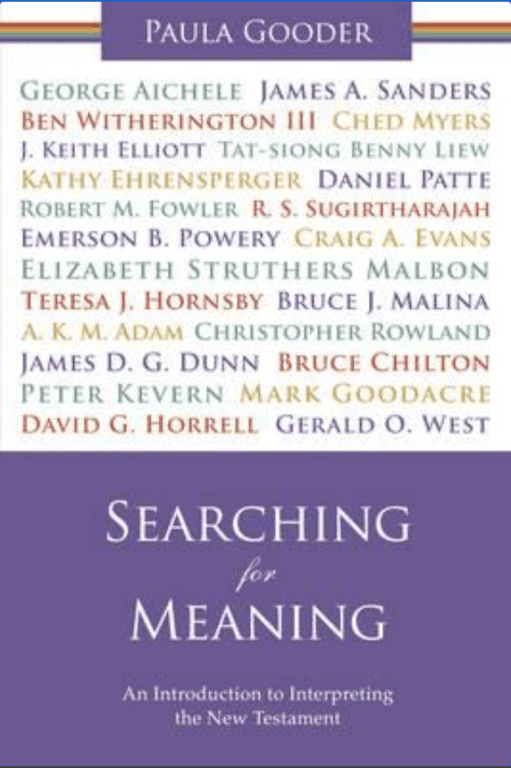 It can be both fascinating and exciting to have at hand just the right tool or tools for studying any given text. Sometimes you may need the crowbar of historical criticism, other times the microscope of textual criticism, and still other times the hammer of liberation criticism. If you are curious to learn more about these interpretative approaches, two good starting points are: A Handbook to Old Testament Exegesis by William Brown and Searching for Meaning: An Introduction to Interpreting the New Testament by Paula Gooder. (In addition, there is a whole array of sacred reading practices that are fascinating to explore.)
For now, let’s pull together some of the implications of having a growing number of hermeneutical tools to play with in your own interpretive toolboxes. Come with me a little bit further through the Looking Glass, and you’ll begin to see (as you may well have already) that, for better and for worse, texts do not have only one plain meaning applicable to all times and places.
For instance, have you ever heard someone ask, “What does the Bible say about ‘x’ topic?” Often the questioner expects a single, simple response. And here’s the thing: the Bible doesn’t say anything, per se. You have to read it. And the more you understand about the vast array of options for how you might read text, the deeper the rabbit hole goes.
And here’s the really important part: because we have agency and choice over how we interpret a text—a choice as to which interpretative tool or tools we may wish to apply—we are arguably responsible for the choices we make. Said more bluntly: the more one knows about textual interpretation, the less convincing it is when someone tries to lay the blame for their hatred, prejudice, or violence on a passage in a text. Is it really the text’s fault, or is someone’s unskillful interpretation to blame?
- Have you throughly explored behind the text for the fullness of the original context, and how it is different or like from our current context?
- Have you tinkered enough within the text to consider all the nuances of language, perspective, and detail?
- Have you invited an increasingly diverse group of people to join you in front of the text to discover angles you may have previously failed to consider? Because as many oppressed groups have discovered, “If you’re not at the table, you might be on the menu.”
The Yale University New Testament scholar Dale Martin has a succinct way of describing the dynamic we’ve been exploring in his excellent book Pedagogy of the Bible: “Texts don’t mean, people mean with texts.” Appropriately, Martin means at least two things with that quote. First, people mean with texts in the sense that text don’t interpret themselves in isolation or have only one plain meaning; instead, we humans create meaning only when we read texts. Think of the various songs, films, or other works of art that have come to mean different things to you at different points in your life. As you’ve heard me quote before, “We don’t see the world as it is, we see it as we are.”
And here’s the second part of Martin’s quote. People also mean with texts in the sense of being mean (or cruel) to one another. Folks sometimes try to beat each other up with what are sometimes called “clobber texts.” But, as we are coming to see more clearly, the more you know about interpretation, the less persuasive it is to scapegoat a text for one’s own meanness. We each have power, options, and responsibility for the interpretive choices we make. Dale Martin has said it this way: “You are responsible for the truth, goodness, morality, and social effect of how you interpret the Bible or any other text.” If your reading is causing harm, it is important to consider whether you have tried out all the possible interpretive tools in your toolbox.
Perhaps the most salient example of textual casuistry in our country today is not with the Bible, but with the U.S. Constitution. Even a cursory study of various 5-4 Supreme Court decisions will expose that there is a huge amount of leeway on how to interpret the United States Constitution—depending on who is doing the interpreting. And as law scholars have shown, it’s not that some justices are “smarter or understand constitutional law better or avoid decisions based on value choices. Rather, their disagreements reflect their differing ideologies, life experiences, and worldviews” (Chemerinsky 54).
And I urge you not to believe the propaganda that some justices are “activists” and others are “neutral interpreters”. If you take a step back and look closely, you will find that all humans—from the most conservative to the most liberal and everywhere in between—are always making interpretive choices. Constitutional “originalists” will try to persuade you that they have the best or only way of interpreting original meanings, but their fundamentalist interpretations of the Constitution do not impress me any more than the fundamentalist interpretations of the Bible. In both cases, the end result tends to be narrow, rigid, and antiquated. We don’t have to limit ourselves to only one interpretative tool when there are so many hermeneutical toys in our toolbox.
Relatedly, when I was growing up, there was a lot of fear around being seen as “picking and choosing” scripture. In the theologically conservative congregation of my childhood, you didn’t want to be someone who was perceived as favoring one part of the Bible over another, since allegedly it was all equally important—as the infallible word of God. Over time, I’ve come to see that everyone picks and chooses. And if we come to accept that we all do have the freedom and responsibility that comes with picking and choosing, there’s one more vitally important decision to make: why not choose love?
If we are all responsible for how we interpret the Bible, or any other text, then why not choose love? Why not select tools that—to the greatest extent possible—will lead to a kinder, more compassionate perspective? Why not choose the interpretative tool for the job that will help increase peace and justice, not merely for some, but for all?
I know it’s complicated, and easier said than done. But this approach is in alignment with the Unitarian Universalist Association’s #SideWithLove campaign: as for me and my house, we are answering the call of love.
Sometimes it is easier to look at a text and decide it is duly antiquated or obsolete—and then write something new that feels more relevant today. Other times it is well worth going deep, staying committed, and wrestling with a text until you receive a blessing.
As you’ve heard me quote before, “We have to give up all hope of a better past.” We cannot change the times in the past when we sided with greed, hated, or delusion. But in each new present moment, we have a new opportunity to side with love. So, I invite you to take a moment right now in real time to pause and ask yourself, “What is love calling me to do?” Take a few deep breaths, then listen. Allow yourself to potentially be surprised at the answer that emerges. In this moment, what is love calling me to do?
The Rev. Dr. Carl Gregg is a certified spiritual director, a D.Min. graduate of San Francisco Theological Seminary, and the minister of the Unitarian Universalist Congregation of Frederick, Maryland. Follow him on Facebook (facebook.com/carlgregg) and Twitter (@carlgregg).
Learn more about Unitarian Universalism: http://www.uua.org/beliefs/principles
Previous Post

September 10, 2021
The Past, Present, & Future of Work
Next Post
December 31, 2021 Top 10 Best Books Read in 2021
Browse Our Archives
Select a Category Advent Anti-Racism Archaeology Atheism Baptism Best of the Year List Book Reviews Buddhism Catholicism Christian Education Church and State Church Planting Climate Change Conscientious Objection to War Creation Spirituality Death Penalty Didache Disability Rights Discernment Easter Ecology Emergent Church Movement Empire-Critical Ethics Evolution Feminist Theology Film Reviews Gandhi Gospel of Mark Gun Control Hinduism Immigration Reform Interfaith Islam JFK Judaism Jungian Spirituality Lectionary Commentary Lent Letters to the Editor LGBT Marriage MLK Multiculturalism Mysticism Nonviolent Activism Occupy Paganism (Earth-centered Religions) Parables Paul Pluralism Politics Process Theology Quantum Physics Requiescat In Pace Seminary and Divinity School Sermon Series Retrospective Sermons Spiritual Direction Spiritual Practices Stewardship (Fundraising) The Book of J The Wheel of the Year (Paganism) Theoblogger Challenge Triathlon Uncategorized Unitarian Universalism Worship Resources Youth Ministry
Select a Month July 2026 May 2026 March 2026 November 2025 October 2025 August 2025 February 2025 December 2024 October 2024 March 2024 January 2024 December 2023 November 2023 March 2023 February 2023 January 2023 December 2022 November 2022 August 2022 March 2022 February 2022 January 2022 December 2021 September 2021 August 2021 July 2021 June 2021 May 2021 February 2021 January 2021 December 2020 August 2020 June 2020 May 2020 April 2020 March 2020 February 2020 January 2020 December 2019 November 2019 October 2019 September 2019 July 2019 June 2019 March 2019 February 2019 January 2019 December 2018 November 2018 October 2018 September 2018 June 2018 May 2018 April 2018 March 2018 February 2018 January 2018 December 2017 November 2017 October 2017 September 2017 August 2017 July 2017 June 2017 May 2017 April 2017 March 2017 February 2017 January 2017 December 2016 November 2016 October 2016 September 2016 August 2016 June 2016 May 2016 April 2016 March 2016 February 2016 January 2016 December 2015 November 2015 October 2015 September 2015 August 2015 July 2015 June 2015 May 2015 April 2015 March 2015 February 2015 January 2015 December 2014 November 2014 October 2014 August 2014 July 2014 June 2014 May 2014 April 2014 March 2014 February 2014 January 2014 December 2013 November 2013 October 2013 September 2013 August 2013 July 2013 June 2013 May 2013 April 2013 March 2013 February 2013 January 2013 December 2012 November 2012 October 2012 September 2012 August 2012 July 2012 June 2012 May 2012 April 2012 March 2012 February 2012 January 2012 December 2011 November 2011 October 2011 September 2011 August 2011 July 2011 June 2011 May 2011 April 2011 March 2011 February 2011 January 2011 December 2010 November 2010 October 2010 August 2009 July 2009 May 2009
Follow Us!
TAKE THE
Religious Wisdom Quiz
Who was the strongest man mentioned in the Bible?
Select your answer to see how you score.
Saul Goliath David Samson
Related posts from Carl Gregg

Reading America at 250: A Nation Wrestles With...


Andrew Holocek on the Power of Darkness

The Stories That Shape Us: Myths, Archetypes, &...
TRENDING AT PATHEOS More Voices

Reading America at 250: A Nation Wrestles With...
As part of my own reflection on the 250th anniversary of the...

Whenever I am reading a book or listening to an argument, I...

President Trump Ban Animal Torture Videos on Facebook
Call for Stricter Regulations of Animal Abuse Content on Facebook Although President...

Draft Amendments to Address Ritual Abuse in New...
The proposed changes would make it illegal for individuals in domestic partnerships...

How Bans on LGBTQ+ Student Clubs Threaten Religious...
On June 20, 2025, the State of Texas passed Senate Bill 12....

The Truth About the Gen Z Revival
This past year, there has been a lot of media buzz surrounding...
view all More Voices blogs
Ad-Free & Subscriber Log-In Subscription Support
- About Us
- 2026 Calendar
- Videos
- Podcasts
- Library of World Religions
- Faith In Media Tracker
- Advertise With Us
- Write for Us
- Privacy Policy
- Terms of Service
- Do Not Sell My Data
- Contact Us
- Radiant Digital
- Manage Newsletter Subscriptions
- Unsubscribe From Notifications
- Sitemap
Copyright 2008-2026, Patheos. All rights reserved.
Subscription Support Ad-Free & Subscriber Log-In
Follow Patheos