
BuddhistCatholicContemplativeEvangelicalGeneral ChristianHinduJewishLatter-day SaintMuslimNew VisionsProgressive Christian
Beliefs
- Buddhist
- Catholic
- Contemplative
- Evangelical
- General Christian
- Hindu
- Jewish
- Latter-day Saint
- More Voices
- Muslim
- New Visions
- Pagan
- Progressive Christian
Topics
- Religion News
- Food and Religion
- Sports and Religion
- Religious Art
- Religious Music and Entertainment
- Religious Events
- History and Religion
- Style and Religion
- Politics and Religion
- Women in Religion
- Recreation Outdoors and Religion
- Business Finance and Religion
- Careers Workplace and Religion
- Education and Religion
- Family Parenting and Religion
- Health Fitness and Religion
- Home and Religion
- Relationships and Religion
- Technology and Religion
- Travel and Religion
Columnists
- Buddhist Columnists
- Business Finance and Religion Columnists
- Careers Workplace and Religion Columnists
- Catholic Columnists
- Contemplative Columnists
- Education and Religion Columnists
- Evangelists Columnists
- Family Parenting and Religion Columnists
- General Christian Columnists
- Health Fitness and Religion Columnists
- Hindu Columnists
- History and Religion Columnists
- Home and Religion Columnists
- Jewish Columnists
- More Voices Columnists
- Latter Day Columnists
- Muslim Columnists
- New Visions Columnists
- Nonreligious Columnists
- Pagan Columnists
- Politics and Religion Columnists
- Progressive Columnists
- Recreation Outdoors and Religion Columnists
- Relationships and Religion Columnists
- Religion News Columnists
- Religious Art Columnists
- Religious Events Columnists
- Religious Music and Entertainment Columnists
- Sports and Religion Columnists
- Style and Religion Columnists
- Technology and Religion Columnists
- Travel and Religion Columnists
- Women in Religion Columnists
Resource Library
- 2026 Calendar
- Library of World Religions
- The 100 Most Holy Places on Earth
- Patheos Answers
- Podcasts
- Videos
- Faith Leaders Database
- Anglican Episcopalian
- Bahai
- Baptist
- Buddhism
- Christianity
- Confucianism
- Eastern Orthodoxy
- Hinduism
- Holiness and Pentecostal
- ISKCON
- Islam
- Judaism
- Lutheran
- Methodist
- The Church of Jesus Christ of Latter-day Saints
- New Age
- Paganism
- Presbytarian and Reformed
- Protestantism
- Religion Behind the Scenes
- Roman Catholic
- Scientology
- Shia Islam
- Sikhism
- Sufism
- Sunni Islam
- Taoism
- Zen
- See all religions
Research Tools
 Ad-Free & Subscriber Log-In Subscription Support
Ad-Free & Subscriber Log-In Subscription Support
Follow Patheos 

- Trending:
- Forgiveness
- |
- Marriage
- |
- Consciousness
- |
- Death Penalty
- |
- Election
- |
- Halloween

- Home
- More Voices
- Doubts & Loves: Israel/Palestine, Perspectives, & Peace
Doubts & Loves: Israel/Palestine, Perspectives, & Peace
Last updated on: August 11, 2021 at 5:04 pm by Carl Gregg
Doubts & Loves: Israel/Palestine, Perspectives, & Peace 2021-08-11T17:04:06-04:00 Carl Gregg
Patheos Explore the world's faith through different perspectives on religion and spirituality! Patheos has the views of the prevalent religions and spiritualities of the world.
In February 2020, I received an invitation to help lead a tour of Israel and Palestine through a company that has an explicit mission of using the travel to increase social justice, peace, and freedom. One of their primary tools for doing that is the practice of “dual narratives.” This approach means that at many points on the trip you have both a Jewish Israeli guide and a Palestinian Arab guide who are in conversation with one another out of a commitment to present different perspectives, keep one another accountable, and be open to previously unforeseen points of connection.
This model really appealed to me, and I wasn’t alone. Within a few weeks, we had the maximum of 30 people already signed-up for a trip. But unfortunately the trip, along with so much else, was delayed due to Covid-19.
Back then, when I was still unclear about how long this pandemic was going to last, I did a ton of research into Israel and Palestine as part of preparing to co-lead this trip. I also planned to write about our travel experience after the pilgrimage was over—and we do still hope to go, hopefully in January 2023, two years after our initial date. But after the outbreak of violence in Israel and Palestine this past May, I went ahead and scheduled this post to share some of my evolving thoughts.
I say evolving thoughts because my mind has changed over time, and I anticipate that it will continue to do so as I learn more. I also acknowledge that this subject is so controversial that it is impossible for one post to even begin to cover all the competing concerns. What I can offer you is some of the core insights, experiences, and perspectives that shape my current view.
I have visited Israel on one previous occasion. In the Winter of 1999, as an undergraduate Religion Major, I had the opportunity to participate in a six-week travel/study program to Egypt, Israel, Jordan, and Italy. We did not have a chance to enter Palestine on that trip, which is one of the reasons I am looking forward to this upcoming trip.
1999 was the year before the Second Intifada, a Palestinian uprising against Israel. At that time—and for many years afterward—whenever the subject of the Israeli–Palestinian conflict came up, I found myself most sympathetic to the two-state solution, an approach which seeks to create an independent Palestine to coexist peacefully alongside Israel.
Now, some people have been enmeshed in this conflict far more deeply and for a far greater length of time than I have. However, it has now been twenty-two years since I was in Israel, and I will be honest that as years have passed, my hope in the realistic possibility of a two-state solution has diminished. Some of the world’s greatest diplomats have tried to make that approach work, and at this point, a part of me keeps hearing that old adage echoing in my head: “One definition of insanity is doing the same thing repeatedly and expecting a different result.”
I’ll say more momentarily about some other possible ways forward, but first let me lay a few more cards on the table about where I’m coming from. I’ll limit myself to two particularly significant and representative influences. First, my wife Magin is Jewish. She has family members who were directly impacted by the Holocaust, and both she and many Jewish people we know have directly experienced the spikes in Anti-Semitism of recent years. Of course, it is possible to criticize specific, unjust policies of Israel without being anti-Semitic, but it is also true that some people and groups have cynically used the Israeli-Palestinian conflict as motivation for cruel anti-semitic attacks on Jewish individuals and groups around the world.
A second significant influence that fewer of you may know about is that my primary meditation teacher for many years is Palestinian. In 1948, his grandparents became refugees from Palestine in the events that most Palestinians call the Nakba (which means “catastrophe”) and which most Jewish people call Israeli Independence Day. And here we find one of the many divergences within this conflict: what one side remembers as one of their greatest victories of independence, another side remembers as one of their greatest tragedies.
I could go on to list many more examples of divergent perspectives, which is how I’ve often taught and led discussions about Israel and Palestine in the past; I’ve begun with British colonialism, turned to what happened in 1948 and 1967, then to the Oslo Peace Accords and the fallout from that. If you are interested in digging into the details, the 4th edition of Alan Dowty’s book Israel / Palestine is one accessible entry point.
But I want to resist the temptation to take you on a whirlwind tour of all that history, as fascinating and important as those events are. I want to try something different because the more I have learned about the region’s history, the more convinced I am that the way forward will not be found in adjudicating the past, the history of which is all too convoluted at this point.
Instead, I find myself asking with Dr. King, “Where do we go from here? Chaos or Community?” Tragically, as in our own country, there are bad faith actors on both sides seeking to sow chaos; but there are also activists and everyday citizens on both sides who remain committed to the possibility of building a diverse, multicultural beloved community.
So as I have sought to construct this upcoming trip to Israel and Palestine, I laid out three core commitments for our group. And I invite you to consider that these same three commitments can aid our own individual and collective reflections on this ongoing conflict. These three commitments are: pilgrimage, perspectives, and peace. I’ll say more about each in turn.
First, pilgrimage. An old proverb tells us that “A tourist passes through a place, a pilgrim allows a place to pass through them.” I invite us to approach this conflict in that spirit. Let us not just pass through. May we be open to being changed—to having our hearts, minds, and spirits opened in unexpected ways—as we learn more about the people and places of Israel and Palestine.
Second, perspectives—plural. In the spirit of the “dual narratives” approach, we need to be listening to people on both sides—and everywhere in between. Along these lines, one of the things that makes me respect someone the most is when I hear them describe the perspective of the person they are in conflict with in the most charitable way possible.
Third, peace: how can we advocate for a transformation of the Israel-Palestinian conflict that is aligned with the Unitarian Universalist Sixth Principle, “The goal of world community with peace, liberty, and justice” not merely for some, but “for all”?
In addition to these three core commitments of pilgrimage, perspectives, and peace, there is a poem that is close to my heart that always comes to mind when I reflect on Israel and Palestine. It is titled “The Place Where We Are Right” by Yehuda Amichai (1924 – 2000). Amichai was born in Germany in 1924. In 1936, at the age of twelve, he immigrated to Palestine with his family. And in 1948, he was a solider in the First Arab–Israeli War. As a result of his experiences, he became an advocate for peace and reconciliation, and was often involved in dialogues with Palestinian poets and writers. His poem was born out that work for peace.
The poem is short, and you can read it in full here. (Go ahead and read it now.)
Then, as the poem invite us to consider, let us ask: what would it mean to approach the Israel and Palestinian conflict with doubts and loves as our entry points?
This conflict has often been described as “Right vs. Right.” Both sides have legitimate claims and legitimate grievances. And if you are in the right, it is hard to let go. Why should you?! But if the other side also feels like they are in the right, it is also hard for them to let go. This dynamic can leave everyone trapped in entrenched, habitat patterns of fear and anger.
One of the most tragic examples of what can happen if you act only from “the place where you are right” is the assassination of the Israeli Prime Minister Yitzhak Rabin. In 1995, because of his work for peace with the Palestinians, he was shot, not by a Palestinian, but by a right-wing Jewish Israeli who opposed the Oslo Peace Process (Eilberg-Schwartz xi). That right-wing Zealot could only see from the place where he was right.
And so it has gone, decade after decade, with both sides often becoming more entrenched in the ways that they are right. But what if we come to see that progress will never be made “From the place where we are right.” But what whispers might be heard of an as-yet-unimagined way forward—if we are honest and vulnerable about our doubts and allow our hearts to open to all in compassion and love?
I will start with the single most powerful example I know, of how doubts and loves might show us a way forward together. If you spend time listening to both Israeli and Palestinian families who have lost loved ones in this tragedy, it quickly becomes clear that both “Israeli and Palestinian families use virtually the same words to describe their grief” (Dowty 256). This shared language around loss can remind us of the common humanity that runs far deeper than any surface conflict.
Regarding this conflict, I also find myself having doubts whenever I encounter people or groups who are convinced that one side or the other is almost exclusively in the right. Don’t get me wrong. By all means, the current situation is untenable from a human rights perspective for the Palestinians. But how to move forward in a way that is aligned with “peace, liberty, and justice”—not just for one group or the other one, but for all? I want to share with you two examples of what that might look like, first from a Jewish perspective and then from a Palestinian perspective.
First, in May, during the outbreak in violence, I was moved by an op-ed in The New York Times by Senator Bernie Sanders, who is Jewish. I’ll read just one paragraph, although the whole article is worth reading in full:
Israel has the absolute right to live in peace and security, but so do the Palestinians. I strongly believe that the United States has a major role to play in helping Israelis and Palestinians to build that future. But if the United States is going to be a credible voice on human rights on the global stage, we must uphold international standards of human rights consistently, even when it’s politically difficult. We must recognize that Palestinian rights matter. Palestinian lives matter.
Amidst this entrenched conflict, I am grateful to see Senator Sanders advocating for the human rights of all.
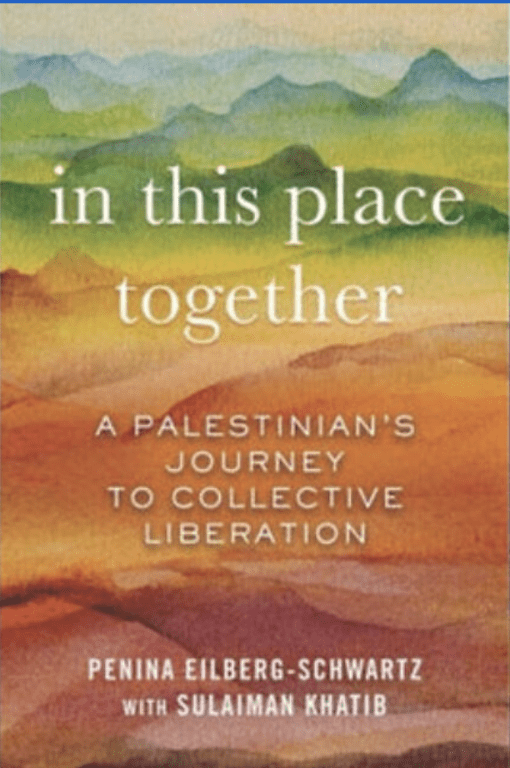 From a Palestinian perspective, I appreciated a book published just a few months ago by our own Beacon Press titled In This Place Together: A Palestinian’s Journey to Collective Liberation co-written by the American Jewish activist Penina Eilberg-Schwartz, and the Palestinian peace activist Sulaiman Khatib. A way toward collective liberation—in which everyone gets more peace, liberty, and justice—is what we are listening for with our doubts and loves.
Similar to the “dual narratives” approach we explored earlier, Khatib confesses that as a younger man, he thought that it was weak equivocation to attempt to address both Israeli and Palestinian sides. For many years, he thought that the hardest and most important way forward was to fight “by any means necessary” for Palestinian rights and dignity. But he has come to believe that it is more hopeful, if also much more difficult, to “hold multiple narratives” and to “carry contradictions in your soul. It is much easier to see one side of the story, to blame the other, to live in victimhood. To feel that all the world is against you, that everyone wants to kill you” (Eilberg-Schwartz xxii). Over time, he has found his heart opening in compassion and love—always with a fierce love for the Palestinian people, but also with a growing love for the Israeli people who feel deeply tied to the same land.
And that has become his starting point—not the strong grievance of the past that both sides still feel deeply, but the difficult truth, in his words, that, “Our two peoples belong to the same place” (Eilberg-Schwartz 202). And it is from this starting point that both Palestinian and Jewish activists have convinced me that—in addition to the two-state solution, serious consideration should also be made to the democratic one-state solution “in which each person living between the Jordan River and the Mediterranean Sea would get one vote”—with constitutional protections built in to ensure the human rights and basic protections of all. Similarly, there are important proposals for a “Middle Way”—often called a confederation of “Two States, One Homeland.” In this model “each government would be accountable for the safety and civil rights of its citizens, but the borders would be porous. People would live where they wanted” (209).
There is admittedly so much more to say. But the important point is this—both for the Israeli-Palestinian conflict and for any entrenched conflicts in our own lives: Where do we feel that only we are right? And are we willing to take the risk of asking the vulnerable questions Yehuda Amichai pointed us to in his poem. If I’m being honest, are there places where I have doubts? And if I open my heart, are there ways I might love more fully and freely in this moment?
Let us open our hearts so as to be more honest and vulnerable about our doubts, and even more open with our love. May we listen together for as yet unforeseen ways forward that might make peace, liberty, and justice possible for all.
The Rev. Dr. Carl Gregg is a certified spiritual director, a D.Min. graduate of San Francisco Theological Seminary, and the minister of the Unitarian Universalist Congregation of Frederick, Maryland. Follow him on Facebook (facebook.com/carlgregg) and Twitter (@carlgregg).
Learn more about Unitarian Universalism: http://www.uua.org/beliefs/principles
Previous Post

August 3, 2021
Yasodhara: The Forgotten Story of the Buddha's Wife
Next Post
August 25, 2021 "Fierce Self-Compassion"
Browse Our Archives
Select a Category Advent Anti-Racism Archaeology Atheism Baptism Best of the Year List Book Reviews Buddhism Catholicism Christian Education Church and State Church Planting Climate Change Conscientious Objection to War Creation Spirituality Death Penalty Didache Disability Rights Discernment Easter Ecology Emergent Church Movement Empire-Critical Ethics Evolution Feminist Theology Film Reviews Gandhi Gospel of Mark Gun Control Hinduism Immigration Reform Interfaith Islam JFK Judaism Jungian Spirituality Lectionary Commentary Lent Letters to the Editor LGBT Marriage MLK Multiculturalism Mysticism Nonviolent Activism Occupy Paganism (Earth-centered Religions) Parables Paul Pluralism Politics Process Theology Quantum Physics Requiescat In Pace Seminary and Divinity School Sermon Series Retrospective Sermons Spiritual Direction Spiritual Practices Stewardship (Fundraising) The Book of J The Wheel of the Year (Paganism) Theoblogger Challenge Triathlon Uncategorized Unitarian Universalism Worship Resources Youth Ministry
Select a Month July 2026 May 2026 March 2026 November 2025 October 2025 August 2025 February 2025 December 2024 October 2024 March 2024 January 2024 December 2023 November 2023 March 2023 February 2023 January 2023 December 2022 November 2022 August 2022 March 2022 February 2022 January 2022 December 2021 September 2021 August 2021 July 2021 June 2021 May 2021 February 2021 January 2021 December 2020 August 2020 June 2020 May 2020 April 2020 March 2020 February 2020 January 2020 December 2019 November 2019 October 2019 September 2019 July 2019 June 2019 March 2019 February 2019 January 2019 December 2018 November 2018 October 2018 September 2018 June 2018 May 2018 April 2018 March 2018 February 2018 January 2018 December 2017 November 2017 October 2017 September 2017 August 2017 July 2017 June 2017 May 2017 April 2017 March 2017 February 2017 January 2017 December 2016 November 2016 October 2016 September 2016 August 2016 June 2016 May 2016 April 2016 March 2016 February 2016 January 2016 December 2015 November 2015 October 2015 September 2015 August 2015 July 2015 June 2015 May 2015 April 2015 March 2015 February 2015 January 2015 December 2014 November 2014 October 2014 August 2014 July 2014 June 2014 May 2014 April 2014 March 2014 February 2014 January 2014 December 2013 November 2013 October 2013 September 2013 August 2013 July 2013 June 2013 May 2013 April 2013 March 2013 February 2013 January 2013 December 2012 November 2012 October 2012 September 2012 August 2012 July 2012 June 2012 May 2012 April 2012 March 2012 February 2012 January 2012 December 2011 November 2011 October 2011 September 2011 August 2011 July 2011 June 2011 May 2011 April 2011 March 2011 February 2011 January 2011 December 2010 November 2010 October 2010 August 2009 July 2009 May 2009
Follow Us!
TAKE THE
Religious Wisdom Quiz
What does Proverbs say about quick-tempered people?
Select your answer to see how you score.
They are always respected They are wise They make peace They cause trouble
Related posts from Carl Gregg

Reading America at 250: A Nation Wrestles With...


Andrew Holocek on the Power of Darkness

The Stories That Shape Us: Myths, Archetypes, &...
TRENDING AT PATHEOS More Voices

Reading America at 250: A Nation Wrestles With...
As part of my own reflection on the 250th anniversary of the...

Whenever I am reading a book or listening to an argument, I...

President Trump Ban Animal Torture Videos on Facebook
Call for Stricter Regulations of Animal Abuse Content on Facebook Although President...

Draft Amendments to Address Ritual Abuse in New...
The proposed changes would make it illegal for individuals in domestic partnerships...

How Bans on LGBTQ+ Student Clubs Threaten Religious...
On June 20, 2025, the State of Texas passed Senate Bill 12....

The Truth About the Gen Z Revival
This past year, there has been a lot of media buzz surrounding...
view all More Voices blogs
Ad-Free & Subscriber Log-In Subscription Support
- About Us
- 2026 Calendar
- Videos
- Podcasts
- Library of World Religions
- Faith In Media Tracker
- Advertise With Us
- Write for Us
- Privacy Policy
- Terms of Service
- Do Not Sell My Data
- Contact Us
- Radiant Digital
- Manage Newsletter Subscriptions
- Unsubscribe From Notifications
- Sitemap
Copyright 2008-2026, Patheos. All rights reserved.
Subscription Support Ad-Free & Subscriber Log-In
Follow Patheos