
BuddhistCatholicContemplativeEvangelicalGeneral ChristianHinduJewishLatter-day SaintMuslimNew VisionsProgressive Christian
Beliefs
- Buddhist
- Catholic
- Contemplative
- Evangelical
- General Christian
- Hindu
- Jewish
- Latter-day Saint
- More Voices
- Muslim
- New Visions
- Pagan
- Progressive Christian
Topics
- Religion News
- Food and Religion
- Sports and Religion
- Religious Art
- Religious Music and Entertainment
- Religious Events
- History and Religion
- Style and Religion
- Politics and Religion
- Women in Religion
- Recreation Outdoors and Religion
- Business Finance and Religion
- Careers Workplace and Religion
- Education and Religion
- Family Parenting and Religion
- Health Fitness and Religion
- Home and Religion
- Relationships and Religion
- Technology and Religion
- Travel and Religion
Columnists
- Buddhist Columnists
- Business Finance and Religion Columnists
- Careers Workplace and Religion Columnists
- Catholic Columnists
- Contemplative Columnists
- Education and Religion Columnists
- Evangelists Columnists
- Family Parenting and Religion Columnists
- General Christian Columnists
- Health Fitness and Religion Columnists
- Hindu Columnists
- History and Religion Columnists
- Home and Religion Columnists
- Jewish Columnists
- More Voices Columnists
- Latter Day Columnists
- Muslim Columnists
- New Visions Columnists
- Nonreligious Columnists
- Pagan Columnists
- Politics and Religion Columnists
- Progressive Columnists
- Recreation Outdoors and Religion Columnists
- Relationships and Religion Columnists
- Religion News Columnists
- Religious Art Columnists
- Religious Events Columnists
- Religious Music and Entertainment Columnists
- Sports and Religion Columnists
- Style and Religion Columnists
- Technology and Religion Columnists
- Travel and Religion Columnists
- Women in Religion Columnists
Resource Library
- 2026 Calendar
- Library of World Religions
- The 100 Most Holy Places on Earth
- Patheos Answers
- Podcasts
- Videos
- Faith Leaders Database
- Anglican Episcopalian
- Bahai
- Baptist
- Buddhism
- Christianity
- Confucianism
- Eastern Orthodoxy
- Hinduism
- Holiness and Pentecostal
- ISKCON
- Islam
- Judaism
- Lutheran
- Methodist
- The Church of Jesus Christ of Latter-day Saints
- New Age
- Paganism
- Presbytarian and Reformed
- Protestantism
- Religion Behind the Scenes
- Roman Catholic
- Scientology
- Shia Islam
- Sikhism
- Sufism
- Sunni Islam
- Taoism
- Zen
- See all religions
Research Tools
 Ad-Free & Subscriber Log-In Subscription Support
Ad-Free & Subscriber Log-In Subscription Support
Follow Patheos 

- Trending:
- Forgiveness
- |
- Marriage
- |
- Consciousness
- |
- Death Penalty
- |
- Election
- |
- Halloween

- Home
- More Voices
- “Imagine There’s No Countries”: Interdependence Day & Immigration Justice
“Imagine There’s No Countries”: Interdependence Day & Immigration Justice
Last updated on: July 6, 2021 at 10:10 am by Carl Gregg
“Imagine There’s No Countries”: Interdependence Day & Immigration Justice 2021-07-06T10:10:55-04:00 Carl Gregg
Patheos Explore the world's faith through different perspectives on religion and spirituality! Patheos has the views of the prevalent religions and spiritualities of the world.
There’s an old joke in Unitarian Universalist (UU) circles that if there’s one “St. John” whom the greatest number of UUs revere, it’s St. John Lennon. Seriously, it’s a whole thing far beyond UUs. There are St. John Lennon votive candles, stained glass windows, prayer cards, and more. Along these lines, John Lennon’s song “Imagine” is particularly beloved. And as I’ve been preparing this post, one line from that song has kept coming to mind: “Imagine there’s no countries / It isn’t hard to do…”
It’s a lovely sentiment, but is it really true that imagining “no countries” is easy to do? Given how long we’ve been trying to pass comprehensive immigration reform in this country, it seems like “imagining no countries” can be quite difficult to do.
Whenever I reflect on the long struggle for immigration justice in this country, I am reminded of Dr. Daisy Machado, one of my favorite professors in seminary, who taught history from a Latina Feminist perspective. I will never forget her asking us to imagine the Earth as we have seen it in pictures taken from space: a breathtakingly beautiful blue-green marble on which we find ourselves floating through the inky blackness of space.
She then invited us to picture a globe—or almost any map we had ever seen—and to notice that political maps, have socially constructed lines dividing up the natural world of the planet with colors and labels reflecting the various ownership claims that human political groups have staked out upon it. With that juxtaposition in mind, what she said next resonated with me deeply and has stuck with me all these years later. She said: “Borders are wounds.” There’s a lot of hard truth in that statement.
From a cosmic perspective, it is so clear that all living beings on this planet are part of one interdependent whole. So from a certain point of view, the majority of those borders are wounds—injuries, tears, cuts, traumas—that we have either inflicted on ourselves or others or that others have inflicted upon us.
Dr. Machado’s view of borders as wounds arises particularly out of her experience as a Latina feminist historian living in Texas. To study the history of the land currently known as Texas is to watch borders shift back and forth over the same homelands again and again. First, there were indigenous inhabitants, who found themselves unexpectedly declared part of the “Kingdom of New Spain,” followed by long periods of significant political instability. Texas even declared national sovereignty for a few years at one point—only to eventually be annexed by the U.S. as our twenty-eighth state. Meanwhile, most folks simply tried to live out their lives, even as border wounds kept being carved out above them, below them, around and sometimes through them.
If we zoom out, we can see similar stories of division and fusion playing out around the world today, as Sonia Shah has detailed in her book The Next Great Migration: The Beauty and Terror of Life on the Move:
Tunisia has built a wall of sandbanks and water-filled trenches along its border with Libya. India and Myanmar have fenced their borders with Bangladesh. Israel has enclosed itself with razor wire, touch sensors, infrared cameras, and motion detectors. Hungary’s fence along its border with Croatia…delivers electric shocks…. Austria has built a fence along its border with Slovenia. Britain plans another one along the channel separating it from France. Norway has fortified its border with Russia. (290-291)
And here in the U.S. we’ve all heard endless amounts of verbiage in recent years about the much-ballyhooed wall on our southern border.
So as I invite us to reflect on immigration justice, please be assured that I am highly aware of how fear-mongering around the issue of immigration has been (and is being) used in this country in cynical, bad faith ways to stoke xenophobic, nativist resentment for political gain. For all these reasons, I can understand how it came to be that Vice President Kamala Harris used her first foreign trip as Vice President to make a speech in Guatemala about undocumented immigrants to the U.S., a speech that boiled down to three words: “Do not come” (The New York Times).
I do not envy the position Vice President Harris is in, and I would not want her job. On the other hand, from the perspective of immigration justice, this news story forces me to ask if that is really the best the United States of America can do?
Now, as we are near July 4th—America’s Independence Day—there are many ways in which I am grateful to be a U.S. citizen. But there is also a reason that, in close proximity to our recent Independence Day, I am inviting “We the people” to widen the circle of whom we include in that consequential “We.” I’m inviting us to keep in mind the other side of the equation: that having won our independence, what and whom will we use our freedom for?
Part of growing up is casting off what we no longer believe in, what is holding us back. But to forever remain in that place of only declaring what we are free from is to enter an arrested development stage of eternal adolescence. An equally important part of growing up is freely choosing *interdependence—*connection, cooperation and community—by declaring not only what and whom you disagree with, but who and what you can embrace.
Many of you have heard me say that, “The stories we tell matter.” Along those lines, we can ask what stories are holding us back and what stories are calling us forward?
I invite you to notice how it feels in your heart, mind, and body when you consider our country’s current three-word story to would-be immigrants: “Do not come.” From a certain point of view, it might feel strong, tough, protectionist. From another point of view, it might feel tight, cold, constricted, unfriendly, shut-down, isolated, fearful and lonely. Is this story of independence calling us forward or holding us back?
Here’s another story to consider: it’s an excerpt of a sonnet penned by Emma Lazarus and emblazoned on the Statue of Liberty in New York Harbor, specifically to welcome immigrants to this country. When you hear these words, what do you notice in your heart, mind, and body?
her name
Mother of Exiles. From her beacon-hand
Glows world-wide welcome…
“Give me your tired, your poor,
Your huddled masses yearning to breathe free,
The wretched refuse of your teeming shore.
Send these, the homeless, tempest-tost to me,
I lift my lamp beside the golden door!”
How do we respond to this story of interdependence? Is it calling us forward or holding us back?
To me, this poem resonates with an inspirational “can do” spirit that makes me proud to be an American. It calls to the better angels of our nature. It speaks of freely choosing, as JFK said, to do things “not because they are easy, but because they are hard.” It feels open-minded, open-handed, open-hearted, compassionate, connected. It feels like it is calling us forward toward what the 6th Principle in my own chosen tradition of Unitarian Universalism calls us to: the goal of world community with peace, liberty, and justice— not merely for some, but for all. Is that just a pipedream? Or—as with landing a human on the moon—are there realistic steps we might take to turn our dreams into deeds?
There are two books I have been reading in researching this post that can help open our minds, hearts, and imaginations to what might be possible with regard to immigration justice: One Billion Americans: The Case for Thinking Bigger by Matthew Yglesias, and Open Borders: The Science and Ethics of Immigration by Bryan Caplan.
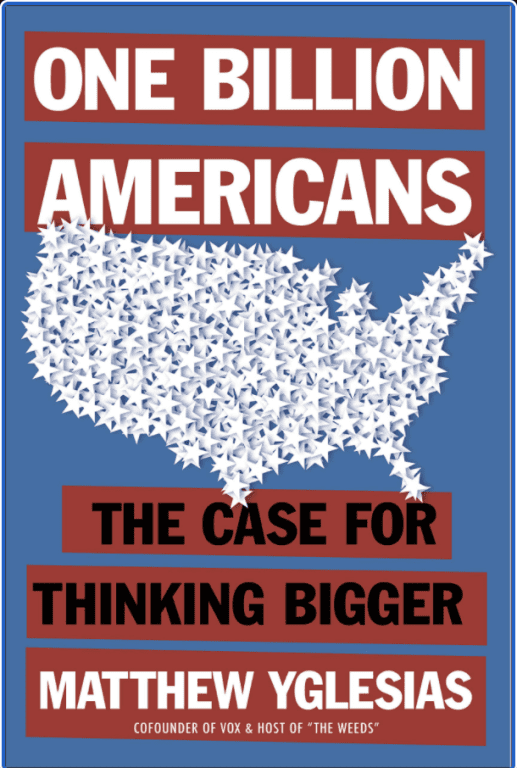 Yglesias’s book throws down the gauntlet right there in the title. Today there are approximately 330 million people here in the U.S. He invites us to consider why we might want to turn “Do not come” into “Ya’ll come” by intentionally tripling the population of our country over time to 1 billion Americans. And even if a national population of 1 billion sounds ludicrous to you, at least consider the thought experiment trying to open our imaginations to consider to why we may be getting it wildly wrong to be so strict about immigration—given how arguably underpopulated this country is.
Importantly, Yglesias is not saying we should increase our population just to be nice. He strongly believes that we need to significantly increase our rate of immigration if the U.S. is going to remain competitive long-term with the growing economic market size of, for instance, China and India, each of which have approximately 1.4 billion people (xii, 9).
Now, as I’ve said already, I’m ultimately much more interested in the goal of “world community” cooperation and collaboration than I am in competing with China and India. But Yglesias makes some important arguments that are worth considering for the short-term. And if we take a breath, step back, and rationally evaluate the situation, it becomes clear that arguably, we have a lot of room in the U.S. for more people (xi).
Let me give you a few points of comparison to the populations density of the 48 contiguous U.S. states, excluding Hawaii and Alaska. Even if we were to heed Yglesias’s maximalist call and literally triple our population from 330 million Americans to 1 billion Americans, we would find ourselves only “about as dense as France and less than half as dense as Germany.”
In Yglesias’s words:
When you picture a land of one billion Americans, don’t imagine an endless sea of gleaming skyscrapers of a vast horrendous slum. Imagine France. France is a country that does contain gleaming skyscrapers…and unfortunately, a few slums. But it’s also the country of the scenic Pyrenees mountains, iconic vineyards, and the rugged coastline of Brittany…. Nobody thinks of France as a country suffering from a hideous level of overcrowding in part because Denmark, Italy, Germany, the United Kingdom, and the Netherlands are all denser. (18-19)
None of this means that we actually have to get anywhere near to one billion Americans, but it does challenge us to open our imaginations and consider that a hard stance of “Do not come” is holding us back from the many real benefits—for all—that a sane, future-oriented immigration policy might bring. And, of course, we would need to couple population growth with something like a Green New Deal so that our work for immigration justice works in tandem with our struggle for climate justice (xix, 44).
I’ve also preached before on the topic of global population control, and cannot replicate those arguments here. However, to consider the situation the other way around, many places in America are arguably underpopulated. To name only some of the most prominent examples from recent decades:
- Detroit has declined “1.85 million people to about 380,000.”
- St. Louis has “lost 65 percent of the 856,000 residents it had in 1950”
- “Philadelphia has lost 25 percent of its peak population, which still amounts to 500,000 people”
- “Cleveland has also lost half a million.”
- “Baltimore has lost 350,000 people
- “Buffalo has lost nearly as many.”
- “New Orleans and Pittsburgh are down nearly 250,000 people”
- “Cincinnati has lost 200,000
- “Newark and Milwaukee have lost about 150,000.” (146-147)
There are ways of shaping immigration policy that could, for instance, grant immigration status contingent upon a willingness to live in one of these cities for, say, five to seven years, to help infuse innovation and growth into currently declining economies.
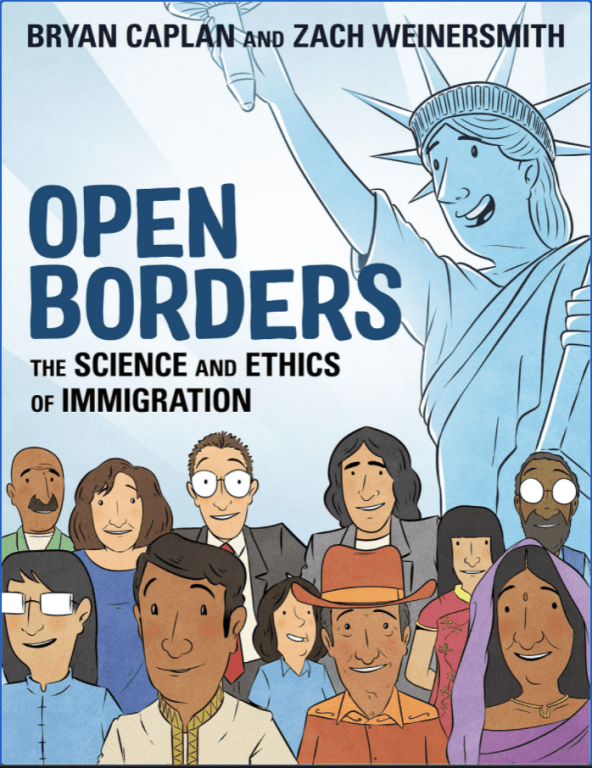 To bring Caplan’s book into the conversation, he has written a provocative and engaging book, illustrated by cartoonist Zach Weinersmith, that makes a similar argument for much more open borders—from both an ethical and an economic perspective. Caplan makes a strong case that not only is increased immigration the right thing to do from a moral perspective (to help out those in need), but also that it will result in a tremendous economic benefit for all concerned.
There’s a lot more to say about all of this—so many ideas on how to shape a humane, pragmatic, and fair immigration policy—and I recommend both Yglesias’s and Caplans’ books as short and accessible starting points for learning more. For now, I hope I’ve at least helped open our collective imaginations to consider what might be possible—and how more-open borders might well be a key part of what it would take to move toward a goal of world community for all.
Encapsulating the inverted perspective of immigration that we’ve been exploring, I want to leave you with a poem by Brian Bilston titled “Refugees.” Take a moment to follow that link and listen to it read now. Notice that at the end of the poem, you are invited to start at the bottom and read it back up to the top, perceiving the exact same words from a radically different point of view.
In the same vein as that flipped perspective, I hope here at the end of this post that it might now be a little easier for you to resonate with that line from John Lennon: “Imagine there’s no countries / It isn’t hard to do…” Lennon then continues:
You may say I’m a dreamer
But I’m not the only one
I hope someday you’ll join us
And the world will live as one
May it be so, and may we each do our part from within our spheres of influence to open our hearts and minds, to widen our circles of inclusion as to whom we mean when we say “We.” Together let’s imagine building a land that is truly for all. Together, may we turn our dreams into deeds, building the better world we dream about.
The Rev. Dr. Carl Gregg is a certified spiritual director, a D.Min. graduate of San Francisco Theological Seminary, and the minister of the Unitarian Universalist Congregation of Frederick, Maryland. Follow him on Facebook (facebook.com/carlgregg) and Twitter (@carlgregg).
Learn more about Unitarian Universalism: http://www.uua.org/beliefs/principles
Previous Post

June 20, 2021
Climate Justice, Courage, & Hope
Next Post
July 14, 2021 Boundaries, Healing, & Hope: How to Shift Out of Survival Mode
Browse Our Archives
Select a Category Advent Anti-Racism Archaeology Atheism Baptism Best of the Year List Book Reviews Buddhism Catholicism Christian Education Church and State Church Planting Climate Change Conscientious Objection to War Creation Spirituality Death Penalty Didache Disability Rights Discernment Easter Ecology Emergent Church Movement Empire-Critical Ethics Evolution Feminist Theology Film Reviews Gandhi Gospel of Mark Gun Control Hinduism Immigration Reform Interfaith Islam JFK Judaism Jungian Spirituality Lectionary Commentary Lent Letters to the Editor LGBT Marriage MLK Multiculturalism Mysticism Nonviolent Activism Occupy Paganism (Earth-centered Religions) Parables Paul Pluralism Politics Process Theology Quantum Physics Requiescat In Pace Seminary and Divinity School Sermon Series Retrospective Sermons Spiritual Direction Spiritual Practices Stewardship (Fundraising) The Book of J The Wheel of the Year (Paganism) Theoblogger Challenge Triathlon Uncategorized Unitarian Universalism Worship Resources Youth Ministry
Select a Month July 2026 May 2026 March 2026 November 2025 October 2025 August 2025 February 2025 December 2024 October 2024 March 2024 January 2024 December 2023 November 2023 March 2023 February 2023 January 2023 December 2022 November 2022 August 2022 March 2022 February 2022 January 2022 December 2021 September 2021 August 2021 July 2021 June 2021 May 2021 February 2021 January 2021 December 2020 August 2020 June 2020 May 2020 April 2020 March 2020 February 2020 January 2020 December 2019 November 2019 October 2019 September 2019 July 2019 June 2019 March 2019 February 2019 January 2019 December 2018 November 2018 October 2018 September 2018 June 2018 May 2018 April 2018 March 2018 February 2018 January 2018 December 2017 November 2017 October 2017 September 2017 August 2017 July 2017 June 2017 May 2017 April 2017 March 2017 February 2017 January 2017 December 2016 November 2016 October 2016 September 2016 August 2016 June 2016 May 2016 April 2016 March 2016 February 2016 January 2016 December 2015 November 2015 October 2015 September 2015 August 2015 July 2015 June 2015 May 2015 April 2015 March 2015 February 2015 January 2015 December 2014 November 2014 October 2014 August 2014 July 2014 June 2014 May 2014 April 2014 March 2014 February 2014 January 2014 December 2013 November 2013 October 2013 September 2013 August 2013 July 2013 June 2013 May 2013 April 2013 March 2013 February 2013 January 2013 December 2012 November 2012 October 2012 September 2012 August 2012 July 2012 June 2012 May 2012 April 2012 March 2012 February 2012 January 2012 December 2011 November 2011 October 2011 September 2011 August 2011 July 2011 June 2011 May 2011 April 2011 March 2011 February 2011 January 2011 December 2010 November 2010 October 2010 August 2009 July 2009 May 2009
Follow Us!
TAKE THE
Religious Wisdom Quiz
What does "Pharisee" mean?
Select your answer to see how you score.
Separated one Teacher Healer Holy one
Related posts from Carl Gregg

Reading America at 250: A Nation Wrestles With...


Andrew Holocek on the Power of Darkness

The Stories That Shape Us: Myths, Archetypes, &...
TRENDING AT PATHEOS More Voices

Reading America at 250: A Nation Wrestles With...
As part of my own reflection on the 250th anniversary of the...

Whenever I am reading a book or listening to an argument, I...

President Trump Ban Animal Torture Videos on Facebook
Call for Stricter Regulations of Animal Abuse Content on Facebook Although President...

Draft Amendments to Address Ritual Abuse in New...
The proposed changes would make it illegal for individuals in domestic partnerships...

How Bans on LGBTQ+ Student Clubs Threaten Religious...
On June 20, 2025, the State of Texas passed Senate Bill 12....

The Truth About the Gen Z Revival
This past year, there has been a lot of media buzz surrounding...
view all More Voices blogs
Ad-Free & Subscriber Log-In Subscription Support
- About Us
- 2026 Calendar
- Videos
- Podcasts
- Library of World Religions
- Faith In Media Tracker
- Advertise With Us
- Write for Us
- Privacy Policy
- Terms of Service
- Do Not Sell My Data
- Contact Us
- Radiant Digital
- Manage Newsletter Subscriptions
- Unsubscribe From Notifications
- Sitemap
Copyright 2008-2026, Patheos. All rights reserved.
Subscription Support Ad-Free & Subscriber Log-In
Follow Patheos