
BuddhistCatholicContemplativeEvangelicalGeneral ChristianHinduJewishLatter-day SaintMuslimNew VisionsProgressive Christian
Beliefs
- Buddhist
- Catholic
- Contemplative
- Evangelical
- General Christian
- Hindu
- Jewish
- Latter-day Saint
- More Voices
- Muslim
- New Visions
- Pagan
- Progressive Christian
Topics
- Religion News
- Food and Religion
- Sports and Religion
- Religious Art
- Religious Music and Entertainment
- Religious Events
- History and Religion
- Style and Religion
- Politics and Religion
- Women in Religion
- Recreation Outdoors and Religion
- Business Finance and Religion
- Careers Workplace and Religion
- Education and Religion
- Family Parenting and Religion
- Health Fitness and Religion
- Home and Religion
- Relationships and Religion
- Technology and Religion
- Travel and Religion
Columnists
- Buddhist Columnists
- Business Finance and Religion Columnists
- Careers Workplace and Religion Columnists
- Catholic Columnists
- Contemplative Columnists
- Education and Religion Columnists
- Evangelists Columnists
- Family Parenting and Religion Columnists
- General Christian Columnists
- Health Fitness and Religion Columnists
- Hindu Columnists
- History and Religion Columnists
- Home and Religion Columnists
- Jewish Columnists
- More Voices Columnists
- Latter Day Columnists
- Muslim Columnists
- New Visions Columnists
- Nonreligious Columnists
- Pagan Columnists
- Politics and Religion Columnists
- Progressive Columnists
- Recreation Outdoors and Religion Columnists
- Relationships and Religion Columnists
- Religion News Columnists
- Religious Art Columnists
- Religious Events Columnists
- Religious Music and Entertainment Columnists
- Sports and Religion Columnists
- Style and Religion Columnists
- Technology and Religion Columnists
- Travel and Religion Columnists
- Women in Religion Columnists
Resource Library
- 2026 Calendar
- Library of World Religions
- The 100 Most Holy Places on Earth
- Patheos Answers
- Podcasts
- Videos
- Faith Leaders Database
- Anglican Episcopalian
- Bahai
- Baptist
- Buddhism
- Christianity
- Confucianism
- Eastern Orthodoxy
- Hinduism
- Holiness and Pentecostal
- ISKCON
- Islam
- Judaism
- Lutheran
- Methodist
- The Church of Jesus Christ of Latter-day Saints
- New Age
- Paganism
- Presbytarian and Reformed
- Protestantism
- Religion Behind the Scenes
- Roman Catholic
- Scientology
- Shia Islam
- Sikhism
- Sufism
- Sunni Islam
- Taoism
- Zen
- See all religions
Research Tools
 Ad-Free & Subscriber Log-In Subscription Support
Ad-Free & Subscriber Log-In Subscription Support
Follow Patheos 

- Trending:
- Forgiveness
- |
- Marriage
- |
- Consciousness
- |
- Death Penalty
- |
- Election
- |
- Halloween

- Home
- More Voices
- Boundaries, Healing, & Hope: How to Shift Out of Survival Mode
Boundaries, Healing, & Hope: How to Shift Out of Survival Mode
Last updated on: July 14, 2021 at 6:12 pm by Carl Gregg
Boundaries, Healing, & Hope: How to Shift Out of Survival Mode 2021-07-14T18:12:25-04:00 Carl Gregg
Patheos Explore the world's faith through different perspectives on religion and spirituality! Patheos has the views of the prevalent religions and spiritualities of the world.
We have been living through an extraordinarily hard time in world history, including years of threats to democracy in our country, an ongoing global pandemic, and on top of that, we’ve each had to face the various personal tragedies and family struggles that inevitably arise for each of us. Any one of those things is more than enough to deal with. Having to handle all of that for such a long period of time has put many of us in various forms of survival mode: hunkering down and doing whatever we could to get through.
For better and worse, we can’t change any of that, the good or the bad, the beautiful or the cruel. As the saying goes, “We have to give up all hope of a better past.” But I invite you to consider if this current season might be a turning point of sorts.
Now, I’m not saying that all our problems are behind us. From the political to the pandemic to the personal, there are still plenty of problems to go around. It’s just that, for the moment, the political and the pandemic at least are not quite as unrelentingly terrible as they have been. So I want to invite us to pause, take a deep breath, and consider if this season of midsummer might be an auspicious opportunity to set one or more intentions to incline ourselves out of a locked-down “survival mode” and into a more sustainable way of being with ourselves, with one another, and with this world.
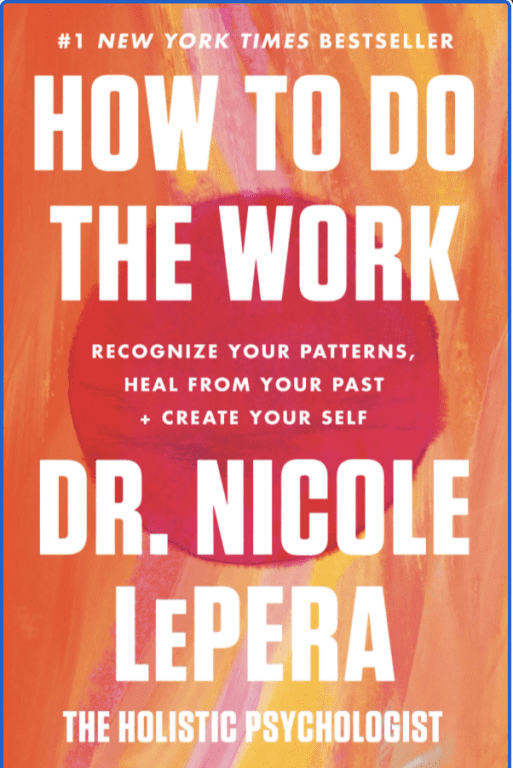 To that end, one perspective I’ve found regularly helpful of late is in the writings of Dr. Nicole LePera, the author of a recent book titled How to Do the Work: Recognize Your Patterns, Heal from Your Past, and Create Your Self. For anyone on Instagram, I also recommend her Instagram feed, where she posts under the handle @the.holistic.psychologist.
Dr. LePera started out along a fairly traditional path: undergraduate degree in psychology from Cornell University, followed by a master’s degree and a Ph.D. in Clinical Psychology from The New School in New York City. But in 2018, after almost a decade as a therapist, she became increasingly interested in a more holistic approach that more fully integrates mental, physical, and spiritual wellness.
And her framework is resonating with a growing number of people. After only a few years, she has more than four million followers on Instagram, and her book became a #1 New York Times bestseller. To give you a quick taste of her perspective, here’s what she wrote on the one-year anniversary of founding The Holistic Psychologist. I invite you to notice if any part of this resonates with you as we—individually and collectively—seek to emerge from our survival mode:
Something brought you here. Something inside of you came here with a deep longing to heal. A longing to be the highest version of yourself. This is something to celebrate. We all have a childhood that is creating our current reality, and today we’ve chosen to heal from our past in order to create a new future. The part of you that knows this to be true is your intuition. It has always been there. We have simply developed a habit of not listening to or trusting what it says. Being here today is a step in healing that broken trust within ourselves. (xv-xvi)
Let me unpack two parts of that. First, what she means by “We all have a childhood that is creating our current reality.” Second, what she means when she invites to listen and trust what our heart, mind, body, and spirit are telling us we need in this particular season of our lives.
To begin, that part about our “childhood creating our current reality” is related to what I described earlier as survival mode. When we are under stress, our human tendency is to revert to maladaptive, habitual behaviors rooted in the family systems we grew up in and/or our traumas from the past.
The psychologist Carl Jung said it this way in a sentence that has stuck with me even since: “Until you make the unconscious conscious, it will direct your life and you will call it fate.” Whew. That’s some heavy stuff. And what can often remain unconscious for us—while powerfully shaping our habitual reactions—are various aspects of the family systems we experienced in early childhood.
Part of Dr. LePera’s focus is to help us become more aware of those patterns, so that we can make more intentional choices. Even just to increase our awareness of our patterns can be a powerful first step allowing us to interrupt our patterns, unhook ourselves, and open up the possibility for more free, generous, and compassionate responses to our lives—to our experiences of reality.
What I appreciate about this sort of perspective is that it can be tremendously empowering. There’s a saying that, “We don’t experience the world simply as it is. We experience the world as we are.” We each really do play a role in co-creating our experience of reality.
But let me add an important caveat that is often left out of such approaches. I’m not saying that reality is all in our individual control. Indeed, many of you have heard my favorite quote from the science fiction writer Philip K. Dick that, “Reality is what doesn’t go away when you stop believing in it.”
Folks like Nicole LePera and her “Holistic Psychologist” perspective can serve as powerful catalysts for doing our own inner work. Regardless of what’s happening in our world, there are transformative steps available on the individual level to change our experience of ourselves, others, and the world.
At the same time, it’s important to acknowledge that regardless of what we do on an individual level, systemic problems like racism, sexism, classism, and homophobia will continue to have disproportionate impacts on historically oppressed groups, and that we must continue to work to dismantle those systems.
But here’s the thing: doing our inner work can help us show up for social justice actions in a wiser, more skillful, and compassionate way. And working for social justice can create better systems that make it easier to show up for our inner work. So it’s all ultimately interrelated.
But for our purposes at the moment, I’m particularly inviting us to become more conscious that a shift in perspective can affect how we experience reality. I barely have time to scratch the surface of what Dr. LePera covers in her book on How to Do the Work, so I will primarily limit myself to one example that has been especially helpful to me. It’s a mindfulness technique called “There Is Noting” that I learned from the meditation teacher Kenneth Folk. The instructions are pretty simple. It invites us to experiment with shifting from our typical first-person, ego-focused perspective of “I am” to a third-person perspective of “There is.” Let me give you an example.
One emotion that many of us have been experiencing far too often recently is anxiety. And don’t get me wrong: “You’re not being paranoid if they really are after you!” There are lots of legitimate reasons to feel anxious. But I want to invite us to explore how we might more skillfully work with anxiety.
When anxiety arises, one common way of expressing that feeling is to say, “I am anxious.” And there is truth in that perspective, but it’s not the only option. If I say, “I am anxious,” that can feel like a very definitive, concrete, solid, and judgmental part of my identity.
What if we play with our perspectives, and instead of saying, “I am anxious,” we try substituting the phrase, “There is anxiety.” Can you feel the difference? To me, the shift from “I am anxious” to “There is anxiety” creates a little bit of distance. Some space open up. Suddenly, the anxiety feels just a little bit more workable. Rather than feeling identified with the emotion (“I am anxious”), I find myself in a “witness stance” from which I can more easily explore that anxiety with curiosity. There is anxiety. Okay. What does this anxiety feel like? Where is it showing up in my body? How is it changing over time?
Importantly, this “There is noting” practice doesn’t stop there. It invites us to notice all the many other things that are often inherent in the arising and passing away of any present moment. What else do I notice in real time? What else is there to notice?
A shift in my awareness from “I am” to“There is” can change my perspective of myself, others, and the world. I feel less tight and constricted, more open and expansive. The feeling that “This One Single Thing (Anxiety) Is Overwhelmingly True” shifts to a sense that many things are present—and each of them now feels a little more workable.
And no, you don’t have to start saying, “There is” all the time instead of “I am.” This mindfulness practice is just another tool to have in your back pocket to use whenever it might be helpful.
The most famous contemporary definition of mindfulness is from Dr. Jon Kabat-Zinn, who defines mindfulness as “awareness that arises through paying attention, on purpose, in the present moment, nonjudgmentally.” The non-judgmental part is key—just noticing on a basic sensate level what is happening in the present moment.
If what is arising for you feels difficult, you can also add in a heartfulness practice by offering yourself compassion. And you can take it one step further by adding an embodied component—for instance by placing your hand on your heart center, or wherever on your body might feel soothing to you.
Mindfulness is a way of putting into practice that old saying that, “You don’t have to believe everything you think.” If your mind is racing, you can again try shifting into third-person to make that immediate experience more workable, noting with a simple label all that is arising for you: “There is thinking.” “There is anticipation.” “There is worry.” If you get caught up in something and start to spiral, this broader approach of witnessing and labeling all the various things that are happening in the present moment can sometimes help to get you unhooked.
Mindfulness is just one way of experimenting with our earlier insight—that we play a role in co-creating our reality. Just to notice that we have slipped into habitual patterns that we learned in childhood which no longer serve us is a powerful first step,. Simply noticing this habit begins to open up the possibility of a shift toward more wisdom, freedom, and compassion.
If you are curious to learn more, Dr. LePera’s book How to Do the Work has lots of tools, frameworks, and practices for exploring our subliminal patterns: inner child work, attachment theory and more. For now, I want to move us toward the second part of what she means when she invites us to trust our intuition: to listen for what our heart, mind, body, and spirit are telling us that we need in this particular season of our lives.
As we seek to emerge more out of survival mode, what would it mean to consider that you are the expert on what you most deeply need. What do you know on an intuitive level that you need in order to move—even if only incrementally—toward greater mental, physical, and spiritual wellness (xv)? Please don’t feel you have to make a five-year plan. Rather, ask yourself what are the one or two small, actionable steps you feel called to experiment with for later on today, for the coming week, or maybe between now and Labor Day (21)?
For some of us, that may be some sort of addition to our lives. For others of us, that may look like some sort of subtraction. I’ll briefly address both.
Some of you may feel like something is missing; you feel a longing to add something to your schedule. That need for adding something more, better or different could mean carving out some time to get lost in a great summer read (mental wellness), setting some dates to reconnect with friends (emotional wellness), getting back to the gym or your preferred exercise routine (physical wellness), making more time to meditate or do yoga (spiritual wellness)—or perhaps just finding some time to play whatever activities or games allow you to get lost for hours on end.
On the other end of the spectrum, some of you may have a sense that the last thing you need is one more thing to do. Rather than adding something, perhaps what you need is subtraction, to give yourself permission to draw some boundaries and limits. You may need some downtime to rest, recuperate, and replenish. You may need to say, not “yes,” but “no” and “later” to the extent that is possible. If you need some help with that, Dr. LePera’s book also has lots of tips and practices around how to skillfully draw boundaries.
Some of you may find that you already know intuitively—in a flash—what one or two actions you most need to add or subtract in this season of your life in order to shift out of autopilot and survival mode and toward greater flourishing. Others of you may need some time to allow your responses to emerge. If so, you can try taking that question for a walk, dropping it periodically into your consciousness with real curiosity—“What do I most need in this moment for greater mental, physical, or spiritual wellness?”—allowing some space and silence for a response to spontaneously emerge. Or you could journal about it, create some art, do gentle movement or dance.
In this season of our lives, may we each find time to slow down–even just a little–and give ourselves a chance to really listen. May we trust that, deep down, we do know what we need even if it’s just one step at the time.
The Rev. Dr. Carl Gregg is a certified spiritual director, a D.Min. graduate of San Francisco Theological Seminary, and the minister of the Unitarian Universalist Congregation of Frederick, Maryland. Follow him on Facebook (facebook.com/carlgregg) and Twitter (@carlgregg).
Learn more about Unitarian Universalism: http://www.uua.org/beliefs/principles
Previous Post

July 6, 2021
"Imagine There's No Countries”: Interdependence Day & Immigration Justice
Next Post
August 3, 2021 Yasodhara: The Forgotten Story of the Buddha's Wife
Browse Our Archives
Select a Category Advent Anti-Racism Archaeology Atheism Baptism Best of the Year List Book Reviews Buddhism Catholicism Christian Education Church and State Church Planting Climate Change Conscientious Objection to War Creation Spirituality Death Penalty Didache Disability Rights Discernment Easter Ecology Emergent Church Movement Empire-Critical Ethics Evolution Feminist Theology Film Reviews Gandhi Gospel of Mark Gun Control Hinduism Immigration Reform Interfaith Islam JFK Judaism Jungian Spirituality Lectionary Commentary Lent Letters to the Editor LGBT Marriage MLK Multiculturalism Mysticism Nonviolent Activism Occupy Paganism (Earth-centered Religions) Parables Paul Pluralism Politics Process Theology Quantum Physics Requiescat In Pace Seminary and Divinity School Sermon Series Retrospective Sermons Spiritual Direction Spiritual Practices Stewardship (Fundraising) The Book of J The Wheel of the Year (Paganism) Theoblogger Challenge Triathlon Uncategorized Unitarian Universalism Worship Resources Youth Ministry
Select a Month July 2026 May 2026 March 2026 November 2025 October 2025 August 2025 February 2025 December 2024 October 2024 March 2024 January 2024 December 2023 November 2023 March 2023 February 2023 January 2023 December 2022 November 2022 August 2022 March 2022 February 2022 January 2022 December 2021 September 2021 August 2021 July 2021 June 2021 May 2021 February 2021 January 2021 December 2020 August 2020 June 2020 May 2020 April 2020 March 2020 February 2020 January 2020 December 2019 November 2019 October 2019 September 2019 July 2019 June 2019 March 2019 February 2019 January 2019 December 2018 November 2018 October 2018 September 2018 June 2018 May 2018 April 2018 March 2018 February 2018 January 2018 December 2017 November 2017 October 2017 September 2017 August 2017 July 2017 June 2017 May 2017 April 2017 March 2017 February 2017 January 2017 December 2016 November 2016 October 2016 September 2016 August 2016 June 2016 May 2016 April 2016 March 2016 February 2016 January 2016 December 2015 November 2015 October 2015 September 2015 August 2015 July 2015 June 2015 May 2015 April 2015 March 2015 February 2015 January 2015 December 2014 November 2014 October 2014 August 2014 July 2014 June 2014 May 2014 April 2014 March 2014 February 2014 January 2014 December 2013 November 2013 October 2013 September 2013 August 2013 July 2013 June 2013 May 2013 April 2013 March 2013 February 2013 January 2013 December 2012 November 2012 October 2012 September 2012 August 2012 July 2012 June 2012 May 2012 April 2012 March 2012 February 2012 January 2012 December 2011 November 2011 October 2011 September 2011 August 2011 July 2011 June 2011 May 2011 April 2011 March 2011 February 2011 January 2011 December 2010 November 2010 October 2010 August 2009 July 2009 May 2009
Follow Us!
TAKE THE
Religious Wisdom Quiz
Which chapter of Isaiah is sometimes called the "miniature Bible"?
Select your answer to see how you score.
Isaiah 40 Isaiah 12 Isaiah 66 Isaiah 53
Related posts from Carl Gregg

Reading America at 250: A Nation Wrestles With...


Andrew Holocek on the Power of Darkness

The Stories That Shape Us: Myths, Archetypes, &...
TRENDING AT PATHEOS More Voices

Reading America at 250: A Nation Wrestles With...
As part of my own reflection on the 250th anniversary of the...

Whenever I am reading a book or listening to an argument, I...

President Trump Ban Animal Torture Videos on Facebook
Call for Stricter Regulations of Animal Abuse Content on Facebook Although President...

Draft Amendments to Address Ritual Abuse in New...
The proposed changes would make it illegal for individuals in domestic partnerships...

How Bans on LGBTQ+ Student Clubs Threaten Religious...
On June 20, 2025, the State of Texas passed Senate Bill 12....

The Truth About the Gen Z Revival
This past year, there has been a lot of media buzz surrounding...
view all More Voices blogs
Ad-Free & Subscriber Log-In Subscription Support
- About Us
- 2026 Calendar
- Videos
- Podcasts
- Library of World Religions
- Faith In Media Tracker
- Advertise With Us
- Write for Us
- Privacy Policy
- Terms of Service
- Do Not Sell My Data
- Contact Us
- Radiant Digital
- Manage Newsletter Subscriptions
- Unsubscribe From Notifications
- Sitemap
Copyright 2008-2026, Patheos. All rights reserved.
Subscription Support Ad-Free & Subscriber Log-In
Follow Patheos