
BuddhistCatholicContemplativeEvangelicalGeneral ChristianHinduJewishLatter-day SaintMuslimNew VisionsProgressive Christian
Beliefs
- Buddhist
- Catholic
- Contemplative
- Evangelical
- General Christian
- Hindu
- Jewish
- Latter-day Saint
- More Voices
- Muslim
- New Visions
- Pagan
- Progressive Christian
Topics
- Religion News
- Food and Religion
- Sports and Religion
- Religious Art
- Religious Music and Entertainment
- Religious Events
- History and Religion
- Style and Religion
- Politics and Religion
- Women in Religion
- Recreation Outdoors and Religion
- Business Finance and Religion
- Careers Workplace and Religion
- Education and Religion
- Family Parenting and Religion
- Health Fitness and Religion
- Home and Religion
- Relationships and Religion
- Technology and Religion
- Travel and Religion
Columnists
- Buddhist Columnists
- Business Finance and Religion Columnists
- Careers Workplace and Religion Columnists
- Catholic Columnists
- Contemplative Columnists
- Education and Religion Columnists
- Evangelists Columnists
- Family Parenting and Religion Columnists
- General Christian Columnists
- Health Fitness and Religion Columnists
- Hindu Columnists
- History and Religion Columnists
- Home and Religion Columnists
- Jewish Columnists
- More Voices Columnists
- Latter Day Columnists
- Muslim Columnists
- New Visions Columnists
- Nonreligious Columnists
- Pagan Columnists
- Politics and Religion Columnists
- Progressive Columnists
- Recreation Outdoors and Religion Columnists
- Relationships and Religion Columnists
- Religion News Columnists
- Religious Art Columnists
- Religious Events Columnists
- Religious Music and Entertainment Columnists
- Sports and Religion Columnists
- Style and Religion Columnists
- Technology and Religion Columnists
- Travel and Religion Columnists
- Women in Religion Columnists
Resource Library
- 2026 Calendar
- Library of World Religions
- The 100 Most Holy Places on Earth
- Patheos Answers
- Podcasts
- Videos
- Faith Leaders Database
- Anglican Episcopalian
- Bahai
- Baptist
- Buddhism
- Christianity
- Confucianism
- Eastern Orthodoxy
- Hinduism
- Holiness and Pentecostal
- ISKCON
- Islam
- Judaism
- Lutheran
- Methodist
- The Church of Jesus Christ of Latter-day Saints
- New Age
- Paganism
- Presbytarian and Reformed
- Protestantism
- Religion Behind the Scenes
- Roman Catholic
- Scientology
- Shia Islam
- Sikhism
- Sufism
- Sunni Islam
- Taoism
- Zen
- See all religions
Research Tools
 Ad-Free & Subscriber Log-In Subscription Support
Ad-Free & Subscriber Log-In Subscription Support
Follow Patheos 

- Trending:
- Forgiveness
- |
- Marriage
- |
- Consciousness
- |
- Death Penalty
- |
- Election
- |
- Halloween

- Home
- More Voices
- Climate Justice, Courage, & Hope
Climate Justice, Courage, & Hope
Last updated on: July 6, 2021 at 9:48 am by Carl Gregg
Climate Justice, Courage, & Hope 2021-07-06T09:48:18-04:00 Carl Gregg
Patheos Explore the world's faith through different perspectives on religion and spirituality! Patheos has the views of the prevalent religions and spiritualities of the world.
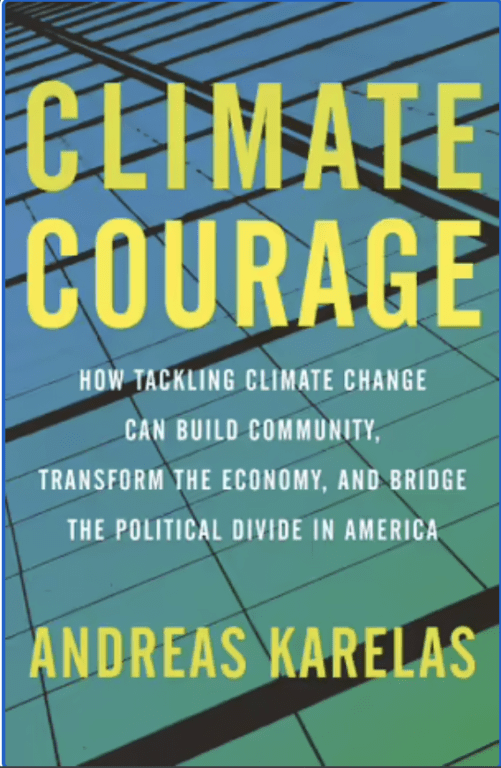 I’ve read quite a few books about climate change over the past year, but I want to share some highlights from one book in particular. It’s titled Climate Courage: How Tackling Climate Change Can Build Community, Transform the Economy, and Bridge the Political Divide in America by Andreas Karelas, who is the executive director of RE-volv, a nonprofit organization that promotes a shift toward clean energy.
The basic gist of our situation, as summarized by one climate scientist is as follows:
- It’s warming.
- It’s us.
- We’re sure.
- It’s bad.
- But! We can fix it. (Nicholas 4)
Now, the extent to which we can “fix” the damage already done is subject to debate, but we likely can agree that we should do as much as possible to avoid making the situation worse. To quote Kate Marvel, another climate scientist: “‘Climate change isn’t a cliff we fall off, but a slope we slide down.’ There is no bottom to the slope; we will keep sliding until we put on the carbon brakes. Every inch of the slide we don’t cede is a victory” (Nicholas 101).
The reason I wanted to focus on Karelas’s book in particular is that he has a framework worth considering about how we can best motivate ourselves to put on the carbon brakes. He underscores that even though the situation is dire, despair is not enough: “Despair cannot power the long-term sustained action we need to address climate change and build a better world. Instead, it overwhelms us with fear and anxiety.” Instead, he emphasizes that, “to break through this stalemate we’re in, we need courage and hope, not discouragement and fear” (xi).
What does that mean specifically? Karelas points us to the potential for increasing numbers of people to come to see climate change as at least as much of an opportunity as it is a challenge—an opportunity to move even more rapidly than we already are toward a “zero emission, renewable energy-based economy.” The additional good news is that in many ways a green economy will “dramatically improve our lives, our communities, and our society” (1).
Many of us in progressive circles have been ready for a Green New Deal for a long time. Some of you reading this post may have been ready since the first Earth Day, more than fifty years ago in 1970—or perhaps even before that. Others of you may have been ready since you first saw Al Gore’s documentary, An Inconvenient Truth, more than fifteen years ago in 2006. Unfortunately at both those points too many people weren’t yet ready to listen, complicated by cynical bad faith actors intentionally spreading misinformation (4). But in more recent years climate activism has become a bigger and bigger tent: the pope and a growing number of other theologically conservative religious leaders are “calling for climate action based on spiritual teachings, the Department of Defense lists climate change as a top security threat, and the clean energy economy boasts the fastest growing job sector in the U.S. economy” (5).
The even bigger elephant in the room is that whether any specific person or group likes it or not, our current fossil fuel-based society cannot continue. It’s “destabilizing our climate and destroying our ecosystems, not to mention that there’s only a limited supply left. Our…disposable, consumptive, throw-away economy, which turns the earth’s resources into waste at increasing rates, cannot be sustained” (8-9).
Along these lines, many of you likely saw the recent headlines that after more than a decade of climate activism against the Keystone XL pipeline, the project was officially ended (The Washington Post). That’s great news, but it is also too long in coming. Fossil fuel companies, U.S. government officials, and environmental scientists have known for more than fifty years—since at least the 1960s—that our use of fossil fuels has been creating an existential threat through “melting ice caps, rising sea levels, acidification of water sources…and significant changes in temperature,” but we’ve squandered the past few decades with far too much avoidance and denial (43).
As George Marshall wrote about in his important book Don’t Even Think About It: Why Our Brains Are Wired to Ignore Climate Change, climate change is tragically easy for we humans to ignore because it is “abstract, distant, invisible, and disputed,” and we have evolved to focus on things that are “concrete, immediate, and indisputable—for instance, a car out of control driving right at you” (14). But the growing frequency of extreme weather events caused by climate change is feeling more and more like a car out of control driving right at us on a disturbingly regular basis. People are noticing and growing concerned that extreme weather—previously described as “once-in-a-century” events—are becoming “once-in-a-mortgage” problems, and they want to do something about it (Holthaus 96).
There are lots of statistics that illustrate this growing shift in awareness, but I’ll limit myself to two representative ones (Karelas 49-52). First, among U.S. citizens, “73 percent now believe global warming is happening and 62 percent correctly understand that it’s caused by humans” (16). And while we can wish those numbers were even higher, I’m grateful to see them well over 50%. And even more important from the perspective of shifting toward a green economy:
A large majority of registered voters (85%)—including 95% of Democrats and 71% of Republicans—support requiring utilities in their state to produce 100% of their electricity from clean-renewable sources by 2050. Nearly two in three conservative Republicans (64%) support this policy. (52)
It is very good news that 85 percent of registered voters support the shift to a zero emission, renewable energy-based economy.
What might that mean specifically? According to a team at Stanford University, in the United States one likely energy formula is:
- 50% Wind (both on-shore and off-shore)
- 45% Solar
- 5% Water (including hydro, geothermal, wave, & tidal)
The percentages would differ from state to state, but those are the overall averages. This model also “doesn’t include any nuclear power, carbon capture and sequestration, or biofuels,” which other potential models do use (74).
So how do we motivate ourselves to make this dream of a green economy into reality by 2050? Speaking for myself, I’ll readily confess that I have learned a lot from the more fear-based response to climate change, such as David Wallace-Wells’s powerful book The Uninhabitable Earth that we’ve explored in a previous post. But my main takeaway from Karelas’s book Climate Courage is that an arguably more effective strategy to reach the most people may be to emphasize the positive (22). We need to harness the same spirit that allowed us to launch the Apollo program which achieved the monumental feat of landing a human being on the moon (Holthaus 96).
There is no guarantee that we will succeed as a species in mitigating climate change, but Karelas highlights many reasons to be hopeful. And to me—as I know is also true for many of you—this proposition is not abstract. I’m forty-three years old. (You can each adjust what I’m about to say to for your situation.) If I’m fortunate to have at least an average life expectancy and live into my mid-80s, I’ll hopefully live at least until the mid-2060s to existentially experience what we have or haven’t achieved in regard to climate justice. I want to look back and be able to say that I did all I could to ensure this planet has stabilized its climate at no more than approximately 1.5° C warmer than the one our ancestors occupied. And regardless of our individual ages, most of us have people we deeply care about who will likely live into the late twenty-first century or even into the twenty-second century (Nicholas 247). I feel led to do all I can to allow future generations to inherit a planet as beautiful and full of life as the one I inherited.
But, of course, this movement is about so much more than me. As many of you have heard me say before, the most important advice I can give you if you are feeling overwhelmed as one person trying to take on huge, systemic issues like climate change—or any of the related social or economic justice issues—is to “stop being one person” (Moore 292). Join a network of climate activists. We are stronger together.
The Rev. Dr. Carl Gregg is a certified spiritual director, a D.Min. graduate of San Francisco Theological Seminary, and the minister of the Unitarian Universalist Congregation of Frederick, Maryland. Follow him on Facebook (facebook.com/carlgregg) and Twitter (@carlgregg).
Learn more about Unitarian Universalism: http://www.uua.org/beliefs/principles
Next Post

July 6, 2021 "Imagine There's No Countries”: Interdependence Day & Immigration Justice
Browse Our Archives
Select a Category Advent Anti-Racism Archaeology Atheism Baptism Best of the Year List Book Reviews Buddhism Catholicism Christian Education Church and State Church Planting Climate Change Conscientious Objection to War Creation Spirituality Death Penalty Didache Disability Rights Discernment Easter Ecology Emergent Church Movement Empire-Critical Ethics Evolution Feminist Theology Film Reviews Gandhi Gospel of Mark Gun Control Hinduism Immigration Reform Interfaith Islam JFK Judaism Jungian Spirituality Lectionary Commentary Lent Letters to the Editor LGBT Marriage MLK Multiculturalism Mysticism Nonviolent Activism Occupy Paganism (Earth-centered Religions) Parables Paul Pluralism Politics Process Theology Quantum Physics Requiescat In Pace Seminary and Divinity School Sermon Series Retrospective Sermons Spiritual Direction Spiritual Practices Stewardship (Fundraising) The Book of J The Wheel of the Year (Paganism) Theoblogger Challenge Triathlon Uncategorized Unitarian Universalism Worship Resources Youth Ministry
Select a Month July 2026 May 2026 March 2026 November 2025 October 2025 August 2025 February 2025 December 2024 October 2024 March 2024 January 2024 December 2023 November 2023 March 2023 February 2023 January 2023 December 2022 November 2022 August 2022 March 2022 February 2022 January 2022 December 2021 September 2021 August 2021 July 2021 June 2021 May 2021 February 2021 January 2021 December 2020 August 2020 June 2020 May 2020 April 2020 March 2020 February 2020 January 2020 December 2019 November 2019 October 2019 September 2019 July 2019 June 2019 March 2019 February 2019 January 2019 December 2018 November 2018 October 2018 September 2018 June 2018 May 2018 April 2018 March 2018 February 2018 January 2018 December 2017 November 2017 October 2017 September 2017 August 2017 July 2017 June 2017 May 2017 April 2017 March 2017 February 2017 January 2017 December 2016 November 2016 October 2016 September 2016 August 2016 June 2016 May 2016 April 2016 March 2016 February 2016 January 2016 December 2015 November 2015 October 2015 September 2015 August 2015 July 2015 June 2015 May 2015 April 2015 March 2015 February 2015 January 2015 December 2014 November 2014 October 2014 August 2014 July 2014 June 2014 May 2014 April 2014 March 2014 February 2014 January 2014 December 2013 November 2013 October 2013 September 2013 August 2013 July 2013 June 2013 May 2013 April 2013 March 2013 February 2013 January 2013 December 2012 November 2012 October 2012 September 2012 August 2012 July 2012 June 2012 May 2012 April 2012 March 2012 February 2012 January 2012 December 2011 November 2011 October 2011 September 2011 August 2011 July 2011 June 2011 May 2011 April 2011 March 2011 February 2011 January 2011 December 2010 November 2010 October 2010 August 2009 July 2009 May 2009
Follow Us!
TAKE THE
Religious Wisdom Quiz
Who interpreted dreams for a Persian king about goats and rams?
Select your answer to see how you score.
Daniel Hosea Obadiah Joel
Related posts from Carl Gregg

Reading America at 250: A Nation Wrestles With...


Andrew Holocek on the Power of Darkness

The Stories That Shape Us: Myths, Archetypes, &...
TRENDING AT PATHEOS More Voices

Reading America at 250: A Nation Wrestles With...
As part of my own reflection on the 250th anniversary of the...

Whenever I am reading a book or listening to an argument, I...

President Trump Ban Animal Torture Videos on Facebook
Call for Stricter Regulations of Animal Abuse Content on Facebook Although President...

Draft Amendments to Address Ritual Abuse in New...
The proposed changes would make it illegal for individuals in domestic partnerships...

How Bans on LGBTQ+ Student Clubs Threaten Religious...
On June 20, 2025, the State of Texas passed Senate Bill 12....

The Truth About the Gen Z Revival
This past year, there has been a lot of media buzz surrounding...
view all More Voices blogs
Ad-Free & Subscriber Log-In Subscription Support
- About Us
- 2026 Calendar
- Videos
- Podcasts
- Library of World Religions
- Faith In Media Tracker
- Advertise With Us
- Write for Us
- Privacy Policy
- Terms of Service
- Do Not Sell My Data
- Contact Us
- Radiant Digital
- Manage Newsletter Subscriptions
- Unsubscribe From Notifications
- Sitemap
Copyright 2008-2026, Patheos. All rights reserved.
Subscription Support Ad-Free & Subscriber Log-In
Follow Patheos