
BuddhistCatholicContemplativeEvangelicalGeneral ChristianHinduJewishLatter-day SaintMuslimNew VisionsProgressive Christian
Beliefs
- Buddhist
- Catholic
- Contemplative
- Evangelical
- General Christian
- Hindu
- Jewish
- Latter-day Saint
- More Voices
- Muslim
- New Visions
- Pagan
- Progressive Christian
Topics
- Religion News
- Food and Religion
- Sports and Religion
- Religious Art
- Religious Music and Entertainment
- Religious Events
- History and Religion
- Style and Religion
- Politics and Religion
- Women in Religion
- Recreation Outdoors and Religion
- Business Finance and Religion
- Careers Workplace and Religion
- Education and Religion
- Family Parenting and Religion
- Health Fitness and Religion
- Home and Religion
- Relationships and Religion
- Technology and Religion
- Travel and Religion
Columnists
- Buddhist Columnists
- Business Finance and Religion Columnists
- Careers Workplace and Religion Columnists
- Catholic Columnists
- Contemplative Columnists
- Education and Religion Columnists
- Evangelists Columnists
- Family Parenting and Religion Columnists
- General Christian Columnists
- Health Fitness and Religion Columnists
- Hindu Columnists
- History and Religion Columnists
- Home and Religion Columnists
- Jewish Columnists
- More Voices Columnists
- Latter Day Columnists
- Muslim Columnists
- New Visions Columnists
- Nonreligious Columnists
- Pagan Columnists
- Politics and Religion Columnists
- Progressive Columnists
- Recreation Outdoors and Religion Columnists
- Relationships and Religion Columnists
- Religion News Columnists
- Religious Art Columnists
- Religious Events Columnists
- Religious Music and Entertainment Columnists
- Sports and Religion Columnists
- Style and Religion Columnists
- Technology and Religion Columnists
- Travel and Religion Columnists
- Women in Religion Columnists
Resource Library
- 2026 Calendar
- Library of World Religions
- The 100 Most Holy Places on Earth
- Patheos Answers
- Podcasts
- Videos
- Faith Leaders Database
- Anglican Episcopalian
- Bahai
- Baptist
- Buddhism
- Christianity
- Confucianism
- Eastern Orthodoxy
- Hinduism
- Holiness and Pentecostal
- ISKCON
- Islam
- Judaism
- Lutheran
- Methodist
- The Church of Jesus Christ of Latter-day Saints
- New Age
- Paganism
- Presbytarian and Reformed
- Protestantism
- Religion Behind the Scenes
- Roman Catholic
- Scientology
- Shia Islam
- Sikhism
- Sufism
- Sunni Islam
- Taoism
- Zen
- See all religions
Research Tools
 Ad-Free & Subscriber Log-In Subscription Support
Ad-Free & Subscriber Log-In Subscription Support
Follow Patheos 

- Trending:
- Forgiveness
- |
- Marriage
- |
- Consciousness
- |
- Death Penalty
- |
- Election
- |
- Halloween

- Home
- More Voices
- How to Find Meaning in Life
How to Find Meaning in Life
Last updated on: January 5, 2021 at 11:08 am by Carl Gregg
How to Find Meaning in Life 2021-01-05T11:08:53-05:00 Carl Gregg
Patheos Explore the world's faith through different perspectives on religion and spirituality! Patheos has the views of the prevalent religions and spiritualities of the world.
The year 2021 has finally arrived! And the beginning of a new year is traditionally a time for reflection on the year that has passed, reevaluation of one’s life from this new perspective, and recommitment in the form of new year’s resolutions.
This time of discernment, which supports our making thoughtful choices about how best to move forward with our lives, reminds me of Robert Frost’s (1874 – 1963) most famous—and also most widely misunderstood—poem, “The Road Not Taken.” This is a fairly old poem, first published more than a century ago, and I would like to invite us to spend a few minutes exploring how Frost might have intended this poem to be interpreted, and how that intended meaning might be of help to us here at the beginning of 2021.
One of the problems with how this poem has come to be read is that the final three lines are often quoted in isolation.
Two roads diverged in a wood, and I—
I took the one less traveled by,
And that has made all the difference.
These lines have often been understood as a recommendation to take the so-called “road less traveled,” which interpretation can lead—at a turning point in life—to a lot of anxiety before the choice: What if I choose the wrong path?
And after the choice has been made, it can also lead to a lot of self-criticism: beating yourself up for not choosing the other, better path that allegedly would have “made all the difference.”
But here’s the interesting thing: all that sort of anxiety, self-criticism, and worry about choosing precisely the right path (as if a single “one correct path”—whether for oneself or for everyone—even exists) was what Frost wanted to minimize with his poem, rather than invoke. To say more, let me give you give you a few key pieces of context, drawing from Katherine Robinson’s guide to this poem.
First, “The Road Not Taken” was originally published in 1916 as a preface to his collection of poetry titled Mountain Interval, which means it was written and published in the middle of World War I, which spanned from 1914 to 1918.
The poem was also probably written specifically about Frost’s experiences of walking in the woods with his friend and fellow poet Edward Thomas (1878 – 1917), who had published a poem the year before titled “Roads.” I’ll give you just a few excerpts of this longer poem:
I love roads…
Roads go on
While we forget, and are
Forgotten like a star
That shoots and is gone….
Now all roads lead to France
And heavy is the tread
Of the living; but the dead
Returning lightly dance:
Whatever the road bring
To me or take from me,
They keep me company
With their pattering,
Frost likely would have had Thomas’ poem “Roads” in mind when he wrote “The Road Not Taken” for Thomas.
Even more specifically, Frost might have had in mind the many times that he and Thomas had taken long walks together, because at the end of each walk, Thomas would almost invariably lament that it would have been better had they taken different forks that day than the ones they chose, since perhaps that different route would have led to more interesting views, better animal sightings, etc. But as Frost once wrote in a letter to Thomas, the somewhat harsh truth was that, “No matter which road you take, you’ll always sigh, and wish you’d taken another” (Robinson). Frost was taking the risk of dropping some truth-bombs on his friend.
That quote perhaps reveals one of Frost’s motivations in writing his famous poem, but you don’t have to know this background if you read the poem closely. Although there is a lot more to say about this poem, I’ll limit myself for now to three clues that can aid in interpreting the poem. I’m also glad to stipulate that there are many possible interpretations of this (or any) poem, and that discerning “authorial intent” is always tricky on multiple levels, but there are also a few interesting points about this poem that are often missed.
The first clue is the title. Many people misremember the title as “The Road Less Travelled,” which is the title of psychologist Scott Peck’s excellent book inspired by the concluding lines of Frost’s poem. But Frost chose the much more haunting title “The Road Not Taken,” putting the focus on alternative, less-conventional alternative choices. The typical interpretation of this poem would make more sense if the title were “The Road Less Traveled” or “The Choices That Make All the Difference.”
But some critics nowadays interpret the title “The Road Not Taken” as a direct gibe at his friend Edward Thomas’s self-undermining habit that, “No matter which road you take, you’ll always sigh, and wish you’d taken another.” Frost might have been trying to hold up a mirror for his friend to notice that his “grass is always greener” attitude was making him miserable no matter what choices he made.
A second intriguing clue comes in the middle, with a number of references as to how both roads finally seemed to the protagonist to be essentially the same:
- At the beginning of the second stanza, we read that the other path was “just as fair.”
- And although the protagonist of the poem tries to determine which path fewer people had chosen, there is an admission at the end of that second stanza that “passing there… had worn them really about the same.”
- Then the third stanza observes that the two paths “both that morning equally lay / In leaves no step had trodden black.”
- And despite all those similarities—and there being no apparent major differences between the two paths—the protagonist says with a sigh in the final stanza:
I shall be telling this with a sigh
Somewhere ages and ages hence:
Two roads diverged in a wood, and I—
I took the one less traveled by,
And that has made all the difference.
Notice the word “sigh” in the first line of the quoted stanza, which is so often left out when the conclusion of this poem is quoted in isolation. That sigh may indicate that the final segment is said with resignation not celebration.
A third and final clue comes at the end with the poem’s final word difference. Interestingly, “made all the difference” doesn’t specify better or worse. Especially when you notice that sigh at the beginning of the final stanza, it could even be that choosing “the road less traveled” made all the difference in missing out on what all the people got to see on the road more traveled by (Robinson).
Now, let me hasten to add that if these aspects of Frost’s poem did not occur to you previously, you are not alone. The first time I heard about it was when I was watching Dead Poet’s Society in college, during the scene when Robin Williams’ character quotes Robert Frost. One of my roommates (who was an English major) said, “You know that Frost meant that line ironically.” I wasn’t sure what he was even talking about at first, but when I started doing a little research, I quickly discovered that he was exactly right.
That being said, there’s a venerable tradition of missing the point that goes back to Frost reading the poem to a group of college students prior to its publication, when he realized that the poem had been “taken pretty seriously … despite doing my best to make it obvious by my manner that I was fooling.” Indeed, literary critic David Orr has called this poem “close to being reader-proof” given the decades of readers who have misunderstood it (Robinson).
The most poignant misreading, however, was by Edward Thomas, the walking partner and fellow poet for whom Robert Frost had written the poem. As was Thomas’s wont (given his indecisiveness) he had been struggling with whether to enlist as a soldier in World War I. Receiving Frost’s poem in the mail was the final piece—among a constellation of factors—that made up his mind to enlist in a regiment of the British Army Reserve. Tragically “He was killed on the first day of the battle of Arras, Easter 1917; he had survived little more than two months in France” (Hollis). He was only thirty-nine years old.
That real-life ending to “The Road Not Traveled” is a reminder that the takeaway from this poem is certainly not that our choices don’t matter. Yes, our choices can sometimes make all the difference. Sometimes we’re in a toxic environment, and the grass really might be greener somewhere else. At other times, there is an issue we need to work out; otherwise, we’ll just keep replicating the same dynamics wherever we go. As Frost said to his friend: “No matter which road you take, you’ll always sigh, and wish you’d taken another.”
So even though there are a thousand inspirational posters that deceptively quote the concluding lines of this poem, I hope that exploring reminds us of its original intention: poking fun at our laughable attempts to create tolerable narratives around remembered events, and a gently chiding invitation to stop always telling the story of our choices with a sigh.
Again, don’t get me wrong: there is value in learning from our past, including our mistakes or missteps. But the spirit of “The Road Not Traveled” has encouraged us to turn down the volume on our regrets. As Lily Tomlin once said,”Forgiveness means giving up all hope for a better past.” And that includes forgiving ourselves.
And here we find ourselves: a few days into the beginning of a new year. We can’t change 2020 and all that came before. But which roads will we choose in this new year? What if we were to experiment with turning down the volume on the anxiety to make precisely the right choice (as if there were any such thing as “the one right choice!”) and turn up the volume on self-compassion, on being kinder to ourselves?
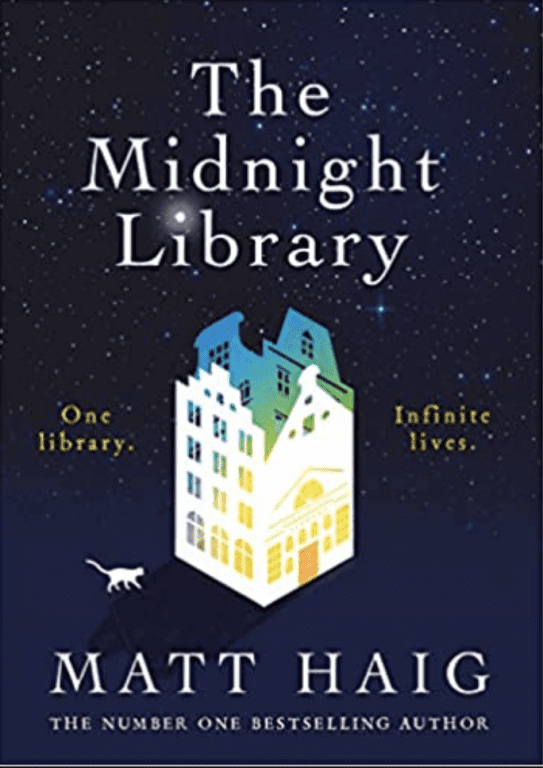 For those of you interested in going deeper, let me highlight two books in particular that could be fruitful reading here at the beginning of 2021—in the spirit of “Choose Your Own Adventure.” If you prefer fiction, I recommend Matt Haig’s recent novel The Midnight Library, which I learned about from my wife Magin, who read it first and passed it along to me. If you prefer nonfiction, I recommend Finnish philosopher Frank Martela’s accessible and beautifully designed book A Wonderful Life: Insights on Finding a Meaningful Existence. I’ll share a little about each in turn.
Since Haig’s novel has only been out a little more than three months, I don’t want to spoil this book for those who may be interested in reading it, so I will only share the opening epigraph to give you a taste of what the book is about:
Between life and death there is a library.… And within that library the shelves go on for ever. Every book provide a chance to try another life you could have lived. To see how things would be if you had made other choices…. Would you have done anything different, if you have the chance to undo your regrets?
Now, I would love to go in depth about this book, but suffice it to say that it can be read as a fascinating fictionalized exploration of “The Road Not Taken.” What if we experimented with learning to tell the story of ourselves with less of a sigh? (Do you know that Brene Brown quote, where she sometimes starts by saying, “The story I’m telling myself about (blank) is….” That invites you to notice that there are multiple possible perspectives and frameworks from which to tell all the stories about yourself and others. And things might change if you learned to tell your stories differently.)
It is also true that much of life is outside of our control, and there is no way of knowing in advance all the consequences of our choices. We can only choose our choice, then live it to the best of our ability.
And if you might prefer to explore these themes from a nonfiction angle, you might appreciate Martela’s recent book. There are lots of fun and interesting aspects of his writing, but for now I’ll limit myself to one point that strongly resonates with the points we’ve been exploring from Robert Frost’s poem. In the same way the protagonist of Frost’s “The Road Not Traveled” keeps getting stuck in indecision about how to choose between two paths that are not really very different from one another, some folks can really get stuck in trying to figure out the one true “Meaning of Life.”
For instance, here’s a quote from philosopher Søren Kierkegaard along those lines from his 1843 book Repetition, a quote that is both hilarious and profound:
“How did I get into the world? Why was I not asked about it and why was I not informed of the rules and regulations but just thrust into the ranks …? How did I get involved in this big enterprise called actuality? Why should I be involved? Isn’t it a matter of choice? And if I am compelled to be involved, where is the manager—I have something to say about this. Is there no manager? To whom shall I make my complaint?” (6-7)
Have you ever felt like that?
You didn’t ask to find yourself going through the world, forced to choose which path to take, You didn’t ask to be in a world in which the past year was hijacked by a global pandemic. Yet here we are, and it’s very much unclear that there is any manager—or that even if there is, that filing a complaint would make any difference!
So what are we to do? One playful suggestion from Martela that can be quite helpful is to experiment with letting go of a need to find one true “meaning of life,” and instead seek “meaning in life” (91). It’s a small change, a single preposition, but it can make a big difference. What are the people, places, and practices that most consistently make your life feel meaningful? That make you feel grateful, more fully alive, more energized, more connected to yourself, others, and the world?
Any general, universal “meaning of life” would necessarily come from the outside, which in any case is well above any of our pay grades. And as astrophysicist Neil deGrasse Tyson has said, ‘The Universe is under no obligation to make sense to you.” A much more down-to-earth and accessible approach is to notice the ways that we can make meaning in our lives—and in the world. That kind of meaning can look like so many different things, depending on our passions and proclivities. Perhaps you find meaning in your work, in volunteering, hobbies, family, or friends. Perhaps It’s all about choosing the people, places, and practices that most consistently make your life feel meaningful—that make you feel grateful, more fully alive, more energized, more connected to yourself, to others, to the world.
The surreal British comedy troupe Monty Python got this point pretty spot on in their film The Meaning of Life. Since that film arrived nearly forty years ago, I don’t feel bad about spoiling one scene. Toward the end of the film, some of you may recall the moment when one of the actors receives a golden envelope, the contents of which purportedly finally reveal the meaning of life.
Upon reading the card, the actor declares it “nothing very special,” then reads aloud the meaning of life phrased in Monty Python’s simple (but also often profound) manner: “Try and be nice to people, avoid eating fat, read a good book every now and then, get some walking in, and try and live together in peace and harmony with people of all creeds and nations.” That sounds a lot like the meaning of life is: making your own meaning in life through the people, places, and practices that you choose (80).
I invite you consider whether there might be a person, place, or habit that has been particular hindrance to your well-being in 2020? To the extent possible for you at this time, s there something that you feel called to let go of or say no to in this new year? (What has been life-negating for you in 2020—a hindrance to your well-being—regularly leaving you feeling drained of energy, alienated, or resentful?)
One traditional practice is to writing down the name of that person, place, or thing on a slip of paper and light it on fire. That act does not necessarily mean that the process of “letting go” is complete, but I invite you to experience that ritual as one step in the process of saying no to a part of your life that has been life-negating for you.
A related new year’s spiritual practice is to light a candle to set an intention for a person, place, or habit that you want to affirm, do or say yes to in the new year. (What has regularly left you feeling energized, connected, grateful, and more fully alive?)
It doesn’t have to be anything huge. Indeed, small changes can sometimes make a big difference. And as inspiration, in the wake of this very hard year—and amidst a pandemic in which we are only nearing the beginning of the end–consider some of these “Gentle Goals for a New Year.”
The Rev. Dr. Carl Gregg is a certified spiritual director, a D.Min. graduate of San Francisco Theological Seminary, and the minister of the Unitarian Universalist Congregation of Frederick, Maryland. Follow him on Facebook (facebook.com/carlgregg) and Twitter (@carlgregg).
Learn more about Unitarian Universalism: http://www.uua.org/beliefs/principles
Previous Post

December 30, 2020
Top 10 Best Books Read in 2020
Browse Our Archives
Select a Category Advent Anti-Racism Archaeology Atheism Baptism Best of the Year List Book Reviews Buddhism Catholicism Christian Education Church and State Church Planting Climate Change Conscientious Objection to War Creation Spirituality Death Penalty Didache Disability Rights Discernment Easter Ecology Emergent Church Movement Empire-Critical Ethics Evolution Feminist Theology Film Reviews Gandhi Gospel of Mark Gun Control Hinduism Immigration Reform Interfaith Islam JFK Judaism Jungian Spirituality Lectionary Commentary Lent Letters to the Editor LGBT Marriage MLK Multiculturalism Mysticism Nonviolent Activism Occupy Paganism (Earth-centered Religions) Parables Paul Pluralism Politics Process Theology Quantum Physics Requiescat In Pace Seminary and Divinity School Sermon Series Retrospective Sermons Spiritual Direction Spiritual Practices Stewardship (Fundraising) The Book of J The Wheel of the Year (Paganism) Theoblogger Challenge Triathlon Uncategorized Unitarian Universalism Worship Resources Youth Ministry
Select a Month July 2026 May 2026 March 2026 November 2025 October 2025 August 2025 February 2025 December 2024 October 2024 March 2024 January 2024 December 2023 November 2023 March 2023 February 2023 January 2023 December 2022 November 2022 August 2022 March 2022 February 2022 January 2022 December 2021 September 2021 August 2021 July 2021 June 2021 May 2021 February 2021 January 2021 December 2020 August 2020 June 2020 May 2020 April 2020 March 2020 February 2020 January 2020 December 2019 November 2019 October 2019 September 2019 July 2019 June 2019 March 2019 February 2019 January 2019 December 2018 November 2018 October 2018 September 2018 June 2018 May 2018 April 2018 March 2018 February 2018 January 2018 December 2017 November 2017 October 2017 September 2017 August 2017 July 2017 June 2017 May 2017 April 2017 March 2017 February 2017 January 2017 December 2016 November 2016 October 2016 September 2016 August 2016 June 2016 May 2016 April 2016 March 2016 February 2016 January 2016 December 2015 November 2015 October 2015 September 2015 August 2015 July 2015 June 2015 May 2015 April 2015 March 2015 February 2015 January 2015 December 2014 November 2014 October 2014 August 2014 July 2014 June 2014 May 2014 April 2014 March 2014 February 2014 January 2014 December 2013 November 2013 October 2013 September 2013 August 2013 July 2013 June 2013 May 2013 April 2013 March 2013 February 2013 January 2013 December 2012 November 2012 October 2012 September 2012 August 2012 July 2012 June 2012 May 2012 April 2012 March 2012 February 2012 January 2012 December 2011 November 2011 October 2011 September 2011 August 2011 July 2011 June 2011 May 2011 April 2011 March 2011 February 2011 January 2011 December 2010 November 2010 October 2010 August 2009 July 2009 May 2009
Follow Us!
TAKE THE
Religious Wisdom Quiz
Who predicted the birth of John the Baptist?
Select your answer to see how you score.
Uriel Raphael Michael Gabriel
Related posts from Carl Gregg

Reading America at 250: A Nation Wrestles With...


Andrew Holocek on the Power of Darkness

The Stories That Shape Us: Myths, Archetypes, &...
TRENDING AT PATHEOS More Voices

Reading America at 250: A Nation Wrestles With...
As part of my own reflection on the 250th anniversary of the...

Whenever I am reading a book or listening to an argument, I...

President Trump Ban Animal Torture Videos on Facebook
Call for Stricter Regulations of Animal Abuse Content on Facebook Although President...

Draft Amendments to Address Ritual Abuse in New...
The proposed changes would make it illegal for individuals in domestic partnerships...

How Bans on LGBTQ+ Student Clubs Threaten Religious...
On June 20, 2025, the State of Texas passed Senate Bill 12....

The Truth About the Gen Z Revival
This past year, there has been a lot of media buzz surrounding...
view all More Voices blogs
Ad-Free & Subscriber Log-In Subscription Support
- About Us
- 2026 Calendar
- Videos
- Podcasts
- Library of World Religions
- Faith In Media Tracker
- Advertise With Us
- Write for Us
- Privacy Policy
- Terms of Service
- Do Not Sell My Data
- Contact Us
- Radiant Digital
- Manage Newsletter Subscriptions
- Unsubscribe From Notifications
- Sitemap
Copyright 2008-2026, Patheos. All rights reserved.
Subscription Support Ad-Free & Subscriber Log-In
Follow Patheos