
BuddhistCatholicContemplativeEvangelicalGeneral ChristianHinduJewishLatter-day SaintMuslimNew VisionsProgressive Christian
Beliefs
- Buddhist
- Catholic
- Contemplative
- Evangelical
- General Christian
- Hindu
- Jewish
- Latter-day Saint
- More Voices
- Muslim
- New Visions
- Pagan
- Progressive Christian
Topics
- Religion News
- Food and Religion
- Sports and Religion
- Religious Art
- Religious Music and Entertainment
- Religious Events
- History and Religion
- Style and Religion
- Politics and Religion
- Women in Religion
- Recreation Outdoors and Religion
- Business Finance and Religion
- Careers Workplace and Religion
- Education and Religion
- Family Parenting and Religion
- Health Fitness and Religion
- Home and Religion
- Relationships and Religion
- Technology and Religion
- Travel and Religion
Columnists
- Buddhist Columnists
- Business Finance and Religion Columnists
- Careers Workplace and Religion Columnists
- Catholic Columnists
- Contemplative Columnists
- Education and Religion Columnists
- Evangelists Columnists
- Family Parenting and Religion Columnists
- General Christian Columnists
- Health Fitness and Religion Columnists
- Hindu Columnists
- History and Religion Columnists
- Home and Religion Columnists
- Jewish Columnists
- More Voices Columnists
- Latter Day Columnists
- Muslim Columnists
- New Visions Columnists
- Nonreligious Columnists
- Pagan Columnists
- Politics and Religion Columnists
- Progressive Columnists
- Recreation Outdoors and Religion Columnists
- Relationships and Religion Columnists
- Religion News Columnists
- Religious Art Columnists
- Religious Events Columnists
- Religious Music and Entertainment Columnists
- Sports and Religion Columnists
- Style and Religion Columnists
- Technology and Religion Columnists
- Travel and Religion Columnists
- Women in Religion Columnists
Resource Library
- 2026 Calendar
- Library of World Religions
- The 100 Most Holy Places on Earth
- Patheos Answers
- Podcasts
- Videos
- Faith Leaders Database
- Anglican Episcopalian
- Bahai
- Baptist
- Buddhism
- Christianity
- Confucianism
- Eastern Orthodoxy
- Hinduism
- Holiness and Pentecostal
- ISKCON
- Islam
- Judaism
- Lutheran
- Methodist
- The Church of Jesus Christ of Latter-day Saints
- New Age
- Paganism
- Presbytarian and Reformed
- Protestantism
- Religion Behind the Scenes
- Roman Catholic
- Scientology
- Shia Islam
- Sikhism
- Sufism
- Sunni Islam
- Taoism
- Zen
- See all religions
Research Tools
 Ad-Free & Subscriber Log-In Subscription Support
Ad-Free & Subscriber Log-In Subscription Support
Follow Patheos 

- Trending:
- Forgiveness
- |
- Marriage
- |
- Consciousness
- |
- Death Penalty
- |
- Election
- |
- Halloween

- Home
- More Voices
- Living the Entangled Life: World-Changing Insights from Mushrooms & Mycelium
Living the Entangled Life: World-Changing Insights from Mushrooms & Mycelium
Last updated on: December 16, 2020 at 12:29 pm by Carl Gregg
Living the Entangled Life: World-Changing Insights from Mushrooms & Mycelium 2020-12-16T12:29:23-05:00 Carl Gregg
Patheos Explore the world's faith through different perspectives on religion and spirituality! Patheos has the views of the prevalent religions and spiritualities of the world.
Two years ago I wrote a post inspired by ecologist Peter Wolleben’s The Hidden Life of Trees. It’s one of those remarkable books that can significantly shift the way you experience the world. There is so much more happening with trees than is often apparent from our human point of view. In particular, there is growing scientific evidence that trees communicate with one another, share resources, and have intricate relationships with other trees in what is sometimes called the “wood wide web.”
If you don’t have time to read the book, The New York Times recently published a major article titled “The Social Life of Forests”. Note the subtitle: “Trees appear to communicate and cooperate through subterranean networks of fungi.” I want to pick up on that fungi piece: it turns out that fungi are fascinating and critical factors in facilitating the exchange of information and nutrients at the heart of nature’s social network, the “wood wide web.”
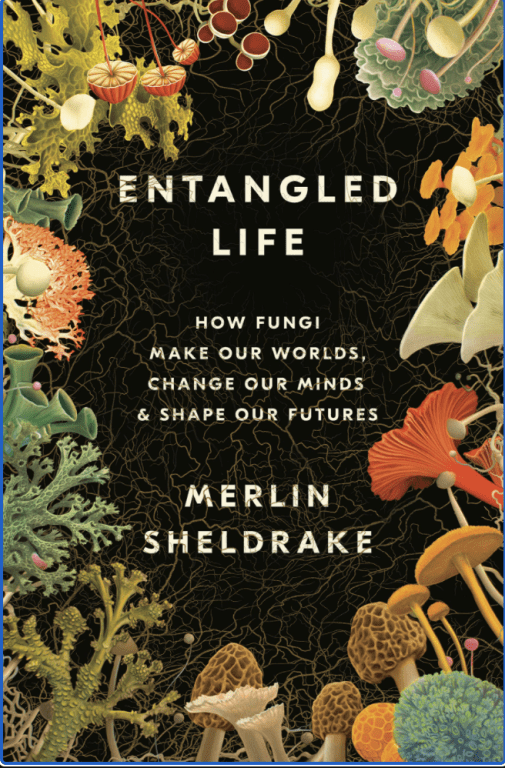 And although I would still recommend The Hidden Life of Trees as the best and most accessible starting point for learning more (especially the new illustrated and condensed version), Wolleben, as a forester, understandably focuses on the tree side of the equation. And what inspired me to pick this topic back up again is a great new book titled Entangled Life; How Fungi Make Our Worlds, Change Our Minds, and Shape Our Futures from the mycologist (the fungi expert) Merlin Sheldrake, who focuses on the equally interesting fungus part in the social network of forests.
He’s an interesting and quirky young scientist, and I suspect there is much more to come from him in the future. For instance, here’s a video of him turning form into function by eating the mushrooms growing out of his book about mushrooms (224). That’s some thoroughgoing commitment to your work!
Overall, the more I learn about so many different areas—especially biology and ecology, quantum entanglement in physics, and insights from my personal meditation practice—the clearer it becomes that the Seventh Principle in my chosen tradition of Unitarian Universalism (“Respect for the interdependent web of all existence of which we are a part”) is quite literal. We are so interdependent and connected with one another, with other living beings, and with the ecosystems of this planet on which we find ourselves.
Our growing awareness of the relationship between plants and fungi in the social life of forests is only the latest example of that classic line from John Muir from his book My First Summer in the Sierra: “When we try to pick out anything by itself we find it hitched to everything else in the universe” (110). I love that, and the deeper you live out of a felt sense of the interdependent web, the more that perspective shifts how you are in the world.
For now, the part that we are picking up—and finding it hitched to everything else—is fungus, and we are only at the tip of the iceberg of what there is to discover about the fantastical and fascinating world of fungi—which includes both mushrooms (the above-ground, fruiting body) and mycelium (the underground, branching, connecting, networking threads).
For instance, primatologist Jane Goodall told the mycology expert Paul Stamets the following in 2013 as she was learning more about the “wood wide web” and the potential breakthroughs in multiple areas from studying fungi: “Don’t stop. You’re with fungi where I was with the chimps when I started” (Stamets 42).
To say more about what that means, “The best estimates suggest that there are between 2.2 and 3.8 million species of fungi in the world—six to ten times the estimated number of plant species—meaning that a mere six percent of all fungal species have been described” (Sheldrake 10). In other words, more than ninety percent of fungi species remain undocumented. But we also know that, “More than ninety percent of plants depend on mycorrhizal fungi” in those underground shared networks of the “wood wide web” (4). So even as there are huge amounts still to learn about fungi, it is already the case that, “The more we learn about fungi, the less makes sense without them” (3).
Indeed, fungus turns out to be an incredibly frequent common denominator among plants, making fungus “a more fundamental part of plants than fruit, flowers, leaves, wood, or even roots” (124). Out of this symbiotic relationship, the fungus gets fed from the energy the plants produce through photosynthesis. In turn, the fungus can scavenge nutrients underground much more thoroughly than the roots of the plant ever could. And oftentimes the fungus connects and allows exchanges between plants through the fungus’s mycelial network (125).
The reality is so interdependent that it seems increasingly inaccurate to say that plants have roots, because that characterizes a plant’s situation as too isolated and independent. It’s much more accurate to say that plants have “fungus-roots”— hyphenated together as one linked word. That’s how interdependent and symbiotic the relationship is. Or you could say that fungi have “myco-rhizas,” —again hyphenating together into one linked word the branching mycelia of fungi and rhizomes growing out horizontally from plant roots (127).
From our human perspective, it is understandable that mushrooms are often the first thing we think of when we think of fungus. They are large, above ground, and fascinating (5). And I love that the Native American language Potawotami includes the word puhpowee, which means “the force which causes mushrooms to push up from the earth overnight” (213).
All right, we’re starting to get toward the end, and there’s so much more to say about the entangled lives of fungi—and how many significant innovations (for our human health care, disease treatment, and many other areas) will likely come from the intensive study of fungi, mushrooms, and mycelium in the years to come. If you are interested in learning more, another good overview is the book Fantastic Fungi by Paul Stamets, which is the summary of a documentary by the same name and creator available for rent on various streaming platforms.
Incidentally, any of my fellow Star Trek nerds out there will recognize that the TV show Star Trek: Discovery took all this fungi research to the next level with tons of mycelium-related themes and technology, including naming a main character and “astromycologist” Paul Stamets in honor of the cutting edge research the real life Paul Stamets is doing in our own present day (197-8).
For now, let me share with you just one more significant aspect. Although fungi do not have brains in the way that we humans typically think of them, numerous peer-reviewed experiments have demonstrated that the mycelium of most species of fungi “actively sense and respond to their surroundings….” The hyphae (the long, branching filamentous parts) have a lot going on. They allow the fungus to “interpret the chemical emissions of others to negotiate a series of complex trading relationships with trees; to knead away at stores of nutrients in the soil; to have sex; to hunt; or to fend off attackers” (41). Moreover, in tests using mazes and blocks of wood, “Mycelium appear to possess a directional memory, although the basis of this memory remains unclear” (47).
The fascinating upshot is that, on the spectrum of sentience or cognition, “intelligent behaviors can arise without brains. A dynamic and responsive network is all that’s needed” (66). As with the hidden life of trees, there’s a lot more going on—a lot of it quite complex—with the entangled life of fungi than seems initially to be the case from our limited human perspectives.
Along these lines, I find it fascinating that one of the things mushrooms have become famous for doing is helping us break down barriers to our understandings of the connections in our own amazing human brains. For instance, here’s a graphic of the “interconnections between networks of [human] brain activity during normal waking consciousness.” Beside it is the brain on Psilocybin—so-called “magic mushrooms.” Note the the tumult of new neuronal pathways that arise. There’s a lot more to say about all that, and if you are curious to learn more, I recommend Michael Pollan’s excellent book, How to Change Your Mind.
As I move toward my conclusion, I’ll say that I think Dr. Sheldrake, the master mycologist, is onto something when he says that, “My exploration of the fungal world has made me reexamine much of what I knew. Evolution, ecosystems, individuality, intelligence, life—none are quite what I thought they were. My hope is that this book loosens some of your certainties, as fungi have loosened mine” (23).
Keeping in mind that hope of loosening our preconceptions, I invite you to read an interesting poem titled “View with a Grain of Sand” by the Polish poet and winner of the Nobel Prize in Literature, Wisława Szymborska. As you read, consider the alternative, non-human views of the world that the hidden lives of trees and the entangled lives of fungus invite us to consider.
Our limited human point of view is not the only way of perceiving the world. So much can begin to open as we consider other angles of perspective inherent in the interdependent web of all existence of which we are inextricably a part.
In that spirit, I want to invite you into a little experiment. Right now in this present moment–in real time– open your heart, mind, and spirit to the interdependent web. Pause and in the silence, open yourself to what is sometimes called “Big Mind – Big Heart.” Don’t overthink what that means. See if you can just do it: open into Big Mind and Big Heart. Take it for a test drive. See what happens. What do you notice?
As Big Mind and Big Heart, there is…
openness,
expansiveness,
warmth,
connection with all living beings.
There is so much room.
May we learn to live out of of a felt sense of the interdependence web of all existence of which we are all a part.
The Rev. Dr. Carl Gregg is a certified spiritual director, a D.Min. graduate of San Francisco Theological Seminary, and the minister of the Unitarian Universalist Congregation of Frederick, Maryland. Follow him on Facebook (facebook.com/carlgregg) and Twitter (@carlgregg).
Learn more about Unitarian Universalism: http://www.uua.org/beliefs/principles
Next Post

December 30, 2020 Top 10 Best Books Read in 2020
Browse Our Archives
Select a Category Advent Anti-Racism Archaeology Atheism Baptism Best of the Year List Book Reviews Buddhism Catholicism Christian Education Church and State Church Planting Climate Change Conscientious Objection to War Creation Spirituality Death Penalty Didache Disability Rights Discernment Easter Ecology Emergent Church Movement Empire-Critical Ethics Evolution Feminist Theology Film Reviews Gandhi Gospel of Mark Gun Control Hinduism Immigration Reform Interfaith Islam JFK Judaism Jungian Spirituality Lectionary Commentary Lent Letters to the Editor LGBT Marriage MLK Multiculturalism Mysticism Nonviolent Activism Occupy Paganism (Earth-centered Religions) Parables Paul Pluralism Politics Process Theology Quantum Physics Requiescat In Pace Seminary and Divinity School Sermon Series Retrospective Sermons Spiritual Direction Spiritual Practices Stewardship (Fundraising) The Book of J The Wheel of the Year (Paganism) Theoblogger Challenge Triathlon Uncategorized Unitarian Universalism Worship Resources Youth Ministry
Select a Month July 2026 May 2026 March 2026 November 2025 October 2025 August 2025 February 2025 December 2024 October 2024 March 2024 January 2024 December 2023 November 2023 March 2023 February 2023 January 2023 December 2022 November 2022 August 2022 March 2022 February 2022 January 2022 December 2021 September 2021 August 2021 July 2021 June 2021 May 2021 February 2021 January 2021 December 2020 August 2020 June 2020 May 2020 April 2020 March 2020 February 2020 January 2020 December 2019 November 2019 October 2019 September 2019 July 2019 June 2019 March 2019 February 2019 January 2019 December 2018 November 2018 October 2018 September 2018 June 2018 May 2018 April 2018 March 2018 February 2018 January 2018 December 2017 November 2017 October 2017 September 2017 August 2017 July 2017 June 2017 May 2017 April 2017 March 2017 February 2017 January 2017 December 2016 November 2016 October 2016 September 2016 August 2016 June 2016 May 2016 April 2016 March 2016 February 2016 January 2016 December 2015 November 2015 October 2015 September 2015 August 2015 July 2015 June 2015 May 2015 April 2015 March 2015 February 2015 January 2015 December 2014 November 2014 October 2014 August 2014 July 2014 June 2014 May 2014 April 2014 March 2014 February 2014 January 2014 December 2013 November 2013 October 2013 September 2013 August 2013 July 2013 June 2013 May 2013 April 2013 March 2013 February 2013 January 2013 December 2012 November 2012 October 2012 September 2012 August 2012 July 2012 June 2012 May 2012 April 2012 March 2012 February 2012 January 2012 December 2011 November 2011 October 2011 September 2011 August 2011 July 2011 June 2011 May 2011 April 2011 March 2011 February 2011 January 2011 December 2010 November 2010 October 2010 August 2009 July 2009 May 2009
Follow Us!
TAKE THE
Religious Wisdom Quiz
Who was known for interpreting dreams in Babylon?
Select your answer to see how you score.
Daniel Moses Joseph David
Related posts from Carl Gregg

Reading America at 250: A Nation Wrestles With...


Andrew Holocek on the Power of Darkness

The Stories That Shape Us: Myths, Archetypes, &...
TRENDING AT PATHEOS More Voices

Reading America at 250: A Nation Wrestles With...
As part of my own reflection on the 250th anniversary of the...

Whenever I am reading a book or listening to an argument, I...

President Trump Ban Animal Torture Videos on Facebook
Call for Stricter Regulations of Animal Abuse Content on Facebook Although President...

Draft Amendments to Address Ritual Abuse in New...
The proposed changes would make it illegal for individuals in domestic partnerships...

How Bans on LGBTQ+ Student Clubs Threaten Religious...
On June 20, 2025, the State of Texas passed Senate Bill 12....

The Truth About the Gen Z Revival
This past year, there has been a lot of media buzz surrounding...
view all More Voices blogs
Ad-Free & Subscriber Log-In Subscription Support
- About Us
- 2026 Calendar
- Videos
- Podcasts
- Library of World Religions
- Faith In Media Tracker
- Advertise With Us
- Write for Us
- Privacy Policy
- Terms of Service
- Do Not Sell My Data
- Contact Us
- Radiant Digital
- Manage Newsletter Subscriptions
- Unsubscribe From Notifications
- Sitemap
Copyright 2008-2026, Patheos. All rights reserved.
Subscription Support Ad-Free & Subscriber Log-In
Follow Patheos