
BuddhistCatholicContemplativeEvangelicalGeneral ChristianHinduJewishLatter-day SaintMuslimNew VisionsProgressive Christian
Beliefs
- Buddhist
- Catholic
- Contemplative
- Evangelical
- General Christian
- Hindu
- Jewish
- Latter-day Saint
- More Voices
- Muslim
- New Visions
- Pagan
- Progressive Christian
Topics
- Religion News
- Food and Religion
- Sports and Religion
- Religious Art
- Religious Music and Entertainment
- Religious Events
- History and Religion
- Style and Religion
- Politics and Religion
- Women in Religion
- Recreation Outdoors and Religion
- Business Finance and Religion
- Careers Workplace and Religion
- Education and Religion
- Family Parenting and Religion
- Health Fitness and Religion
- Home and Religion
- Relationships and Religion
- Technology and Religion
- Travel and Religion
Columnists
- Buddhist Columnists
- Business Finance and Religion Columnists
- Careers Workplace and Religion Columnists
- Catholic Columnists
- Contemplative Columnists
- Education and Religion Columnists
- Evangelists Columnists
- Family Parenting and Religion Columnists
- General Christian Columnists
- Health Fitness and Religion Columnists
- Hindu Columnists
- History and Religion Columnists
- Home and Religion Columnists
- Jewish Columnists
- More Voices Columnists
- Latter Day Columnists
- Muslim Columnists
- New Visions Columnists
- Nonreligious Columnists
- Pagan Columnists
- Politics and Religion Columnists
- Progressive Columnists
- Recreation Outdoors and Religion Columnists
- Relationships and Religion Columnists
- Religion News Columnists
- Religious Art Columnists
- Religious Events Columnists
- Religious Music and Entertainment Columnists
- Sports and Religion Columnists
- Style and Religion Columnists
- Technology and Religion Columnists
- Travel and Religion Columnists
- Women in Religion Columnists
Resource Library
- 2026 Calendar
- Library of World Religions
- The 100 Most Holy Places on Earth
- Patheos Answers
- Podcasts
- Videos
- Faith Leaders Database
- Anglican Episcopalian
- Bahai
- Baptist
- Buddhism
- Christianity
- Confucianism
- Eastern Orthodoxy
- Hinduism
- Holiness and Pentecostal
- ISKCON
- Islam
- Judaism
- Lutheran
- Methodist
- The Church of Jesus Christ of Latter-day Saints
- New Age
- Paganism
- Presbytarian and Reformed
- Protestantism
- Religion Behind the Scenes
- Roman Catholic
- Scientology
- Shia Islam
- Sikhism
- Sufism
- Sunni Islam
- Taoism
- Zen
- See all religions
Research Tools
 Ad-Free & Subscriber Log-In Subscription Support
Ad-Free & Subscriber Log-In Subscription Support
Follow Patheos 

- Trending:
- Forgiveness
- |
- Marriage
- |
- Consciousness
- |
- Death Penalty
- |
- Election
- |
- Halloween

- Home
- More Voices
- The Death-positive Movement & The Order of the Good Death
The Death-positive Movement & The Order of the Good Death
Last updated on: August 3, 2020 at 4:06 pm by Carl Gregg
The Death-positive Movement & The Order of the Good Death 2020-08-03T16:06:30-04:00 Carl Gregg
Patheos Explore the world's faith through different perspectives on religion and spirituality! Patheos has the views of the prevalent religions and spiritualities of the world.
As of last week, more than 150,000 people have died from the coronavirus in the U.S. alone. And we should be honest that that number is likely an undercount due to inconsistencies in how various localities attribute COVID-19 as a cause of death (The New York Times). Worldwide, more than 600,000 people have died of Coronavirus (NPR). The death toll will continue mounting in coming months. So in such a time as this, taking a step back to reflect on our own mortality seems in order.
Now, I will readily confess that confronting the subject of death can feel like a lot to take on: it can be a heavy, freighted topic, but it is also incredibly important. As the saying goes, “None of us are getting out of this alive!” One option, of course, is denial: trying to avoid the topic of death as much as possible until our time inevitably comes. But I invite you to consider that there is a better way. Keeping our mortality in mind and cultivating practices supportive of dying well (to the extent that is within our control) can be a key part—and sometimes a deeply moving, meaningful, and beautiful part—of living well.
Along these lines, reminders of mortality can be a central practice in the Buddhist tradition. Indeed, some Buddhist traditions specifically include “four reminders” which are sometimes linked to the origin story of the Buddha. After all, the rich and privileged Prince Siddhartha was launched onto the spiritual quest that would lead him to become the Buddha precisely when he wandered outside the protected gates of his palace and encountered three visceral, existential reminders about impermanence and change. He encountered, in turn:
- Old age (a person whose body had grown frail)
- Sickness (a person whose body had become ill), and
- Death (a body that had died)
In each of these cases, the young Siddhartha Gautama—the future Buddha—realized, “I am not exempt”: I too will grow older, get sick, and someday die.
My intent is not to be unduly morbid. Instead, it is to realize that reminders of our mortality—that none of us are promised even the next moment—can wake us up into more fully and freely experiencing life. We’re not going to be around forever, so stop sweating the small stuff; let that [BLEEP] go. We’re not promised even tomorrow, so let’s make the most of this time that we do have here and now. Can you feel that aliveness, that edge that remembering our mortality can bring?
The fourth reminder is that contemplative practices offer us a path of liberation—not an escape from those first three reminders (old age, sickness, and death), but a way of transforming our relationship to unsatisfactoriness. As the saying goes, “We can’t stop the waves of change from coming, but we can learn to surf.”
If you will indulge me in a related tangent, part of what comes to mind when I think about death is sex. Not in a weird way, but in a free association to another of those other big, freighted parts of the human condition. And it regularly makes me proud to be part of the Unitarian Universalist movement that is more than five decades into a commitment to comprehensive, lifespan sexuality education. Our Whole Lives (affectionally abbreviated as OWL) was launched fifty years ago in 1970. (This program was originally called AYS, About Your Sexuality.) For more than five decades Unitarian Universalism has been at the forefront of the sex-positive movement: affirming a wide range of sexuality as natural and healthy and emphasizing safer sex practices, consent, body-positivity, and reproductive justice.
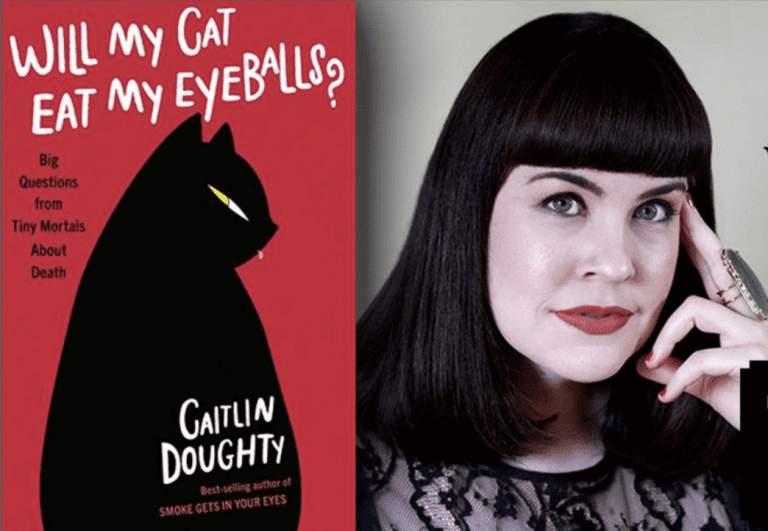 I bring up that longterm commitment to the sex-positive movement because we quite progressive UUs have some work to do to be equally as committed to the death-positive movement. Death-positive, you might be asking yourself, “What is that?” For the uninitiated, allow me to introduce you to Caitlin Doughty, my favorite death-positive advocate. Doughty describes herself as a “mortician, activist, and funeral industry rabble-rouser.” I highly recommend all three of her books:
- her memoir Smoke Gets in Your Eyes: And Other Lessons from the Crematory
- her travelogue From Here to Eternity: Traveling the World to Find the Good Death
- her most recent book Will My Cat Eat My Eyeballs? Big Questions from Tiny Mortals about Death.
All her writing is equal parts hilarious and profound. Some of you may recall that four years ago, I wrote a blog post on mortality inspired by Doughty’s memoir, as well as by the physician Atul Gwande’s book Being Mortal. I highly recommend that book as well, if you or someone you love is wrestling with end-of-life medical decisions.
For now, I would like to share with you the eight central values of the Death Positive Movement as articulated by a group Doughty helped found, called The Order of the Good Death:
- Hiding death and dying behind closed doors does more harm than good to our society.
- The culture of silence around death should be broken through discussion, gatherings, art, innovation, and scholarship.
- Talking about and engaging with my inevitable death is not morbid, but displays a natural curiosity about the human condition.
- The dead body is not dangerous, and everyone should be empowered (should they wish to be) to be involved in care for their own dead.
- The laws that govern death, dying and end-of-life care should ensure that a person’s wishes are honored, regardless of sexual, gender, racial or religious identity. [More information available at “Death with Dignity“]
- My death should be handled in a way that does not do great harm to the environment. [More information available at “Green Burial“]
- My family and friends should know my end-of-life wishes, and I should have the necessary paperwork to back-up those wishes. [More information available at “Conversation Project” and “Five Wishes”]
- My open, honest advocacy around death can make a difference, and can change culture.
And our culture is changing even if we still have a long way to go. One of the most pervasive death positive shifts is the Hospice Movement (which started in the 1960s and entered the U.S. in the mid-1970s). Hospice has initiated a much-needed sea change in according death greater dignity.
Relatedly, many of you may be familiar with doulas in the context of accompanying, guiding, and empowering people giving birth. There are also a growing number of people being trained as death doulas to accompany, guide, and empower people at the end of life.
And some of you may have also heard of or even participated in the Death Cafe movement, which was founded in 2004 as a way to connect people who want to talk about death in an open, honest way. As one of their promotional slogans says, Death Cafes, “never involve agendas, advertising or set conclusions. Interesting conversations are guaranteed!”
If you google “Death Cafe” (or visit deathcafe.com) and your zip code into the “Find a Death Cafe” link, you’ll find that the closest Death Cafes. You may even find one has moved to Zoom during the pandemic, and is open to all.
Here one description:
Death Cafes are an opportunity to demystify the death experience. We offer an open, safe environment for discussing thoughts and feelings about all manner of death and dying.
At a Death Cafe people drink tea, eat cake and discuss death. [“Life’s short, eat dessert first,” right?!] Our aim is to increase awareness of death to help people make the most of their (finite) lives…. Please note: Death Cafes are not meant to act as support groups or grief counseling.
If this post leaves you a little “death curious,” perhaps joining an upcoming Death Cafe might be right for you.
Overall, the hope is that being more open, honest, and transparent about our inevitable death can empower us to make the most of the life that we have. One ancient Buddhist inquiry practice puts it this way: “Since death alone is certain, and the time of death uncertain, what should I do?”
As we sit with that question, allowing it to sink in, I want to conclude with a story. A few years ago my colleague the Rev. Georgette Wonders preached a sermon on the subject of death and mortality to Bradford UU Community Church in Kenosha, Wisconsin, the congregation she served as minister. That sermon was titled “Facing Death: The UU Book of the Dead.” She preached it on Sunday, August 6, 2014 with no knowledge at the time that she would be killed two days later in a car accident.
I invite you to reflect on the final section of Rev. Wonders’ sermon on “Facing Death: The UU Book of the Dead.” She is speaking to us from beyond the grave: both her words and the example of how she lived her life are part of the legacy that she had left behind as a gift for those of us still living. As you listen, notice if any words or phrases particularly resonate with you in this season of your life. Whether we are saying goodbye to a loved one—or whether we are the one being said goodbye to—the way we prepare is to:
-
Live each day as if it were the only day.… Every time you part, from this day forward, tell them you love them, even if you are in and out all day long.
-
Appreciate the little things—the common, everyday things—because they will become almost unbearably precious when death comes knocking at the door.
-
Overcome your resentments and learn not to accumulate them.
-
Be useful and light upon the earth.
-
Live a grateful life.
As [the late UU minister] Forrest Church wrote, “Death is not life’s goal, only life’s terminus.… The one thing that can’t be taken from us, even by death, is the love we give away before we go.” So begin now or continue on. Love as if our lives depend on it, for they do! It is a miracle that we are here at all…that anything is.
In closing, consider this poem by Mary Oliver, “In Blackwater Woods.”
The Rev. Dr. Carl Gregg is a certified spiritual director, a D.Min. graduate of San Francisco Theological Seminary, and the minister of the Unitarian Universalist Congregation of Frederick, Maryland. Follow him on Facebook (facebook.com/carlgregg) and Twitter (@carlgregg).
Learn more about Unitarian Universalism: http://www.uua.org/beliefs/principles
Previous Post

June 22, 2020
Trust Women: Bodies, Laws, & Reproductive Justice
Browse Our Archives
Select a Category Advent Anti-Racism Archaeology Atheism Baptism Best of the Year List Book Reviews Buddhism Catholicism Christian Education Church and State Church Planting Climate Change Conscientious Objection to War Creation Spirituality Death Penalty Didache Disability Rights Discernment Easter Ecology Emergent Church Movement Empire-Critical Ethics Evolution Feminist Theology Film Reviews Gandhi Gospel of Mark Gun Control Hinduism Immigration Reform Interfaith Islam JFK Judaism Jungian Spirituality Lectionary Commentary Lent Letters to the Editor LGBT Marriage MLK Multiculturalism Mysticism Nonviolent Activism Occupy Paganism (Earth-centered Religions) Parables Paul Pluralism Politics Process Theology Quantum Physics Requiescat In Pace Seminary and Divinity School Sermon Series Retrospective Sermons Spiritual Direction Spiritual Practices Stewardship (Fundraising) The Book of J The Wheel of the Year (Paganism) Theoblogger Challenge Triathlon Uncategorized Unitarian Universalism Worship Resources Youth Ministry
Select a Month July 2026 May 2026 March 2026 November 2025 October 2025 August 2025 February 2025 December 2024 October 2024 March 2024 January 2024 December 2023 November 2023 March 2023 February 2023 January 2023 December 2022 November 2022 August 2022 March 2022 February 2022 January 2022 December 2021 September 2021 August 2021 July 2021 June 2021 May 2021 February 2021 January 2021 December 2020 August 2020 June 2020 May 2020 April 2020 March 2020 February 2020 January 2020 December 2019 November 2019 October 2019 September 2019 July 2019 June 2019 March 2019 February 2019 January 2019 December 2018 November 2018 October 2018 September 2018 June 2018 May 2018 April 2018 March 2018 February 2018 January 2018 December 2017 November 2017 October 2017 September 2017 August 2017 July 2017 June 2017 May 2017 April 2017 March 2017 February 2017 January 2017 December 2016 November 2016 October 2016 September 2016 August 2016 June 2016 May 2016 April 2016 March 2016 February 2016 January 2016 December 2015 November 2015 October 2015 September 2015 August 2015 July 2015 June 2015 May 2015 April 2015 March 2015 February 2015 January 2015 December 2014 November 2014 October 2014 August 2014 July 2014 June 2014 May 2014 April 2014 March 2014 February 2014 January 2014 December 2013 November 2013 October 2013 September 2013 August 2013 July 2013 June 2013 May 2013 April 2013 March 2013 February 2013 January 2013 December 2012 November 2012 October 2012 September 2012 August 2012 July 2012 June 2012 May 2012 April 2012 March 2012 February 2012 January 2012 December 2011 November 2011 October 2011 September 2011 August 2011 July 2011 June 2011 May 2011 April 2011 March 2011 February 2011 January 2011 December 2010 November 2010 October 2010 August 2009 July 2009 May 2009
Follow Us!
TAKE THE
Religious Wisdom Quiz
Who was Timothy's mother?
Select your answer to see how you score.
Priscilla Lois Mary Eunice
Related posts from Carl Gregg

Reading America at 250: A Nation Wrestles With...


Andrew Holocek on the Power of Darkness

The Stories That Shape Us: Myths, Archetypes, &...
TRENDING AT PATHEOS More Voices

Reading America at 250: A Nation Wrestles With...
As part of my own reflection on the 250th anniversary of the...

Whenever I am reading a book or listening to an argument, I...

President Trump Ban Animal Torture Videos on Facebook
Call for Stricter Regulations of Animal Abuse Content on Facebook Although President...

Draft Amendments to Address Ritual Abuse in New...
The proposed changes would make it illegal for individuals in domestic partnerships...

How Bans on LGBTQ+ Student Clubs Threaten Religious...
On June 20, 2025, the State of Texas passed Senate Bill 12....

The Truth About the Gen Z Revival
This past year, there has been a lot of media buzz surrounding...
view all More Voices blogs
Ad-Free & Subscriber Log-In Subscription Support
- About Us
- 2026 Calendar
- Videos
- Podcasts
- Library of World Religions
- Faith In Media Tracker
- Advertise With Us
- Write for Us
- Privacy Policy
- Terms of Service
- Do Not Sell My Data
- Contact Us
- Radiant Digital
- Manage Newsletter Subscriptions
- Unsubscribe From Notifications
- Sitemap
Copyright 2008-2026, Patheos. All rights reserved.
Subscription Support Ad-Free & Subscriber Log-In
Follow Patheos