
BuddhistCatholicContemplativeEvangelicalGeneral ChristianHinduJewishLatter-day SaintMuslimNew VisionsProgressive Christian
Beliefs
- Buddhist
- Catholic
- Contemplative
- Evangelical
- General Christian
- Hindu
- Jewish
- Latter-day Saint
- More Voices
- Muslim
- New Visions
- Pagan
- Progressive Christian
Topics
- Religion News
- Food and Religion
- Sports and Religion
- Religious Art
- Religious Music and Entertainment
- Religious Events
- History and Religion
- Style and Religion
- Politics and Religion
- Women in Religion
- Recreation Outdoors and Religion
- Business Finance and Religion
- Careers Workplace and Religion
- Education and Religion
- Family Parenting and Religion
- Health Fitness and Religion
- Home and Religion
- Relationships and Religion
- Technology and Religion
- Travel and Religion
Columnists
- Buddhist Columnists
- Business Finance and Religion Columnists
- Careers Workplace and Religion Columnists
- Catholic Columnists
- Contemplative Columnists
- Education and Religion Columnists
- Evangelists Columnists
- Family Parenting and Religion Columnists
- General Christian Columnists
- Health Fitness and Religion Columnists
- Hindu Columnists
- History and Religion Columnists
- Home and Religion Columnists
- Jewish Columnists
- More Voices Columnists
- Latter Day Columnists
- Muslim Columnists
- New Visions Columnists
- Nonreligious Columnists
- Pagan Columnists
- Politics and Religion Columnists
- Progressive Columnists
- Recreation Outdoors and Religion Columnists
- Relationships and Religion Columnists
- Religion News Columnists
- Religious Art Columnists
- Religious Events Columnists
- Religious Music and Entertainment Columnists
- Sports and Religion Columnists
- Style and Religion Columnists
- Technology and Religion Columnists
- Travel and Religion Columnists
- Women in Religion Columnists
Resource Library
- 2026 Calendar
- Library of World Religions
- The 100 Most Holy Places on Earth
- Patheos Answers
- Podcasts
- Videos
- Faith Leaders Database
- Anglican Episcopalian
- Bahai
- Baptist
- Buddhism
- Christianity
- Confucianism
- Eastern Orthodoxy
- Hinduism
- Holiness and Pentecostal
- ISKCON
- Islam
- Judaism
- Lutheran
- Methodist
- The Church of Jesus Christ of Latter-day Saints
- New Age
- Paganism
- Presbytarian and Reformed
- Protestantism
- Religion Behind the Scenes
- Roman Catholic
- Scientology
- Shia Islam
- Sikhism
- Sufism
- Sunni Islam
- Taoism
- Zen
- See all religions
Research Tools
 Ad-Free & Subscriber Log-In Subscription Support
Ad-Free & Subscriber Log-In Subscription Support
Follow Patheos 

- Trending:
- Forgiveness
- |
- Marriage
- |
- Consciousness
- |
- Death Penalty
- |
- Election
- |
- Halloween

- Home
- More Voices
- Trust Women: Bodies, Laws, & Reproductive Justice
Trust Women: Bodies, Laws, & Reproductive Justice
Last updated on: June 22, 2020 at 10:33 am by Carl Gregg
Trust Women: Bodies, Laws, & Reproductive Justice 2020-06-22T10:33:52-04:00 Carl Gregg
Patheos Explore the world's faith through different perspectives on religion and spirituality! Patheos has the views of the prevalent religions and spiritualities of the world.
I have posted about reproductive justice once before—seven years ago, in 2013. At that time, the year 2011 had been the single worst year for abortion rights since Roe v. Wade, with 92 abortion restrictions passed in state legislatures. 2012 followed suit as the second-worst year for abortion rights since 1973 with 43 abortion-restricting provisions enacted at the state level (Guttmacher 2013). That year I also led a six-session class on reproductive justice at the congregation where I serve as minister.
In the wake of all of that, I have been thinking for a while that I didn’t have much left to say about a woman’s right to choose, but in the wake of renewed efforts to limit access to abortion, it turns out I do. (Let me also acknowledge here at the top that abortion rights also directly impact many transgender men as well as some gender-nonbinary folks, who can get pregnant.)
The current events that prompted me to begin planning this post were yet another series of state laws attempting to limit access to abortion, which disproportionately impacts women who are poor and people of color. And all of this is about to reach an inflection point, likely sometime this week, when the United States Supreme Court will release its ruling on June Medical Services v. Russo. This case involves the constitutionality of a Louisiana state law requiring doctors performing abortions to have admission privileges at a state-authorized hospital within 30 miles of a clinic that provides abortion. The effect of this law would mean that only a single doctor in the entire state of Louisiana would be able to legally perform abortions. (There would be a similar ripple effect in other states in which the state legislatures have a majority of representatives favoring abortion restrictions.)
This year’s case is very similar to the 2016 case, Whole Woman’s Health v. Hellerstedt, in which the Supreme Court ruled 5-3 that a state law in Texas was placing an “undue burden” on women seeking an abortion. Nevertheless, here we are two years later again waiting to see whether or not the U.S. Supreme Court will rule in favor of reproductive justice.
The term “reproductive justice” was coined by a black women’s caucus in Chicago in 1994 to connect reproductive rights with the larger social justice movement. As an attempt to bridge the tendentious split between the so-called “pro-life” and “pro-choice” camps, reproductive justice seeks to reframe the debate in terms of “The right to have children, to not have children, and to parent the children we have in safe and healthy environments” (Reproductive Justice 2015).
Relatedly, it may also be helpful to say a little more about what is and isn’t happening in the U.S. today in regard to reproductive justice. Part of why it’s important to have open transparent conversations about reproductive justice is that abortion is a fairly common and ordinary procedure: “Approximately 3 out of 10 American women who are currently age 47 or older have had one or more abortions. Looking forward, approximately 1 in 4 American women who are currently 47 years or younger are expected to have one or more in the future” (Watson 5). So although that is a notable decrease in the number of abortions over time, the projected rates still include 25% of American women.
Here’s another interesting statistic: “Almost half of American pregnancies are unintended. Forty-five percent” (30)! At least part of the reason for these accidental pregnancies is that although contraception has improved over the decades, contraception methods are not 100% reliable, and let’s just say that in the heat of the moment not everyone consistently remembers to follow all the recommendations in the instruction manual (33). If you will indulge me in a little sex ed, it is under-appreciated that:
- “If 100 sexually active couples used no contraception for a year, researchers would expect 85 of them to get pregnant.
- If the same 100 couples used condoms perfectly, 2 would get pregnant. But with typical condom use, 18 of them will get pregnant….
- Perfect diaphragm use results in 6 pregnancies per 100 couples over a year; typical use results in 12.
- Perfect pill, patch, or ring use results in only 0.3 pregnancies in 100; typical use results in 9 pregnancies per 100 couples over a year.” (32)
And this isn’t even getting into the related struggle around increasing ease of access to contraception.
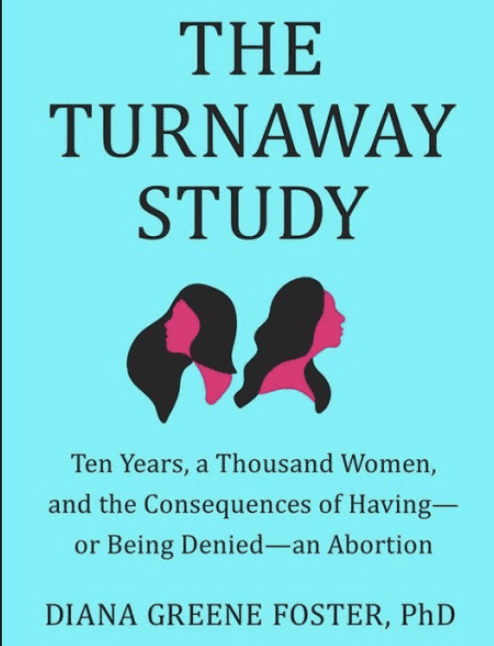 Instead of getting further into that, I would like to move to the most interesting discovery I made in my recent research into reproductive justice, which is a new book titled The Turnaway Study: Ten Years, a Thousand Women, and the Consequences of Having—or Being Denied—an Abortion (Scribner 2020) by Diana Greene Foster, a professor at the University of California, San Francisco. If this post leaves you interested in learning more, I highly recommend Dr. Foster’s book.
In contrast to the misinformation, speculation, and personal anecdotes often circulated in regard to reproductive justice, Dr. Foster’s research is grounded in a rigorous social scientific methodology. Her team conducted “Eight thousand interviews of nearly one thousand women over eight years” (Foster 11).
And although Foster’s book was published only a few weeks ago, some of you may have seen the headlines from a few years ago when the biggest finding of their study was published in the prestigious medical journal JAMA Psychiatry. What the Turnaway Study’s extensive research found is that for the vast majority, “abortion does not harm women’s mental health,” and “ninety-five percent of women who have abortions felt their decision was right for them” (247).
When women were asked why they chose to get an abortion, approximately two-thirds of women listed more than one reason (26):
- The number one reason women gave (~40%) is financial: “They did not think they had enough money to raise a child” or an additional child (36).
- The second most frequent reason (36%) was timing: “It wasn’t the right time for a baby (37).
- The third most common reason (31%) was men: They were in a relationship that was too toxic, fragile, or abusive to support a child (or another child) (38).
- Another common reason (29%) was that, “They wanted an abortion to be able to take care of the children they already had (38).
- And twenty percent of women said that “having a new baby would derail life plans and career goals” (39).
The takeaway here is that, by and large, “Women make thoughtful, well-considered decisions about whether to have an abortion” (20).
To quote Ruth Bader Ginsburg— the second female Supreme Court Justice ever to be appointed—legalized access to abortion is about “a woman’s autonomous charge of her full life’s course” (186). Or let me back up and quote Sandra Day O’Connor, the first woman to serve on the Supreme Court, who was appointed in 1981. (As a side note, think about what that means: for the first two hundred and five years of this country’s existence, the Supreme Court was all male.) And here’s what Justice O’Connor—the first Supreme Court Justice in U.S. history who could actually be pregnant said in the 1992 case Planned Parenthood v. Casey:
The liberty of the woman is at stake in a sense unique to the human condition, and so, unique to the law. The mother who carries a child to full term is subject to anxieties, to physical constraints, to pain that only she must bear… Her suffering is too intimate and personal for the State to insist…upon its own vision of the women’s role” (231).
And despite the trope that a woman’s decision about abortion is “always difficult,” the data from the Turnaway Study show that is only true about fifty percent of the time: “For about half of women seeking abortion, it is a straightforward, even easy decision, and for about half it is difficult. That a woman makes this decision easily does not mean she takes it lightly. Instead, the choice may be clear when she considers her options and circumstances” (303).
Now, all this being said, I suspect there are at least a few of you reading this post who identify as pro-life. And from conversations I have had over the years, I understand that for many of you it is less about being anti-choice, and more about being “pro fetal rights” (Watson 13).
 When I speak about reproductive justice in progressive/liberal circles, usually at least one or two people followup with me afterwards to ask if one can be progressive and pro fetal rights. The answer is yes, if you are willing to be part of the big tent that is the progressive movement. And that is similar to our situation in the U.S. generally. As the bioethicist Katie Watson has written in her important book Scarlet A: The Ethics, Law, and Politics of Ordinary Abortion (Oxford University Press, 2018):
The abortion debate often seems to boil down to a debate about vulnerability: Who or what is more in need of protection, fetuses or women? For me, the vulnerable thing in need of protection is pluralism—the idea that Americans who vigorously disagree about gender, family, sex, religion, and endless other topics can all flourish in the same country.
I’m not asking you to like abortion. I’m asking you to like pluralism. I’m asking you to acknowledge that your feeling, opinion, belief, or conviction about the moral status of embryos and fetuses cannot be proven to the level required to force it on others through force of law. In the United States, we can’t force a neighbor to end a pregnancy we don’t think she should continue, and we can’t force a neighbor to continue a pregnancy we don’t think she should end. (213-214)
Along those lines, as I move to my conclusion, I want to take the risk of bringing up a reminder about the other end of the spectrum from Dr. Watson’s call for pluralism, and that is what happened in 2009 when Dr. George Tiller was killed by an anti-abortion extremist while serving as an usher at his Lutheran church in Kansas. I bring up this tragedy because of the reason that Dr. Tiller gave for why he was willing to serve as a physician at one of only three clinics nationwide at the time which provided late termination of pregnancy. This motto—emblazoned on the wall of his Wichita clinic and which he also often wore as a button on his lapel—was two simple words: “Trust women.” That’s why Dr. Tiller did what he did. He trusted the autonomy, the experience, the choice of women (311-312). He trusted that the vast preponderance of women seeking his help were acting in good faith and doing the best they could, given their life circumstances—which often include the gender wage gap, systemic sexism, lack of universal child and health care, domestic violence, etc.
And that is a crucial cornerstone of feminism: valuing women’s experience. It’s a vital step in dismantling patriarchy, and in building a more fair and equitable world: a world with peace, liberty, and justice, not merely for some people—not merely for some men—but for all. A world in which we can all get free. Trust women. That commitment can take us a long way toward building a new way.
The Rev. Dr. Carl Gregg is a certified spiritual director, a D.Min. graduate of San Francisco Theological Seminary, and the minister of the Unitarian Universalist Congregation of Frederick, Maryland. Follow him on Facebook (facebook.com/carlgregg) and Twitter (@carlgregg).
Learn more about Unitarian Universalism: http://www.uua.org/beliefs/principles
Next Post

August 3, 2020 The Death-positive Movement & The Order of the Good Death
Browse Our Archives
Select a Category Advent Anti-Racism Archaeology Atheism Baptism Best of the Year List Book Reviews Buddhism Catholicism Christian Education Church and State Church Planting Climate Change Conscientious Objection to War Creation Spirituality Death Penalty Didache Disability Rights Discernment Easter Ecology Emergent Church Movement Empire-Critical Ethics Evolution Feminist Theology Film Reviews Gandhi Gospel of Mark Gun Control Hinduism Immigration Reform Interfaith Islam JFK Judaism Jungian Spirituality Lectionary Commentary Lent Letters to the Editor LGBT Marriage MLK Multiculturalism Mysticism Nonviolent Activism Occupy Paganism (Earth-centered Religions) Parables Paul Pluralism Politics Process Theology Quantum Physics Requiescat In Pace Seminary and Divinity School Sermon Series Retrospective Sermons Spiritual Direction Spiritual Practices Stewardship (Fundraising) The Book of J The Wheel of the Year (Paganism) Theoblogger Challenge Triathlon Uncategorized Unitarian Universalism Worship Resources Youth Ministry
Select a Month July 2026 May 2026 March 2026 November 2025 October 2025 August 2025 February 2025 December 2024 October 2024 March 2024 January 2024 December 2023 November 2023 March 2023 February 2023 January 2023 December 2022 November 2022 August 2022 March 2022 February 2022 January 2022 December 2021 September 2021 August 2021 July 2021 June 2021 May 2021 February 2021 January 2021 December 2020 August 2020 June 2020 May 2020 April 2020 March 2020 February 2020 January 2020 December 2019 November 2019 October 2019 September 2019 July 2019 June 2019 March 2019 February 2019 January 2019 December 2018 November 2018 October 2018 September 2018 June 2018 May 2018 April 2018 March 2018 February 2018 January 2018 December 2017 November 2017 October 2017 September 2017 August 2017 July 2017 June 2017 May 2017 April 2017 March 2017 February 2017 January 2017 December 2016 November 2016 October 2016 September 2016 August 2016 June 2016 May 2016 April 2016 March 2016 February 2016 January 2016 December 2015 November 2015 October 2015 September 2015 August 2015 July 2015 June 2015 May 2015 April 2015 March 2015 February 2015 January 2015 December 2014 November 2014 October 2014 August 2014 July 2014 June 2014 May 2014 April 2014 March 2014 February 2014 January 2014 December 2013 November 2013 October 2013 September 2013 August 2013 July 2013 June 2013 May 2013 April 2013 March 2013 February 2013 January 2013 December 2012 November 2012 October 2012 September 2012 August 2012 July 2012 June 2012 May 2012 April 2012 March 2012 February 2012 January 2012 December 2011 November 2011 October 2011 September 2011 August 2011 July 2011 June 2011 May 2011 April 2011 March 2011 February 2011 January 2011 December 2010 November 2010 October 2010 August 2009 July 2009 May 2009
Follow Us!
TAKE THE
Religious Wisdom Quiz
The light shines in the darkness, and the darkness has not ____ it.
Select your answer to see how you score.
Accepted Comprehended Extinguished Understood
Related posts from Carl Gregg

Reading America at 250: A Nation Wrestles With...


Andrew Holocek on the Power of Darkness

The Stories That Shape Us: Myths, Archetypes, &...
TRENDING AT PATHEOS More Voices

Reading America at 250: A Nation Wrestles With...
As part of my own reflection on the 250th anniversary of the...

Whenever I am reading a book or listening to an argument, I...

President Trump Ban Animal Torture Videos on Facebook
Call for Stricter Regulations of Animal Abuse Content on Facebook Although President...

Draft Amendments to Address Ritual Abuse in New...
The proposed changes would make it illegal for individuals in domestic partnerships...

How Bans on LGBTQ+ Student Clubs Threaten Religious...
On June 20, 2025, the State of Texas passed Senate Bill 12....

The Truth About the Gen Z Revival
This past year, there has been a lot of media buzz surrounding...
view all More Voices blogs
Ad-Free & Subscriber Log-In Subscription Support
- About Us
- 2026 Calendar
- Videos
- Podcasts
- Library of World Religions
- Faith In Media Tracker
- Advertise With Us
- Write for Us
- Privacy Policy
- Terms of Service
- Do Not Sell My Data
- Contact Us
- Radiant Digital
- Manage Newsletter Subscriptions
- Unsubscribe From Notifications
- Sitemap
Copyright 2008-2026, Patheos. All rights reserved.
Subscription Support Ad-Free & Subscriber Log-In
Follow Patheos