
BuddhistCatholicContemplativeEvangelicalGeneral ChristianHinduJewishLatter-day SaintMuslimNew VisionsProgressive Christian
Beliefs
- Buddhist
- Catholic
- Contemplative
- Evangelical
- General Christian
- Hindu
- Jewish
- Latter-day Saint
- More Voices
- Muslim
- New Visions
- Pagan
- Progressive Christian
Topics
- Religion News
- Food and Religion
- Sports and Religion
- Religious Art
- Religious Music and Entertainment
- Religious Events
- History and Religion
- Style and Religion
- Politics and Religion
- Women in Religion
- Recreation Outdoors and Religion
- Business Finance and Religion
- Careers Workplace and Religion
- Education and Religion
- Family Parenting and Religion
- Health Fitness and Religion
- Home and Religion
- Relationships and Religion
- Technology and Religion
- Travel and Religion
Columnists
- Buddhist Columnists
- Business Finance and Religion Columnists
- Careers Workplace and Religion Columnists
- Catholic Columnists
- Contemplative Columnists
- Education and Religion Columnists
- Evangelists Columnists
- Family Parenting and Religion Columnists
- General Christian Columnists
- Health Fitness and Religion Columnists
- Hindu Columnists
- History and Religion Columnists
- Home and Religion Columnists
- Jewish Columnists
- More Voices Columnists
- Latter Day Columnists
- Muslim Columnists
- New Visions Columnists
- Nonreligious Columnists
- Pagan Columnists
- Politics and Religion Columnists
- Progressive Columnists
- Recreation Outdoors and Religion Columnists
- Relationships and Religion Columnists
- Religion News Columnists
- Religious Art Columnists
- Religious Events Columnists
- Religious Music and Entertainment Columnists
- Sports and Religion Columnists
- Style and Religion Columnists
- Technology and Religion Columnists
- Travel and Religion Columnists
- Women in Religion Columnists
Resource Library
- 2026 Calendar
- Library of World Religions
- The 100 Most Holy Places on Earth
- Patheos Answers
- Podcasts
- Videos
- Faith Leaders Database
- Anglican Episcopalian
- Bahai
- Baptist
- Buddhism
- Christianity
- Confucianism
- Eastern Orthodoxy
- Hinduism
- Holiness and Pentecostal
- ISKCON
- Islam
- Judaism
- Lutheran
- Methodist
- The Church of Jesus Christ of Latter-day Saints
- New Age
- Paganism
- Presbytarian and Reformed
- Protestantism
- Religion Behind the Scenes
- Roman Catholic
- Scientology
- Shia Islam
- Sikhism
- Sufism
- Sunni Islam
- Taoism
- Zen
- See all religions
Research Tools
 Ad-Free & Subscriber Log-In Subscription Support
Ad-Free & Subscriber Log-In Subscription Support
Follow Patheos 

- Trending:
- Forgiveness
- |
- Marriage
- |
- Consciousness
- |
- Death Penalty
- |
- Election
- |
- Halloween

- Home
- More Voices
- Meditation, Neuroscience, Psychedelics: Who Am I? Who Are You? Who Are We?
Meditation, Neuroscience, Psychedelics: Who Am I? Who Are You? Who Are We?
Last updated on: June 8, 2020 at 2:21 pm by Carl Gregg
Meditation, Neuroscience, Psychedelics: Who Am I? Who Are You? Who Are We? 2020-06-08T14:21:13-04:00 Carl Gregg
Patheos Explore the world's faith through different perspectives on religion and spirituality! Patheos has the views of the prevalent religions and spiritualities of the world.
Growing up in South Carolina, the first time I can remember really engaging with Black History Month was in middle school. Not coincidentally, that was the same year I had my first African-American teacher. It was 8th grade Earth Science, and every weekday that February various ones of us were assigned to make presentations about different black scientists. I remember some of my classmates voicing racist objections to those Black History Month assignments, but we learned a lot, and I still remember some of those lessons decades later.
Along these lines, I invite you to view a short video of the astrophysicist Neil deGrasse Tyson, available at youtube.com/watch?v=z7ihNLEDiuM. One of the many things I love about this clip is the reminder that whatever your fields of interest or spheres of influence, there are opportunities to dismantle racism and advocate for building a diverse, multicultural beloved community with equitable opportunities for all.
I. Consciousness
In the spirit of that burning curiosity which fueled Dr. Neil deGrasse Tyson to overcome all the obstacles in his way to pursue his passion for science, I want to invite us to spend some time reflecting on some of the basic questions at the foundation of scientific inquiry: Who am I? Who are you? Who are we? Those three questions may seem simple, but if you keep asking them and looking closely, you’ll find they can take you down quite a rabbit hole.
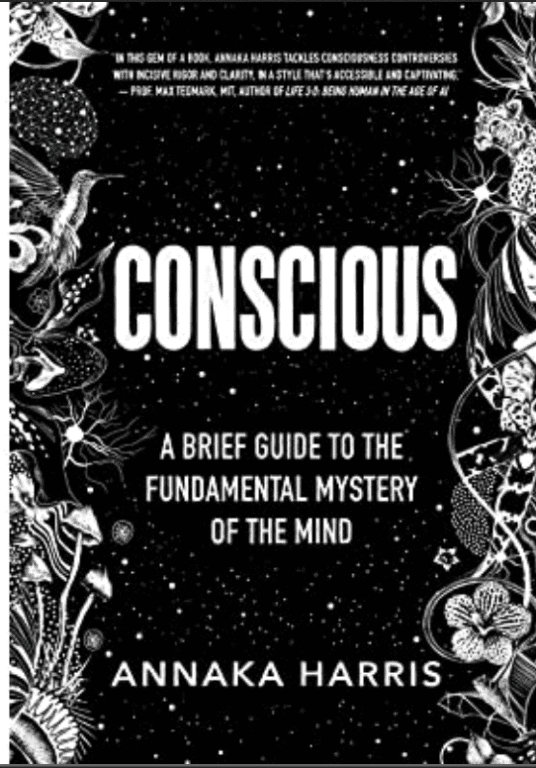 As our guide, I’ll be drawing from the book Conscious: A Brief Guide to the Fundamental Mystery of the Mind by Annaka Harris (Harper, 2019). She’s a bestselling science writer, who also happens to be married to Sam Harris, neuroscientist and bestselling author, whose books some of you may know. (There are some things I really love about Sam Harris’s work and other aspects I strongly disagree with, but that would be another post in itself.)
For now, I will say that similar to the curiosity about the universe that led Neil deGrasse Tyson to become an astrophysicist, curiosity about consciousness itself is the driving motivation behind Annaka Harris’s book. And if you stop to consider: it really is quite strange that billions of years of evolution resulted in *consciousness—*in self-awareness, in sentience (3).
We humans are made of the same elemental particles as the stars, as is everything in the universe (6). But the remarkable truth, as one eco-theologian has put it, is that we humans are “stardust now evolved to the place that the stardust can think about itself! …We are the universe becoming conscious of itself. We are stardust that has begun to contemplate the stars” (Dowd 92).
That truth is mind-blowing enough on it own that we could fruitfully stop there and ponder a long while. But Harris challenges us to press on, zoom out, and ask the further question of what else in the universe is conscious in addition to humanity. What else has self-awareness and sentience?
- Are our common household pets, dogs and cats, conscious? Most of us would say, clearly yes, even if our pets have less sentience than we humans do.
- What about plants and trees? Are they conscious? That’s a harder call, but those of you who remember my post a little more than a year ago on The Hidden Life of Trees (or if you’ve read the incredible book by that same title) know that there is a growing amount of scientific evidence of sentience in plants—even if, again, less consciousness than in animals. (And if we take Darwin’s idea of the “descent of man” seriously—as we should—doesn’t it make sense that if we are conscious that some of those beings we evolved from would also have some forms of sentience?)
- But what happens if we zoom out even further? What about bacteria or a rock? Are they conscious?
The further down the tree of life we go, the more difficult it is to find evidence of sentience; but, as Harris writes, “At some point along the spectrum the answer is yes, and the great mystery lies in why the ‘lights turn on’ for some collections of matter in the universe” (Harris 5-6).
For we humans with our advanced consciousness—who are self-reflexively aware of our awareness—what have we discovered about sentience in ourselves and others? Well, here’s where it’s helpful that Annaka Harris is married to a neuroscientist, who has also been quite open about experimenting with psychedelics. Let’s start with neuroscience, then move on to psychedelics.
II. Neuroscience
One of the most interesting and challenging discoveries scientists have found through brain scans is that we humans become conscious of events “slightly after they have occurred” (25). Let me say more about that. Whenever something happens in the world around you, sense data comes in through your five senses, traveling different distances through your nervous system to your brain at which point “the signals get synchronized through a process called ‘binding’—and only then do they enter your conscious experience (26).
Take, for instance, the example of kicking a soccer ball. At slightly different speeds your brain receives impulses about the:
- sensations from your foot touching the ball (that has to travel a relatively long distance from your foot, up the nerves in your leg, and further up through your spinal cord to your brain,
- the popping sound of your foot hitting the ball (that, likewise, creates sound waves that travel to your ear that then send information to your brain),
- your visual tracking of the action (that has a comparatively short distance to travel from your eye to your brain),
- there may also be saliva or other tastes in your mouth, various smells coming in through your nose, or any number of other data.
Your brain collects all those separate pieces of sense data, synchronizes them together, and only then does that that edited version enter your consciousness.
To reiterate the insight we’re being invited to come to terms with, neuroscience invites us to wrestle with the strange truth that we live slightly “in the past”: the brain knows before the conscious mind does (26). Our conscious self is only aware of the edited version of what the brain produces. Indeed, multiple brain scan experiments have shown that, “Researchers can reliably detect the brain activity signaling impending movements [such as the decision to move a finger] about half a second before subjects feel they make the conscious decision to move (26-27).
You might be thinking, What?! That’s some wild stuff with serious implications that are not yet fully understood about the interplay between our body and our brain on the one hand and our mind, our sentience, and our consciousness on the other. After all, what does it mean if “another person watching a scan of your brain can know what you’re going to do before you do.”
If you are interested in learning more there’s a good short introductory chapter in Annaka Harris’s book Conscious on “Is Consciosness Free” — although the whole book is a short and quick that is worth reading in full. Or you could go straight to a full book-length treatment on just this topic such as Michael Gazzaniga’s The Consciousness Instinct.
All of this takes us back to those deceptively simple questions with which we began: Who are you anyway?! What am I? Who are we (27)? Most of us, including myself, often live with a sense of our “self” as floating separately from our bodies and periodically telling our bodies what to do (29). But neuroscience challenges us to consider that the sense of our conscious will “inhabiting” our head is an illusion akin to thinking that the earth is stationary with the sun rotating around us (30). From our everyday perspective the earth does appear to be still and the sun does appear to rise over us in the East and set in the West. Despite this illusion, however, science has shown us that the Earth is actually moving constantly, both rotating on its own axis and revolving around the sun. Or take our current COVID-19 pandemic: to our ancestors such plagues may have seemed like magic or a curse, but science has shown us the bizarre truth that a microscopic virus—invisible to the naked eye—is able to slow our civilization down almost to a halt (1). Reality is weird, ya’ll.
Back to neuroscience, although it may feel like our conscious mind is floating outside our brain and controlling our body, science challenges us that the directionality may be exactly the opposite. For instance, I suspect each of us can think of examples in which you have witnessed intoxication (drugs or alcohol), disease (such as Alzheimers), or traumatic injury impact someone’s brain—or your own brain—such that you or they seemed no longer their ‘self.’ (30, 53). But what does that really mean? The more you pay attention over time, the clearer it is that there is no one persistent ‘self.’
III. Meditation
Having laid the above groundwork, we can now begin to trace a fascinating intersection between modern neuroscience, psychedelic experiences, and ancient Buddhist meditation practices. On the one hand, some of the neuroscience I’ve been sharing with you can feel disturbing to our sense of self—and rightly so. On the other hand, anyone who has spent a fair amount of time hanging out in the meditation circles may find a lot of those discoveries standard fare: twenty-first century technology like EEGs (electroencephalograms) confirming what meditators have been telling us for millennia: our sense of self is a delusion. Don’t get me wrong: it’s a useful delusion, but a delusion nonetheless—not unlike the illusion that the sun is rotating around the Earth, when the reality is quite different (52).
In the Buddhist tradition, the teaching of “non-self” is one of the three most important insights—often called the “Three Marks of Existence.” One classic metaphor for non-self is a braided rope. This metaphor can also clarify that the point is less that the braided rope (our sense of self) doesn’t exist; rather, both the rope (and our sense of self) can be unbraided into their component parts and/or rebraided (through drugs, disease, injury, trauma, aging, other experiences, etc.) into different selves. And this is where we need to bring back in all that stuff we learned earlier about how our brains synchronize and bind all the desperate data from our five senses together before passing that edited information to our brains.
A lot of what meditation is about (especially vipassanā or insight mediation) is a simple practice of noting all the separate sensations that make up our moment-to-moment experience. And when scientists do brain scans of meditators who have spent many hours doing such practices, they find that when experienced meditators practice meditation, a part of their brains called the default mode network (that contributes to our sense of self) is suppressed. And that’s a potentially very interesting neuroscience correlate to “awakening” or “enlightenment” experiences in which one’s sense of self drops away completely.
IV. Psychedelics
And finally we can also bring in the burgeoning field of psychedelic research. Just as longterm meditation can suppress the brain’s default mode network, brain scans of people taking psychedelics show a disruption in a particular circuit in the brain’s default mode network, which causes people under the influence of psychedelics to lose their sense of self (49). Common experiences from using psychedelics include “floating and finding inner peace, distortions in time, and a conviction that the self is disintegrating….”
In addition, don’t miss this particularly important insight: when people on psychedelics report that their sense of self drops away, “consciousness remains fully present” (49). Let me repeat that: for people on psychedelics, when the sense of self drops off, consciousness remains fully present. Presence and awareness remain. Keep that in mind in conjunction with the neuroscience we consider earlier that “Researchers can reliably detect the brain activity signaling impending movements [such as the decision to move a finger] about half a second before subjects feels they make the conscious decision to move. Then ask yourself:
- Who am I?
- Who are you?
- Who are we?
If you are interested in learning more, I highly recommend Michael Pollan’s excellent book How to Change Your Mind: What the New Science of Psychedelics Teaches Us About Consciousness, Dying, Addiction, Depression, and Transcendence, which The New York Times named one of the “10 Best Books of 2018.”
At this point, I should state clearly that I am not recommending that anyone break the law; but there is increasingly strong scientific evidence that the laws should be changed to allow for responsible, therapeutic use of psychedelics.
It is also crucial to add that with psychedelics—as well as with meditation—not only can the sense of self drop away, but also a felt, sense can arise of what the 7th Principle in my own chosen tradition of Unitarian Universalism calls “the interdependent web of all existence of which we are a part” (50-51).
Who Am I? Who Are You? Who Are We?
And here’s where we come full circle to that video of the African American astrophysicist Neil deGrasse Tyson advocating to tear down all the barriers blocking human beings from doing what they love—and build up systems of collective flourishing in which we are all free to pursue what we are passionate about.
Along these lines, one of my favorite terms for what it means to live out of a felt sense of interdependence is ubuntu, which comes from the Zulu tradition of Southern Africa. I learned it from Desmond Tutu, who was inspired by ubuntu to create the South African Truth and Reconciliation Commission. Ubuntu has been translated variously as: ”I am because we are,” “humanity toward others,” or “a universal bond of sharing that connects all humanity.”
Both spirituality and science invite us to realize the profound truth that we are not isolated selves, even if we feel that way sometimes. We are deeply interconnected with one another and with the many other sentient beings on this planet who are at various points on the spectrum of consciousness.
From this perspective, for instance, we can notice that the recent headlines about SpaceX unduly centered our place on this planet. When the news proclaims that the SpaceX crew launched into space to dock at the International Space Station—sure, that’s true in a sense. But it’s also true that we have all always already been floating in space on this blue marble we call the Earth. That’s the deeper, more signifiant truth of the cosmic situation in which we find ourselves.
Just as astronauts learn to slip “the surly bonds of earth,” may we humans get better at learning to slip the surly bonds of ego that hold us back from one another.
May we transcend the historically contingent social constructions of ethnicity and tribe.
May we live into a felt sense of global interdependence as we float together on this beautiful and fragile planet.
And may we open ourselves more fully, not to “I think there I am,” but to the deeper truth that “I am because we are.”
That’s who I am.
That’s who you are.
That’s who we are.
Realizing the truth of our interdependence can liberate us to build the world we dream about: a world of peace, liberty, and justice—not merely for some—but for all.
May all sentient beings be filled with loving kindness.
May all sentient beings be peaceful and at ease.
May all sentient beings live with an open heart.
May all sentient beings be liberated and free.
For Further Study: Religion scholar Jeffrey Kripal has said “Consciousness as such is the new sacred.” Read more in my post on “Sexy Secrets about Religion.”
The Rev. Dr. Carl Gregg is a certified spiritual director, a D.Min. graduate of San Francisco Theological Seminary, and the minister of the Unitarian Universalist Congregation of Frederick, Maryland. Follow him on Facebook (facebook.com/carlgregg) and Twitter (@carlgregg).
Learn more about Unitarian Universalism: http://www.uua.org/beliefs/principles
Next Post

June 22, 2020 Trust Women: Bodies, Laws, & Reproductive Justice
Browse Our Archives
Select a Category Advent Anti-Racism Archaeology Atheism Baptism Best of the Year List Book Reviews Buddhism Catholicism Christian Education Church and State Church Planting Climate Change Conscientious Objection to War Creation Spirituality Death Penalty Didache Disability Rights Discernment Easter Ecology Emergent Church Movement Empire-Critical Ethics Evolution Feminist Theology Film Reviews Gandhi Gospel of Mark Gun Control Hinduism Immigration Reform Interfaith Islam JFK Judaism Jungian Spirituality Lectionary Commentary Lent Letters to the Editor LGBT Marriage MLK Multiculturalism Mysticism Nonviolent Activism Occupy Paganism (Earth-centered Religions) Parables Paul Pluralism Politics Process Theology Quantum Physics Requiescat In Pace Seminary and Divinity School Sermon Series Retrospective Sermons Spiritual Direction Spiritual Practices Stewardship (Fundraising) The Book of J The Wheel of the Year (Paganism) Theoblogger Challenge Triathlon Uncategorized Unitarian Universalism Worship Resources Youth Ministry
Select a Month July 2026 May 2026 March 2026 November 2025 October 2025 August 2025 February 2025 December 2024 October 2024 March 2024 January 2024 December 2023 November 2023 March 2023 February 2023 January 2023 December 2022 November 2022 August 2022 March 2022 February 2022 January 2022 December 2021 September 2021 August 2021 July 2021 June 2021 May 2021 February 2021 January 2021 December 2020 August 2020 June 2020 May 2020 April 2020 March 2020 February 2020 January 2020 December 2019 November 2019 October 2019 September 2019 July 2019 June 2019 March 2019 February 2019 January 2019 December 2018 November 2018 October 2018 September 2018 June 2018 May 2018 April 2018 March 2018 February 2018 January 2018 December 2017 November 2017 October 2017 September 2017 August 2017 July 2017 June 2017 May 2017 April 2017 March 2017 February 2017 January 2017 December 2016 November 2016 October 2016 September 2016 August 2016 June 2016 May 2016 April 2016 March 2016 February 2016 January 2016 December 2015 November 2015 October 2015 September 2015 August 2015 July 2015 June 2015 May 2015 April 2015 March 2015 February 2015 January 2015 December 2014 November 2014 October 2014 August 2014 July 2014 June 2014 May 2014 April 2014 March 2014 February 2014 January 2014 December 2013 November 2013 October 2013 September 2013 August 2013 July 2013 June 2013 May 2013 April 2013 March 2013 February 2013 January 2013 December 2012 November 2012 October 2012 September 2012 August 2012 July 2012 June 2012 May 2012 April 2012 March 2012 February 2012 January 2012 December 2011 November 2011 October 2011 September 2011 August 2011 July 2011 June 2011 May 2011 April 2011 March 2011 February 2011 January 2011 December 2010 November 2010 October 2010 August 2009 July 2009 May 2009
Follow Us!
TAKE THE
Religious Wisdom Quiz
What tax collector wrote a Gospel and was called by Jesus?
Select your answer to see how you score.
Matthew Luke Mark Barnabas
Related posts from Carl Gregg

Reading America at 250: A Nation Wrestles With...


Andrew Holocek on the Power of Darkness

The Stories That Shape Us: Myths, Archetypes, &...
TRENDING AT PATHEOS More Voices

Reading America at 250: A Nation Wrestles With...
As part of my own reflection on the 250th anniversary of the...

Whenever I am reading a book or listening to an argument, I...

President Trump Ban Animal Torture Videos on Facebook
Call for Stricter Regulations of Animal Abuse Content on Facebook Although President...

Draft Amendments to Address Ritual Abuse in New...
The proposed changes would make it illegal for individuals in domestic partnerships...

How Bans on LGBTQ+ Student Clubs Threaten Religious...
On June 20, 2025, the State of Texas passed Senate Bill 12....

The Truth About the Gen Z Revival
This past year, there has been a lot of media buzz surrounding...
view all More Voices blogs
Ad-Free & Subscriber Log-In Subscription Support
- About Us
- 2026 Calendar
- Videos
- Podcasts
- Library of World Religions
- Faith In Media Tracker
- Advertise With Us
- Write for Us
- Privacy Policy
- Terms of Service
- Do Not Sell My Data
- Contact Us
- Radiant Digital
- Manage Newsletter Subscriptions
- Unsubscribe From Notifications
- Sitemap
Copyright 2008-2026, Patheos. All rights reserved.
Subscription Support Ad-Free & Subscriber Log-In
Follow Patheos