
BuddhistCatholicContemplativeEvangelicalGeneral ChristianHinduJewishLatter-day SaintMuslimNew VisionsProgressive Christian
Beliefs
- Buddhist
- Catholic
- Contemplative
- Evangelical
- General Christian
- Hindu
- Jewish
- Latter-day Saint
- More Voices
- Muslim
- New Visions
- Pagan
- Progressive Christian
Topics
- Religion News
- Food and Religion
- Sports and Religion
- Religious Art
- Religious Music and Entertainment
- Religious Events
- History and Religion
- Style and Religion
- Politics and Religion
- Women in Religion
- Recreation Outdoors and Religion
- Business Finance and Religion
- Careers Workplace and Religion
- Education and Religion
- Family Parenting and Religion
- Health Fitness and Religion
- Home and Religion
- Relationships and Religion
- Technology and Religion
- Travel and Religion
Columnists
- Buddhist Columnists
- Business Finance and Religion Columnists
- Careers Workplace and Religion Columnists
- Catholic Columnists
- Contemplative Columnists
- Education and Religion Columnists
- Evangelists Columnists
- Family Parenting and Religion Columnists
- General Christian Columnists
- Health Fitness and Religion Columnists
- Hindu Columnists
- History and Religion Columnists
- Home and Religion Columnists
- Jewish Columnists
- More Voices Columnists
- Latter Day Columnists
- Muslim Columnists
- New Visions Columnists
- Nonreligious Columnists
- Pagan Columnists
- Politics and Religion Columnists
- Progressive Columnists
- Recreation Outdoors and Religion Columnists
- Relationships and Religion Columnists
- Religion News Columnists
- Religious Art Columnists
- Religious Events Columnists
- Religious Music and Entertainment Columnists
- Sports and Religion Columnists
- Style and Religion Columnists
- Technology and Religion Columnists
- Travel and Religion Columnists
- Women in Religion Columnists
Resource Library
- 2026 Calendar
- Library of World Religions
- The 100 Most Holy Places on Earth
- Patheos Answers
- Podcasts
- Videos
- Faith Leaders Database
- Anglican Episcopalian
- Bahai
- Baptist
- Buddhism
- Christianity
- Confucianism
- Eastern Orthodoxy
- Hinduism
- Holiness and Pentecostal
- ISKCON
- Islam
- Judaism
- Lutheran
- Methodist
- The Church of Jesus Christ of Latter-day Saints
- New Age
- Paganism
- Presbytarian and Reformed
- Protestantism
- Religion Behind the Scenes
- Roman Catholic
- Scientology
- Shia Islam
- Sikhism
- Sufism
- Sunni Islam
- Taoism
- Zen
- See all religions
Research Tools
 Ad-Free & Subscriber Log-In Subscription Support
Ad-Free & Subscriber Log-In Subscription Support
Follow Patheos 

- Trending:
- Forgiveness
- |
- Marriage
- |
- Consciousness
- |
- Death Penalty
- |
- Election
- |
- Halloween

- Home
- More Voices
- What’s Next? Bart Ehrman’s History of the Afterlife
What’s Next? Bart Ehrman’s History of the Afterlife
Last updated on: April 18, 2020 at 9:51 am by Carl Gregg
What’s Next? Bart Ehrman’s History of the Afterlife 2020-04-18T09:51:40-04:00 Carl Gregg
Patheos Explore the world's faith through different perspectives on religion and spirituality! Patheos has the views of the prevalent religions and spiritualities of the world.
What happens next is a very human question. These days, so many of us are wondering: what’s next with this pandemic? What’s next for the economy? What’s next for our country? What’s next for those most vulnerable? What’s next for those I love most in the world?
What’s next is also a question most of us ask at one time or another when confronted by our own mortality: what’s going to happen after I die? And our human vulnerability to disease and death has been very much before us the past few weeks.
But way back in the summer—long before the novel coronavi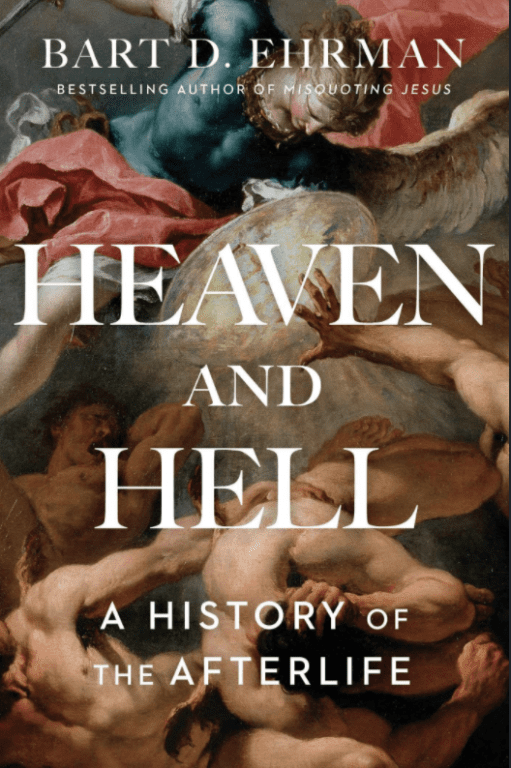 rus started making headlines—I had already pre-ordered Bart Ehrman’s latest book, Heaven and Hell: A History of the Afterlife. And now that the book finally arrived, it feels more relevant than ever.
At the same time, I will admit that in the wake of so many deaths around the world, there’s a part of me that feels averse to talking more about mortality, the afterlife, and whatever does (or doesn’t) come next. But another part of me feels like it is more important than ever—in such a time as this—to address such matters as life and death as clearly and compassionately as we can. So stick with me for a few minutes, and we’ll hit some interesting points along the way.
Let me start with a story. I was raised in a large Southern Baptist Church in the midlands of South Carolina. As with many other evangelical Christian congregations, First Baptist Florence had a general folk theology that after someone died, they were looking down on you from heaven—and that you would one day be reunited with them after your own death. All that’s assuming, of course, that you were both destined for the “Good Place” and not the “Bad Place,” but let’s set that aside for now.
I remember this worldview about what comes next being unexpectedly challenged one Sunday afternoon during a youth group Bible Study. We were reading the book of 1 Thessalonians, which is chronologically the oldest book in the Christian New Testament, written around 49 CE, about two decades after the death of the historical Jesus.
So here’s the thing. Part of why the apostle Paul wrote this letter to the church at Thessalonica is that people were starting to ask questions and get worried. If you think it is scandalous that two millennia have passed and Jesus hasn’t come back yet (hint: it is!), many of Jesus’s earliest followers expected him to return within their lifetime. But as an increasing number of people died, year after year, with no sign of Jesus’s return, people were growing troubled.
The passage we were reading that fateful afternoon in my youth group was Paul’s attempt to reassure them in 1 Thessalonians 4:
We who are alive, who are left until the coming of the Lord, will by no means precede those who have died. 16 For the Lord himself, with a cry of command, with the archangel’s call and with the sound of God’s trumpet, will descend from heaven, and the dead in Christ will rise first. 17 Then we who are alive, who are left, will be caught up in the clouds together with them to meet the Lord in the air; and so we will be with the Lord forever.
For anyone wondering, yes, this is one of the textual sources for all that rapture business that made those Left Behind authors a ton of money.
But here’s the part I want you to notice. The plain sense of this text is that those who have died are still in the ground, and that they will remain there until Jesus returns. For Paul, the good news is not that the dead are in heaven looking down on us. Rather, the good news is that whenever Jesus returns, the dead will rise first, ahead of those who are still alive.
When this point was made that afternoon many years ago in my youth group Bible Study, a lot of people were troubled. One person in particular began weeping convulsively at the idea that her beloved grandmother was at the moment lifeless in her grave—even if in the future she still had the hope of being raptured.
The Bible study devolved into a handful of her friends trying to comfort her by saying that, “Surely her grandmother was actually in heaven with Jesus and the angels watching over her.” Although I sympathized with her distress, I also remember thinking, “Wait. Are we supposed to believe what the Bible says or what we want to be true?” (Because if the latter, I’ve got some suggestions!)
I thought of that youth group Bible study again a few years later in a philosophy class, when I was assigned to read Plato’s Apology, which tells the story of Socrates’s final days as he awaits his death sentence for allegedly corrupting the youth of Athens with all his pesky questions. Socrates is known for proclaiming himself the wisest person in Athens because he realizes how little it is possible to know with certainty. According to Socrates, most people delude themselves into thinking they have much more knowledge than they actually possess.
On his deathbed, Socrates remains true to form, and proclaims that, “To be afraid of death is only another form of thinking that one is wise when one is not.” He goes on to say that there is no way of knowing whether our death will be a good thing or a bad thing (29). His best guess is that one of two possibilities will be the case: We will experience either “annihilation” or a transformation, “a migration of the soul from this place to another.”
From Socrates’s point of view, there is no need to dread either possibility. If death is annihilation, then it will be like a “very deep, dreamless sleep,” which Socrates suggests is nothing to fear because we won’t be conscious of it. And if there is a transformation—a chance to spend eternity with those we loved on earth or famous humans throughout history—then, Socrates said, that will be a most excellent surprise that he looks forward to (30).
As with my childhood friend, who so longed for her beloved grandmother to be looking down on her in heaven, Socrates’s hope is to spend immortality with fascinating souls from history, but he confesses that he cannot know for sure on this side of the veil.
Looking more broadly, “a recent Pew Research Poll showed that 72 percent of all Americans agree that there is a literal heaven where people go when they die; 58 percent believe in an actual, literal hell.” Those numbers are quite high, even if they are lower than in previous periods of U.S. history (xviii). And therein lies one of the most important points I want to invite you to consider. It may be less important what anyone believed about the afterlife at any given time and much more important to notice that views about the afterlife have changed considerably over time—and there is every reason to think they will continue to change.
I’ll give you a few quick examples, but if you really want to dig into the details, I recommend Ehrman’s book. With even a cursory survey of history, however, it quickly becomes apparent that modern Western notions of the dead looking down on us from a heavenly paradise were very much not always the popular opinion. Indeed, if it is not too controversial to say so, such views had to be invented over time.
To start at the beginning, The Epic of Gilgamesh (from ancient Mesopotamia, almost 4,000 years ago, provides us with “the earliest record in human history of the terror of death.” The wild man Enkidu imagines an afterlife quite different than modern heaven and hell. In this ancient view, everyone remains in the ground, where you eat “dust and clay” and “dwell in darkness” forever (20). Not particularly cheery.
Fast forwarding a thousand years, we come to the end of the 8th century BCE and Homer’s Odyssey which was a huge influence on the worldview of ancient Greece (35). Homer’s epic Greek poetry imagines those who have died as dull “bodiless shades.” The blind prophet Tiresias describes the underworld as “this joyless kingdom of the dead.” And Achilles, a hero of the Trojan War, says that the underworld is “where the senseless, burnt-out wraiths of mortals make their homes” (39). There is likewise a famous scene in which Odysseus tries to embrace the ghost of his deceased mother. The text says:
Three times I rushed toward her, desperate to hold her,
three times she flustered through my fingers, sifting away
like a shadow, dissolving like a dream…. (41)
Again, quite different than many modern ideas of heaven and hell.
Let me give you one more example from the ancient pagan world. Today there is a widespread use of the initial R.I.P., meaning “Rest in Peace.” The widespread ancient equivalent inscription was a seven-letter Latin abbreviation “n.f.f.n.s.n.c.” which stands for “non fui, fui, non sum, non curo,” which translated means, “I was not. I was. I am not. I care not” (79).
Turning briefly to the Bible, one might think that here we will find the modern conceptions of heaven and hell, but surprisingly to many people it is more complicated than that. Indeed, “Nowhere in the entire Hebrew Bible [the Christian “Old Testament”] is there any discussion at all of heaven and hell as places of rewards and punishments for those who have died” (83). Those of you who know the Bible well may be thinking, “Wait. What about Sheol? The word Sheol occurs a little more than sixty times in the Hebrew Bible, and predominantly it is used as a reference to “death” or the “grave” (83-85). Similar to Odysseus’s experience with his mother, there are a few instances of people being called back up from Sheol, but in each case, it is clear that Sheol was neither “a place of reward for the righteous,” nor punishment for the wicked. Rather it was more a place of relative nonexistence (86).
As we move toward the first century CE and the time of the historical Jesus, we find a diversity of Jewish beliefs about the afterlife. We have the desert-dwelling, monastic-like Essenes (most famous for giving us the Dead Sea Scrolls), who believed in an immortal soul that would live on after the body perished; the Pharisees, who took it one step further and espoused belief in a bodily resurrection after death; and the Sadducees, who went in the other direction entirely and taught that there was no afterlife (144-145).
Amidst these different Jewish groups, a close examination of the Christian Scriptures will show you that Jesus wasn’t particularly concerned with “whether the soul of a person who died would go to heaven or hell” (16). He was instead focused on cultivating the “kingdom of God,” what we might call today the “beloved community” (166-167).
And as we already saw with Paul’s letter to the Thessalonians, after Jesus was killed—and year after year passed without his return (and Rome continued to reign politically instead of the kingdom of God)—views of the afterlife continued to evolve. And by the third century, we finally see stories about rewards and punishments in the afterlife becoming the dominant view “even though they differed from anything found in the teachings of Jesus, Paul, or Revelation” (250).
And fascinatingly, as teachings about heaven as reward and hell as punishment began to flourish, we also find one of the earliest strands of my own chosen tradition of Unitarian Universalism entering the picture. In the early third century, Origen of Alexandria began to stir major controversy with his theological treatises arguing that, in the end, everyone would be saved—a theology known as universalism, as in the second half of that long name Unitarian Universalism.
But it’s here that I don’t want us to miss the most important point. To me, the most important takeaway of our quick hop through the history of the afterlife is not that you need to remember all the details. The point is that there have always been a variety of views about the afterlife that have evolved, changed, and been invented and reinvented over time. And that means we ourselves are as worthy as anyone who has come before us to help further evolve understandings of what does (or doesn’t) come next, if we do so with care, compassion, and integrity.
So what might that prophetic equitability mean specifically for how we think about what’s next, given all we know now, in the early twenty-first century? By way of responding to that question, as I move toward my conclusion, there’s one more really interesting twist I want to leave you with that is a huge part of one’s inheritance for those who identify as Unitarian Universalists (or many related progressive traditions), an insight that can very much inform our lives for the days ahead. Just as views of the afterlife changed over time, that fierce, compassionate, controversial commitment of Universalists in the eighteenth century to preaching universal salvation continued to grow, evolve, and change. Significantly, their focus began to shift from rejecting hell in a next world to “loving the hell out of this world.”
Instead of focusing most of our time and energy on “what’s next” after we die—as some folks have done throughout history—things get really interesting when you shift your focus to “what’s next” here on earth. And in UU history, as a result of that shift, the same spirit of preaching universal salvation for all in the next world evolved into:
- the struggle for universal freedom through the abolition of slavery in the nineteenth century, (What do we do next if everyone matters?!)
- universal suffrage for women in the twentieth century (What do we do next if everyone matters?!), and
- universal rights for Lesbian, Gay, Bisexual, and Transgender citizens in the early twenty-first century. (What do we do next if everyone matters?!)
So as we all wonder what’s next with our current societal and global crises, I invite you to consider that universalism can be a touchstone—as we advocate in this or any age—for what the UU First Principle calls “The inherent worth and dignity of every person” and what the UU 6th Principle calls “The goal of world community with peace, liberty, and justice [not merely for some, but] for all.”
What do we do next if every person matters? Here in the twenty-first century, I promise you that achieving universalist goals such as
- “universal health care,”
- “universal education through college or vocational training” and a
- “universal basic income,”
will be hard, but they are no more difficult than ending slavery, expanding the right to vote, and achieving marriage equality. We can do hard things. And, hey, we seem to already be unexpectedly dipping our toes in the waters of a universal basic income with the $1,200 stimulus checks!
In that spirit, the best of Easter has always been about unexpected new hope and surprising new life on the other side of death and loss. So may it be this year in ways yet unforeseen. None of us know with certainty what’s next after this life. But may we do all we can for as long as we can to make the most of this life for as many people as we can.
The Rev. Dr. Carl Gregg is a certified spiritual director, a D.Min. graduate of San Francisco Theological Seminary, and the minister of the Unitarian Universalist Congregation of Frederick, Maryland. Follow him on Facebook (facebook.com/carlgregg) and Twitter (@carlgregg).
Learn more about Unitarian Universalism: http://www.uua.org/beliefs/principles
Previous Post

March 31, 2020
How to Reimagine Your Life during a Pandemic
Browse Our Archives
Select a Category Advent Anti-Racism Archaeology Atheism Baptism Best of the Year List Book Reviews Buddhism Catholicism Christian Education Church and State Church Planting Climate Change Conscientious Objection to War Creation Spirituality Death Penalty Didache Disability Rights Discernment Easter Ecology Emergent Church Movement Empire-Critical Ethics Evolution Feminist Theology Film Reviews Gandhi Gospel of Mark Gun Control Hinduism Immigration Reform Interfaith Islam JFK Judaism Jungian Spirituality Lectionary Commentary Lent Letters to the Editor LGBT Marriage MLK Multiculturalism Mysticism Nonviolent Activism Occupy Paganism (Earth-centered Religions) Parables Paul Pluralism Politics Process Theology Quantum Physics Requiescat In Pace Seminary and Divinity School Sermon Series Retrospective Sermons Spiritual Direction Spiritual Practices Stewardship (Fundraising) The Book of J The Wheel of the Year (Paganism) Theoblogger Challenge Triathlon Uncategorized Unitarian Universalism Worship Resources Youth Ministry
Select a Month July 2026 May 2026 March 2026 November 2025 October 2025 August 2025 February 2025 December 2024 October 2024 March 2024 January 2024 December 2023 November 2023 March 2023 February 2023 January 2023 December 2022 November 2022 August 2022 March 2022 February 2022 January 2022 December 2021 September 2021 August 2021 July 2021 June 2021 May 2021 February 2021 January 2021 December 2020 August 2020 June 2020 May 2020 April 2020 March 2020 February 2020 January 2020 December 2019 November 2019 October 2019 September 2019 July 2019 June 2019 March 2019 February 2019 January 2019 December 2018 November 2018 October 2018 September 2018 June 2018 May 2018 April 2018 March 2018 February 2018 January 2018 December 2017 November 2017 October 2017 September 2017 August 2017 July 2017 June 2017 May 2017 April 2017 March 2017 February 2017 January 2017 December 2016 November 2016 October 2016 September 2016 August 2016 June 2016 May 2016 April 2016 March 2016 February 2016 January 2016 December 2015 November 2015 October 2015 September 2015 August 2015 July 2015 June 2015 May 2015 April 2015 March 2015 February 2015 January 2015 December 2014 November 2014 October 2014 August 2014 July 2014 June 2014 May 2014 April 2014 March 2014 February 2014 January 2014 December 2013 November 2013 October 2013 September 2013 August 2013 July 2013 June 2013 May 2013 April 2013 March 2013 February 2013 January 2013 December 2012 November 2012 October 2012 September 2012 August 2012 July 2012 June 2012 May 2012 April 2012 March 2012 February 2012 January 2012 December 2011 November 2011 October 2011 September 2011 August 2011 July 2011 June 2011 May 2011 April 2011 March 2011 February 2011 January 2011 December 2010 November 2010 October 2010 August 2009 July 2009 May 2009
Follow Us!
TAKE THE
Religious Wisdom Quiz
How was the crossing of the Jordan similar to the crossing of the Red Sea?
Select your answer to see how you score.
A great wind caused the event The waters were parted It happened at night The people walked on stones
Related posts from Carl Gregg

Reading America at 250: A Nation Wrestles With...


Andrew Holocek on the Power of Darkness

The Stories That Shape Us: Myths, Archetypes, &...
TRENDING AT PATHEOS More Voices

Reading America at 250: A Nation Wrestles With...
As part of my own reflection on the 250th anniversary of the...

Whenever I am reading a book or listening to an argument, I...

President Trump Ban Animal Torture Videos on Facebook
Call for Stricter Regulations of Animal Abuse Content on Facebook Although President...

Draft Amendments to Address Ritual Abuse in New...
The proposed changes would make it illegal for individuals in domestic partnerships...

How Bans on LGBTQ+ Student Clubs Threaten Religious...
On June 20, 2025, the State of Texas passed Senate Bill 12....

The Truth About the Gen Z Revival
This past year, there has been a lot of media buzz surrounding...
view all More Voices blogs
Ad-Free & Subscriber Log-In Subscription Support
- About Us
- 2026 Calendar
- Videos
- Podcasts
- Library of World Religions
- Faith In Media Tracker
- Advertise With Us
- Write for Us
- Privacy Policy
- Terms of Service
- Do Not Sell My Data
- Contact Us
- Radiant Digital
- Manage Newsletter Subscriptions
- Unsubscribe From Notifications
- Sitemap
Copyright 2008-2026, Patheos. All rights reserved.
Subscription Support Ad-Free & Subscriber Log-In
Follow Patheos