
BuddhistCatholicContemplativeEvangelicalGeneral ChristianHinduJewishLatter-day SaintMuslimNew VisionsProgressive Christian
Beliefs
- Buddhist
- Catholic
- Contemplative
- Evangelical
- General Christian
- Hindu
- Jewish
- Latter-day Saint
- More Voices
- Muslim
- New Visions
- Pagan
- Progressive Christian
Topics
- Religion News
- Food and Religion
- Sports and Religion
- Religious Art
- Religious Music and Entertainment
- Religious Events
- History and Religion
- Style and Religion
- Politics and Religion
- Women in Religion
- Recreation Outdoors and Religion
- Business Finance and Religion
- Careers Workplace and Religion
- Education and Religion
- Family Parenting and Religion
- Health Fitness and Religion
- Home and Religion
- Relationships and Religion
- Technology and Religion
- Travel and Religion
Columnists
- Buddhist Columnists
- Business Finance and Religion Columnists
- Careers Workplace and Religion Columnists
- Catholic Columnists
- Contemplative Columnists
- Education and Religion Columnists
- Evangelists Columnists
- Family Parenting and Religion Columnists
- General Christian Columnists
- Health Fitness and Religion Columnists
- Hindu Columnists
- History and Religion Columnists
- Home and Religion Columnists
- Jewish Columnists
- More Voices Columnists
- Latter Day Columnists
- Muslim Columnists
- New Visions Columnists
- Nonreligious Columnists
- Pagan Columnists
- Politics and Religion Columnists
- Progressive Columnists
- Recreation Outdoors and Religion Columnists
- Relationships and Religion Columnists
- Religion News Columnists
- Religious Art Columnists
- Religious Events Columnists
- Religious Music and Entertainment Columnists
- Sports and Religion Columnists
- Style and Religion Columnists
- Technology and Religion Columnists
- Travel and Religion Columnists
- Women in Religion Columnists
Resource Library
- 2026 Calendar
- Library of World Religions
- The 100 Most Holy Places on Earth
- Patheos Answers
- Podcasts
- Videos
- Faith Leaders Database
- Anglican Episcopalian
- Bahai
- Baptist
- Buddhism
- Christianity
- Confucianism
- Eastern Orthodoxy
- Hinduism
- Holiness and Pentecostal
- ISKCON
- Islam
- Judaism
- Lutheran
- Methodist
- The Church of Jesus Christ of Latter-day Saints
- New Age
- Paganism
- Presbytarian and Reformed
- Protestantism
- Religion Behind the Scenes
- Roman Catholic
- Scientology
- Shia Islam
- Sikhism
- Sufism
- Sunni Islam
- Taoism
- Zen
- See all religions
Research Tools
 Ad-Free & Subscriber Log-In Subscription Support
Ad-Free & Subscriber Log-In Subscription Support
Follow Patheos 

- Trending:
- Forgiveness
- |
- Marriage
- |
- Consciousness
- |
- Death Penalty
- |
- Election
- |
- Halloween

- Home
- More Voices
- “What is it you plan to do with your one wild & precious life?”: The Life-saving, Ecstatic Poetry of Mary Oliver
“What is it you plan to do with your one wild & precious life?”: The Life-saving, Ecstatic Poetry of Mary Oliver
Last updated on: April 27, 2020 at 10:28 am by Carl Gregg
“What is it you plan to do with your one wild & precious life?”: The Life-saving, Ecstatic Poetry of Mary Oliver 2020-04-27T10:28:07-04:00 Carl Gregg
Patheos Explore the world's faith through different perspectives on religion and spirituality! Patheos has the views of the prevalent religions and spiritualities of the world.
Mary Oliver (1935 – 2019) has been called “America’s most beloved poet” by no less than The New Yorker, and she has long been a favorite in my own chosen tradition of Unitarian Universalism. In 2006, Oliver delivered the Ware Lecture at the annual UU General Assembly. She read many wonderful poems during that hourlong presentation, and toward the end she made her way around to one of the poems that many people had been waiting for all night: “Wild Geese.” She introduced it as “an old, old poem everybody wants me to read—so I’ll do it.”
Mary Oliver wrote “Wild Geese” in 1986. I invite you to listen to Mary Oliver herself reading her poem. As you listen, I invite you to notice if a particular word or phrase resonates with you. Krista Tippett, host of the program “On Being,” when she interviewed Mary Oliver, described “Wild Geese” as “a poem that has saved lives.” I relatedly recommend “Mary Oliver for Corona Times (Thoughts after the poem Wild Geese)” written a few weeks ago by Adrie Kusserow, a professor of cultural anthropology at Saint Michael’s College.
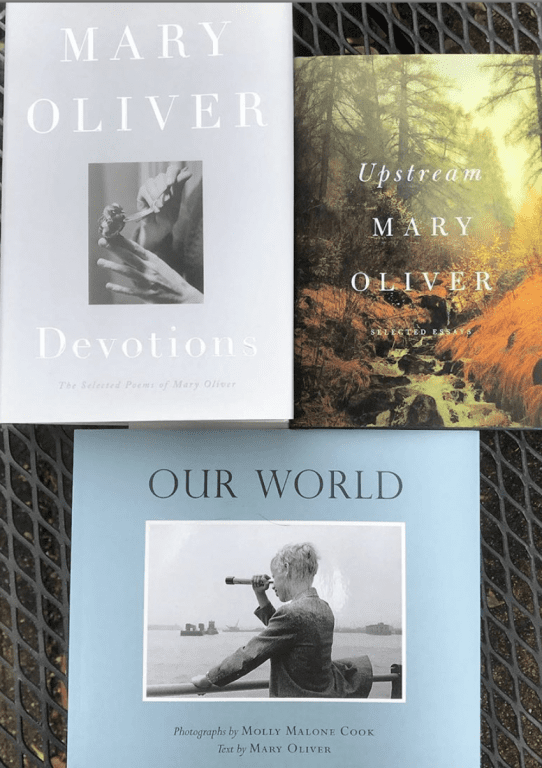
Mary Oliver was born in a semi-rural suburb of Cleveland, Ohio (“Poetry Foundation”). And she has been honest in interviews that she had a difficult childhood with significant neglect and abuse. To share only one of many such stories, she wrote in her 2016 book Upstream: Selected Essays of the time that, “My father took me ice-skating, then forgot me, and went home.” He didn’t remember that he had left her for many hours (Oliver 2016: 17). But it was also that toxic home environment that made her want to be out of the house as much as possible, and launched what would become a lifelong habit of long walks in the woods.
 Regarding her childhood, if there’s one thing that has been most frequently misunderstood about Mary Oliver, it is that many people have wrongly assumed that she was able to spend her days wandering in nature because she came from a privileged, pampered, and wealthy background. The opposite was the case. As she has written about the early years of her career, “We did not…have much income. We had love and work and play instead” (Cook 47).
By “we,” Mary Oliver means that in the late fifties, she met the photographer Mary Malone Cook, who became her partner in life. As Oliver wrote in a volume of prose and photographs co-authored with Cook titled Our World, although Cook was ten years her senior, “I took one look and fell, hook and tumble” (42). To make a brief connection to my previous blog post about the award-winning playwright and writer Lorraine Hansberry, prior to being with Mary Oliver, Cook was in a relationship with Hansberry. Indeed, the photograph on the cover of an excellent recent biography of Hansberry was taken by Cook. Oliver has written about that relationship: “I believe she loved totally and was loved totally. I know about it, and am glad” (3).
By the mid-1960s, however, Oliver and Cook were a couple and remained together in their beloved Provincetown, Massachusetts for more than four decades, until Cook’s death in 2005. And although Oliver is the one famous for writing, I love this passage from Cook’s journal:
Mary has just returned with yellow flowers and a wet Luke [meaning their dog] who has been swimming in the ponds. I always ask her for news…. What I mean is news of humans. Mary comes home with fox news, bird news, and her loving friends the geese Merlin and Dreamer, who are going to become parents under Mary’s eyes once again. How many years has she been watching them? They come running to her. That’s Mary’s news. (72)
Along these lines, if there is one major takeaway from the life and work of Mary Oliver, it is the transformative value of spending more time wandering around in nature with no goal other than to being open to wonder — and most importantly paying attention so that you don’t miss all the unexpected things there are to see, hear, touch, taste, and smell.
In a poem from her 1994 collection, White Pine, she says it this way: “To pay attention, this is our endless / and proper work” (2017: 264). Similarly, from her 2008 poem “Sometimes” in the collection Red Bird:
Instructions for living a life:
Pay attention.
Be astonished.
Tell about it. (Oliver 2017: 105)
On occasion, her poems are that explicit about what to do. More often, her poems simply show us the fruit of her own close and patient attention to nature.
While “Just Lying on the Grass at Blackwater,” a sparrow’s song comes to her attention, and she reflects:
All afternoon
I grow wiser, listening to him…. (Oliver 2017: 163-4)
I love that: noticing how we can grow wiser through time spent lying beside a pond listening to bird song.
From reading Mary Oliver, I also appreciate her advice that: “If you suddenly and unexpectedly feel joy, / don’t hesitate. Give in to it” (61). This sentiment reminds me of what is likely the most famous two lines Mary Oliver has ever written—from “The Summer Day,” which was part of her 1990 collection, House of Light. These two lines have appeared in so many places: spray-painted on walls; emblazoned on t-shirts, bumper stickers, Internet memes; quite a few people have these lines permanently tattooed on their body. The most famous couplet Mary Oliver ever wrote goes like this:
Tell me, what is it you plan to do
with your one wild and precious life? (Oliver 2017: 316)
One of the most recent places this quote has appeared is as the epigraph to Cheryl Strayed’s bestselling memoir Wild, endearing it to a whole new generation.
For now, as I move toward my conclusion, let me say a few words about Mary Oliver’s legacy. In 1965, the poet and novelist James Dickey (1923-1997) was invited to write a brief review for The New York Times of the then twenty-eight-year-old Mary Oliver’s first book of poetry, No Voyage. He gave her the backhanded compliment of being “good, but predictably good.” For the next more than five decades (from 1963 to 2016), Mary Oliver would publish at least thirty-six more books (mostly poetry as well as occasional prose). But none of her books ever received a full-length review in The New York Times.
That being said in 2007, an article in the Times itself confessed that the last laugh went to the Oliver. Even if many poetry critics said some pretty harsh things about her over the years, she won “a Pulitzer Prize in 1984 and a National Book Award in 1992…. And [even toward the end of her life she remained] far and away, this country’s best-selling poet…. [At that time,] the top 15 best-selling poetry volumes in America…included no fewer than five Mary Oliver titles, all published by Beacon Press of Boston.”
A New Yorker article from a few years ago on “What Mary Oliver’s Critics Don’t Understand” observed that,
Part of the key to Oliver’s appeal is her accessibility: she writes blank verse in a conversational style, with no typographical gimmicks. But an equal part is that she offers her readers a spiritual release that they might not have realized they were looking for. Oliver is an ecstatic poet in the vein of her idols, who include Shelley, Keats, and Whitman. She tends to use nature as a springboard to the sacred, which is the beating heart of her work.
To me this approach resonates strongly with the first of the UU Six Sources: “Direct experience of that transcending mystery and wonder, affirmed in all cultures, which moves us to a renewal of the spirit and an openness to the forces which create and uphold life.”
If this poetry service leaves you curious to read more Mary Oliver, I recommend starting with her recent collection titled Devotions, published in 2017, a little more than a year prior to her death. Mary Oliver herself made the selection of what poems to include, drawing from the entirety of her career, and she put the poems in reverse chronological order, so the newest are first (Oliver 2017: 443). There are also two excellent audiobooks of Oliver reading her poetry, also published by Beacon Press.
For now, in the spirit of reflecting on Oliver’s legacy, I invite you to consider these words from the end of her poem “When Death Comes” from her 1992 collection titled New and Selected Poems, which won the National Book Award:
When it’s over, I want to say: all my life
I was a bride married to amazement…. (Oliver 2017: 285-6)
Mary Oliver died a little more than a year ago in January 2019. The cause of death was lymphoma. She was 83 years old (NPR).
I think we can say looking back on the sweep of her more than eight decades on this planet that all her life she was married to amazement. She did not “simply visit this world.” She took this world lovingly in her arms and offered back the fruit of her loving attention to all who would take, read, and then do likewise.
As part of the benediction during each week’s Sunday Service, I invite the congregation I serve to notice that we are different for having spent that time together. And I know that I am different—I am a closer, more eager, more ecstatic observer of nature—for having spent more than twenty years at this point reading and re-reading Mary Oliver. In her writing, she is always teaching us, forming us, inviting us, luring us to pay attention to the world with the same wonder, awe, and devotion that she brought to her lifelong habit of long walks in nature. Her resulting poetry has been, and continues to be life-saving for many.
For now, I will leave the final words to Mary Oliver from the end of her poem “To Begin With, the Sweet Grass”:
And what do I risk to tell you this, which is all I know?
Love yourself. Then forget it. Then, love the world (79).
The Rev. Dr. Carl Gregg is a certified spiritual director, a D.Min. graduate of San Francisco Theological Seminary, and the minister of the Unitarian Universalist Congregation of Frederick, Maryland. Follow him on Facebook (facebook.com/carlgregg) and Twitter (@carlgregg).
Learn more about Unitarian Universalism: http://www.uua.org/beliefs/principles

Browse Our Archives
Select a Category Advent Anti-Racism Archaeology Atheism Baptism Best of the Year List Book Reviews Buddhism Catholicism Christian Education Church and State Church Planting Climate Change Conscientious Objection to War Creation Spirituality Death Penalty Didache Disability Rights Discernment Easter Ecology Emergent Church Movement Empire-Critical Ethics Evolution Feminist Theology Film Reviews Gandhi Gospel of Mark Gun Control Hinduism Immigration Reform Interfaith Islam JFK Judaism Jungian Spirituality Lectionary Commentary Lent Letters to the Editor LGBT Marriage MLK Multiculturalism Mysticism Nonviolent Activism Occupy Paganism (Earth-centered Religions) Parables Paul Pluralism Politics Process Theology Quantum Physics Requiescat In Pace Seminary and Divinity School Sermon Series Retrospective Sermons Spiritual Direction Spiritual Practices Stewardship (Fundraising) The Book of J The Wheel of the Year (Paganism) Theoblogger Challenge Triathlon Uncategorized Unitarian Universalism Worship Resources Youth Ministry
Select a Month July 2026 May 2026 March 2026 November 2025 October 2025 August 2025 February 2025 December 2024 October 2024 March 2024 January 2024 December 2023 November 2023 March 2023 February 2023 January 2023 December 2022 November 2022 August 2022 March 2022 February 2022 January 2022 December 2021 September 2021 August 2021 July 2021 June 2021 May 2021 February 2021 January 2021 December 2020 August 2020 June 2020 May 2020 April 2020 March 2020 February 2020 January 2020 December 2019 November 2019 October 2019 September 2019 July 2019 June 2019 March 2019 February 2019 January 2019 December 2018 November 2018 October 2018 September 2018 June 2018 May 2018 April 2018 March 2018 February 2018 January 2018 December 2017 November 2017 October 2017 September 2017 August 2017 July 2017 June 2017 May 2017 April 2017 March 2017 February 2017 January 2017 December 2016 November 2016 October 2016 September 2016 August 2016 June 2016 May 2016 April 2016 March 2016 February 2016 January 2016 December 2015 November 2015 October 2015 September 2015 August 2015 July 2015 June 2015 May 2015 April 2015 March 2015 February 2015 January 2015 December 2014 November 2014 October 2014 August 2014 July 2014 June 2014 May 2014 April 2014 March 2014 February 2014 January 2014 December 2013 November 2013 October 2013 September 2013 August 2013 July 2013 June 2013 May 2013 April 2013 March 2013 February 2013 January 2013 December 2012 November 2012 October 2012 September 2012 August 2012 July 2012 June 2012 May 2012 April 2012 March 2012 February 2012 January 2012 December 2011 November 2011 October 2011 September 2011 August 2011 July 2011 June 2011 May 2011 April 2011 March 2011 February 2011 January 2011 December 2010 November 2010 October 2010 August 2009 July 2009 May 2009
Follow Us!
TAKE THE
Religious Wisdom Quiz
Which book follows Psalms in the Bible?
Select your answer to see how you score.
Job Ecclesiastes Proverbs Song of Solomon
Related posts from Carl Gregg

Reading America at 250: A Nation Wrestles With...


Andrew Holocek on the Power of Darkness

The Stories That Shape Us: Myths, Archetypes, &...
TRENDING AT PATHEOS More Voices

Reading America at 250: A Nation Wrestles With...
As part of my own reflection on the 250th anniversary of the...

Whenever I am reading a book or listening to an argument, I...

President Trump Ban Animal Torture Videos on Facebook
Call for Stricter Regulations of Animal Abuse Content on Facebook Although President...

Draft Amendments to Address Ritual Abuse in New...
The proposed changes would make it illegal for individuals in domestic partnerships...

How Bans on LGBTQ+ Student Clubs Threaten Religious...
On June 20, 2025, the State of Texas passed Senate Bill 12....

The Truth About the Gen Z Revival
This past year, there has been a lot of media buzz surrounding...
view all More Voices blogs
Ad-Free & Subscriber Log-In Subscription Support
- About Us
- 2026 Calendar
- Videos
- Podcasts
- Library of World Religions
- Faith In Media Tracker
- Advertise With Us
- Write for Us
- Privacy Policy
- Terms of Service
- Do Not Sell My Data
- Contact Us
- Radiant Digital
- Manage Newsletter Subscriptions
- Unsubscribe From Notifications
- Sitemap
Copyright 2008-2026, Patheos. All rights reserved.
Subscription Support Ad-Free & Subscriber Log-In
Follow Patheos