
BuddhistCatholicContemplativeEvangelicalGeneral ChristianHinduJewishLatter-day SaintMuslimNew VisionsProgressive Christian
Beliefs
- Buddhist
- Catholic
- Contemplative
- Evangelical
- General Christian
- Hindu
- Jewish
- Latter-day Saint
- More Voices
- Muslim
- New Visions
- Pagan
- Progressive Christian
Topics
- Religion News
- Food and Religion
- Sports and Religion
- Religious Art
- Religious Music and Entertainment
- Religious Events
- History and Religion
- Style and Religion
- Politics and Religion
- Women in Religion
- Recreation Outdoors and Religion
- Business Finance and Religion
- Careers Workplace and Religion
- Education and Religion
- Family Parenting and Religion
- Health Fitness and Religion
- Home and Religion
- Relationships and Religion
- Technology and Religion
- Travel and Religion
Columnists
- Buddhist Columnists
- Business Finance and Religion Columnists
- Careers Workplace and Religion Columnists
- Catholic Columnists
- Contemplative Columnists
- Education and Religion Columnists
- Evangelists Columnists
- Family Parenting and Religion Columnists
- General Christian Columnists
- Health Fitness and Religion Columnists
- Hindu Columnists
- History and Religion Columnists
- Home and Religion Columnists
- Jewish Columnists
- More Voices Columnists
- Latter Day Columnists
- Muslim Columnists
- New Visions Columnists
- Nonreligious Columnists
- Pagan Columnists
- Politics and Religion Columnists
- Progressive Columnists
- Recreation Outdoors and Religion Columnists
- Relationships and Religion Columnists
- Religion News Columnists
- Religious Art Columnists
- Religious Events Columnists
- Religious Music and Entertainment Columnists
- Sports and Religion Columnists
- Style and Religion Columnists
- Technology and Religion Columnists
- Travel and Religion Columnists
- Women in Religion Columnists
Resource Library
- 2026 Calendar
- Library of World Religions
- The 100 Most Holy Places on Earth
- Patheos Answers
- Podcasts
- Videos
- Faith Leaders Database
- Anglican Episcopalian
- Bahai
- Baptist
- Buddhism
- Christianity
- Confucianism
- Eastern Orthodoxy
- Hinduism
- Holiness and Pentecostal
- ISKCON
- Islam
- Judaism
- Lutheran
- Methodist
- The Church of Jesus Christ of Latter-day Saints
- New Age
- Paganism
- Presbytarian and Reformed
- Protestantism
- Religion Behind the Scenes
- Roman Catholic
- Scientology
- Shia Islam
- Sikhism
- Sufism
- Sunni Islam
- Taoism
- Zen
- See all religions
Research Tools
 Ad-Free & Subscriber Log-In Subscription Support
Ad-Free & Subscriber Log-In Subscription Support
Follow Patheos 

- Trending:
- Forgiveness
- |
- Marriage
- |
- Consciousness
- |
- Death Penalty
- |
- Election
- |
- Halloween

- Home
- More Voices
- The Tangled Tree of Life: Celebrating #DarwinDay 2020
The Tangled Tree of Life: Celebrating #DarwinDay 2020
Last updated on: February 11, 2020 at 4:38 pm by Carl Gregg
The Tangled Tree of Life: Celebrating #DarwinDay 2020 2020-02-11T16:38:56-05:00 Carl Gregg
Patheos Explore the world's faith through different perspectives on religion and spirituality! Patheos has the views of the prevalent religions and spiritualities of the world.
Charles Darwin was born two hundred and eleven years ago this Wednesday, on February 12, 1809. And in recent years his birthday has been celebrated as International Darwin Day, an annual opportunity to celebrate the principles that guided his life: “perpetual curiosity, scientific thinking, and hunger for truth.”
As brilliant as Darwin was, a lot of additional scientific discoveries related to evolution have been made in the more than one hundred years since his death (202). So in the spirit of Darwin Day, I would like to invite us to take a brief tour of where those same characteristics of “perpetual curiosity, scientific thinking, and hunger for truth” that led to Darwin’s great discovery have taken scientists who have come after Darwin. In particular, I would like to focus on one recent and significant paradigm shift in the understandings of evolution called “horizontal gene transfer.”
In contrast to the recent breakthroughs related to horizontal gene transfer, Darwin conceived of evolution vertically. His primary metaphor was the tree of life that began at the root level with simpler life forms only to grow up and branch out into increasingly complex forms of life (6). Indeed, the only illustration in the first edition of Darwin’s 1859 book On the Origin of Species by Means of Natural Selection was a tree-life graphic of species branching up and out over time (32-33).
For Darwin, all living beings (including we human beings) are related due to our evolution from a common ancestor—what is called “common descent.” Over time, the ascending lines of species could diverge (or “branch out”), but those branches did not converge or come back together. In the traditional understanding of evolution, “genes flow only vertically (up the tree of life), from parent to offspring, and can’t be traded sideways across species” (xi). But it turns out that the tree of life is much more “tangled” than Darwin realized.
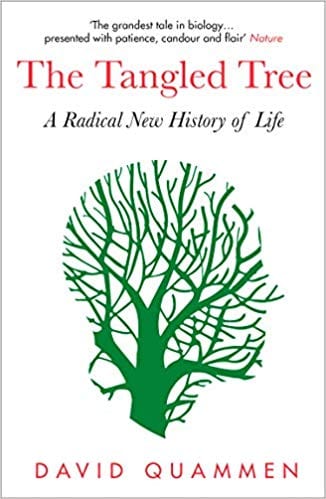 If this post leaves you curious to learn more, I recommend the book The Tangled Tree: A Radical New History of Life by David Quammen, which The New York Times named as one of their top 100 books of 2018.” Quammen is both a clear writer about technical topics and a weaver of many fascinating stories about the scientists behind the breakthrough discoveries.
Now, in the spirit of full disclosure, we’re going to get a little nerdy, but stick with me because it’s going to take us to some interesting places. For instance, consider that our human cells originally evolved not only
gradually in the typical Darwinian manner of gene mutation and natural selection…. Our mitochondria came aboard suddenly…as captured bacteria. Plants acquired their chloroplasts the same way. Our genomes are mosaics…. Roughly 8 percent of the human genome consists of the remnants of retroviruses that have invaded our lineage—invaded the DNA, not just the bodies, of our ancestors—and stayed. We are at least one-twelfth viral, at the deepest core of our identities. (349)
Such insights are arguably part of the third revolution in evolutionary science, with the first beginning with Darwin, the second with Mendel and genetics, and the fourth potentially on the horizon with the genome-engineering power of CRISPR.
And although understanding the origins of life is important in itself, one of the most practical reasons to better understand this phenomenon is that horizontal gene transfer is a major contributing factor to the rapid evolution of antibiotic resistant bacteria (such as the super bug MRSA) that is very much still happening in our own time (239).
Thinking back, I can’t remember with certainty if I learned about horizontal gene transfer when I took a formal Biology class in the mid-1990s. But scientists have been taking increasing note of horizontal gene transfer since the 1980s (255). And the study of this phenomenon became much easier and faster in the mid-1990s due to technological advances related to the Human Genome Project, which mapped all the genes in our human DNA (274).
Also since the film Dolittle is in theaters these days, let me relatedly tell you about a real-life Dr. Dr. Ford Doolittle (1941-), who is an evolutionary and molecular biologist and currently a professor emeritus at Dalhousie University in Nova Scotia. I love the story about him, that in 1998, the journal Science contacted him for a recommendation of someone who could write an article from a microbiology perspective for their upcoming special issue on evolution.
To their surprise he nominated himself. When he added that he wanted to use this opportunity to raise awareness in the scientific community about the under-appreciated importance of horizontal gene transfer, they were not wild about the idea, but it would have been too rude at that point to rescind the offer (283). His article, published the next year in 1999 was even more successful that he could have hoped: “Suddenly horizontal gene transfer seemed a mainstream idea, an ongoing process of major importance at least in microbial evolution—something that had to be considered and discussed—rather than a hallucination, an artifact, or a quirk” (287).
And keeping in mind that single illustration that Darwin had included in his first edition of Origin, Doolittle’s article included an important sketch that riffed on Darwin’s tree of life. Doolittle called it a “reticulated tree” from the verb meaning to “divide or mark (something) in such a way as to resemble a net or network.” I find that fascinating: thinking of evolution less as a tree and more as a net or network. Doolittle’s reticulated tree had branches not only going out and up, but also making many connections weaving in and out horizontally—almost like a bramble or thicket. (285).
The more scientists have dived into this new paradigm, the deeper the rabbit hole seems to go, kind of like those Matryoshka “Russian nesting” dolls: with each one that you remove, there’s still another inside. Specifically, remember what I shared earlier about how bacteria captured early in eukaryotic cells became mitochondria in our cells, and chloroplasts in plant cells? Well, scientists have further discovered that those pivotal bacteria:
had themselves been recipients of horizontal gene transfer, from different kinds of bacteria, before their capture. This means that parts of genomes existed within other genomes before becoming parts of still other genomes, including yours. It is all a snarl…a mess…a plate of spaghetti (295).
So although evolution is not as classically majestic as a tree, that intricate web of genetic inheritance remains compelling nonetheless.
To underscore my primary takeaway from exploring this still-developing corner of science, horizontal gene transfer strikes me as a powerful reminder of what my tradition of Unitarian Universalism calls our Seventh Principle, “Respect for the interdependent web of all existence of which we are a part.” We humans are incredible animals in so many ways, but not because we were spoken into existence a few thousand years ago in a separate, special act of creation. Thinking and acting along those lines has gotten us to a point of climate catastrophe. We must learn to understand ourselves as evolving through a process that is deeply intricate, interwoven, and interdependent with the other forms of life and ecosystems of this planet.
Evolution has often been understood as almost exclusively about the “survival of the fittest.” In Tennyson’s words, “Nature, red in tooth and claw.” But in the words of one scientist: more than a century after Darwin’s death, we are coming to a fuller understanding of evolution as “much more about mergers and acquisitions and collaboration than about change within isolated lineages. It is about not just the divergence of branches but also their inosculation”—a fancy word for when “trunks, branches or roots of two trees grow together” (304).
I find these scientific shifts astonishing. And since microbiology, bacteria, and viruses are such crucial parts of horizontal gene transfer, allow me to move toward my conclusion with one more story that exemplifies the Darwin Day spirit of “perpetual curiosity, scientific thinking, and hunger for truth.” All this talk of microbiology also reminded me of someone I hadn’t thought much about in decades—not since those aforementioned days of high school AP Biology II. The person I’m thinking of is Antonie van Leeuwenhoek (1632-1723), a Dutch businessman who is best remembered for being “the Father of Microbiology” (11).
Back in the 1670s, more than 150 years before Darwin, Leeuwenhoek made his living as a draper: he owned and operated a drapery shop. And at first, he began making magnifying lenses to more accurately ascertain the thread-count on his draperies. By chance, the idea occurred to him to examine other items under his magnifying lenses. To his astonishment, he discovered an abundance of tiny creatures swimming around in various nearby water samples that he gathered—as well as tiny creatures swimming around in scrapings that he took from his own mouth (12). Can you imagine how shocking and disturbing that first glimpse of microbiology must have been!
I also love that microbiology was founded when some dude, who was simply trying to make sure that his thread count was on point, happened to stumble backward into a whole other level of reality—one that was teeming with life—that had been there all along. We just hadn’t noticed yet! From that happenstance discovery, so much has flowed. We now know that:
the total mass of bacteria exceeds the total mass of all plants and animals on Earth…. There may be more than a billion bacterial cells in an average ounce of soil, and five million in a teaspoon of fresh water…. A single kind of marine bacteria…which drifts free in the world’s tropical oceans and photosynthesizes like a plant, may be the most abundant creature on Earth. One source places its standing population at three octillion individuals….” (86).
That’s a three followed by twenty-seven zeros. And with the discovery of horizontal gene transfer, we are increasingly aware of how all those teeming hordes of bacteria are much more deeply woven into ourselves than we could have previously imagined.
Our awareness of this micro-aspect of our reality came from an individual closely observing how the world actually is—which can often be quite different than what we have been told. Darwin did likewise. He was a naturalist who spent incredible amounts of time tracing, logging, and comparing various forms of life: discovering what forms of life are actually out there—and how they evolved—beyond what had been previously known.
The philosopher Ludwig Wittgenstein used to say it this way: “Don’t think — but look and see!” Don’t think you know how the world is. Look and see. You might be surprised what you discover.
So, continuing in the Darwin Day spirit of “perpetual curiosity, scientific thinking, and hunger for truth,” I will conclude with the final paragraph of Darwin’s 1859 book On the Origin of Species. Whereas many scientific texts are often not well written and become obsolete after new discoveries are made, Darwin’s books have been widely praised for both the beauty of his prose and for being well worth revisiting even more than a century and a half later. So, I invite you to consider anew these words from the conclusion to Origin. Note that Darwin begins by naming aspects of life we often perceive as solely negative—then shows how those very things are essential to the engine of evolution. In Darwin’s words:
from the war of nature,
from famine and death,
the most exalted object which we are capable of conceiving…
the production of the higher animals,
directly follows.
There is grandeur in this view of life…; and
whilst this planet has gone cycling on
according to the fixed law of gravity,
from so simple a beginning
endless forms
most beautiful and
most wonderful
have been,
and are being,
evolved.
The Rev. Dr. Carl Gregg is a certified spiritual director, a D.Min. graduate of San Francisco Theological Seminary, and the minister of the Unitarian Universalist Congregation of Frederick, Maryland. Follow him on Facebook (facebook.com/carlgregg) and Twitter (@carlgregg).
Learn more about Unitarian Universalism: http://www.uua.org/beliefs/principles
Previous Post

February 6, 2020
The Love of Wisdom & the Wisdom of Love
Next Post
February 20, 2020 "The Radiant & Radical Life of Lorraine Hansberry"
Browse Our Archives
Select a Category Advent Anti-Racism Archaeology Atheism Baptism Best of the Year List Book Reviews Buddhism Catholicism Christian Education Church and State Church Planting Climate Change Conscientious Objection to War Creation Spirituality Death Penalty Didache Disability Rights Discernment Easter Ecology Emergent Church Movement Empire-Critical Ethics Evolution Feminist Theology Film Reviews Gandhi Gospel of Mark Gun Control Hinduism Immigration Reform Interfaith Islam JFK Judaism Jungian Spirituality Lectionary Commentary Lent Letters to the Editor LGBT Marriage MLK Multiculturalism Mysticism Nonviolent Activism Occupy Paganism (Earth-centered Religions) Parables Paul Pluralism Politics Process Theology Quantum Physics Requiescat In Pace Seminary and Divinity School Sermon Series Retrospective Sermons Spiritual Direction Spiritual Practices Stewardship (Fundraising) The Book of J The Wheel of the Year (Paganism) Theoblogger Challenge Triathlon Uncategorized Unitarian Universalism Worship Resources Youth Ministry
Select a Month July 2026 May 2026 March 2026 November 2025 October 2025 August 2025 February 2025 December 2024 October 2024 March 2024 January 2024 December 2023 November 2023 March 2023 February 2023 January 2023 December 2022 November 2022 August 2022 March 2022 February 2022 January 2022 December 2021 September 2021 August 2021 July 2021 June 2021 May 2021 February 2021 January 2021 December 2020 August 2020 June 2020 May 2020 April 2020 March 2020 February 2020 January 2020 December 2019 November 2019 October 2019 September 2019 July 2019 June 2019 March 2019 February 2019 January 2019 December 2018 November 2018 October 2018 September 2018 June 2018 May 2018 April 2018 March 2018 February 2018 January 2018 December 2017 November 2017 October 2017 September 2017 August 2017 July 2017 June 2017 May 2017 April 2017 March 2017 February 2017 January 2017 December 2016 November 2016 October 2016 September 2016 August 2016 June 2016 May 2016 April 2016 March 2016 February 2016 January 2016 December 2015 November 2015 October 2015 September 2015 August 2015 July 2015 June 2015 May 2015 April 2015 March 2015 February 2015 January 2015 December 2014 November 2014 October 2014 August 2014 July 2014 June 2014 May 2014 April 2014 March 2014 February 2014 January 2014 December 2013 November 2013 October 2013 September 2013 August 2013 July 2013 June 2013 May 2013 April 2013 March 2013 February 2013 January 2013 December 2012 November 2012 October 2012 September 2012 August 2012 July 2012 June 2012 May 2012 April 2012 March 2012 February 2012 January 2012 December 2011 November 2011 October 2011 September 2011 August 2011 July 2011 June 2011 May 2011 April 2011 March 2011 February 2011 January 2011 December 2010 November 2010 October 2010 August 2009 July 2009 May 2009
Follow Us!
TAKE THE
Religious Wisdom Quiz
Which Gospel contains the "Sermon on the Mount"?
Select your answer to see how you score.
Luke John Mark Matthew
Related posts from Carl Gregg

Reading America at 250: A Nation Wrestles With...


Andrew Holocek on the Power of Darkness

The Stories That Shape Us: Myths, Archetypes, &...
TRENDING AT PATHEOS More Voices

Reading America at 250: A Nation Wrestles With...
As part of my own reflection on the 250th anniversary of the...

Whenever I am reading a book or listening to an argument, I...

President Trump Ban Animal Torture Videos on Facebook
Call for Stricter Regulations of Animal Abuse Content on Facebook Although President...

Draft Amendments to Address Ritual Abuse in New...
The proposed changes would make it illegal for individuals in domestic partnerships...

How Bans on LGBTQ+ Student Clubs Threaten Religious...
On June 20, 2025, the State of Texas passed Senate Bill 12....

The Truth About the Gen Z Revival
This past year, there has been a lot of media buzz surrounding...
view all More Voices blogs
Ad-Free & Subscriber Log-In Subscription Support
- About Us
- 2026 Calendar
- Videos
- Podcasts
- Library of World Religions
- Faith In Media Tracker
- Advertise With Us
- Write for Us
- Privacy Policy
- Terms of Service
- Do Not Sell My Data
- Contact Us
- Radiant Digital
- Manage Newsletter Subscriptions
- Unsubscribe From Notifications
- Sitemap
Copyright 2008-2026, Patheos. All rights reserved.
Subscription Support Ad-Free & Subscriber Log-In
Follow Patheos