
BuddhistCatholicContemplativeEvangelicalGeneral ChristianHinduJewishLatter-day SaintMuslimNew VisionsProgressive Christian
Beliefs
- Buddhist
- Catholic
- Contemplative
- Evangelical
- General Christian
- Hindu
- Jewish
- Latter-day Saint
- More Voices
- Muslim
- New Visions
- Pagan
- Progressive Christian
Topics
- Religion News
- Food and Religion
- Sports and Religion
- Religious Art
- Religious Music and Entertainment
- Religious Events
- History and Religion
- Style and Religion
- Politics and Religion
- Women in Religion
- Recreation Outdoors and Religion
- Business Finance and Religion
- Careers Workplace and Religion
- Education and Religion
- Family Parenting and Religion
- Health Fitness and Religion
- Home and Religion
- Relationships and Religion
- Technology and Religion
- Travel and Religion
Columnists
- Buddhist Columnists
- Business Finance and Religion Columnists
- Careers Workplace and Religion Columnists
- Catholic Columnists
- Contemplative Columnists
- Education and Religion Columnists
- Evangelists Columnists
- Family Parenting and Religion Columnists
- General Christian Columnists
- Health Fitness and Religion Columnists
- Hindu Columnists
- History and Religion Columnists
- Home and Religion Columnists
- Jewish Columnists
- More Voices Columnists
- Latter Day Columnists
- Muslim Columnists
- New Visions Columnists
- Nonreligious Columnists
- Pagan Columnists
- Politics and Religion Columnists
- Progressive Columnists
- Recreation Outdoors and Religion Columnists
- Relationships and Religion Columnists
- Religion News Columnists
- Religious Art Columnists
- Religious Events Columnists
- Religious Music and Entertainment Columnists
- Sports and Religion Columnists
- Style and Religion Columnists
- Technology and Religion Columnists
- Travel and Religion Columnists
- Women in Religion Columnists
Resource Library
- 2026 Calendar
- Library of World Religions
- The 100 Most Holy Places on Earth
- Patheos Answers
- Podcasts
- Videos
- Faith Leaders Database
- Anglican Episcopalian
- Bahai
- Baptist
- Buddhism
- Christianity
- Confucianism
- Eastern Orthodoxy
- Hinduism
- Holiness and Pentecostal
- ISKCON
- Islam
- Judaism
- Lutheran
- Methodist
- The Church of Jesus Christ of Latter-day Saints
- New Age
- Paganism
- Presbytarian and Reformed
- Protestantism
- Religion Behind the Scenes
- Roman Catholic
- Scientology
- Shia Islam
- Sikhism
- Sufism
- Sunni Islam
- Taoism
- Zen
- See all religions
Research Tools
 Ad-Free & Subscriber Log-In Subscription Support
Ad-Free & Subscriber Log-In Subscription Support
Follow Patheos 

- Trending:
- Forgiveness
- |
- Marriage
- |
- Consciousness
- |
- Death Penalty
- |
- Election
- |
- Halloween

- Home
- More Voices
- The Love of Wisdom & the Wisdom of Love
The Love of Wisdom & the Wisdom of Love
Last updated on: February 6, 2020 at 9:26 am by Carl Gregg
The Love of Wisdom & the Wisdom of Love 2020-02-06T09:26:15-05:00 Carl Gregg
Patheos Explore the world's faith through different perspectives on religion and spirituality! Patheos has the views of the prevalent religions and spiritualities of the world.
For the Ordination of Scot Hull as a Unitarian Universalist Minister
Traditional Reading (Proverbs 3:13-18): 13 Blessed are those who find wisdom, those who gain understanding, 14 for she is more profitable than silver and yields better returns than gold. 15 She is more precious than rubies; nothing you desire can compare with her. 16 Long life is in her right hand; in her left hand are riches and honor. 17 Her ways are pleasant ways, and all her paths are peace. 18 She is a tree of life to those who take hold of her; those who hold her fast will be blessed.
Traditional Reading (Mark 12:28-31): 28 One of the teachers of the law came and heard them debating. Noticing that Jesus had given them a good answer, he asked him, “Of all the commandments, which is the most important?” 29 “The most important one,” answered Jesus, “is this: ‘Hear, O Israel: The Lord our God, the Lord is one. 30 Love the Lord your God with all your heart and with all your soul and with all your mind and with all your strength.’ 31 The second is this: ‘Love your neighbor as yourself.’There is no commandment greater than these.”
Contemporary Reading (“Pale Blue Dot” – Carl Sagan): Look again at that dot. That’s here. That’s home. That’s us. On it everyone you love, everyone you know, everyone you ever heard of, every human being who ever was, lived out their lives. The aggregate of our joy and suffering, thousands of confident religions, ideologies, and economic doctrines, every hunter and forager, every hero and coward, every creator and destroyer of civilization, every king and peasant, every young couple in love, every mother and father, hopeful child, inventor and explorer, every teacher of morals, every corrupt politician, every “superstar,” every “supreme leader,” every saint and sinner in the history of our species lived there–on a mote of dust suspended in a sunbeam. The Earth is a very small stage in a vast cosmic arena. Think of the rivers of blood spilled by all those generals and emperors so that, in glory and triumph, they could become the momentary masters of a fraction of a dot. Think of the endless cruelties visited by the inhabitants of one corner of this pixel on the scarcely distinguishable inhabitants of some other corner, how frequent their misunderstandings, how eager they are to kill one another, how fervent their hatreds. Our posturings, our imagined self-importance, the delusion that we have some privileged position in the Universe, are challenged by this point of pale light. Our planet is a lonely speck in the great enveloping cosmic dark. In our obscurity, in all this vastness, there is no hint that help will come from elsewhere to save us from ourselves. The Earth is the only world known so far to harbor life. There is nowhere else, at least in the near future, to which our species could migrate. Visit, yes. Settle, not yet. Like it or not, for the moment the Earth is where we make our stand. It has been said that astronomy is a humbling and character-building experience. There is perhaps no better demonstration of the folly of human conceits than this distant image of our tiny world. To me, it underscores our responsibility to deal more kindly with one another, and to preserve and cherish the pale blue dot, the only home we’ve ever known.
Let’s start closest to our own time. Scot, for your contemporary reading, you chose a passage from Carl Sagan’s final book for a popular audience, Pale Blue Dot: A Vision of the Human Future in Space. It was published in 1994, two years before his death. (He was only 62 when he died.)
The inspiration for that final book is the Pale Blue Dot photograph taken in 1990 of planet Earth from 3.7 billion miles away by the Voyager 1 space probe: “In the photograph, Earth’s apparent size is less than a pixel; [our] planet appears as a tiny dot against the vastness of space, among bands of sunlight reflected by the camera.”
Turning to our traditional readings, do passages from millennia-old scriptures still matter in the face of our insignificance in the grand scheme of thing? Sagan challenges us that from a deep space perspective, “everyone you love [is] on a mote of dust suspended in a sunbeam.” (Although I will add that the more I’ve thought about it, it arguably sounds kind of cool when you say it that way. Or maybe I just have a perverse sense of what’s cool!)
Regardless—since, prior to seminary, one of Scot’s former lives included graduate school in philosophy, allow me to briefly bring in one of the passages that has stayed with me all these years later from my days as an undergraduate philosophy major. It is from the final paragraph of an essay titled “The Absurd” by the philosopher Thomas Nagel (1937-), who is the University Professor of Philosophy and Law, Emeritus, at New York University.
In the essay, Nagel is wrestling with our cosmological context as did Sagan before him. How shall we live once we know just how far we are from being the center of “life, the universe, and everything.” Our planet is only the third rock from the sun. We are not even at the center of our solar system is; rather, we are on the edge of the Milky Way Galaxy that is merely one among more than two trillion galaxies in the universe. (And that’s not even getting into the real possibility that we live not in a universe, but a multiverse.)
Once we become aware of our infinitesimal place in the larger scheme of things, reality can begin to seem absurd; hence, the title of Nagel’s essay. One response might be to throw up your hands in despair and declare that nothing matters. Nagel disagrees with that choice, and here’s the paragraph that stuck with me:
If a sense of the absurd is a way of perceiving our true situation…then what reason can we have to resent or escape it? …It results from the ability to understand our human limitations. It need not be a matter for agony unless we make it so… Such dramatics, even if carried on in private, betray a failure to appreciate the cosmic unimportance of the situation. If [in a universal perspective] there is no reason to believe that anything matters, then that doesn’t matter either.…
I love what he does there. If we don’t matter in the grand scheme of things, then the grand scheme of things doesn’t have to matter to us.
To sneak in another philosopher, this time the late American pragmatist Richard Rorty, this insight is “not to say something philosophical and pessimistic but something political and hopeful—namely, if we can work together, we can make ourselves into whatever we are clever and courageous enough to imagine ourselves becoming.” Since our situation is absurd, and there is nothing forcing our hand and guaranteeing either good or bad results, *the choice is ours—radically ours—*to do what we can on this “pale blue dot,” where we find ourselves.
Now, as Unitarian Universalists, we are typically a fan of choice. Our movement has been called A Chosen Faith. We value the importance of individuals freely choosing to be in covenant with us. We value each individual’s “free and responsible search for truth and meaning,” although occasionally folks among us overemphasize the “free” part of that search—and forget about the “responsible” part, but that’s a sermon for another day!
As UUs, we tend to be fairly ok with folks “picking and choosing.” If a doctrine or practice feels obsolete, pretend you are in the film Frozen—and “let it go!” But let’s keep the parts that continue to feel life-giving and relevant. I experienced a much different approach to tradition growing up in a theologically conservative church. I remember “picking and choosing,” especially in regard to the Bible, as something regularly condemned.
And it is here that those millennia-old scripture passages that Scot chose may have some significant wisdom for us early twenty-first century mortals amidst all our absurdity. When you heard that passage earlier from the Gospel of Mark, did you notice that picking and choosing is precisely what Jesus did? He was asked, “Which commandment is the first of all?” Behind the question is that Jews have traditionally identified 613 commandments (or mitzvot) in the Torah.
So Jesus was being asked which one of those 613 was most important. He could have said, “Picking and choosing is bad; all 613 are equally important.” Or he could have chosen one of passages that has been used to justify patriarchy, xenophobia, or violence. Instead, he did pick, and he chose love.
Jesus, who would have been familiar with all 613 commandments from the Torah, chose to lift up what we call Deuteronomy 6:4-5 (also known as the Shema) as the first and greatest commandment: “You shall love…God with all your heart…soul, and…might.”
And he didn’t stop there. Jesus went the “second mile” beyond what his questioner asked, and named the second greatest commandment. This time, Jesus looked to the book of Leviticus. Especially after choosing the love of God for the gold medal, perhaps it would have been logical to choose a more “realistic” option to receive the silver. After all, he was looking to the book of Leviticus, which is replete with oppressive content as well as the occasional standout feature. (If you’re not sure what I’m talking about, check out Leviticus 25 about the year of Jubilee.) In the midst of a book that also has a lot of restrictive rules regarding holiness, Jesus singled-out the following verse for the second greatest commandment: “You shall love your neighbor as yourself” (Leviticus 19:18). That’s some savvy “picking and choosing!”
And let me say a little more about why this whole “picking and choosing” is so important. More than a decade ago, I was a pastor in northeast Louisiana, one of the most conservative parts of the country. And when I would sometimes find myself in debates about whether same-sex marriage should be legal, the single most common strategy I would encounter is someone quoting one of the seven so-called “clobber passages” in the Bible that people have so often used to justify homophobia and heterosexism. (The same dynamics play out around other classic “clobber passages” used to justify slavery, sexism, racism, genocide, and other atrocities.)
After quoting such a passage, I would often hear someone say that they wished the Bible didn’t say that, but that’s what it says, and “We can’t pick and choose.” (Psychologists call this defense externalizing!) When asked to present a more progressive perspective, I would sometimes begin by showing a short video clip called “Prop 8: The Musical.” Some of you may recall that Proposition 8 was passed in 2008, adding an amendment to the California Constitution that said, “Only marriage between a man and a woman is valid.” In the video, a group of conservatives and a group of liberals are fighting about what the Bible says about homosexuality, when suddenly comedian Jack Black appears, dressed as Jesus.
When asked if the Bible says “‘These people’ are an abomination,” he replies, “Well…it says the exact same thing about this shrimp cocktail.” Jack Black as Jesus continues by saying, “You know, the Bible says a lot of interesting things…like you can stone your wife or sell your daughter in slavery.” Aghast, someone in the crowd objects, “Well, we ignore those verses.” Jack Black as Jesus wastes no time in retorting, “Well then, it seems to me you pick and choose. And if you pick and choose, why not choose love instead of hate – after all, your nation was founded on the separation of church and state.” Jack Black as Jesus then slowly fades away saying, “See ya lata’, sinners!”
Although many millennia have passed since these traditional scripture passages were first written, this piece of ancient Jewish wisdom seems as relevant as ever: given a choice of 613 commandments, “the greatest of these is love.” Or in Dr. King’s words “I have decided to stick with love. Hate is too great a burden to bear.”
Now, let’s talk a little more about love. I mentioned earlier that Scot and I have the academic study of philosophy in common. Philosophy comes from 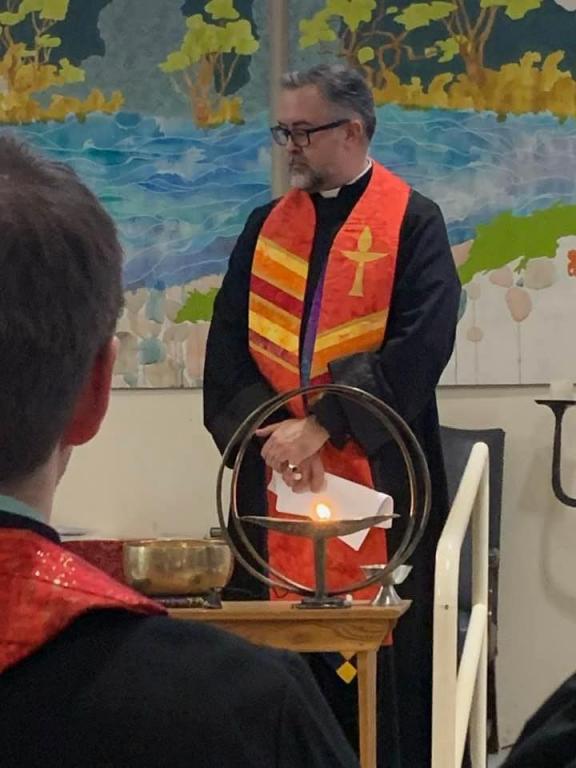 the combination of two Greek words. The first half, φιλο/philo, means (“love”), and the second half, σοφία/sophia, mean “wisdom”—so a philosopher is a lover of wisdom. That spirit is beautifully represented in the passage Scot chose from Proverbs: “Blessed are those who find wisdom, those who gain understanding….” But, Scot, here’s the thing: you didn’t end up with that Ph.D. in Philosophy—not that there’s anything wrong with that. (I didn’t either, although it’s a path I considered at one point.) But you have ended up with a Master of Divinity, although there may yet be further degrees in your future.
What I want to lift up this afternoon—on this your ordination day— is that there’s something significant in you feeling called to quit your job and go back to school not to finish your doctorate in philosophy, but to earn a professional degree in ministry. I hope and expect you will bring your wide-ranging love of philosophy—your love of wisdom—to your work as a UU minister. I suspect it will continue to serve you and those around you well.
Even more importantly, may your ministry shift your heart ever more fully from the love of wisdom to the wisdom of love. Scot, when you have a choice—and we almost always do have a choice—choose love. We are twenty-first century Unitarian Universalists. As UU ministers—and you are about to become one—we have so much freedom over what to preach, what to teach, and how to spend our time. And since we get to pick and choose, why not choose love?
For now, I’ll leave you with these words of wisdom from Helen Schucman (1909-1981), a professor of medical psychology at Columbia University in New York, who unexpectedly found herself caught up in channeling words of love such as this piece of wisdom: “Your task is not to seek for love, but merely to seek and find all the barriers within yourself that you have built against it.” Your task, Scot—as you prepare to go from this sanctuary as the newest ordained minister in our living tradition—is not to seek for love, but merely to seek and find all the barriers within yourself that you have built against it.”
The Rev. Dr. Carl Gregg is a certified spiritual director, a D.Min. graduate of San Francisco Theological Seminary, and the minister of the Unitarian Universalist Congregation of Frederick, Maryland. Follow him on Facebook (facebook.com/carlgregg) and Twitter (@carlgregg).
Learn more about Unitarian Universalism: http://www.uua.org/beliefs/principles
Previous Post

January 8, 2020
Marie Kondo, Animism, & Changing Your Life
Next Post
February 11, 2020 The Tangled Tree of Life: Celebrating #DarwinDay 2020
Browse Our Archives
Select a Category Advent Anti-Racism Archaeology Atheism Baptism Best of the Year List Book Reviews Buddhism Catholicism Christian Education Church and State Church Planting Climate Change Conscientious Objection to War Creation Spirituality Death Penalty Didache Disability Rights Discernment Easter Ecology Emergent Church Movement Empire-Critical Ethics Evolution Feminist Theology Film Reviews Gandhi Gospel of Mark Gun Control Hinduism Immigration Reform Interfaith Islam JFK Judaism Jungian Spirituality Lectionary Commentary Lent Letters to the Editor LGBT Marriage MLK Multiculturalism Mysticism Nonviolent Activism Occupy Paganism (Earth-centered Religions) Parables Paul Pluralism Politics Process Theology Quantum Physics Requiescat In Pace Seminary and Divinity School Sermon Series Retrospective Sermons Spiritual Direction Spiritual Practices Stewardship (Fundraising) The Book of J The Wheel of the Year (Paganism) Theoblogger Challenge Triathlon Uncategorized Unitarian Universalism Worship Resources Youth Ministry
Select a Month July 2026 May 2026 March 2026 November 2025 October 2025 August 2025 February 2025 December 2024 October 2024 March 2024 January 2024 December 2023 November 2023 March 2023 February 2023 January 2023 December 2022 November 2022 August 2022 March 2022 February 2022 January 2022 December 2021 September 2021 August 2021 July 2021 June 2021 May 2021 February 2021 January 2021 December 2020 August 2020 June 2020 May 2020 April 2020 March 2020 February 2020 January 2020 December 2019 November 2019 October 2019 September 2019 July 2019 June 2019 March 2019 February 2019 January 2019 December 2018 November 2018 October 2018 September 2018 June 2018 May 2018 April 2018 March 2018 February 2018 January 2018 December 2017 November 2017 October 2017 September 2017 August 2017 July 2017 June 2017 May 2017 April 2017 March 2017 February 2017 January 2017 December 2016 November 2016 October 2016 September 2016 August 2016 June 2016 May 2016 April 2016 March 2016 February 2016 January 2016 December 2015 November 2015 October 2015 September 2015 August 2015 July 2015 June 2015 May 2015 April 2015 March 2015 February 2015 January 2015 December 2014 November 2014 October 2014 August 2014 July 2014 June 2014 May 2014 April 2014 March 2014 February 2014 January 2014 December 2013 November 2013 October 2013 September 2013 August 2013 July 2013 June 2013 May 2013 April 2013 March 2013 February 2013 January 2013 December 2012 November 2012 October 2012 September 2012 August 2012 July 2012 June 2012 May 2012 April 2012 March 2012 February 2012 January 2012 December 2011 November 2011 October 2011 September 2011 August 2011 July 2011 June 2011 May 2011 April 2011 March 2011 February 2011 January 2011 December 2010 November 2010 October 2010 August 2009 July 2009 May 2009
Follow Us!
TAKE THE
Religious Wisdom Quiz
Which Psalm contains "Create in me a clean heart, O God"?
Select your answer to see how you score.
Psalm 51 Psalm 33 Psalm 110 Psalm 70
Related posts from Carl Gregg

Reading America at 250: A Nation Wrestles With...


Andrew Holocek on the Power of Darkness

The Stories That Shape Us: Myths, Archetypes, &...
TRENDING AT PATHEOS More Voices

Reading America at 250: A Nation Wrestles With...
As part of my own reflection on the 250th anniversary of the...

Whenever I am reading a book or listening to an argument, I...

President Trump Ban Animal Torture Videos on Facebook
Call for Stricter Regulations of Animal Abuse Content on Facebook Although President...

Draft Amendments to Address Ritual Abuse in New...
The proposed changes would make it illegal for individuals in domestic partnerships...

How Bans on LGBTQ+ Student Clubs Threaten Religious...
On June 20, 2025, the State of Texas passed Senate Bill 12....

The Truth About the Gen Z Revival
This past year, there has been a lot of media buzz surrounding...
view all More Voices blogs
Ad-Free & Subscriber Log-In Subscription Support
- About Us
- 2026 Calendar
- Videos
- Podcasts
- Library of World Religions
- Faith In Media Tracker
- Advertise With Us
- Write for Us
- Privacy Policy
- Terms of Service
- Do Not Sell My Data
- Contact Us
- Radiant Digital
- Manage Newsletter Subscriptions
- Unsubscribe From Notifications
- Sitemap
Copyright 2008-2026, Patheos. All rights reserved.
Subscription Support Ad-Free & Subscriber Log-In
Follow Patheos