
BuddhistCatholicContemplativeEvangelicalGeneral ChristianHinduJewishLatter-day SaintMuslimNew VisionsProgressive Christian
Beliefs
- Buddhist
- Catholic
- Contemplative
- Evangelical
- General Christian
- Hindu
- Jewish
- Latter-day Saint
- More Voices
- Muslim
- New Visions
- Pagan
- Progressive Christian
Topics
- Religion News
- Food and Religion
- Sports and Religion
- Religious Art
- Religious Music and Entertainment
- Religious Events
- History and Religion
- Style and Religion
- Politics and Religion
- Women in Religion
- Recreation Outdoors and Religion
- Business Finance and Religion
- Careers Workplace and Religion
- Education and Religion
- Family Parenting and Religion
- Health Fitness and Religion
- Home and Religion
- Relationships and Religion
- Technology and Religion
- Travel and Religion
Columnists
- Buddhist Columnists
- Business Finance and Religion Columnists
- Careers Workplace and Religion Columnists
- Catholic Columnists
- Contemplative Columnists
- Education and Religion Columnists
- Evangelists Columnists
- Family Parenting and Religion Columnists
- General Christian Columnists
- Health Fitness and Religion Columnists
- Hindu Columnists
- History and Religion Columnists
- Home and Religion Columnists
- Jewish Columnists
- More Voices Columnists
- Latter Day Columnists
- Muslim Columnists
- New Visions Columnists
- Nonreligious Columnists
- Pagan Columnists
- Politics and Religion Columnists
- Progressive Columnists
- Recreation Outdoors and Religion Columnists
- Relationships and Religion Columnists
- Religion News Columnists
- Religious Art Columnists
- Religious Events Columnists
- Religious Music and Entertainment Columnists
- Sports and Religion Columnists
- Style and Religion Columnists
- Technology and Religion Columnists
- Travel and Religion Columnists
- Women in Religion Columnists
Resource Library
- 2026 Calendar
- Library of World Religions
- The 100 Most Holy Places on Earth
- Patheos Answers
- Podcasts
- Videos
- Faith Leaders Database
- Anglican Episcopalian
- Bahai
- Baptist
- Buddhism
- Christianity
- Confucianism
- Eastern Orthodoxy
- Hinduism
- Holiness and Pentecostal
- ISKCON
- Islam
- Judaism
- Lutheran
- Methodist
- The Church of Jesus Christ of Latter-day Saints
- New Age
- Paganism
- Presbytarian and Reformed
- Protestantism
- Religion Behind the Scenes
- Roman Catholic
- Scientology
- Shia Islam
- Sikhism
- Sufism
- Sunni Islam
- Taoism
- Zen
- See all religions
Research Tools
 Ad-Free & Subscriber Log-In Subscription Support
Ad-Free & Subscriber Log-In Subscription Support
Follow Patheos 

- Trending:
- Forgiveness
- |
- Marriage
- |
- Consciousness
- |
- Death Penalty
- |
- Election
- |
- Halloween

- Home
- More Voices
- Marie Kondo, Animism, & Changing Your Life
Marie Kondo, Animism, & Changing Your Life
Last updated on: January 9, 2020 at 9:19 am by Carl Gregg
Marie Kondo, Animism, & Changing Your Life 2020-01-09T09:19:19-05:00 Carl Gregg
Patheos Explore the world's faith through different perspectives on religion and spirituality! Patheos has the views of the prevalent religions and spiritualities of the world.
Happy New Year! And happy new decade! For anyone wondering, yes I’m aware that since there was no “Year Zero,” technically the new decade doesn’t start until 2021. But in this case I am on the side of our cultural tendency to think in terms of the ‘90s, the 2000s, and the 2010s.
And what a difference a decade can make. Perhaps the past ten years have been fairly stable for you; there’s nothing wrong with that. But for many people, including myself, there has been a lot of change over the past ten years. If you think back over your life during the 2010s, how much of what has happened could you have predicted?
In January 2010, I was the in the middle of my sixth year as the Associate Pastor at a liberal Baptist church in northeast Louisiana. Magin, my wife, was working in Public Relations and Marketing, while completing her master’s degree in English. Ten years ago, our plan was for Magin to enter a Ph.D. program, and I would apply for ministry jobs in whatever city we ended up in. Reality had other ideas in mind.
As it turns out, I have spent most of the past decade coming into full fellowship with the Unitarian Universalist Association, and I am currently in my eighth year as the minister of the UU Congregation of Frederick, Maryland. But my present situation would be quite a surprise to my ten-years-ago self. Becoming a UU minister was not even on my radar screen until March 2012, more than two years into this past decade.) And Magin, instead of going the classic ivory tower route, ended up earning an MFA in Creative Nonfiction at Goucher, and has spent most of this decade as an English Professor at Frederick Community College. Ten years ago, however, she thought she had given up on creative writing and teaching at a community college was not even on her radar. What a difference a decade can make.
Looking back over the past ten years, many great things have happened. To name only a few: I completed my doctorate, I ran the Baltimore Marathon, and we adopted an additional cat and dog along the way. There have been hard times as well: in this past decade my last grandparent died, my mother was treated for breast cancer, Magin and I had a miscarriage, and I had half of my thyroid taken out to remove a papillary carcinoma. When you start adding it up, it’s a lot: the good and the bad, the joys and the sorrows.
Reflecting on the past ten years fills me with both humility and hope: the humble assurance that it is wildly arrogant to presume that any of us fully know what’s coming (either for good or ill) and a hopeful trust in all the good that has come (sometimes in the form of love and support), even in the hard times.
So, ready or not, we find ourselves at the beginning of a new year and decade. What will I make—what will you make, what will we make—not only of this new year of 2020, but also of this coming new decade, the 2020s?
For now, when I looked back at my notes of potential New Year’s topics, at the top of the list was Marie Kondo. At this time last year, Netflix released Tidying Up with Marie Kondo, and as you may remember, America went wild for organizing and decluttering. To take my own DC Metro area as an example, during the first week of that show, donations to Goodwill were up 66% compared to the previous year (The Washington Post).
For any of you who have “Kondo’d” your living space, at one point or another, I would be interested to know if you’ve kept it up. Magin and I have done a decent job of maintaining tidyness most of the time. But although Marie Kondo claims that, “People who use the KonMari Method never revert to clutter again,” I would say that, as with most things, your mileage may vary.
And although I don’t agree with all parts of Marie Kondo’s methodology, there is wisdom in many aspects of her approach. I will only have time to touch on part of her process, but her books and TV show are widely available if you are curious about the details. I will limit myself to one example that is near and dear to my heart: books. And I encourage you to consider how my experience with books might relate to similar categories of items in your own life—*clothes, tools, papers, mementos, etc.—*which I know, for some of you, may also include books.
Did you see the meme circulating on the Internet last year that quotes Marie Kondo as saying, “Ideally, keep less than 30 books”? Not only did she never say that, it is also a fundamental misunderstanding of her approach. For Kondo, there is no generic limit of books, clothes, or any other item. The answer varies with each individual, depending on whether a given object “sparks joy” for that person (2014: 39).
For me, here’s the thing: I love books and reading, but I also love living in a 1,100 sq. ft row house in downtown Frederick. If I kept all the books I read, our house would be filled entirely with books. And although I do sometimes use ebooks for pleasure reading, I have found that it is really helpful for me to be able to write in and flip the pages of an actual physical book for anything I’m planning to use for sermon research or other writing projects.
There was a time in my life when I basically kept every book, and imagined myself having an ever-expanding personal library with shelves upon shelves upon shelves. And I remain fascinated by beautiful photos of libraries around the world. But I reached a turning point a few years ago, and it was as much related to reaching midlife as to any organizational consultant’s advice. At a certain point, I had lived long enough to sufficiently experience how I actually behave, not in theory, but in reality. Prior to that point, there were a lot of books that I was keeping around with the intention to read them again “someday.” But I increasingly noticed that with rare exception, “someday” never comes.
Every year there are a huge number of new books published that I don’t have time to read, so a book has to be truly excellent for me to revisit it when I could be reading a book I haven’t yet read. So I started going through my books about once a year and asking myself the somewhat morbid question, “Am I going to live long enough to read this book again?” (Reflecting on one’s mortality is a time-honored spiritual practice across many traditions for getting one’s priorities straight, and it really works a lot of the time.) If I realize that there is likely not “world enough and time” for me to revisit a book, I feel much freer and easeful about giving it away. So far this method is working to maintain a rough correlation between the number of books I own and the available shelf space.
And now that I’m a few years into this periodic book purging process, I can report that approximately once a year I will find myself looking for a book only to realize that I have given away. I will usually have a brief moment of panic, then realize, “Oh well. I don’t really need it.” Or: “I can think of another way to accomplish the same thing.”
Conversely, here’s the perverse side of failing to take Marie Kondo’s advice on decluttering. Have you ever had the experience of having so much stuff that you are keeping around “just in case you need it,” only to not be able to find the thing when you need it because it is lost amidst all the unorganized piles of stuff. So then you end up buying a new one anyway—only to later (too late to help) also find the old one. So now you have two of that thing anyway, and you would’ve been better off giving the old one away in the first place—so that at least you can easily locate all the things you have.
Generally, Marie Kondo is right on about the value of cleaning by giving stuff away, and storing everything you do keep so that it is easily visible. And let’s all be honest that she is truly a folding ninja. I bow to her folding prowess. Also, respect to Magin, who has been consistent for more than a year now about folding her clothes in the Kondo-approved method. I haven’t even tried. Maybe one day. There’s just so much reading I’d rather be doing instead!
For now, rather than staying on the surface of Marie Kondo’s organizational philosophy, I would like to take us one level deeper. If you watched the Netflix series, you may remember that after introducing herself to new clients, one of the first things she does is kneel for about two minutes of silence, then bow to “greet the house” that they will be tidying (188). You may also remember her physically tapping books to “wake them up” or encouraging people to bid a kind farewell out loud to objects that no longer spark joy (193).
I can’t recall whether it comes up in the tv series, but at least in her book, it is explicit that she learned these practices from the Japanese religion of Shinto. She writes that, “The Japanese people have treated material things with special care since ancient times…. The Japanese believed that gods resided not only in natural phenomena such as the sea and the land [as did the similarly polytheist culture of the Romans and Greeks] but also in the cooking stove and even in each individual grain of rice, and therefore they treated all of them with reverence” (Kondo 2016: 277). Here we can begin to see the ways that Marie Kondo’s practices of tidying can point us toward something much more radical underneath.
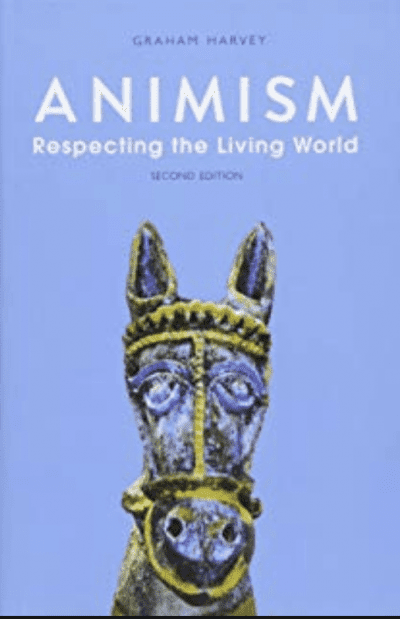 Shinto, along with the perhaps more familiar practices of Neo-Paganism, are both part of a larger set of traditions call Animism (Harvey 2017: 84-5). And the best definition of Animism that I have found is that, “Animists are people who recognize that the world is full of persons, only some of whom are human, and that life is always lived in relationship with others” (xiii).
An animist worldview invites us to expand our definition of personhood from humans-only to a spectrum that includes other beings on this planet who also experience forms of sentience and subjectivity. (I have said a lot more about what that sort of spectrum might include in previous posts about Peter Singer’s ethics and animal rights.)
An animist worldview doesn’t mean, by the way, that one has to become vegetarian or vegan, although one might. After all, animism arose in hunter-gatherer societies that were very much omnivorous. The key is that these societies intentionally cultivated reverence for the natural world and treated even the animals they killed with respect and gratitude (115).
For our current purposes, let me put it this way: We are potentially missing out if we dismiss Animism too quickly as an archaic or “primitive” worldview that literally believes in a god inhabiting everything, down to each single grain of rice. What is much more interesting about contemporary Animism at its best is the cultivation of authentic reverence for all of life: certainly still including a reverence for ourselves and our fellow humans beings, but also including a reverence—and felt sense of relationship with—animal life, plant life, all the items in our home, and even the home itself—as well as rocks, rivers, seas, wind, stars, and more. That sort of shift is truly radical, and worth consideration here at the beginning of a new decade.
If we turn the clock back to the 1980s, we find an ecologist coining the term Anthropocene (similar to the word anthropology) to highlight the ways we humans have created a new geologic time period in which we are the dominant force shaping this planet. Anthropocene literally means “the age of the humans.” And one of the most recent results of that very human worldview is the horrifying climate catastrophe of fires sweeping across Australia.
The more I think about it, the less silly—and more wise—it seems to me to watch Marie Kondo kneel and bow to greet a new house, tap books to wake them up, or speak kindly to your clothes. Some of these practices—or something like them—may be well worth taking on: whatever helps cultivate a felt sense of reverence and relationship toward all aspects of this remarkable planet on which we find ourselves. From a UU perspective, an Animism for the twenty-first century might look something like a unified version of our 1st and 7th Principles: not only the inherent worth and dignity of every person, but also “The inherent worth and dignity of the interdependent web of all existence of which we are a part.”
It turns out that Marie Kondo—or at least the worldview that shaped her—might be a lot deeper than is sometimes acknowledged. Indeed, another way of describing this shift we have been exploring is the move from a “shallow ecology” to a “deep ecology.” A shallow ecology is human-centered: We should “save the rainforest because it might contain cures for cancer (this is, “good for humans”), and we should reduce carbon emissions to prevent our human cities from being flooded when climate change melts the icecaps. In contrast, a deep ecology is eco-centric: While we humans remain a vital part of the equation, we become one among many factors in addition to the “communities, needs, desires, and rights” of all the other aspects of the environment that are non-human. A deep ecology “invites the preservation of ecosystems because they are diverse, viable, important and valued in their own right (180-181).
From a scientific perspective, a deep ecology can also be viewed as deeply Darwinian. After all, one of the core insights from Darwin’s theory of common descent is that we humans are not “a little lower than the angels, but merely a little higher than the apes.” We are not special creations spoken into existence 6,000 years ago. Rather, in the great tree of life, we humans are one among many species who have evolved within the larger Animal Kingdom, and we are deeply interdependent with the ecosystems in which we find ourselves.
As the Indigenous activist Winona LaDuke (1959-) has said: “Environmentalism is a strange term. I think it is really about rediscovering your humanity and how your humanity relates to life” (229). If we as a species were ever to really grasp that insight in a deeply Darwinian way—in a deep ecology way—we would begin to find ourselves on a much more sustainable path for many decades and centuries to come.
Works Cited
Harvey, Graham. Animism: Respecting the Living World, 2nd Edition (Columbia University Press, 2005/2017).
Kondō, Marie, The Life-Changing Magic of Tidying Up: The Japanese Art of Decluttering and Organizing (Ten Speed Press, 2014)
________, Spark Joy: An Illustrated Master Class on the Art of Organizing and Tidying Up (2016).
The Rev. Dr. Carl Gregg is a certified spiritual director, a D.Min. graduate of San Francisco Theological Seminary, and the minister of the Unitarian Universalist Congregation of Frederick, Maryland. Follow him on Facebook (facebook.com/carlgregg) and Twitter (@carlgregg).
Learn more about Unitarian Universalism: http://www.uua.org/beliefs/principles
Previous Post

December 28, 2019
Top 10 Best Books Read this Decade: 2010-2019
Next Post
February 6, 2020 The Love of Wisdom & the Wisdom of Love
Browse Our Archives
Select a Category Advent Anti-Racism Archaeology Atheism Baptism Best of the Year List Book Reviews Buddhism Catholicism Christian Education Church and State Church Planting Climate Change Conscientious Objection to War Creation Spirituality Death Penalty Didache Disability Rights Discernment Easter Ecology Emergent Church Movement Empire-Critical Ethics Evolution Feminist Theology Film Reviews Gandhi Gospel of Mark Gun Control Hinduism Immigration Reform Interfaith Islam JFK Judaism Jungian Spirituality Lectionary Commentary Lent Letters to the Editor LGBT Marriage MLK Multiculturalism Mysticism Nonviolent Activism Occupy Paganism (Earth-centered Religions) Parables Paul Pluralism Politics Process Theology Quantum Physics Requiescat In Pace Seminary and Divinity School Sermon Series Retrospective Sermons Spiritual Direction Spiritual Practices Stewardship (Fundraising) The Book of J The Wheel of the Year (Paganism) Theoblogger Challenge Triathlon Uncategorized Unitarian Universalism Worship Resources Youth Ministry
Select a Month July 2026 May 2026 March 2026 November 2025 October 2025 August 2025 February 2025 December 2024 October 2024 March 2024 January 2024 December 2023 November 2023 March 2023 February 2023 January 2023 December 2022 November 2022 August 2022 March 2022 February 2022 January 2022 December 2021 September 2021 August 2021 July 2021 June 2021 May 2021 February 2021 January 2021 December 2020 August 2020 June 2020 May 2020 April 2020 March 2020 February 2020 January 2020 December 2019 November 2019 October 2019 September 2019 July 2019 June 2019 March 2019 February 2019 January 2019 December 2018 November 2018 October 2018 September 2018 June 2018 May 2018 April 2018 March 2018 February 2018 January 2018 December 2017 November 2017 October 2017 September 2017 August 2017 July 2017 June 2017 May 2017 April 2017 March 2017 February 2017 January 2017 December 2016 November 2016 October 2016 September 2016 August 2016 June 2016 May 2016 April 2016 March 2016 February 2016 January 2016 December 2015 November 2015 October 2015 September 2015 August 2015 July 2015 June 2015 May 2015 April 2015 March 2015 February 2015 January 2015 December 2014 November 2014 October 2014 August 2014 July 2014 June 2014 May 2014 April 2014 March 2014 February 2014 January 2014 December 2013 November 2013 October 2013 September 2013 August 2013 July 2013 June 2013 May 2013 April 2013 March 2013 February 2013 January 2013 December 2012 November 2012 October 2012 September 2012 August 2012 July 2012 June 2012 May 2012 April 2012 March 2012 February 2012 January 2012 December 2011 November 2011 October 2011 September 2011 August 2011 July 2011 June 2011 May 2011 April 2011 March 2011 February 2011 January 2011 December 2010 November 2010 October 2010 August 2009 July 2009 May 2009
Follow Us!
TAKE THE
Religious Wisdom Quiz
What was the primary liquid measurement in Biblical times?
Select your answer to see how you score.
Bath Cor Hin Ephah
Related posts from Carl Gregg

Reading America at 250: A Nation Wrestles With...


Andrew Holocek on the Power of Darkness

The Stories That Shape Us: Myths, Archetypes, &...
TRENDING AT PATHEOS More Voices

Reading America at 250: A Nation Wrestles With...
As part of my own reflection on the 250th anniversary of the...

Whenever I am reading a book or listening to an argument, I...

President Trump Ban Animal Torture Videos on Facebook
Call for Stricter Regulations of Animal Abuse Content on Facebook Although President...

Draft Amendments to Address Ritual Abuse in New...
The proposed changes would make it illegal for individuals in domestic partnerships...

How Bans on LGBTQ+ Student Clubs Threaten Religious...
On June 20, 2025, the State of Texas passed Senate Bill 12....

The Truth About the Gen Z Revival
This past year, there has been a lot of media buzz surrounding...
view all More Voices blogs
Ad-Free & Subscriber Log-In Subscription Support
- About Us
- 2026 Calendar
- Videos
- Podcasts
- Library of World Religions
- Faith In Media Tracker
- Advertise With Us
- Write for Us
- Privacy Policy
- Terms of Service
- Do Not Sell My Data
- Contact Us
- Radiant Digital
- Manage Newsletter Subscriptions
- Unsubscribe From Notifications
- Sitemap
Copyright 2008-2026, Patheos. All rights reserved.
Subscription Support Ad-Free & Subscriber Log-In
Follow Patheos