
BuddhistCatholicContemplativeEvangelicalGeneral ChristianHinduJewishLatter-day SaintMuslimNew VisionsProgressive Christian
Beliefs
- Buddhist
- Catholic
- Contemplative
- Evangelical
- General Christian
- Hindu
- Jewish
- Latter-day Saint
- More Voices
- Muslim
- New Visions
- Pagan
- Progressive Christian
Topics
- Religion News
- Food and Religion
- Sports and Religion
- Religious Art
- Religious Music and Entertainment
- Religious Events
- History and Religion
- Style and Religion
- Politics and Religion
- Women in Religion
- Recreation Outdoors and Religion
- Business Finance and Religion
- Careers Workplace and Religion
- Education and Religion
- Family Parenting and Religion
- Health Fitness and Religion
- Home and Religion
- Relationships and Religion
- Technology and Religion
- Travel and Religion
Columnists
- Buddhist Columnists
- Business Finance and Religion Columnists
- Careers Workplace and Religion Columnists
- Catholic Columnists
- Contemplative Columnists
- Education and Religion Columnists
- Evangelists Columnists
- Family Parenting and Religion Columnists
- General Christian Columnists
- Health Fitness and Religion Columnists
- Hindu Columnists
- History and Religion Columnists
- Home and Religion Columnists
- Jewish Columnists
- More Voices Columnists
- Latter Day Columnists
- Muslim Columnists
- New Visions Columnists
- Nonreligious Columnists
- Pagan Columnists
- Politics and Religion Columnists
- Progressive Columnists
- Recreation Outdoors and Religion Columnists
- Relationships and Religion Columnists
- Religion News Columnists
- Religious Art Columnists
- Religious Events Columnists
- Religious Music and Entertainment Columnists
- Sports and Religion Columnists
- Style and Religion Columnists
- Technology and Religion Columnists
- Travel and Religion Columnists
- Women in Religion Columnists
Resource Library
- 2026 Calendar
- Library of World Religions
- The 100 Most Holy Places on Earth
- Patheos Answers
- Podcasts
- Videos
- Faith Leaders Database
- Anglican Episcopalian
- Bahai
- Baptist
- Buddhism
- Christianity
- Confucianism
- Eastern Orthodoxy
- Hinduism
- Holiness and Pentecostal
- ISKCON
- Islam
- Judaism
- Lutheran
- Methodist
- The Church of Jesus Christ of Latter-day Saints
- New Age
- Paganism
- Presbytarian and Reformed
- Protestantism
- Religion Behind the Scenes
- Roman Catholic
- Scientology
- Shia Islam
- Sikhism
- Sufism
- Sunni Islam
- Taoism
- Zen
- See all religions
Research Tools
 Ad-Free & Subscriber Log-In Subscription Support
Ad-Free & Subscriber Log-In Subscription Support
Follow Patheos 

- Trending:
- Forgiveness
- |
- Marriage
- |
- Consciousness
- |
- Death Penalty
- |
- Election
- |
- Halloween

- Home
- More Voices
- How Democracies Die & An Education in Hope
How Democracies Die & An Education in Hope
Last updated on: November 20, 2019 at 8:34 pm by Carl Gregg
How Democracies Die & An Education in Hope 2019-11-20T20:34:54-05:00 Carl Gregg
Patheos Explore the world's faith through different perspectives on religion and spirituality! Patheos has the views of the prevalent religions and spiritualities of the world.
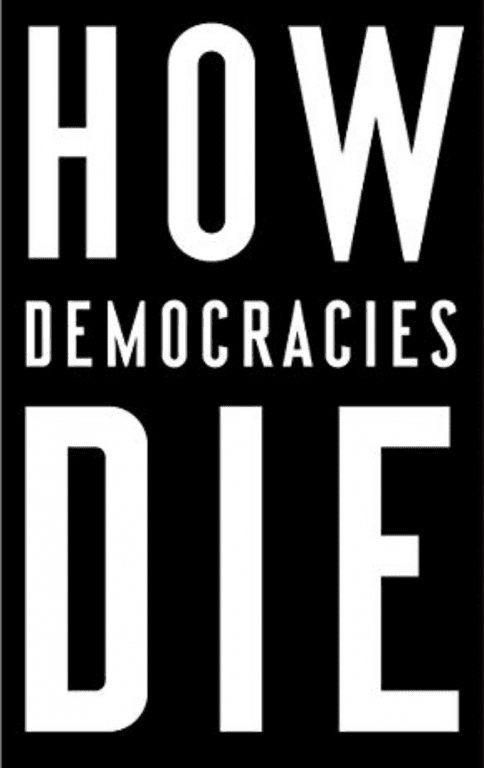 On Sunday, we passed the mark of being one year away from the next U.S. presidential election, which will be held on November 3, 2020. In reflecting on the current state of our body politic, one of the most helpful resources I have found is Steven Levitsky and Daniel Ziblatt’s powerful and accessible book, published last year with the sobering title of How Democracies Die. Both authors are professors of government at Harvard University. For most of their careers, they have been teaching, writing, and researching about historic dangers to democracy (Europe in the 1930s or Latin America in the 1970s) as well as new forms of contemporary authoritarianism around the world. But until the last few years, they never anticipated asking if democracy was in danger here at home (1).
Previously, they had trust in the strong supports for our democratic traditions:
- Our Constitution,
- Our national creed of freedom and equality,
- Our historically robust middle class,
- Our high levels of wealth and education, and
- Our large, diversified private sector. (1)
But serious warning signs have started to appear. In their words:
American states, which were once praised by the great jurist Louis Brandeis as ‘laboratories of democracy,’ are in danger of becoming laboratories of authoritarianism as those in power rewrite electoral rules, redraw constituencies, and even redesign voting rights to ensure that they do not lose. And in 2016, for the first time in U.S. history, a man with no experience in public office, little observable commitment to constitutional rights, and clear authoritarian tendencies was elected president. (2)
To be clear up front, I will not try to parse the impeachment investigation. (You already have The Washington Post and many other media outlets doing that.)
One renown guide for protecting democratic norms is a small but seminal book published in 1978 titled The Breakdown of Democratic Regimes by the late Juan Linz (1926 – 2013), who for many years was a professor of sociology and political science at Yale University. “Born in Weimar Germany and raised amid Spain’s civil War, Linz knew all too well the perils of losing a democracy,” and he laid the foundations for an authoritarianism litmus test for determining whether a politician is acting anti-democratically (21).
According to the above political scientists, there is significant cause for concern if a politician does even one of the following:
- rejects in words or action, the democratic rules of the game,
- denies the legitimacy of opponents,
- tolerates or encourages violence,
- indicates a willingness to curtail the civil liberties of opponents, including the media (21-22)
In you are curious to learn more, Levisky’s and Ziblatt’s book How Democracies Die goes into the further details about each of those four categories (23-34).
They also detail—in ways we need to be direct and honest about—that President Trump has met all four criteria of that litmus test (65-67). To list only a few highlights:
- President Trump showed a weak commitment to the democratic rules of the game when he repeatedly “questioned the legitimacy of the electoral process and made the unprecedented suggestion that he might not accept the results of the 2016 Election” (61).
- He denied his opponent’s legitimacy both through his “birther” conspiracy theories about President Obama and through repeatedly declaring that Hillary Clinton “has to go to jail” and chanting “Lock her up!” (62).
- Candidate Trump repeatedly encouraged violence—emboldening “supporters who physically assaulted reporters…and responding to protesters at his rallies by inciting violence among his supporters” (62-64).
- He has also regularly shown a “readiness to curtail the civil liberties of rivals and critics” (64).
I hope I am being clear that irrespective of partisan political differences, these anti-democratic and uncivil actions are neither normal nor ever acceptable in a liberal democracy such as the United States. “With the exception of Richard Nixon, no major-party presidential candidate met even one of these four criteria over the last century…. No other major presidential candidate in modern U.S. history, including Nixon, has demonstrated such a weak public commitment to constitutional rights and democratic norms” (65).
I should also add one other significant factor: President Trump’s compulsive lying and rampant use of Orwellian disinformation. He recently passed his 1,000th day in office, and according to the Fact Checker’s database used by The Washington Post, the latest count is that he has made 13,435 false or misleading claims during his time as president. “From the start of his presidency, he has averaged nearly 14 false or misleading claims a day.” To be honest, this rate of “exaggerated numbers, unwarranted boasts and outright falsehoods” is exhausting—and that is part of the point.
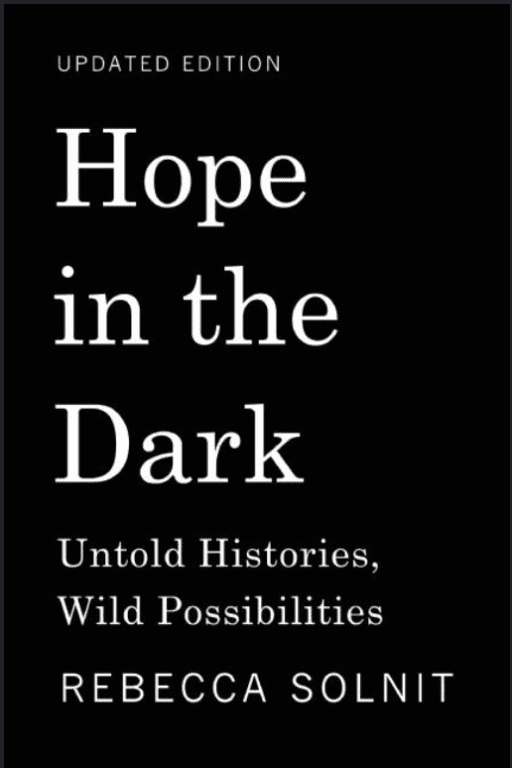 I could continue, but I want to emphasize not only the many real and present dangers to our democracy, but also why it is vital nevertheless to remain hopeful. And if you are in search of some hope at such a time as this, one book I would recommend is Hope in the Dark by Rebecca Solnit.
Now, I will readily admit that hope, wrongly understood, can seem naïve, an unwarranted optimism. False hope can make you want to scream, “Don’t you see how bad it is!” That is not the hope we need. “Hope is not the belief that everything was, is, or will be fine” (xiii). There is no guarantee of a better future. But if we give up hope of even the possibility that things could change for the better, then we capitulate all our power to the corrupt powers that be (xi).
The Brazilian educator Paulo Freire is best known for his paradigm-shifting book Pedagogy of the Oppressed. But for our current situation, his lesser-known follow-up Pedagogy of Hope may be more instructive. Here’s one crucial quote from that book: “Without a minimum of hope, we cannot so much as start the struggle. But without the struggle, hope dissipates, loses its bearings, and turns into hopelessness. And hopelessness can turn into tragic despair. Hence the need for a kind of education in hope” (12). I love that idea—of giving ourselves an education in hope.
Here’s the thing: no one really knows what the future holds. But we do ourselves and our forebears a disservice when we forget how much unlikely change has already happened. There was no guarantee that abolitionists would win the struggle to end slavery in the nineteenth century, that suffragettes would win the right to vote for women in the early twentieth century, that the freedom riders and so many other racial justice activists would come out on top in the civil rights movement, that LGBTQ+ citizens of this country would achieve same-sex marriage rights. We can do hard things!
In contrast, however, there are those in every age who benefit from claiming that the status quo is “immutable, inevitable, and invulnerable.” But it is none of those things (xix). Everything changes. The only real guarantee is impermanence. As you sometimes hear in meditation circles, “Whatever has the nature to arise—whether pleasant, unpleasant, or neutral—also has the nature to pass away.” Whatever is the present case, “This too shall pass.” Change is gonna come. Our invitation, our call, our challenge is to influence the direction in which change happens—to help “bend the arc of the universe toward justice.”
Consider this quote from Václav Havel (1936-2011), written from a jail cell where he had been unjustly imprisoned for writing dissident literature. A few years later he would be elected President of Czechoslovakia, but there was no guarantee of that victory when he penned these words:
The kind of hope I often think about (especially in situations that are particularly hopeless, such as prison) I understand above all as a state of mind, not a state of the world…. Hope is not prognostication. It is an orientation of the spirit, an orientation of the heart; it transcends the world that is immediately experienced, and is anchored somewhere beyond its horizons. Hope, in this deep and powerful sense, is not the same as joy that things are going well, or willingness to invest in enterprises that are obviously headed for early success, but, rather, an ability to work for something because it is good, not just because it stands a chance to success. (11)
We are called to give ourselves—our lives, our time, our energy—in the struggle for human dignity, justice, equity, compassion, peace, liberty, and democracy, not because we are guaranteed to achieve those goals, but because they are good and true and right.
Over the last few years as our core values have been increasingly under threat, one of my guides has been the frequently prescient Sarah Kendzior. She is a journalist with an academic expertise on authoritarianism. The focus of her doctoral dissertation was “how the Uzbekistan dictatorship employed the Internet to undermine public trust in and manipulate the media,” so let’s say she has quite the skill set for connecting the dots with current events here in the U.S.
On November 18, 2016, ten days after the most recent presidential election, she wrote a powerful essay seeking to draw on what she had learned from studying totalitarianism in the states that were formerly part of the Soviet Union, for what we might do to counter authoritarianism here in the U.S. I’ll share with you just a brief excerpt of her wisdom for such a time as this:
Write down
what you value;
what standards you hold for yourself and for others.
Write about
your dreams for the future and
your hopes for your children.
Write about
the struggle of your ancestors and how
the hardship they overcame shaped the person you are today…..
You still have your freedom,
so use it.
There are many groups organizing for both resistance and subsistence,
but we are heading into dark times, and you need to be your own light.
Do not accept brutality and cruelty as normal
even if it is sanctioned.
Protect the vulnerable and encourage the afraid.
If you are brave, stand up for others.
If you cannot be brave—and it is often hard to be brave—
be kind.
But most of all, never lose sight of
who you are and
what you value.
If you find yourself doing something that feels questionable or wrong
a few months or years from now,
find that essay you wrote on who you are and read it.
Ask if that version of yourself would have done the same thing.
And if the answer is no?
Don’t do it.
The Rev. Dr. Carl Gregg is a certified spiritual director, a D.Min. graduate of San Francisco Theological Seminary, and the minister of the Unitarian Universalist Congregation of Frederick, Maryland. Follow him on Facebook (facebook.com/carlgregg) and Twitter (@carlgregg).
Learn more about Unitarian Universalism: http://www.uua.org/beliefs/principles
Previous Post

October 30, 2019
Defense Against the Dark Arts: Harry Potter for Such a Time as This
Next Post
November 12, 2019 How Change Happens: Why do some social movements succeed & others fail?
Browse Our Archives
Select a Category Advent Anti-Racism Archaeology Atheism Baptism Best of the Year List Book Reviews Buddhism Catholicism Christian Education Church and State Church Planting Climate Change Conscientious Objection to War Creation Spirituality Death Penalty Didache Disability Rights Discernment Easter Ecology Emergent Church Movement Empire-Critical Ethics Evolution Feminist Theology Film Reviews Gandhi Gospel of Mark Gun Control Hinduism Immigration Reform Interfaith Islam JFK Judaism Jungian Spirituality Lectionary Commentary Lent Letters to the Editor LGBT Marriage MLK Multiculturalism Mysticism Nonviolent Activism Occupy Paganism (Earth-centered Religions) Parables Paul Pluralism Politics Process Theology Quantum Physics Requiescat In Pace Seminary and Divinity School Sermon Series Retrospective Sermons Spiritual Direction Spiritual Practices Stewardship (Fundraising) The Book of J The Wheel of the Year (Paganism) Theoblogger Challenge Triathlon Uncategorized Unitarian Universalism Worship Resources Youth Ministry
Select a Month July 2026 May 2026 March 2026 November 2025 October 2025 August 2025 February 2025 December 2024 October 2024 March 2024 January 2024 December 2023 November 2023 March 2023 February 2023 January 2023 December 2022 November 2022 August 2022 March 2022 February 2022 January 2022 December 2021 September 2021 August 2021 July 2021 June 2021 May 2021 February 2021 January 2021 December 2020 August 2020 June 2020 May 2020 April 2020 March 2020 February 2020 January 2020 December 2019 November 2019 October 2019 September 2019 July 2019 June 2019 March 2019 February 2019 January 2019 December 2018 November 2018 October 2018 September 2018 June 2018 May 2018 April 2018 March 2018 February 2018 January 2018 December 2017 November 2017 October 2017 September 2017 August 2017 July 2017 June 2017 May 2017 April 2017 March 2017 February 2017 January 2017 December 2016 November 2016 October 2016 September 2016 August 2016 June 2016 May 2016 April 2016 March 2016 February 2016 January 2016 December 2015 November 2015 October 2015 September 2015 August 2015 July 2015 June 2015 May 2015 April 2015 March 2015 February 2015 January 2015 December 2014 November 2014 October 2014 August 2014 July 2014 June 2014 May 2014 April 2014 March 2014 February 2014 January 2014 December 2013 November 2013 October 2013 September 2013 August 2013 July 2013 June 2013 May 2013 April 2013 March 2013 February 2013 January 2013 December 2012 November 2012 October 2012 September 2012 August 2012 July 2012 June 2012 May 2012 April 2012 March 2012 February 2012 January 2012 December 2011 November 2011 October 2011 September 2011 August 2011 July 2011 June 2011 May 2011 April 2011 March 2011 February 2011 January 2011 December 2010 November 2010 October 2010 August 2009 July 2009 May 2009
Follow Us!
TAKE THE
Religious Wisdom Quiz
Who was the mother of Jesus?
Select your answer to see how you score.
Ruth Mary Elizabeth Sarah
Related posts from Carl Gregg

Reading America at 250: A Nation Wrestles With...


Andrew Holocek on the Power of Darkness

The Stories That Shape Us: Myths, Archetypes, &...
TRENDING AT PATHEOS More Voices

Reading America at 250: A Nation Wrestles With...
As part of my own reflection on the 250th anniversary of the...

Whenever I am reading a book or listening to an argument, I...

President Trump Ban Animal Torture Videos on Facebook
Call for Stricter Regulations of Animal Abuse Content on Facebook Although President...

Draft Amendments to Address Ritual Abuse in New...
The proposed changes would make it illegal for individuals in domestic partnerships...

How Bans on LGBTQ+ Student Clubs Threaten Religious...
On June 20, 2025, the State of Texas passed Senate Bill 12....

The Truth About the Gen Z Revival
This past year, there has been a lot of media buzz surrounding...
view all More Voices blogs
Ad-Free & Subscriber Log-In Subscription Support
- About Us
- 2026 Calendar
- Videos
- Podcasts
- Library of World Religions
- Faith In Media Tracker
- Advertise With Us
- Write for Us
- Privacy Policy
- Terms of Service
- Do Not Sell My Data
- Contact Us
- Radiant Digital
- Manage Newsletter Subscriptions
- Unsubscribe From Notifications
- Sitemap
Copyright 2008-2026, Patheos. All rights reserved.
Subscription Support Ad-Free & Subscriber Log-In
Follow Patheos