
BuddhistCatholicContemplativeEvangelicalGeneral ChristianHinduJewishLatter-day SaintMuslimNew VisionsProgressive Christian
Beliefs
- Buddhist
- Catholic
- Contemplative
- Evangelical
- General Christian
- Hindu
- Jewish
- Latter-day Saint
- More Voices
- Muslim
- New Visions
- Pagan
- Progressive Christian
Topics
- Religion News
- Food and Religion
- Sports and Religion
- Religious Art
- Religious Music and Entertainment
- Religious Events
- History and Religion
- Style and Religion
- Politics and Religion
- Women in Religion
- Recreation Outdoors and Religion
- Business Finance and Religion
- Careers Workplace and Religion
- Education and Religion
- Family Parenting and Religion
- Health Fitness and Religion
- Home and Religion
- Relationships and Religion
- Technology and Religion
- Travel and Religion
Columnists
- Buddhist Columnists
- Business Finance and Religion Columnists
- Careers Workplace and Religion Columnists
- Catholic Columnists
- Contemplative Columnists
- Education and Religion Columnists
- Evangelists Columnists
- Family Parenting and Religion Columnists
- General Christian Columnists
- Health Fitness and Religion Columnists
- Hindu Columnists
- History and Religion Columnists
- Home and Religion Columnists
- Jewish Columnists
- More Voices Columnists
- Latter Day Columnists
- Muslim Columnists
- New Visions Columnists
- Nonreligious Columnists
- Pagan Columnists
- Politics and Religion Columnists
- Progressive Columnists
- Recreation Outdoors and Religion Columnists
- Relationships and Religion Columnists
- Religion News Columnists
- Religious Art Columnists
- Religious Events Columnists
- Religious Music and Entertainment Columnists
- Sports and Religion Columnists
- Style and Religion Columnists
- Technology and Religion Columnists
- Travel and Religion Columnists
- Women in Religion Columnists
Resource Library
- 2026 Calendar
- Library of World Religions
- The 100 Most Holy Places on Earth
- Patheos Answers
- Podcasts
- Videos
- Faith Leaders Database
- Anglican Episcopalian
- Bahai
- Baptist
- Buddhism
- Christianity
- Confucianism
- Eastern Orthodoxy
- Hinduism
- Holiness and Pentecostal
- ISKCON
- Islam
- Judaism
- Lutheran
- Methodist
- The Church of Jesus Christ of Latter-day Saints
- New Age
- Paganism
- Presbytarian and Reformed
- Protestantism
- Religion Behind the Scenes
- Roman Catholic
- Scientology
- Shia Islam
- Sikhism
- Sufism
- Sunni Islam
- Taoism
- Zen
- See all religions
Research Tools
 Ad-Free & Subscriber Log-In Subscription Support
Ad-Free & Subscriber Log-In Subscription Support
Follow Patheos 

- Trending:
- Forgiveness
- |
- Marriage
- |
- Consciousness
- |
- Death Penalty
- |
- Election
- |
- Halloween

- Home
- More Voices
- How Change Happens: Why do some social movements succeed & others fail?
How Change Happens: Why do some social movements succeed & others fail?
Last updated on: November 12, 2019 at 6:00 pm by Carl Gregg
How Change Happens: Why do some social movements succeed & others fail? 2019-11-12T18:00:04-05:00 Carl Gregg
Patheos Explore the world's faith through different perspectives on religion and spirituality! Patheos has the views of the prevalent religions and spiritualities of the world.
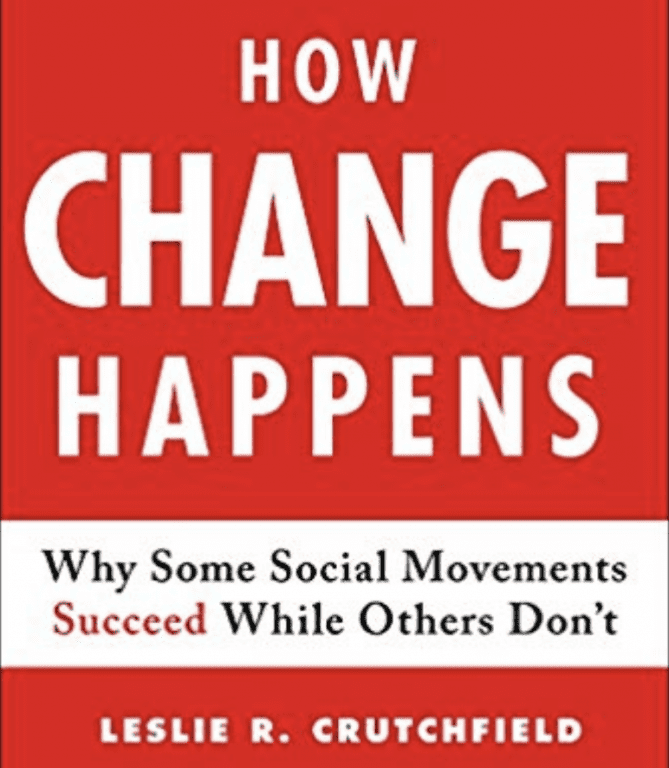 What does (and doesn’t) work in building the better world we dream about? Why do some movements for social change succeed while others fizzle or even fail? For considering these questions, one of the most helpful resources I have found recently is the book How Change Happens by Leslie Crutchfield. She is the executive director of Georgetown University’s Global Social Enterprise Initiative. She and her team have researched some of the major recent movements for social change in the United States to find common patterns.
How many of you remember going out to eat at a restaurant that had a “smoking section” and a “non-smoking section”? (Not a separate room, but a designated set of tables—as if the smoke was supposed to somehow know to stay on a certain side of the room?) Or how many of you remember when smoking was allowed on airplanes, which was until 1988 for most domestic flights—and until 2000 on some flights? At the time, many people considered ubiquitous smoking to be “just the way things are”—and/or too difficult to change because of powerful, monied interests intent on blocking change by any means necessary.
But today,
Youth smoking rates have dropped down to 6 percent. For adults, from an all-time high when more than half of men in America smoked, rates have flat-lined to around 15 percent on average. Tobacco is banned from most places in the United States—offices, airports, malls—and in some states, even in casinos. (1)
Individuals are, of course, free to smoke at home and in various designated places if they so choose, but that’s a remarkable shift around smoking that I did not necessarily expect ever to see.
Similarly, MADD (“Mothers Against Drunk Driving”) succeeded in “cutting by half the alcohol-related driving deaths since the 1980s” (3).
A 50% decline in drunk driving deaths—incredible! That’s another tremendous social change in a relatively short period of time.
I should hasten to add at this point that around this same time period, there was also social change in more regressive directions. For instance, “Gun laws today are more lenient than at any point in modern U.S. history…. There are more gun shops in the United States than there are McDonald’s and Starbucks combined” (2).
So what can we learn from these various movements about what does and doesn’t work? I’ll start with the bad news. According to Leslie Crutchfield and her team at Georgetown, who have crunched the numbers and compared the data, “There’s no real recipe for social change, no ‘movement in a box’ that we can put in place to create a more equitable, just society” (ix). But there is good news: These researchers have identified six strategies that “seemed to distinguish the effective movements from the others”:
- Strong grassroots
- Builds momentum state-by-state
- Changes hearts and policy
- Partners with “Adversarial Allies”
- Partners with Corporations
- “Leader-full” (12-14)
I’ll say more about each of these factors in turn. As I do so, keep in mind the groups and causes closest to your heart. Are there one or more strategies that you or others might be able to help implement to increase your chances of creating the social change you dream about?
First, strong grassroots: lots of ordinary people committed to local, bottom-up activism. For example, the single most important reason that the NRA has been so successful in expanding gun rights in recent decades is that, “Gun control advocates historically have failed to match the scale and intensity of the NRA’s grassroots field movements” (23). This same factor—the “size and intensity of the base”—was also decisive in the success of MADD (“Mothers Against Drunk Driving”) and the coalition of LGBTQ+ groups that catalyzed the legalization of same-sex marriage (23). In contrast, the (to date) much less successful movement to prevent gun violence, embodied in organizations such as the Brady Campaign, were most often focused—not on the grassroots—but on elites at the national level in trying to pass a comprehensive gun control bill through Congress (24).
The good news is that in just the past few years there are new players on the field, such as Everytown for Gun Safety, who are trying to learn from both the mistakes of the past and the successes of the NRA (42). Now, “(E)very time dozens of [grassroots NRA activists] show up at a town council meeting in their neon orange hunting garb, an equal number of passionate women sporting bright red “Moms Demand Action” [to prevent gun violence] T-shirts show up on the opposite side” (45-46). I love that! There are no guarantees. But empowering a strong base of grassroots activists is one way to significantly increase your chance of creating social change.
Second, although it is tempting (and sometimes possible) to create change in one fell swoop at the federal level, the more time-tested and reliable strategy is to build momentum incrementally: town-by-town, city-by-city, state-by-state. Two decades ago, there was essentially no chance of achieving LGBTAQ+ equality on the national level. In fact, the opposite was happening. In 1996, President Clinton signed the Defense of Marriage Act (defining marriage as only between opposite-sex couples), and there were thirteen states with ballot measures attempting to ban same-sex marriage (2). Fast forward a decade and the outlook didn’t seem that much better: “More non-discrimination bills were passed in 2005 than any year since 1992” (54).
From that low point, a new way forward was dreamed up called the 10/10/10/20 = 50 Vision—a targeted approach to achieve incremental victory that would hopefully snowball:
- 10 states with full marriage,
- 10 with full civil unions,
- 10 with some form of relationship recognition laws (like domestic partnerships),
- 20 (the remaining ones) with either non-discrimination laws or significant cultural change (55).
This piecemeal approach laid crucial groundwork that helped make possible the Supreme Court decision in 2015 (Obergefell v. Hodges) recognizing same-sex marriage rights in all fifty states.
Here’s the thing, though: these strategies can be used by anyone. NRA activists used a similar strategy to roll back gun restrictions in state after state, similarly laying the groundwork for a Supreme Court victory in 2008 (Columbia v. Heller), ruling—to my mind, incorrectly—that the Second Amendment protects an individual’s right to posses a firearm “unconnected with service in a militia” (62).
In 2012, my hope was that we would get sweeping federal change around banning military-style assault weapons after Sandy Hook, but the reality seems to be that we need to do the slow town-by-town, city-by-city, state-by-state work to achieve common sense reform for preventing gun violence. And the good news is that in the last few years, Everytown for Gun Safety has had significant success in about half of U.S. states (71). If you are interested in this movement, I encourage you to google “Everytown for Gun Safety” and get involved.
Third, have a dual focus on both hearts and policy. Traditionally, common sense held that humans “think-feel-do,” in that order. Researchers used to believe that people first think differently (i.e., we change our minds), which makes us feel differently, which finally makes us behave differently. Think-feel-do. But recent science has shown that changing our minds most often comes not first, but last. So the actual order is usually “feel-do-think.” Our visceral, emotional reactions cause us to act in various ways, which we then rationalize after the fact. Feel-do-think (97).
The feel-do-think approach was used to great effect in the marriage equality movement, particularly when relatives and friends shared their stories of loved ones coming out of the closet (89). People’s hearts were moved; then they began to open more to LGBTQ+ friends and family members, and finally, they found their minds had changed.
Recall that our third point is emphasizing both hearts and policy. Marriage equality activities were successful because they were simultaneously seeking to change hearts and the law of the land. In contrast, #OccupyWallStreet effectively captured many people’s hearts and minds with the powerful slogan “We are the 99 Percent,” but they never coalesced around specific policy demands (99). The key then is to emphasize both hearts and policy.
Fourth, partnering with “Adversarial Allies.” Here’s another surprising point where we need to name some more hard truths. Have you ever heard the term “Liberal circular firing squad?” That’s when progressive activists sit around squabbling and feuding amongst themselves (103). In the words of one activist from the tobacco control movement whose experience is echoed in many similar stories: “I did not anticipate the ferocity, the nastiness, the viciousness. It was not the industry opponents who surprised me. It was the people and organizations whom I assumed were allies” (111). The lesson here is that in movements that have succeeded, various folks had to set aside their endless parsing of differences, their egos, and their control-issues to work together in a coalition for the greater good. That’s what it means to partner with “adversarial allies.”
Fifth, partner with Corporations. Especially in the wake of Citizens United (the infamous “corporations are people” Supreme Court decision), corporations are often viewed as the villains whose power needs to be curtailed in the struggle against wealth inequality. That’s often true, but it is also true that in the history of social change, businesses have often played a crucial, positive role: modeling progressive policy changes, serving as partners in advocacy and education, and innovating supporting products such as electric cars, breathalyzers, “smart guns,” and Nicorette gum (126-127). In seeking social change, corporations can be crucial allies.
Sixth, be “Leader-full”: find a balance of shared power between the extremes of a “leaderless” anarchy or a completely hierarchal dictatorship. For instance, have you ever heard of Founder’s Syndrome? It’s when an organization is unable to grow beyond the reach and abilities of a single charismatic leader. A movement can be hampered if it is limited to what one finite person can micromanage. And a movement can fall apart if that linchpin burns out, quits, retires, or dies (146). To avoid this trap, be leader-full: distribute power at various points throughout an organization (165).
It’s also important to avoid the other extreme. Occupy Wall Street, for instance, was leaderless, and having a leader (or many leaders) can be crucial. For example, I spoke earlier about how effective the NRA has been at the grassroots level, but they also have a strong primary leader in Wayne LaPierre. (He is often a force for evil in the world—an incredibly effective one.) In the wake of Sandy Hook in December 2012, LaPierre
refused to concede that guns were part of the problem. “The only thing that stops a bad guy with a gun is a good guy with a gun,” he proclaimed…. His tone deaf response was appalling to millions…. But the NRA went on to secure even more gun rights victories, not fewer. (153)
Having an effective leader can make a crucial difference. Let’s take the lessons wherever we can find them, and apply them in our work for good.
For now, I’ll give the last word to the final paragraph of Leslie Crutchfield’s book How Change Happens:
As Robert F. Kennedy said,
“Few will have the greatness to bend history itself,
but each of us can work to change
a small portion of events.
It is from numberless acts of courage and belief
that human history is shaped.
Each time [someone] stands up for an ideal,
or acts to improve the lot of others,
or strikes out against injustice,
[they] send forth a tiny ripple of hope, and
crossing each other from a million different centers
of energy and daring,
those ripples build a current
which can sweep down the mightiest walls
of oppression and resistance.”
That is how change happens. (182)
The Rev. Dr. Carl Gregg is a certified spiritual director, a D.Min. graduate of San Francisco Theological Seminary, and the minister of the Unitarian Universalist Congregation of Frederick, Maryland. Follow him on Facebook (facebook.com/carlgregg) and Twitter (@carlgregg).
Learn more about Unitarian Universalism: http://www.uua.org/beliefs/principles
Previous Post

November 4, 2019
How Democracies Die & An Education in Hope
Next Post
November 20, 2019 What’s Holding Us Back & How Do We Go from Here?
Browse Our Archives
Select a Category Advent Anti-Racism Archaeology Atheism Baptism Best of the Year List Book Reviews Buddhism Catholicism Christian Education Church and State Church Planting Climate Change Conscientious Objection to War Creation Spirituality Death Penalty Didache Disability Rights Discernment Easter Ecology Emergent Church Movement Empire-Critical Ethics Evolution Feminist Theology Film Reviews Gandhi Gospel of Mark Gun Control Hinduism Immigration Reform Interfaith Islam JFK Judaism Jungian Spirituality Lectionary Commentary Lent Letters to the Editor LGBT Marriage MLK Multiculturalism Mysticism Nonviolent Activism Occupy Paganism (Earth-centered Religions) Parables Paul Pluralism Politics Process Theology Quantum Physics Requiescat In Pace Seminary and Divinity School Sermon Series Retrospective Sermons Spiritual Direction Spiritual Practices Stewardship (Fundraising) The Book of J The Wheel of the Year (Paganism) Theoblogger Challenge Triathlon Uncategorized Unitarian Universalism Worship Resources Youth Ministry
Select a Month July 2026 May 2026 March 2026 November 2025 October 2025 August 2025 February 2025 December 2024 October 2024 March 2024 January 2024 December 2023 November 2023 March 2023 February 2023 January 2023 December 2022 November 2022 August 2022 March 2022 February 2022 January 2022 December 2021 September 2021 August 2021 July 2021 June 2021 May 2021 February 2021 January 2021 December 2020 August 2020 June 2020 May 2020 April 2020 March 2020 February 2020 January 2020 December 2019 November 2019 October 2019 September 2019 July 2019 June 2019 March 2019 February 2019 January 2019 December 2018 November 2018 October 2018 September 2018 June 2018 May 2018 April 2018 March 2018 February 2018 January 2018 December 2017 November 2017 October 2017 September 2017 August 2017 July 2017 June 2017 May 2017 April 2017 March 2017 February 2017 January 2017 December 2016 November 2016 October 2016 September 2016 August 2016 June 2016 May 2016 April 2016 March 2016 February 2016 January 2016 December 2015 November 2015 October 2015 September 2015 August 2015 July 2015 June 2015 May 2015 April 2015 March 2015 February 2015 January 2015 December 2014 November 2014 October 2014 August 2014 July 2014 June 2014 May 2014 April 2014 March 2014 February 2014 January 2014 December 2013 November 2013 October 2013 September 2013 August 2013 July 2013 June 2013 May 2013 April 2013 March 2013 February 2013 January 2013 December 2012 November 2012 October 2012 September 2012 August 2012 July 2012 June 2012 May 2012 April 2012 March 2012 February 2012 January 2012 December 2011 November 2011 October 2011 September 2011 August 2011 July 2011 June 2011 May 2011 April 2011 March 2011 February 2011 January 2011 December 2010 November 2010 October 2010 August 2009 July 2009 May 2009
Follow Us!
TAKE THE
Religious Wisdom Quiz
What Christian group is known for large-scale evangelistic crusades?
Select your answer to see how you score.
Evangelicals Orthodox Quakers Methodists
Related posts from Carl Gregg

Reading America at 250: A Nation Wrestles With...


Andrew Holocek on the Power of Darkness

The Stories That Shape Us: Myths, Archetypes, &...
TRENDING AT PATHEOS More Voices

Reading America at 250: A Nation Wrestles With...
As part of my own reflection on the 250th anniversary of the...

Whenever I am reading a book or listening to an argument, I...

President Trump Ban Animal Torture Videos on Facebook
Call for Stricter Regulations of Animal Abuse Content on Facebook Although President...

Draft Amendments to Address Ritual Abuse in New...
The proposed changes would make it illegal for individuals in domestic partnerships...

How Bans on LGBTQ+ Student Clubs Threaten Religious...
On June 20, 2025, the State of Texas passed Senate Bill 12....

The Truth About the Gen Z Revival
This past year, there has been a lot of media buzz surrounding...
view all More Voices blogs
Ad-Free & Subscriber Log-In Subscription Support
- About Us
- 2026 Calendar
- Videos
- Podcasts
- Library of World Religions
- Faith In Media Tracker
- Advertise With Us
- Write for Us
- Privacy Policy
- Terms of Service
- Do Not Sell My Data
- Contact Us
- Radiant Digital
- Manage Newsletter Subscriptions
- Unsubscribe From Notifications
- Sitemap
Copyright 2008-2026, Patheos. All rights reserved.
Subscription Support Ad-Free & Subscriber Log-In
Follow Patheos