
BuddhistCatholicContemplativeEvangelicalGeneral ChristianHinduJewishLatter-day SaintMuslimNew VisionsProgressive Christian
Beliefs
- Buddhist
- Catholic
- Contemplative
- Evangelical
- General Christian
- Hindu
- Jewish
- Latter-day Saint
- More Voices
- Muslim
- New Visions
- Pagan
- Progressive Christian
Topics
- Religion News
- Food and Religion
- Sports and Religion
- Religious Art
- Religious Music and Entertainment
- Religious Events
- History and Religion
- Style and Religion
- Politics and Religion
- Women in Religion
- Recreation Outdoors and Religion
- Business Finance and Religion
- Careers Workplace and Religion
- Education and Religion
- Family Parenting and Religion
- Health Fitness and Religion
- Home and Religion
- Relationships and Religion
- Technology and Religion
- Travel and Religion
Columnists
- Buddhist Columnists
- Business Finance and Religion Columnists
- Careers Workplace and Religion Columnists
- Catholic Columnists
- Contemplative Columnists
- Education and Religion Columnists
- Evangelists Columnists
- Family Parenting and Religion Columnists
- General Christian Columnists
- Health Fitness and Religion Columnists
- Hindu Columnists
- History and Religion Columnists
- Home and Religion Columnists
- Jewish Columnists
- More Voices Columnists
- Latter Day Columnists
- Muslim Columnists
- New Visions Columnists
- Nonreligious Columnists
- Pagan Columnists
- Politics and Religion Columnists
- Progressive Columnists
- Recreation Outdoors and Religion Columnists
- Relationships and Religion Columnists
- Religion News Columnists
- Religious Art Columnists
- Religious Events Columnists
- Religious Music and Entertainment Columnists
- Sports and Religion Columnists
- Style and Religion Columnists
- Technology and Religion Columnists
- Travel and Religion Columnists
- Women in Religion Columnists
Resource Library
- 2026 Calendar
- Library of World Religions
- The 100 Most Holy Places on Earth
- Patheos Answers
- Podcasts
- Videos
- Faith Leaders Database
- Anglican Episcopalian
- Bahai
- Baptist
- Buddhism
- Christianity
- Confucianism
- Eastern Orthodoxy
- Hinduism
- Holiness and Pentecostal
- ISKCON
- Islam
- Judaism
- Lutheran
- Methodist
- The Church of Jesus Christ of Latter-day Saints
- New Age
- Paganism
- Presbytarian and Reformed
- Protestantism
- Religion Behind the Scenes
- Roman Catholic
- Scientology
- Shia Islam
- Sikhism
- Sufism
- Sunni Islam
- Taoism
- Zen
- See all religions
Research Tools
 Ad-Free & Subscriber Log-In Subscription Support
Ad-Free & Subscriber Log-In Subscription Support
Follow Patheos 

- Trending:
- Forgiveness
- |
- Marriage
- |
- Consciousness
- |
- Death Penalty
- |
- Election
- |
- Halloween

- Home
- More Voices
- Open, Direct, Mutual, Present, Spontaneous—without judgement or agenda: Martin Buber’s Life of Dialogue
Open, Direct, Mutual, Present, Spontaneous—without judgement or agenda: Martin Buber’s Life of Dialogue
Last updated on: October 10, 2019 at 9:53 am by Carl Gregg
Open, Direct, Mutual, Present, Spontaneous—without judgement or agenda: Martin Buber’s Life of Dialogue 2019-10-10T09:53:45-04:00 Carl Gregg
Patheos Explore the world's faith through different perspectives on religion and spirituality! Patheos has the views of the prevalent religions and spiritualities of the world.
We are in the middle of the Jewish High Holy Days, which stretch from Rosh Hashanah (the Jewish New Year) on September to Yom Kippur (the Day of Atonement) on October 9. The ten days in total are also known collectively as the Days of Repentance or the Days of Awe. And the High Holy Days is an auspicious time to reflect on the life and teachings of the Jewish philosopher Martin Buber for how they may be able to continue to guide us today.
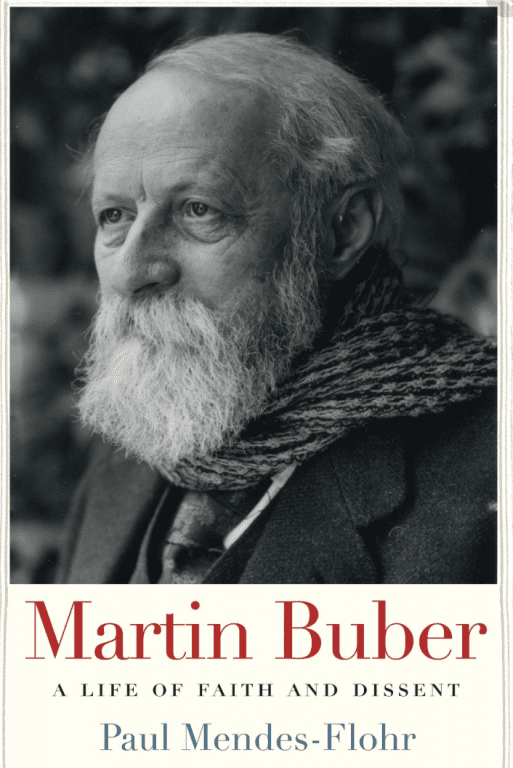 Buber was born in 1878 in Vienna, Austria, and one set of early events had significant resonance across his life: When Buber was three years old, his parents separated (Mendes-Flohr 1). In particular, he remembered his mother leaving without telling him goodbye, and he was soon sent to live with his paternal grandparents in Ukraine (1-2). (Yes, that would be the same Ukraine that’s currently in the news.)
Neither his father nor his grandparents explained to him that his mother had eloped with a Russian officer, and in his own words, he felt “too timid to ask.” After living with his grandparents for quite a few months, he found himself impulsively asking an older girl who lived nearby about his mother. She told him honestly, “No, your mother is not coming back any more.” Some moments we never forget. And almost eight decades later, near the end of his life, Buber shared that, “Whatever I have learned in the course of my life about the meaning of meeting and dialogue between people springs from that moment when I was four” (2). I find that fascinating and moving: that the seeds for a life of cultivating connection in dialogue were planted in a decisive encounter at such a young age by someone willing to be direct and honest with him.
Buber lived with his paternal grandparents for about a decade, and returned home at age fourteen when his father remarried (15). And although his father was a member of a much more liberal Jewish congregation compared to his more orthodox grandparents, Buber’s own openness was already remarkable.
As many of you know, my wife is Jewish, and I have had fortunate opportunities to attend many Jewish events, including many bar and bat mitzvahs. And it is unusual, as you might guess, to hear Christian scriptures quoted at a Jewish coming of age service. And that is quite understandable given the history of Anti-Judaism and Anti-Semitism within Christianity. But when Buber became a bar mitzvah, he quoted not only from traditional Jewish sources, but also from the German poet Schiller and the Christian epistle of 1 Corinthians (19).
Buber had a lifelong interest in building bridges through being in conversation with diverse people and sources. He called his approach a “life of dialogue.” It can be easy sometimes to go through life on autopilot, but Buber tried to guide himself and others back toward “an engaged response” to our everyday life and to those we meet along the way (42). Now, I will admit that prospect can feel exhausting. (I have an introverted side, and sometimes I don’t want to be engaged.) But Buber wasn’t telling us to never rest or take care of ourselves. Rather, he’s inviting us to notice when we’ve been shut down for too long (as he was as a young child)—and to open ourselves to the transformation that can happen when we open ourselves to direct, honest dialogue with another person.
And almost four decades after his four-year-old encounter with that neighbor girl, his reflections on these possibilities crystallized most fully in his 1923 book I and Thou, which can also be translated as “I and You” (3). For Buber, the ideal is an I-You relationship in which two people are willing to risk being vulnerable with one another as close, long-term friends can do. For Buber, an “I-Thou” dialogue is communication that is “open, direct, mutual, present, spontaneous” without any judgement or agenda (Kramer 202).
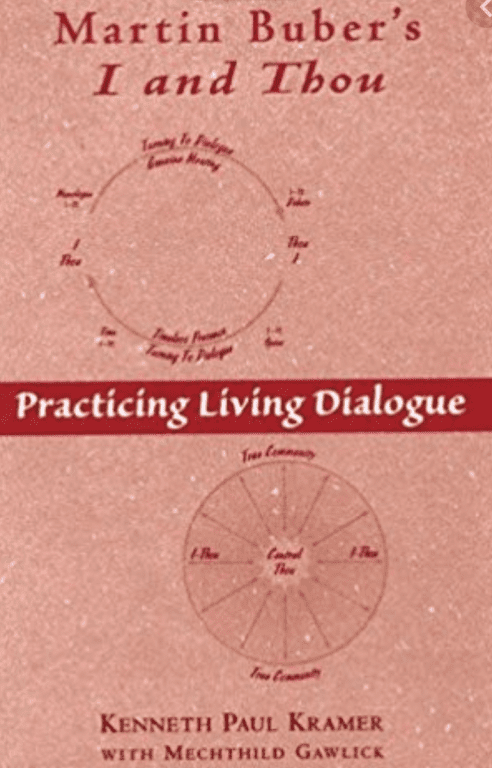 More often, however, Buber observed what he called I-it relationships in which we treat other people as an object or a thing without allowing ourselves to the full lived reality of who that person is. I should hasten to add that Buber readily grants that neither he nor anyone else can maintain constant “I-Thou” relationships all the time. And even when we have moments of profound, intimate connection, all relationships revert back to a transactional “I-it” at various points (13).
I first read Buber’s book almost twenty years ago, but his fairly simple framework has come back to mind a surprising number of times. I have found it really helpful to notice at various times: Whoa, I just treated that person like an “it” instead of a “you”—or a sacred “Thou.” Or conversely, wow, that person really saw me or let me really see them.
Buber would go further to say that parts of nature, such as a tree, can be a “Thou” if we take the time to really experience a particular plant’s individuality (51). Buber also wrote of a time that a rock unexpectedly—and only fleetingly—became a “Thou” to him.:
On a gloomy morning I walked upon the highway, saw a piece of mica lying there, lifted it up and looked at it for a long time…. And suddenly, when I raised my eyes from it, I realized that while I looked I had not been conscious of “object” and “subject”; in my looking the mica and “I” had been one; in my looking I had tasted unity. I looked at it again, but the unity did not return. (119)
I appreciate his honesty that cultivating such “I-Thou” connections is not simple or easy—and that sometimes we stumble backward into them in ways that are not always repeatable.
Indeed, sometimes the connection doesn’t happen despite our best efforts. And there are some fascinating accounts of his public attempts over the years at interfaith dialogue. Some were successful. Other times he would confess afterward that:
There is a boundary beyond which the possibility of [dialogical] encounter ceases and only the reporting of factual information remains. I cannot fight against an opponent who is thoroughly opposed to me, not can I fight against an opponent who stands on a different plane than I.” (Mendes-Flohr 168-170)
Even Buber, the great champion of “I-Thou” relationships, was willing to admit that it wouldn’t work if the other person was only willing to treat him as an “it”—and not as a dynamic, evolving, complex human being.
I should emphasize as well that Buber’s worldview and actions extended far beyond the interpersonal. When Hitler seized power in Germany, Buber continued to be a “leading voice within the Jewish community of Central Europe.” To limit myself to only one quote from Buber during that period that particularly stood out to me, and that seems especially relevant in our own time of rising authoritarianism, mass shootings, and climate change: addressing the German-Jewish community shortly after Hitler seized power, Buber said: “The world has become unreliable…. It is up to us to make the world reliable again for children” (2-3). Because Buber kept speaking out, the Gestapo eventually forbade him at first from lecturing publicly and then from any form of teaching (191-192). And in 1938—at significant personal and financial cost—Buber, his wife, and quite a few of his closest family members left Germany for Palestine (201, 218).
It is also significant to consider that, in regard to Hitler, Buber’s I-Thou provides a powerful lens for interpreting Hitler’s autobiographical manifesto Mein Kampf. Buber’s primary emphasis was the value of meeting each individual as a unique “you”—as a “Thou” of sacred worth. In contrast, as one philosopher has noted:
Hitler excludes a second-person mode of address. In Mein Kampf, there is an I, a we, and a they, but there is no you that would allow for an intimate relation. Hitler does not allow himself to be seen in any form of frailty, and he does not obligate himself to anyone else in his or her frailty. He merges himself with a strong, idealized we and projects all weakness onto an external they…. There is a pure, good “we” that is no peril of being corrupted by “them.”… If only they (the evil forces) could be eliminated, we would be saved” (Hägglund 122).
On this point, it is significant that in 1939 on the first anniversary of Kristallnacht (when the windows were smashed in Jewish-owned buildings across Nazi Germany), Buber published an article in the Tel Aviv daily newspaper titled “They and We.” Part of his goal was to highlight how different the Nazi worldview was from his own call for more “I and Thou” (Mendes-Flohr 223).
At the same time, Buber was honest that from the time he fled Germany in 1938 and continuing for more than a decade, the German people in many ways became a “they” to him. For quite a few years after the end of World War II, he continued to feel unable to return to German to speak in front of what he felt had become a “faceless German public.” The shattering betrayal of the Holocaust had left him unable to take the risk of experiencing “them” as an individual “you” much less a “Thou.”
One of the experiences that allowed him to begin to shift internally again occurred in 1951, when the University of Hamburg in Germany awarded him the Goethe prize, named after arguably “the greatest German literary figure of the modern era.” This offer put Buber in the awkward position of having to decide whether to accept the award. On the one hand, he did not want to give the appearance that accepting the award meant all was forgiven. On the other hand, he wanted to support those seeking to shape Germany’s future toward the humanistic tradition that Goethe represented. He ultimately accepted the award on the condition that the prize money be given to an organization promoting Arab-Jewish understanding. In one move, he sought to contribute to building bridges across divides in both Germany and Palestine (272).
About a decade later in 1962, Buber also famously spoke out against the execution of Adolf Eichmann, one of the major organizers of the Holocaust. For Buber, this stance had nothing to do with supporting Eichmann and everything to do with his consistent opposition to the death penalty. Buber said that Eichmann
should be made to feel that the Jewish people were not [utterly] exterminated by the Nazis, and that they live on here in Israel. Perhaps he should be put to work on the land—on a kibbutz. Farming the soil of Israel. Seeing young people around him. And realizing every day that we have survived his plans for us. Would not this be the ultimate and most fitting punishment? (318-319)
For Buber it was more important to be true to his conscience than to sacrifice his integrity in a vain attempt to be universally beloved. And although he was beloved by many, he was also usually respected, even by his critics. Indeed, a few months after Eichmann’s execution, David Ben-Gurion, the Prime Minister of Israel, wrote a note on Buber’s birthday that included the line, “I honor and oppose you” (319).
Martin Buber died a few years later in 1965 at the age of 87 (321-322). Significantly, in the spirit of his commitment to a “life of dialogue,” he left a substantial sum in his will to double the number of “scholarships for Arab students at Hebrew University” (323).
At Buber’s funeral, the closing eulogy was delivered by a colleague and friend of many decades whose remembrances includes these words:
We, his friends were troubled by his decision to go to Frankfurt in 1953 to accept the Peace Prize of the German Book Trade. We were not sure the time had come to be in Germany again. Buber went. But he did not touch the money. He donated it to [organizations] working for peace with Arabs. And he was also ready to be virtually alone in his opposition to Eichmann’s execution, the stand of a great teacher. (324)
In the spirit of “I and Thou,” he concluded the eulogy by addressing Buber as a you: “You were a blessing to us. May your memory be a blessing to us, and a guide to the coming generations. You have done your share…” (324).
Buber’s life and teachings live as a reminder, calling me back to the potential that exists in any human-to-human encounter. The choice is ours whether we will choose at any given time to risk opening ourselves to all that can emerge from “open, direct, mutual, present, spontaneous” communication that is without any judgement or agenda.
The Rev. Dr. Carl Gregg is a certified spiritual director, a D.Min. graduate of San Francisco Theological Seminary, and the minister of the Unitarian Universalist Congregation of Frederick, Maryland. Follow him on Facebook (facebook.com/carlgregg) and Twitter (@carlgregg).
Learn more about Unitarian Universalism: http://www.uua.org/beliefs/principles
Previous Post

September 24, 2019
"This Life: Secular Faith & Spiritual Freedom"
Browse Our Archives
Select a Category Advent Anti-Racism Archaeology Atheism Baptism Best of the Year List Book Reviews Buddhism Catholicism Christian Education Church and State Church Planting Climate Change Conscientious Objection to War Creation Spirituality Death Penalty Didache Disability Rights Discernment Easter Ecology Emergent Church Movement Empire-Critical Ethics Evolution Feminist Theology Film Reviews Gandhi Gospel of Mark Gun Control Hinduism Immigration Reform Interfaith Islam JFK Judaism Jungian Spirituality Lectionary Commentary Lent Letters to the Editor LGBT Marriage MLK Multiculturalism Mysticism Nonviolent Activism Occupy Paganism (Earth-centered Religions) Parables Paul Pluralism Politics Process Theology Quantum Physics Requiescat In Pace Seminary and Divinity School Sermon Series Retrospective Sermons Spiritual Direction Spiritual Practices Stewardship (Fundraising) The Book of J The Wheel of the Year (Paganism) Theoblogger Challenge Triathlon Uncategorized Unitarian Universalism Worship Resources Youth Ministry
Select a Month July 2026 May 2026 March 2026 November 2025 October 2025 August 2025 February 2025 December 2024 October 2024 March 2024 January 2024 December 2023 November 2023 March 2023 February 2023 January 2023 December 2022 November 2022 August 2022 March 2022 February 2022 January 2022 December 2021 September 2021 August 2021 July 2021 June 2021 May 2021 February 2021 January 2021 December 2020 August 2020 June 2020 May 2020 April 2020 March 2020 February 2020 January 2020 December 2019 November 2019 October 2019 September 2019 July 2019 June 2019 March 2019 February 2019 January 2019 December 2018 November 2018 October 2018 September 2018 June 2018 May 2018 April 2018 March 2018 February 2018 January 2018 December 2017 November 2017 October 2017 September 2017 August 2017 July 2017 June 2017 May 2017 April 2017 March 2017 February 2017 January 2017 December 2016 November 2016 October 2016 September 2016 August 2016 June 2016 May 2016 April 2016 March 2016 February 2016 January 2016 December 2015 November 2015 October 2015 September 2015 August 2015 July 2015 June 2015 May 2015 April 2015 March 2015 February 2015 January 2015 December 2014 November 2014 October 2014 August 2014 July 2014 June 2014 May 2014 April 2014 March 2014 February 2014 January 2014 December 2013 November 2013 October 2013 September 2013 August 2013 July 2013 June 2013 May 2013 April 2013 March 2013 February 2013 January 2013 December 2012 November 2012 October 2012 September 2012 August 2012 July 2012 June 2012 May 2012 April 2012 March 2012 February 2012 January 2012 December 2011 November 2011 October 2011 September 2011 August 2011 July 2011 June 2011 May 2011 April 2011 March 2011 February 2011 January 2011 December 2010 November 2010 October 2010 August 2009 July 2009 May 2009
Follow Us!
TAKE THE
Religious Wisdom Quiz
What tax collector wrote a Gospel and was called by Jesus?
Select your answer to see how you score.
Matthew Luke Mark Barnabas
Related posts from Carl Gregg

Reading America at 250: A Nation Wrestles With...


Andrew Holocek on the Power of Darkness

The Stories That Shape Us: Myths, Archetypes, &...
TRENDING AT PATHEOS More Voices

Reading America at 250: A Nation Wrestles With...
As part of my own reflection on the 250th anniversary of the...

Whenever I am reading a book or listening to an argument, I...

President Trump Ban Animal Torture Videos on Facebook
Call for Stricter Regulations of Animal Abuse Content on Facebook Although President...

Draft Amendments to Address Ritual Abuse in New...
The proposed changes would make it illegal for individuals in domestic partnerships...

How Bans on LGBTQ+ Student Clubs Threaten Religious...
On June 20, 2025, the State of Texas passed Senate Bill 12....

The Truth About the Gen Z Revival
This past year, there has been a lot of media buzz surrounding...
view all More Voices blogs
Ad-Free & Subscriber Log-In Subscription Support
- About Us
- 2026 Calendar
- Videos
- Podcasts
- Library of World Religions
- Faith In Media Tracker
- Advertise With Us
- Write for Us
- Privacy Policy
- Terms of Service
- Do Not Sell My Data
- Contact Us
- Radiant Digital
- Manage Newsletter Subscriptions
- Unsubscribe From Notifications
- Sitemap
Copyright 2008-2026, Patheos. All rights reserved.
Subscription Support Ad-Free & Subscriber Log-In
Follow Patheos