
BuddhistCatholicContemplativeEvangelicalGeneral ChristianHinduJewishLatter-day SaintMuslimNew VisionsProgressive Christian
Beliefs
- Buddhist
- Catholic
- Contemplative
- Evangelical
- General Christian
- Hindu
- Jewish
- Latter-day Saint
- More Voices
- Muslim
- New Visions
- Pagan
- Progressive Christian
Topics
- Religion News
- Food and Religion
- Sports and Religion
- Religious Art
- Religious Music and Entertainment
- Religious Events
- History and Religion
- Style and Religion
- Politics and Religion
- Women in Religion
- Recreation Outdoors and Religion
- Business Finance and Religion
- Careers Workplace and Religion
- Education and Religion
- Family Parenting and Religion
- Health Fitness and Religion
- Home and Religion
- Relationships and Religion
- Technology and Religion
- Travel and Religion
Columnists
- Buddhist Columnists
- Business Finance and Religion Columnists
- Careers Workplace and Religion Columnists
- Catholic Columnists
- Contemplative Columnists
- Education and Religion Columnists
- Evangelists Columnists
- Family Parenting and Religion Columnists
- General Christian Columnists
- Health Fitness and Religion Columnists
- Hindu Columnists
- History and Religion Columnists
- Home and Religion Columnists
- Jewish Columnists
- More Voices Columnists
- Latter Day Columnists
- Muslim Columnists
- New Visions Columnists
- Nonreligious Columnists
- Pagan Columnists
- Politics and Religion Columnists
- Progressive Columnists
- Recreation Outdoors and Religion Columnists
- Relationships and Religion Columnists
- Religion News Columnists
- Religious Art Columnists
- Religious Events Columnists
- Religious Music and Entertainment Columnists
- Sports and Religion Columnists
- Style and Religion Columnists
- Technology and Religion Columnists
- Travel and Religion Columnists
- Women in Religion Columnists
Resource Library
- 2026 Calendar
- Library of World Religions
- The 100 Most Holy Places on Earth
- Patheos Answers
- Podcasts
- Videos
- Faith Leaders Database
- Anglican Episcopalian
- Bahai
- Baptist
- Buddhism
- Christianity
- Confucianism
- Eastern Orthodoxy
- Hinduism
- Holiness and Pentecostal
- ISKCON
- Islam
- Judaism
- Lutheran
- Methodist
- The Church of Jesus Christ of Latter-day Saints
- New Age
- Paganism
- Presbytarian and Reformed
- Protestantism
- Religion Behind the Scenes
- Roman Catholic
- Scientology
- Shia Islam
- Sikhism
- Sufism
- Sunni Islam
- Taoism
- Zen
- See all religions
Research Tools
 Ad-Free & Subscriber Log-In Subscription Support
Ad-Free & Subscriber Log-In Subscription Support
Follow Patheos 

- Trending:
- Forgiveness
- |
- Marriage
- |
- Consciousness
- |
- Death Penalty
- |
- Election
- |
- Halloween

- Home
- More Voices
- “If You’re Not at the Table, You May Be on the Menu”: Principles of Social Justice
“If You’re Not at the Table, You May Be on the Menu”: Principles of Social Justice
Last updated on: October 10, 2019 at 10:07 am by Carl Gregg
“If You’re Not at the Table, You May Be on the Menu”: Principles of Social Justice 2019-10-10T10:07:08-04:00 Carl Gregg
Patheos Explore the world's faith through different perspectives on religion and spirituality! Patheos has the views of the prevalent religions and spiritualities of the world.
Here’s the thing about big words such as community, peace, liberty, and justice: they mean different things to different people. And I don’t mean to be flippant or insensitive when I say that there’s a lot of truth in the saying that, “One person’s terrorist is another person’s freedom fighter.” So much depends on one’s point of view.
When speaking of justice, philosophers have classically made a distinction between distributive justice (which tends to be concerned about distributing justice, or making sure everyone has at least their basic needs met for food, water, shelter, rest, safety, and security) and retributive justice (which focuses on retribution, or punishment for injustices) (Miller 2001:2-3). And I can relatedly understand the ancient adage that “An unjust law is no law at all.” But notice as well that this idea that justice is a higher law can cut both ways: create vigilantes for either distributive justice or retributive justice.
So I want to invite us to reflect on what we mean when we say that we are for justice. I want to invite us to consider what people deserve and what they need. I want to invite us to ask, “What’s fair? And who decides? It matters, for instance, who is in the room when decisions about justice are made. As a slogan from the disability rights movement emphasizes, “Nothing about us without us.” Or as another aphorism reminds us, “If you’re not at the table, you may be on the menu.”
Along these lines, one of my touchstones for considering the questions of what’s fair and who decides is a book by the American political philosopher John Rawls (1921-2002) titled A Theory of Justice. One of the biggest takeaways from his book is a thought experiment that can be paradigm-shifting in how someone—especially someone raised with privilege—answers the question “What’s fair? And who decides?”
Rawls invites us to imagine that we are behind what he calls a “veil of ignorance.” From behind this veil, you do not know which advantages or disadvantages you would have in the imagined society under consideration—such as your gender, class, race, sexual orientation, ability, or religion. From this “original position,” you must choose “the principles of justice” that would structure the future society you would live in.
Now, perhaps you are a gambler, and want to play the odds. Maybe you are willing to design an unequal society in hopes that you will be lucky enough to come out on top when the veil is lifted and it is revealed which privileges and social advantages you will be assigned.
But Rawls assumes that the rational choice in your position would be to structure society in such a way that even the most vulnerable among us would have at least their basic needs met. Rawls’s theory of justice challenges us to fight for the same accommodations and dignity for others that we would want if we or our closest loved ones were in that situation (81).
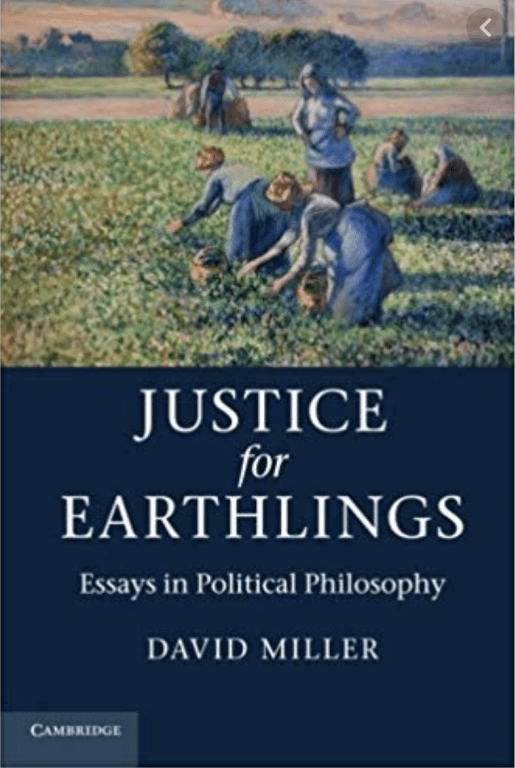 And as significant and helpful as I find this perspective, it’s worth considering that some of the contemporary ways we approach justice, at least the ways we have come to refer to them, are relatively recent in origin. It was only in the year 1900—barely more than a century ago—that the first book was published that included the term social justice in its title (4). And it is far more recent still—not until the last decades of the twentieth-century—that the term “global justice” became widespread (Miller 2013: 165). It is not only the word justice that we must wrestle with, but also the scale at which we seek to do justice in our globalized, pluralistic, postmodern world of 7.6 billion people–and climbing.
So, at the risk of oversimplifying, when we talk about social justice or global justice, one crude definition of what we mean is “how the good and bad things in life should be distributed” (Miller 2001: 1). “Who gets the advantages and who bears the burdens?” What’s fair? Who decides?
Let me say more using a set of cartoons. (Click on the link to view the cartoons. I’ll be here when you get back.) Setting aside the unfortunate choice to make the situation about watching a baseball game at which the spectators have a high likelihood of being hit by a baseball—I have found this set of cartoons to be a clarifying visual aid for thinking about justice
Panel 1 (“equality”) shows why treating everyone the same is inadequate because people are not all the same. Giving everyone a box to stand on works out perfectly for the person in the middle, but the person on the left doesn’t need a box. And the person on the right, even when standing on the box, is still staring at the fence.
Panel 2 (“equity”) is a strategy of giving everyone what they need. In Marx’s language, “From each according to their ability (or resources); to each according to their socially recognized needs” (Gilbert 24). Note that in this second panel there are still three boxes total, but the tall person’s box on the left has been redistributed—Go social justice!—to the now joyous person on the right who can finally see over the fence!
Panel 3 (“reality”) is a sad reminder of our current state of extreme wealth inequality, in which the person on the left has absurdly too many boxes such that they are standing dangerously high up—and the person on the right is demoralizingly sitting in a hole. I have previously addressed wealth inequality at length, so I will limit myself to one data point for now. In the United States today,
The bottom 90%—a group of almost 145 million families who possess approximately $94,000 on average—collectively own about as much of the total household wealth (22%) as the 161,000 families who are included in the top 0.1%, whose average wealth is approximately $82 million, 845 times larger than the bottom 90%…. The top 0.1% is about as large as the income share of the top 1%.
Having more than others can arguably be considered fair, but some people having 845 times more than others corrupts any chance of a fair playing field.
Panel 4 (“liberation”) challenges us to take down the fence: to change the institution, the system, the structure that is holding people back in the first place. So although this cartoon isn’t perfect (and of course, nothing is), I invite you to use it as a tool to reflect on the ways you too may shift reality—within your spheres of influence—toward more equity or even toward collective liberation.
Along these lines, I have been heartened recently to hear more interest in Certified B Corporations, which are legally required to
consider the impact of their decisions on their workers, customers, suppliers, community and the environment…. B Corp companies must undergo a rigorous measurement of a company’s full environmental, social and governance (E.S.G.) commitment, which measures a company’s commitment to reducing environmental impact and supporting social justice as well as governance and engagement within their communities.
This stance is in contrast to the traditional understanding that corporations only exist to increase shareholder value. And while I celebrate an increase in the number of B Corporations, the deeper question for me is whether all corporations should be required to consider the impact of their decisions on other people and on this planet. Maybe we’ve been doing this wrong for quite a while now! Sometimes we need to take down those walls that are keeping us from creating a world of peace, liberty, and justice—not merely for some, not merely for shareholders—but for all. For now, perhaps a greater awareness of Certified B Corporations can remind us that a better world is possible. I’m grateful to be with so many of you on our journey to create such a world. Together, may we turn our dreams into deeds.
The Rev. Dr. Carl Gregg is a certified spiritual director, a D.Min. graduate of San Francisco Theological Seminary, and the minister of the Unitarian Universalist Congregation of Frederick, Maryland. Follow him on Facebook (facebook.com/carlgregg) and Twitter (@carlgregg).
Learn more about Unitarian Universalism: http://www.uua.org/beliefs/principles
Next Post

October 14, 2019 Indigenous Peoples' Day, Scientific Knowledge, & the Teachings of Plants
Browse Our Archives
Select a Category Advent Anti-Racism Archaeology Atheism Baptism Best of the Year List Book Reviews Buddhism Catholicism Christian Education Church and State Church Planting Climate Change Conscientious Objection to War Creation Spirituality Death Penalty Didache Disability Rights Discernment Easter Ecology Emergent Church Movement Empire-Critical Ethics Evolution Feminist Theology Film Reviews Gandhi Gospel of Mark Gun Control Hinduism Immigration Reform Interfaith Islam JFK Judaism Jungian Spirituality Lectionary Commentary Lent Letters to the Editor LGBT Marriage MLK Multiculturalism Mysticism Nonviolent Activism Occupy Paganism (Earth-centered Religions) Parables Paul Pluralism Politics Process Theology Quantum Physics Requiescat In Pace Seminary and Divinity School Sermon Series Retrospective Sermons Spiritual Direction Spiritual Practices Stewardship (Fundraising) The Book of J The Wheel of the Year (Paganism) Theoblogger Challenge Triathlon Uncategorized Unitarian Universalism Worship Resources Youth Ministry
Select a Month July 2026 May 2026 March 2026 November 2025 October 2025 August 2025 February 2025 December 2024 October 2024 March 2024 January 2024 December 2023 November 2023 March 2023 February 2023 January 2023 December 2022 November 2022 August 2022 March 2022 February 2022 January 2022 December 2021 September 2021 August 2021 July 2021 June 2021 May 2021 February 2021 January 2021 December 2020 August 2020 June 2020 May 2020 April 2020 March 2020 February 2020 January 2020 December 2019 November 2019 October 2019 September 2019 July 2019 June 2019 March 2019 February 2019 January 2019 December 2018 November 2018 October 2018 September 2018 June 2018 May 2018 April 2018 March 2018 February 2018 January 2018 December 2017 November 2017 October 2017 September 2017 August 2017 July 2017 June 2017 May 2017 April 2017 March 2017 February 2017 January 2017 December 2016 November 2016 October 2016 September 2016 August 2016 June 2016 May 2016 April 2016 March 2016 February 2016 January 2016 December 2015 November 2015 October 2015 September 2015 August 2015 July 2015 June 2015 May 2015 April 2015 March 2015 February 2015 January 2015 December 2014 November 2014 October 2014 August 2014 July 2014 June 2014 May 2014 April 2014 March 2014 February 2014 January 2014 December 2013 November 2013 October 2013 September 2013 August 2013 July 2013 June 2013 May 2013 April 2013 March 2013 February 2013 January 2013 December 2012 November 2012 October 2012 September 2012 August 2012 July 2012 June 2012 May 2012 April 2012 March 2012 February 2012 January 2012 December 2011 November 2011 October 2011 September 2011 August 2011 July 2011 June 2011 May 2011 April 2011 March 2011 February 2011 January 2011 December 2010 November 2010 October 2010 August 2009 July 2009 May 2009
Follow Us!
TAKE THE
Religious Wisdom Quiz
Which Psalm contains "Create in me a clean heart, O God"?
Select your answer to see how you score.
Psalm 51 Psalm 33 Psalm 110 Psalm 70
Related posts from Carl Gregg

Reading America at 250: A Nation Wrestles With...


Andrew Holocek on the Power of Darkness

The Stories That Shape Us: Myths, Archetypes, &...
TRENDING AT PATHEOS More Voices

Reading America at 250: A Nation Wrestles With...
As part of my own reflection on the 250th anniversary of the...

Whenever I am reading a book or listening to an argument, I...

President Trump Ban Animal Torture Videos on Facebook
Call for Stricter Regulations of Animal Abuse Content on Facebook Although President...

Draft Amendments to Address Ritual Abuse in New...
The proposed changes would make it illegal for individuals in domestic partnerships...

How Bans on LGBTQ+ Student Clubs Threaten Religious...
On June 20, 2025, the State of Texas passed Senate Bill 12....

The Truth About the Gen Z Revival
This past year, there has been a lot of media buzz surrounding...
view all More Voices blogs
Ad-Free & Subscriber Log-In Subscription Support
- About Us
- 2026 Calendar
- Videos
- Podcasts
- Library of World Religions
- Faith In Media Tracker
- Advertise With Us
- Write for Us
- Privacy Policy
- Terms of Service
- Do Not Sell My Data
- Contact Us
- Radiant Digital
- Manage Newsletter Subscriptions
- Unsubscribe From Notifications
- Sitemap
Copyright 2008-2026, Patheos. All rights reserved.
Subscription Support Ad-Free & Subscriber Log-In
Follow Patheos