
BuddhistCatholicContemplativeEvangelicalGeneral ChristianHinduJewishLatter-day SaintMuslimNew VisionsProgressive Christian
Beliefs
- Buddhist
- Catholic
- Contemplative
- Evangelical
- General Christian
- Hindu
- Jewish
- Latter-day Saint
- More Voices
- Muslim
- New Visions
- Pagan
- Progressive Christian
Topics
- Religion News
- Food and Religion
- Sports and Religion
- Religious Art
- Religious Music and Entertainment
- Religious Events
- History and Religion
- Style and Religion
- Politics and Religion
- Women in Religion
- Recreation Outdoors and Religion
- Business Finance and Religion
- Careers Workplace and Religion
- Education and Religion
- Family Parenting and Religion
- Health Fitness and Religion
- Home and Religion
- Relationships and Religion
- Technology and Religion
- Travel and Religion
Columnists
- Buddhist Columnists
- Business Finance and Religion Columnists
- Careers Workplace and Religion Columnists
- Catholic Columnists
- Contemplative Columnists
- Education and Religion Columnists
- Evangelists Columnists
- Family Parenting and Religion Columnists
- General Christian Columnists
- Health Fitness and Religion Columnists
- Hindu Columnists
- History and Religion Columnists
- Home and Religion Columnists
- Jewish Columnists
- More Voices Columnists
- Latter Day Columnists
- Muslim Columnists
- New Visions Columnists
- Nonreligious Columnists
- Pagan Columnists
- Politics and Religion Columnists
- Progressive Columnists
- Recreation Outdoors and Religion Columnists
- Relationships and Religion Columnists
- Religion News Columnists
- Religious Art Columnists
- Religious Events Columnists
- Religious Music and Entertainment Columnists
- Sports and Religion Columnists
- Style and Religion Columnists
- Technology and Religion Columnists
- Travel and Religion Columnists
- Women in Religion Columnists
Resource Library
- 2026 Calendar
- Library of World Religions
- The 100 Most Holy Places on Earth
- Patheos Answers
- Podcasts
- Videos
- Faith Leaders Database
- Anglican Episcopalian
- Bahai
- Baptist
- Buddhism
- Christianity
- Confucianism
- Eastern Orthodoxy
- Hinduism
- Holiness and Pentecostal
- ISKCON
- Islam
- Judaism
- Lutheran
- Methodist
- The Church of Jesus Christ of Latter-day Saints
- New Age
- Paganism
- Presbytarian and Reformed
- Protestantism
- Religion Behind the Scenes
- Roman Catholic
- Scientology
- Shia Islam
- Sikhism
- Sufism
- Sunni Islam
- Taoism
- Zen
- See all religions
Research Tools
 Ad-Free & Subscriber Log-In Subscription Support
Ad-Free & Subscriber Log-In Subscription Support
Follow Patheos 

- Trending:
- Forgiveness
- |
- Marriage
- |
- Consciousness
- |
- Death Penalty
- |
- Election
- |
- Halloween

- Home
- More Voices
- Earthrise, Big History, & Deep Time
Earthrise, Big History, & Deep Time
Last updated on: October 24, 2019 at 10:34 am by Carl Gregg
Earthrise, Big History, & Deep Time 2019-10-24T10:34:27-04:00 Carl Gregg
Patheos Explore the world's faith through different perspectives on religion and spirituality! Patheos has the views of the prevalent religions and spiritualities of the world.
I. Big History
The English writer H. G. Wells (1866-1946) is best remembered for his science fiction novels—The Time Machine (1895), The Island of Doctor Moreau (1896), The Invisible Man (1897), and The War of the Worlds (1898). Wells was also a futurist, and his books “foresaw the advent of aircraft, tanks, space travel, nuclear weapons, satellite television and something resembling the World Wide Web.”
In response to the horrors of the first World War, Wells similarly attempted to peer into the future:
There can be no peace now, we realize, but a common peace in all the world; no prosperity but a general prosperity. But there can be no common peace and prosperity without common historical ideas…. With nothing but narrow, selfish, and conflicting nationalist traditions…people are bound to drift towards conflict and destruction. (Christian viii)
The historian David Christian is one of the best examples I know of someone attempting to take on the project that Wells called for, of cultivating common historical ideas for the whole human race.
Dr. Christian was trained at Oxford, and since the 1980s, he has been developing a perspective he calls Big History, which “frames human history in terms of cosmic, geological, and biological history.” He is the director of Macquarie University’s Big History Institute, and is the cofounder, along with Bill Gates, of the Big History Project, which has built a free online high-school syllabus on big history.
Here’s a chart that is one example of a tool Dr. Christian has developed for helping us grasp the span of Big History. (Note, in particular, the shift in the righthand column from years to days to minutes and back to years.):
David Christian, Origin Story: A Big History of Everything
Event
Approximate Date
Divided by 1 billion
Big Bang
13.8 billion years ago
13 years, 8 months ago
Our sun & solar system form
4.5 billion years ago
4 years, 6 months ago
Earliest life on Earth
3.8 billion years ago
3 years, 9 months ago
An asteroid wipes out the dinosaurs
65 million years ago
24 days ago
First evidence of our species, Homo sapiens
200,000 years ago
100 minutes ago
First evidence of cities, states, agrarian civilizations
5,000 years ago
2.5 minutes ago
Roman and Han Empires flourish
2,000 years ago
1 minute ago
Fossil Fuels revolution beings
200 years ago
6 seconds ago
The sun dies
4.5 billion years in the future
4 years, 6 months to go
The universe fades to darkness; entropy wins
Gazillions and gazillions of years in the future
Billions and billions of years
from now
The following is another attempt at making “Deep Time” understandable:
Imagine that you have thirty large volumes on your bookshelf. Each tome is 450 pages long, and every page stands for one million years. Let this set of books represent the scientific story of our 13.7 billion-year-old universe.
The narrative begins with the Big Bang on page 1 of Volume 1, but the first twenty-one books show no obvious signs of life at all. The earth story begins only in Volume 21, 4.5 billion years ago, but life doesn’t appear until Volume 22, about 3.8 billion years ago. Even then, living organisms do not become particularly interesting, at least in human terms, until almost the end of Volume 29. There, the famous Cambrian Explosion occurs, and the patterns of life suddenly burst out into an unprecedented array of complexity and diversity.
Dinosaurs come in around the middle of Volume 30 but are wiped out on page 385. Only during the last sixty-five pages of Volume 30 does mammalian life begin to flourish. Our hominid ancestors show up several pages from the end of volume 30, but modern humans do not appear until the bottom of the final page. The entire history of human intelligence, ethics, religious aspiration, and scientific discovery takes up only the last few lines on the last page of the last volume. (Dowd xii)
II. “Earthrise”
I remember as a child the first time I really “got” that the sun doesn’t really rise in the East and set in the West. Rather, our planet spins completely on its axis (every 24 hours) while also circling (every year) around the sun. Whoa! I know some of you are astronomy experts who think this way all the time, but for the rest of us, it can be a little trippy to shift into remembering how our place in the solar system actually works.
I can also remember the first time I really began to grasp “deep space” and “deep time”: that our solar system is on the edge of the Milky Way galaxy that itself is one of at least two trillion galaxies in the universe. And that is all part of the 13.8 billion year old Universe Story. Whoa! Again, it can be mind-blowing if you stop and really consider it.
And I would like to invite us to spend a few minutes reflecting on how that sort of comic perspective can shift our way of being in the world. And I would like to use one particular moment as a prime example of what I’m talking about.
On December 24 (Christmas Eve) 1968, three astronauts, the crew of Apollo 8, became the first human beings to leave Earth’s orbit. Their first three orbits were focused on the surface of the moon. Then on their fourth orbit, the following exchange was captured by the onboard voice recorder:
Borman: Oh my God! Look at that picture over there! Here’s the Earth coming up. Wow, that is pretty.
Anders: Hey don’t take that, it’s not scheduled.
Borman: (Laughter) You got a color film, Jim [Lovell]?
Anders: Hand me that roll of color quick, will you—
Lovell: Oh man, that’s great!
Anders: Hurry, Quick…
Lovell: Take several of them! Here, give it to me…
Borman: Calm down, Lovell. (Poole 1)
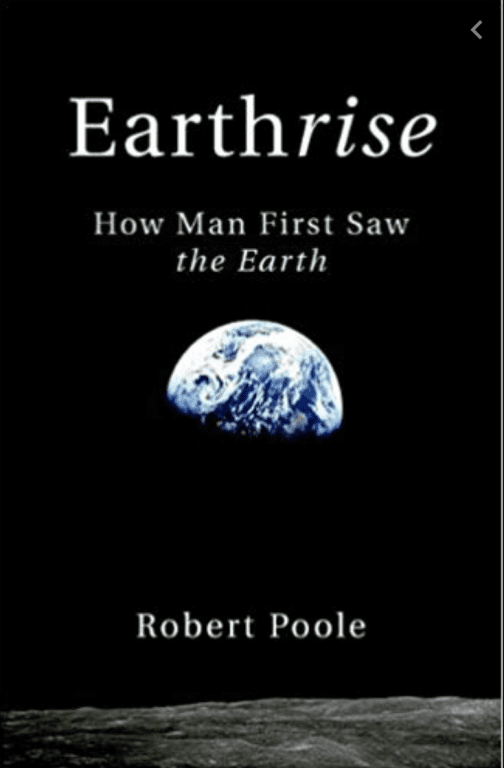 How human that exchange is! The good news is that they did get it together to take a photo in that unexpected moment including the famous “Earthrise” photo.
Anders later reflected on why that moment caught them by surprise:
We’d spent all our time on Earth training about how to study the Moon, how to go to the Moon; it was very lunar oriented. And yet when I looked up and saw the Earth coming up on this very stark, beat up lunar horizon—an Earth that was the only color that we could see, a very fragile looking Earth, a very delicate looking Earth—I was immediately almost overcome by the thought that here we came all this way to the Moon, and yet the most significant thing we’re seeing is our own home planet, the Earth. (2)
Indeed, in a fascinating example of how what you think will be important is often different than what is actually important, if you look back at NASA’s mission plans for Apollo 8, photos of the Earth were categorized as “targets of opportunity” and “lowest priority.”
But after viewing that first photo, the poet Archibald MacLeish famously wrote that:
For the first time in all of time, [humans] have seen the Earth: seen it not as continents or oceans from the little distance of a hundred miles or two or three, but seen it from the depths of space; seen it whole and round and beautiful and small…. To see the Earth as it truly is, small and blue and beautiful in that eternal silence where it floats, is to see ourselves as riders on the Earth together, brothers [and sisters] on that bright loveliness in the eternal cold—[sisters and] brothers who know that they are truly [siblings]. (8)
It is not a coincidence that fifteen months after that December 1968 “Earthrise” photo was published, the first Earth Day was celebrated in April 1970. That first visual image of the Earth helped further catalyze the burgeoning environmental moment (9).
Similarly, it is striking to read the reports of astronauts reflecting on how the Earth seems from space. An Apollo 15 astronaut said that as he looked back at Earth, it “shrank from the size of a basketball, to a baseball, a golf ball, and finally a marble. The most beautiful marble you could imagine.” Or in the words of an Apollo 11 astronaut:
I looked out of my window and tried to find Earth. The little planet is so small out there in the vastness that at first I couldn’t even locate it. And when I did, a tingling of awe spread over me. There it was, shining like a jewel in a black sky.… I looked away for a moment and, poof, it was gone. I couldn’t find it again without searching closely.
Here on Earth, our planet seems massive. So it is remarkable to consider that from the relatively nearby perspective of being near our moon, there are many times one might not be able to even locate Earth amidst the vast inky darkness of space.
But my absolute favorite astronaut quote comes from Edgar Mitchell from Apollo 14, who said that from the point of view of space,
You develop an instant global consciousness, a people orientation, an intense dissatisfaction with the state of the world and a compulsion to do something about it. From out there on the moon, international politics look so petty. You want to grab a politician by the scruff of the neck, and drag him a quarter of a million miles out and say, “Look at that, you [beep].” [Insert word, it’s probably best I not include.]
Now, I readily admit that I can get lost sometimes in those petty squabbles Mitchell criticizes. But I am always grateful for reminders such as “Earthrise” that point me back to the bigger picture. Developing a global consciousness—and cultivating a cosmic awareness of deep time and big history—can be some of the most powerful tools in working toward the Unitarian Universalist Sixth Principle calls, “The goal of world community with peace, liberty, and justice for all.”
In that spirit, for now, I will leave you with one final quote, this time from Carl Sagan’s final book for a popular audience, Pale Blue Dot: A Vision of the Human Future in Space. It was published in 1994, two years before his death. (He was only 62 when he died.)
The inspiration for that final book is the famous Pale Blue Dot photograph taken in 1990 of planet Earth from 3.7 billion miles away by the Voyager 1 space probe: “In the photograph, Earth’s apparent size is less than a pixel; [our] planet appears as a tiny dot against the vastness of space, among bands of sunlight reflected by the camera.” Reflecting on that photo, Sagan wrote:
Our posturings, our imagined self-importance, the delusions that we have some privileged position, are challenged by this point of pale light. Our planet is a lonely speck in the great enveloping cosmic dark…. There is no hint that help will come from elsewhere to save us from ourselves…. This distant image of our tiny wold…underscores our responsibility to deal more kindly with one another, and to preserve and cherish the pale blue dot, the only home we’ve got. (191-192)
The Rev. Dr. Carl Gregg is a certified spiritual director, a D.Min. graduate of San Francisco Theological Seminary, and the minister of the Unitarian Universalist Congregation of Frederick, Maryland. Follow him on Facebook (facebook.com/carlgregg) and Twitter (@carlgregg).
Learn more about Unitarian Universalism: http://www.uua.org/beliefs/principles
Next Post

October 30, 2019 Defense Against the Dark Arts: Harry Potter for Such a Time as This
Browse Our Archives
Select a Category Advent Anti-Racism Archaeology Atheism Baptism Best of the Year List Book Reviews Buddhism Catholicism Christian Education Church and State Church Planting Climate Change Conscientious Objection to War Creation Spirituality Death Penalty Didache Disability Rights Discernment Easter Ecology Emergent Church Movement Empire-Critical Ethics Evolution Feminist Theology Film Reviews Gandhi Gospel of Mark Gun Control Hinduism Immigration Reform Interfaith Islam JFK Judaism Jungian Spirituality Lectionary Commentary Lent Letters to the Editor LGBT Marriage MLK Multiculturalism Mysticism Nonviolent Activism Occupy Paganism (Earth-centered Religions) Parables Paul Pluralism Politics Process Theology Quantum Physics Requiescat In Pace Seminary and Divinity School Sermon Series Retrospective Sermons Spiritual Direction Spiritual Practices Stewardship (Fundraising) The Book of J The Wheel of the Year (Paganism) Theoblogger Challenge Triathlon Uncategorized Unitarian Universalism Worship Resources Youth Ministry
Select a Month July 2026 May 2026 March 2026 November 2025 October 2025 August 2025 February 2025 December 2024 October 2024 March 2024 January 2024 December 2023 November 2023 March 2023 February 2023 January 2023 December 2022 November 2022 August 2022 March 2022 February 2022 January 2022 December 2021 September 2021 August 2021 July 2021 June 2021 May 2021 February 2021 January 2021 December 2020 August 2020 June 2020 May 2020 April 2020 March 2020 February 2020 January 2020 December 2019 November 2019 October 2019 September 2019 July 2019 June 2019 March 2019 February 2019 January 2019 December 2018 November 2018 October 2018 September 2018 June 2018 May 2018 April 2018 March 2018 February 2018 January 2018 December 2017 November 2017 October 2017 September 2017 August 2017 July 2017 June 2017 May 2017 April 2017 March 2017 February 2017 January 2017 December 2016 November 2016 October 2016 September 2016 August 2016 June 2016 May 2016 April 2016 March 2016 February 2016 January 2016 December 2015 November 2015 October 2015 September 2015 August 2015 July 2015 June 2015 May 2015 April 2015 March 2015 February 2015 January 2015 December 2014 November 2014 October 2014 August 2014 July 2014 June 2014 May 2014 April 2014 March 2014 February 2014 January 2014 December 2013 November 2013 October 2013 September 2013 August 2013 July 2013 June 2013 May 2013 April 2013 March 2013 February 2013 January 2013 December 2012 November 2012 October 2012 September 2012 August 2012 July 2012 June 2012 May 2012 April 2012 March 2012 February 2012 January 2012 December 2011 November 2011 October 2011 September 2011 August 2011 July 2011 June 2011 May 2011 April 2011 March 2011 February 2011 January 2011 December 2010 November 2010 October 2010 August 2009 July 2009 May 2009
Follow Us!
TAKE THE
Religious Wisdom Quiz
What was the rider of the Red Horse in Revelation given?
Select your answer to see how you score.
A balance scale A large sword A crown A bow
Related posts from Carl Gregg

Reading America at 250: A Nation Wrestles With...


Andrew Holocek on the Power of Darkness

The Stories That Shape Us: Myths, Archetypes, &...
TRENDING AT PATHEOS More Voices

Reading America at 250: A Nation Wrestles With...
As part of my own reflection on the 250th anniversary of the...

Whenever I am reading a book or listening to an argument, I...

President Trump Ban Animal Torture Videos on Facebook
Call for Stricter Regulations of Animal Abuse Content on Facebook Although President...

Draft Amendments to Address Ritual Abuse in New...
The proposed changes would make it illegal for individuals in domestic partnerships...

How Bans on LGBTQ+ Student Clubs Threaten Religious...
On June 20, 2025, the State of Texas passed Senate Bill 12....

The Truth About the Gen Z Revival
This past year, there has been a lot of media buzz surrounding...
view all More Voices blogs
Ad-Free & Subscriber Log-In Subscription Support
- About Us
- 2026 Calendar
- Videos
- Podcasts
- Library of World Religions
- Faith In Media Tracker
- Advertise With Us
- Write for Us
- Privacy Policy
- Terms of Service
- Do Not Sell My Data
- Contact Us
- Radiant Digital
- Manage Newsletter Subscriptions
- Unsubscribe From Notifications
- Sitemap
Copyright 2008-2026, Patheos. All rights reserved.
Subscription Support Ad-Free & Subscriber Log-In
Follow Patheos