
BuddhistCatholicContemplativeEvangelicalGeneral ChristianHinduJewishLatter-day SaintMuslimNew VisionsProgressive Christian
Beliefs
- Buddhist
- Catholic
- Contemplative
- Evangelical
- General Christian
- Hindu
- Jewish
- Latter-day Saint
- More Voices
- Muslim
- New Visions
- Pagan
- Progressive Christian
Topics
- Religion News
- Food and Religion
- Sports and Religion
- Religious Art
- Religious Music and Entertainment
- Religious Events
- History and Religion
- Style and Religion
- Politics and Religion
- Women in Religion
- Recreation Outdoors and Religion
- Business Finance and Religion
- Careers Workplace and Religion
- Education and Religion
- Family Parenting and Religion
- Health Fitness and Religion
- Home and Religion
- Relationships and Religion
- Technology and Religion
- Travel and Religion
Columnists
- Buddhist Columnists
- Business Finance and Religion Columnists
- Careers Workplace and Religion Columnists
- Catholic Columnists
- Contemplative Columnists
- Education and Religion Columnists
- Evangelists Columnists
- Family Parenting and Religion Columnists
- General Christian Columnists
- Health Fitness and Religion Columnists
- Hindu Columnists
- History and Religion Columnists
- Home and Religion Columnists
- Jewish Columnists
- More Voices Columnists
- Latter Day Columnists
- Muslim Columnists
- New Visions Columnists
- Nonreligious Columnists
- Pagan Columnists
- Politics and Religion Columnists
- Progressive Columnists
- Recreation Outdoors and Religion Columnists
- Relationships and Religion Columnists
- Religion News Columnists
- Religious Art Columnists
- Religious Events Columnists
- Religious Music and Entertainment Columnists
- Sports and Religion Columnists
- Style and Religion Columnists
- Technology and Religion Columnists
- Travel and Religion Columnists
- Women in Religion Columnists
Resource Library
- 2026 Calendar
- Library of World Religions
- The 100 Most Holy Places on Earth
- Patheos Answers
- Podcasts
- Videos
- Faith Leaders Database
- Anglican Episcopalian
- Bahai
- Baptist
- Buddhism
- Christianity
- Confucianism
- Eastern Orthodoxy
- Hinduism
- Holiness and Pentecostal
- ISKCON
- Islam
- Judaism
- Lutheran
- Methodist
- The Church of Jesus Christ of Latter-day Saints
- New Age
- Paganism
- Presbytarian and Reformed
- Protestantism
- Religion Behind the Scenes
- Roman Catholic
- Scientology
- Shia Islam
- Sikhism
- Sufism
- Sunni Islam
- Taoism
- Zen
- See all religions
Research Tools
 Ad-Free & Subscriber Log-In Subscription Support
Ad-Free & Subscriber Log-In Subscription Support
Follow Patheos 

- Trending:
- Forgiveness
- |
- Marriage
- |
- Consciousness
- |
- Death Penalty
- |
- Election
- |
- Halloween

- Home
- More Voices
- “This Life: Secular Faith & Spiritual Freedom”
“This Life: Secular Faith & Spiritual Freedom”
Last updated on: September 24, 2019 at 10:19 am by Carl Gregg
“This Life: Secular Faith & Spiritual Freedom” 2019-09-24T10:19:14-04:00 Carl Gregg
Patheos Explore the world's faith through different perspectives on religion and spirituality! Patheos has the views of the prevalent religions and spiritualities of the world.
Martin Hägglund (1976 – ), originally from Sweden, is a professor of Comparative Literature and Humanities at Yale University. He opens his book This Life: Secular Faith and Spiritual Freedom with a poignant epigram from Wuthering Heights (1847), Emily Brontë’s only novel:
If I were in heaven…I should be extremely miserable…. I dreamt, once, that I was there…. Heaven did not seem to be my home; and I broke my heart with weeping to come back to earth; and the angels were so angry that they flung me out, into the middle of the heath on the top of Wuthering Heights, where I awoke sobbing for joy.
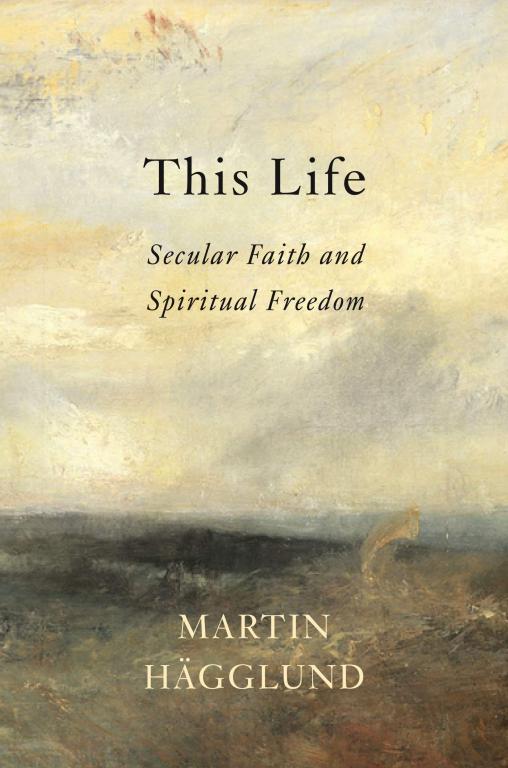 If I think back to the perspective of my theologically conservative childhood faith, that quote is extraordinarily challenging. How could one be miserable in heaven? Heaven is supposed to be the ultimate “good place,” with harps and wings, mansions for everyone, and streets paved with gold. If you were in heaven, how could you long to return to Earth? I was taught that this world was a vale of tears due to the inevitable losses of this finite human life in which we find ourselves—whereas heaven would be a place with no loss, only praise and rapture. But for Brontë’s character it was awakening in this life and this world that caused her to be overwhelmed with joy.
Along these lines, there was a moment in my childhood sometime during middle school, when I had an unexpected moment of clarity about my childhood congregation’s teachings about heaven. I suddenly realized: Wait, I don’t think any of these folks really believe deep down all this business about having eternity in heaven. Or if they do, they certainly seem to be hedging their bets here on Earth.
Here’s the thing: they told me to read the Bible, and I actually did—and then I start to notice inconsistencies. For instance, I found myself bothered by a particular passage in the sixth chapter of the Gospel of Matthew that says:
19 “Do not lay up for yourselves treasures on earth, where moth and rust destroy and where thieves break in and steal; 20 but lay up for yourselves treasures in heaven, where neither moth nor rust destroys and where thieves do not break in and steal. 21 For where your treasure is, there your heart will be also.
But when I looked around, I saw a whole lot of adults storing up treasure on earth. And my increasingly skeptical adolescent brain thought, if you all really believed that you had, at most, 80-120 years here on Earth compared to a literal eternity in heaven, then wouldn’t you sell all your earthly possessions (as Jesus’s earliest followers) did, spend the rest of your life serving the “least of these,” and earn some stars to garnish your heavenly crown to come?
Now, I will confess that I, of course, don’t definitively know what happens after we die. As I have shared with you in previous posts there are some interesting theories out there related to what Jung called the Collective Unconscious (which is perhaps connected to how our individual consciousnesses emerge and which our consciousness might merge back into in some form even after we have “shuffled off this mortal coil”). I also have been doing this ministry thing long enough to have had people share with me a significant number of stories about weird, uncanny experiences around trauma, death, and dying.
Taking all of that into consideration, part of what I nevertheless appreciate most about Hägglund’s book is his emphasis on what we do know: this life, in the way we currently know and experience it, is finite (4). And there also is a real possibility that when we die, that’s it: lights out. So a major takeaway from Hägglund’s view is to make the most of this life that we know we do have right now while we still have it.
Hägglund actually ratchets up the stakes one notch further, inviting us to consider whether we would even enjoy eternal life if such were possible. Quoting another scholar, he makes the case that:
If one—anyone—tries to imagine [their] existence stretching forward not merely 300 years, but 300,000 or 300 million or 300 billion, or whatever (immortality, “world without end,”) these lengths of time are but a beginning), it will soon…become impossible to retain any sense of a recognizable structure of human emotions, reactions, intentions, aspirations, interrelations, etc. (203-204)
Hägglund assumes that this argument will convince his reader that living forever would be undesirable. Are you convinced? For what it’s worth, if given the opportunity, I’d be open to giving it a shot. And I’m not alone. There’s a whole burgeoning field of transhumanism exploring just that possibility for the distant day when technology might make such a possibility an option. (Consider, for example, the Black Mirror episode, “San Junipero.”)
For now, I appreciate the case Hägglund does make for what he calls secular faith: putting your trust, your devotion not in an afterlife or a next world, but in this life and in this world (5). His other primary emphasis is spiritual freedom: creating systems in which we finite humans can choose what we should do with the limited time we have (12).
Along these lines, when someone says that they have to do something, I’m occasionally reminded of the fierce motto of New Hampshire: “Live Free or Die.” Do I have to do ______? I sometimes want to say, “All I have to do is live free or die.” But there is immense power in what I (or we) choose to do with whatever freedom we have (27).
One contemporary exemplar that Hägglund explores of what it can mean to embrace the full reality of this life in which we find ourselves is Norwegian author Karl Knausgård (1968 – ) He is most well known for his six-volume autobiographical series titled My Struggle which he completed almost a decade ago in 2011. Over the course of an astounding 3,600 pages, he undertakes an incredibly close study of his actual life “no matter how quotidian, painful, or intimate the details may be….”:
We spend many pages going grocery shopping, pushing baby prams in the city, and attending to daily exchanges with his children—all rendered with a fidelity to everyday life that neither idealizes nor deprecates the experiences in question (90-91).
Full disclosure: as I have heard about this global bestselling series over the past decade, part of me couldn’t help thinking, “That sounds terrible.” But when I keep hearing rave reviews, including from other favorite authors such as Zadie Smith—who has said she “needs the next installment like crack”—I find myself curious as to what this series is about.
And to be fair, the point is not a narcissistic obsession with one person’s life. Rather, the goal is to point you back to your own life:
When he dedicates twenty pages to exchanges over breakfast with his daughters on a rainy Wednesday morning—or seeks to pry open every sensation and emotion that resonated in his twelve-year-old self on the way home from swim practice one particular winter night—he is not simply imposing his life on us. He is teaching us (and himself) how we can remember what we tend to forget. By describing the quotidian [the everyday] in painstaking detail, he opens our eyes to how much is going on even during days when nothing seems to happen. And by resuscitating his former selves, he sensitizes us to memories that can open painful wounds but also bring us back to life. (92)
He is directing us back to our always diminishing number of opportunities to make the most out of this life and this world. As Thoreau wrote in Walden: “ I wanted to live deep and suck out all the marrow of life.”
I should perhaps add at least briefly that Knausgård’s series is wholly idiosyncratic or unprecedented. What he’s set out to do in many ways is a twenty-first century version of the French writer Marcel Proust’s (1871-1922) seven-volume, 3,000-page series In Search of Lost Time (À la recherche du temps perdu). Like Knausgård, Proust:
can dwell on the experience of falling asleep for more than thirty pages, or seek to distill every nuance of an erotic touch, a flickering memory, an awakening sensation. Through the power of his prose, he wants to sharpen our perception and refine our sense. The aim is not to transport us to another life but to make us genuinely experience the life we are already living (107).
Along these lines, part of what I’m learning in my own meditation practice about the importance not only of waking up (which often refers to peak experiences on the spiritual journey), but also of waking down to the reality of your life (which is where we will always inevitably find ourselves returning).
In addition to this emphasis on embracing the fullness of this life, I also would be remiss if I failed to mention that another huge part of Knausgård’s project is illuminating how we are shaping one another and this world. Traditional religion has often been “other worldly” to the detriment of our human bodies (as if only spirit really matters…) and our planet (as if only heaven really matters…).
Along those lines, I’ve often appreciated The Rev. Dr. Martin Luther King, Jr.’s prophetic words on April 3, 1968 on what turned out to be his final speech, the night before he was killed:
It’s all right to talk about “long white robes over yonder,” in all of its symbolism. But ultimately people want some suits and dresses and shoes to wear down here. It’s all right to talk about “streets flowing with milk and honey,” but God has commanded us to be concerned about the slums down here, and [the] children who can’t eat three square meals a day. It’s all right to talk about the new Jerusalem, but one day, God’s preachers must talk about the New York, the new Atlanta, the new Philadelphia, the new Los Angeles, the new Memphis, Tennessee. This is what we have to do. (376)
More than 50 years later those words seem more prescient than ever.
Although Dr. King was assassinated two years before the first Earth Day, I have no doubt that if he were still alive, then he would been marching side by side with Greta Thunberg and millions of others on Friday in the youth-led global #ClimateStrike. And it is notable and not a coincidence that both Hägglund, the author of This Life, and the young climate activist Greta Thunberg are Swedish, as well as that the obsessed-with-the-details-of-this-life writer Knausgård is Norwegian. The Nordic European countries in which they were raised have a strong emphasis on this world and this life. And Hägglund’s book concludes with a strong call for more democratic socialism (301-311).
After all, if this life and this planet is all any of us know we have with certainty, then the impulse is more urgent to help ensure that as many people as possible have what the Sixth Principle in my own tradition of Unitarian Universalism calls “The goal of world community with peace, liberty, and justice”—not merely for some—“ but for all.” So may we make the most of this world and this life in our care for ourselves, one another, and this planet.
The Rev. Dr. Carl Gregg is a certified spiritual director, a D.Min. graduate of San Francisco Theological Seminary, and the minister of the Unitarian Universalist Congregation of Frederick, Maryland. Follow him on Facebook (facebook.com/carlgregg) and Twitter (@carlgregg).
Learn more about Unitarian Universalism: http://www.uua.org/beliefs/principles
Previous Post

September 17, 2019
How to be "10% Happier”
Browse Our Archives
Select a Category Advent Anti-Racism Archaeology Atheism Baptism Best of the Year List Book Reviews Buddhism Catholicism Christian Education Church and State Church Planting Climate Change Conscientious Objection to War Creation Spirituality Death Penalty Didache Disability Rights Discernment Easter Ecology Emergent Church Movement Empire-Critical Ethics Evolution Feminist Theology Film Reviews Gandhi Gospel of Mark Gun Control Hinduism Immigration Reform Interfaith Islam JFK Judaism Jungian Spirituality Lectionary Commentary Lent Letters to the Editor LGBT Marriage MLK Multiculturalism Mysticism Nonviolent Activism Occupy Paganism (Earth-centered Religions) Parables Paul Pluralism Politics Process Theology Quantum Physics Requiescat In Pace Seminary and Divinity School Sermon Series Retrospective Sermons Spiritual Direction Spiritual Practices Stewardship (Fundraising) The Book of J The Wheel of the Year (Paganism) Theoblogger Challenge Triathlon Uncategorized Unitarian Universalism Worship Resources Youth Ministry
Select a Month July 2026 May 2026 March 2026 November 2025 October 2025 August 2025 February 2025 December 2024 October 2024 March 2024 January 2024 December 2023 November 2023 March 2023 February 2023 January 2023 December 2022 November 2022 August 2022 March 2022 February 2022 January 2022 December 2021 September 2021 August 2021 July 2021 June 2021 May 2021 February 2021 January 2021 December 2020 August 2020 June 2020 May 2020 April 2020 March 2020 February 2020 January 2020 December 2019 November 2019 October 2019 September 2019 July 2019 June 2019 March 2019 February 2019 January 2019 December 2018 November 2018 October 2018 September 2018 June 2018 May 2018 April 2018 March 2018 February 2018 January 2018 December 2017 November 2017 October 2017 September 2017 August 2017 July 2017 June 2017 May 2017 April 2017 March 2017 February 2017 January 2017 December 2016 November 2016 October 2016 September 2016 August 2016 June 2016 May 2016 April 2016 March 2016 February 2016 January 2016 December 2015 November 2015 October 2015 September 2015 August 2015 July 2015 June 2015 May 2015 April 2015 March 2015 February 2015 January 2015 December 2014 November 2014 October 2014 August 2014 July 2014 June 2014 May 2014 April 2014 March 2014 February 2014 January 2014 December 2013 November 2013 October 2013 September 2013 August 2013 July 2013 June 2013 May 2013 April 2013 March 2013 February 2013 January 2013 December 2012 November 2012 October 2012 September 2012 August 2012 July 2012 June 2012 May 2012 April 2012 March 2012 February 2012 January 2012 December 2011 November 2011 October 2011 September 2011 August 2011 July 2011 June 2011 May 2011 April 2011 March 2011 February 2011 January 2011 December 2010 November 2010 October 2010 August 2009 July 2009 May 2009
Follow Us!
TAKE THE
Religious Wisdom Quiz
I am a day when the high priest enters the Most Holy Place once a year to make atonement. What day am I?
Select your answer to see how you score.
Passover The Day of Trumpets The Day of Atonement The Sabbath
Related posts from Carl Gregg

Reading America at 250: A Nation Wrestles With...


Andrew Holocek on the Power of Darkness

The Stories That Shape Us: Myths, Archetypes, &...
TRENDING AT PATHEOS More Voices

Reading America at 250: A Nation Wrestles With...
As part of my own reflection on the 250th anniversary of the...

Whenever I am reading a book or listening to an argument, I...

President Trump Ban Animal Torture Videos on Facebook
Call for Stricter Regulations of Animal Abuse Content on Facebook Although President...

Draft Amendments to Address Ritual Abuse in New...
The proposed changes would make it illegal for individuals in domestic partnerships...

How Bans on LGBTQ+ Student Clubs Threaten Religious...
On June 20, 2025, the State of Texas passed Senate Bill 12....

The Truth About the Gen Z Revival
This past year, there has been a lot of media buzz surrounding...
view all More Voices blogs
Ad-Free & Subscriber Log-In Subscription Support
- About Us
- 2026 Calendar
- Videos
- Podcasts
- Library of World Religions
- Faith In Media Tracker
- Advertise With Us
- Write for Us
- Privacy Policy
- Terms of Service
- Do Not Sell My Data
- Contact Us
- Radiant Digital
- Manage Newsletter Subscriptions
- Unsubscribe From Notifications
- Sitemap
Copyright 2008-2026, Patheos. All rights reserved.
Subscription Support Ad-Free & Subscriber Log-In
Follow Patheos