
BuddhistCatholicContemplativeEvangelicalGeneral ChristianHinduJewishLatter-day SaintMuslimNew VisionsProgressive Christian
Beliefs
- Buddhist
- Catholic
- Contemplative
- Evangelical
- General Christian
- Hindu
- Jewish
- Latter-day Saint
- More Voices
- Muslim
- New Visions
- Pagan
- Progressive Christian
Topics
- Religion News
- Food and Religion
- Sports and Religion
- Religious Art
- Religious Music and Entertainment
- Religious Events
- History and Religion
- Style and Religion
- Politics and Religion
- Women in Religion
- Recreation Outdoors and Religion
- Business Finance and Religion
- Careers Workplace and Religion
- Education and Religion
- Family Parenting and Religion
- Health Fitness and Religion
- Home and Religion
- Relationships and Religion
- Technology and Religion
- Travel and Religion
Columnists
- Buddhist Columnists
- Business Finance and Religion Columnists
- Careers Workplace and Religion Columnists
- Catholic Columnists
- Contemplative Columnists
- Education and Religion Columnists
- Evangelists Columnists
- Family Parenting and Religion Columnists
- General Christian Columnists
- Health Fitness and Religion Columnists
- Hindu Columnists
- History and Religion Columnists
- Home and Religion Columnists
- Jewish Columnists
- More Voices Columnists
- Latter Day Columnists
- Muslim Columnists
- New Visions Columnists
- Nonreligious Columnists
- Pagan Columnists
- Politics and Religion Columnists
- Progressive Columnists
- Recreation Outdoors and Religion Columnists
- Relationships and Religion Columnists
- Religion News Columnists
- Religious Art Columnists
- Religious Events Columnists
- Religious Music and Entertainment Columnists
- Sports and Religion Columnists
- Style and Religion Columnists
- Technology and Religion Columnists
- Travel and Religion Columnists
- Women in Religion Columnists
Resource Library
- 2026 Calendar
- Library of World Religions
- The 100 Most Holy Places on Earth
- Patheos Answers
- Podcasts
- Videos
- Faith Leaders Database
- Anglican Episcopalian
- Bahai
- Baptist
- Buddhism
- Christianity
- Confucianism
- Eastern Orthodoxy
- Hinduism
- Holiness and Pentecostal
- ISKCON
- Islam
- Judaism
- Lutheran
- Methodist
- The Church of Jesus Christ of Latter-day Saints
- New Age
- Paganism
- Presbytarian and Reformed
- Protestantism
- Religion Behind the Scenes
- Roman Catholic
- Scientology
- Shia Islam
- Sikhism
- Sufism
- Sunni Islam
- Taoism
- Zen
- See all religions
Research Tools
 Ad-Free & Subscriber Log-In Subscription Support
Ad-Free & Subscriber Log-In Subscription Support
Follow Patheos 

- Trending:
- Forgiveness
- |
- Marriage
- |
- Consciousness
- |
- Death Penalty
- |
- Election
- |
- Halloween

- Home
- More Voices
- A Clock on the Floor Runs Slower than One on a Table—& Other Wild Truths about Time
A Clock on the Floor Runs Slower than One on a Table—& Other Wild Truths about Time
Last updated on: March 8, 2019 at 12:08 pm by Carl Gregg
A Clock on the Floor Runs Slower than One on a Table—& Other Wild Truths about Time 2019-03-08T12:08:14-05:00 Carl Gregg
Patheos Explore the world's faith through different perspectives on religion and spirituality! Patheos has the views of the prevalent religions and spiritualities of the world.
In the seventeenth century, the English politician Andrew Marvell (1621–1678) wrote of all we might accomplish if not for our human limitations: “Had we but world enough and time.” Or as Chaucer penned three centuries earlier: “Time flies, and for no man will it abide.” Turning the clock back even further to the first century BCE, the Roman poet Virgil (70 BCE – 19 BCE) said, “Fugit irreparable tempus” (“Time flies irretrievably”) (Burdick 189).
Despite the cautions of these and so many other writings about time, we humans persist in various attempts to master time. Indeed, this Sunday, in most parts of this country, daylight savings time will begin at 2:00 a.m. Get ready to “spring forward!” You lose an hour of early morning sleep, but gain an hour of daylight in the evening. I personally think messing with time twice a year is a terrible idea: the disruption to our internal sense of time is not worth it. But for now, what I’m more interested in is all the aspects of time that remain outside human control.
Time is a slippery concept. As Dean Buonomano mentioned in his book Your Brain Is a Time Machine: The Neuroscience and Physics of Time (W. W. Norton & Company, 2017) studies have shown time to be the most commonly used noun in the English language (3). That makes sense: time is central to the human experience. “When we are not asking for the time, we are speaking of saving time, killing time, serving time, keeping time, not having time, tracking time, bedtime, time outs, buying time, good times, time travel, overtime, free time, and lunchtime” (3).
On the other hand, the more you study time, the more most people will confess that for the most part we rarely have a precise idea of what we’re talking about. As Augustine of Hippo (354-430 AD) said more than 1,500 years ago, “What then is time? If no one asks me, I know what it is. If I wish to explain it to him who asks, I do not know” (4).
But surely we’ve figured out a few things about time in the past millennia and a half since Augustine’s day? If we turn to the twentieth century, physicist Richard Feynman (1918 -1988) said, “Maybe it is just as well if we face the fact that time is one of the things we probably cannot define… What really matters anyway is not how we define time, but how we measure it” (34). As Einstein showed us, time is relative—so Feynman highlights that what arguably matters most is how we measure the relative difference between two times. I’ll say more about that momentarily.
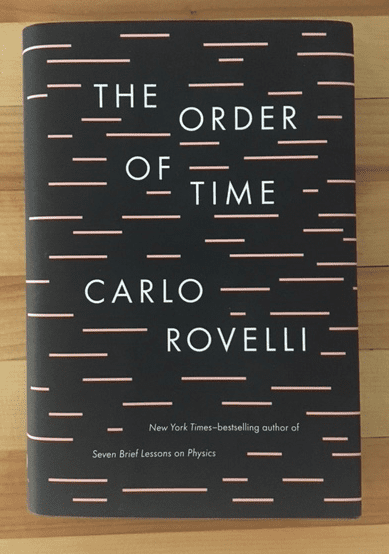 But first, as an inspiration for this exploration, allow me to introduce you to the contemporary physicist Carlo Rovelli (1956-). If I had to limit myself to one book on the nature of time, I would recommend that you read his recent book The Order of Time, which has the virtue of being short (less than 200 pages), tiny (~ 4” x 6”), and easily readable. And unlike many scientists, he has a beautiful and accessible writing style. (Have any of you read any of his books? He’s been described as the new Stephen Hawking. His Seven Brief Lessons on Physics is also great—and brief!.)
To begin to reflect further on time, if I look around the room in which I am in, I can see various clocks. Your watch or phone may add further iterations of what time it is. And whenever one or more clocks disagree, our typical sense is that there remains an independent, universal standard of time to which we can reset those clocks. But the truth is more complicated than that. As Alan Burdick explores in his book Why Time Flies: A Mostly Scientific Investigation (Simon & Schuster, 2017), time (as we typically think of it) is actually nothing more than “what everybody agrees time is” (5).
Now, come on, you might say. We live almost two decades into the twenty-first century. Surely there is an ultra-precise clock in a room somewhere that we can consult to give us The One True Answer to what time it is. But here’s the open secret: there’s not! That being said, thirty miles away from where I live in Gaithersburg, Maryland is one of two laboratories of the NIST (National Institute of Standards and Technology), “a federal agency that helps produce the official, civil time for the United States.” These laboratories:
keep a dozen or more cesium clocks running at any given time. As precise as these clocks are, they disagree with one another on a scale of nanoseconds, so every twelve minutes they are compared to one another…. The data from the clock ensemble is then numerically mashed into…the basis for the official time. (7)
So the clock on your laptop or desktop computer is calibrated through servers that pass at various points through servers at the NIST or related agencies around the world. Similarly, if you have a cell phone, that clock is set through the GPS (“Global Positioning Satellite”) system, synchronized through the U.S. Naval Observatory near Washington, D.C., which utilizes a system of more than seventy cesium clocks (8).
But there is no one “World’s Best Clock.” Rather, what is known as Coordinated Universal Time is calculated “only on paper and only in retrospect.” If, for instance, you were to ask Dr. Elisa Arias, the director of the Time Department at the Bureau of International Weights and Measures, “What is the best clock in the world,” she would hand you the Circular T, a monthly newsletter documenting “the difference between Coordinated Universal Time and the local realization of UTC as measured by a particular laboratory on a particular day” (Burdick 12).
It turns out that the world’s best time does not come from a a super-smart clock, but from a committee. The committee “relies on advanced computers and algorithms and the input of atomic clocks, but the metacalculations, the slight favoring of one clocks’s input over another’s, is ultimately filtered through the conversation of thoughtful sciences. Time is a group of people talking” (14).
That’s not, however, how we conventionally think of time, or how scientists classically conceived of time. Isaac Newton (1642 – 1726/27)—no scientific slouch!—thought of time as absolute. He taught that “there was a true and universal time that applied unequivocally to all points in space” (7). That was a reasonable perspective in the eighteenth century, but we now know that the truth is much more complicated as Einstein wrote about in the series of papers he published in his “miracle year” of 1905.
It is no coincidence that Einstein formulated his theories of relativity in the wake of working “in the Swiss Patent Office dealing specifically with patents relating to the synchronization of the clocks in railway stations.” Einstein was intimately familiar through that work with the lack of one universal time. And after Einstein, we know that space and time are not isolated phenomena. They are relative to one another, which is why scientists started combining them in the one word spacetime. But it’s really even more complex that than—more like spacetimes, plural (56)!
The bizarre truth, as numerous scientific studies have shown, is that if you are on top of a mountain, time passes faster than if you are basking in the sun at sea level. That’s wild to me! “A clock placed on the floor runs a little more slowly than one placed on a table” (9). Speed, in contrast, slows down time: the closer you move to the speed of light, the slower time passes (34). That’s wild too!
So although agreeing upon a Coordinated Universal Time has many benefits to us locally here on Earth (keeping the trains and planes running on time, helping us meet up with one another on schedule), there is also an important sense in which Coordinated Universal Time is a social construct.
Let me say a little more about that. If you were to ask whether a clock on the floor or a clock on the roof was more accurate, there is a sense in which physicists tell us that:
The question is meaningless. We might just as well ask what is the most real—the value of sterling in dollars or the value of dollars in sterling. There is no ‘truer’ value; they are two currencies which have value relative to each other. There is no truer time. There are two times that change relative to each other. Neither is truer than the other…. Times are legion. (15)
Although that may feel like a claim that is down the rabbit hole in Alice in Wonderland, it is also what science tells us is the case in this sometimes uncanny reality in which we find ourselves.
Let me give you another example. Imagine that your best friend has traveled to Proxima b, a recently discovered planet four light years away. What is your best friend doing now on Proxima b? Scientists invite us to consider that such a question is a category error: it makes no sense. I can say more about why with a series of comparisons:
-
If your best friend is in the room and you ask what they are doing now, the answer is usually an easy one: you are looking…and you can tell…. The light takes a few fractions of a second—therefore you are not quite seeing what they are doing now but what they were doing a few nanoseconds ago.
-
If they were in New York and you phone them from Liverpool, their voices takes a few milliseconds to reach you, so the most you can claim to know is what your friend was up to a few milliseconds ago….
-
If your friend is on Proxima b, however, light takes four years to reach you from there….
If, ten years ago, your friend had left for Proxima b, taking with them a calendar to keep track of the passage of time, can we think that now for them is when they have recorded that ten years have passed? No, this does not work either: they might have returned here ten of their years after leaving, arriving back where, in the meantime, twenty years have passed [because time moves more slowly the closer one travels to the speed of light]. So, when the hell is ‘now’ on ‘Proxima b?’ The truth of the matter is that we need to give up on the question. (38-39)
Along these lines, one of physicist Carlo Rovelii’s catch phrases for this truth is that “‘Now’ means nothing’”—because there are spacetimes (plural!) throughout the universe (37). Or more elaborately, “Our ‘present’ does not extend throughout the universe. It is like a bubble around us” (40). Again: bizarre, but true.
We are accustomed to thinking of the world as made up of nouns—what we called in my elementary school grammar classes “people, places, or things” (86). But the universe is really much more of a verb than a noun. It is more accurate to think of the universe as made up of less of “entities and substances” and more of “events, happenings, and processes” (87).
As the particle physicist Karen Barad explores in her excellent—but challenging—book titled Meeting the Universe Halfway, “Time is not a succession of evenly spaced individual moments…. Space is not a collection of preexisting points…. Rather, spaciality is intra-activity produced” (180-181). Think about the difference between intermurals (“between” two rival schools) and intramurals (contests from teams “within” a school).
In my chosen tradition of Unitarian Universalism, our Fifth Source counsels us to “heed the guidance of reason and the results of science.” And part of what innumerable scientific experiments have shown is:
- the slowing down of time according to altitude and speed;
- the non-existence of the present;
- the fact that the relations between times are dynamic. (172)
Science is many things, but it doesn’t have to be boring!
And to me one of the takeaways is to begin to appreciate that:
We are more complex than our mental faculties are capable of grasping…. We barely see just a tiny window of the vast electromagnetic spectrum emitted by things. We do afnot see the atomic structure of matter, nor the curvature of space. We see a coherent world that we extrapolate from our interaction with the universe, organized in simplistic terms that our…brain is capable of handling. …
Certainly one response to such truths is to be overwhelmed at the bizarreness of it all. Another equally legitimate response is awe—awe at this wondrous reality in which we find ourselves—and gratitude for all the ways in which we have been able to grasp some of the mysteries of the universe.
The Rev. Dr. Carl Gregg is a certified spiritual director, a D.Min. graduate of San Francisco Theological Seminary, and the minister of the Unitarian Universalist Congregation of Frederick, Maryland. Follow him on Facebook (facebook.com/carlgregg) and Twitter (@carlgregg).
Learn more about Unitarian Universalism: http://www.uua.org/beliefs/principles
Previous Post

February 21, 2019
From Stigma to Dignity: America’s First Mental Health Court
Browse Our Archives
Select a Category Advent Anti-Racism Archaeology Atheism Baptism Best of the Year List Book Reviews Buddhism Catholicism Christian Education Church and State Church Planting Climate Change Conscientious Objection to War Creation Spirituality Death Penalty Didache Disability Rights Discernment Easter Ecology Emergent Church Movement Empire-Critical Ethics Evolution Feminist Theology Film Reviews Gandhi Gospel of Mark Gun Control Hinduism Immigration Reform Interfaith Islam JFK Judaism Jungian Spirituality Lectionary Commentary Lent Letters to the Editor LGBT Marriage MLK Multiculturalism Mysticism Nonviolent Activism Occupy Paganism (Earth-centered Religions) Parables Paul Pluralism Politics Process Theology Quantum Physics Requiescat In Pace Seminary and Divinity School Sermon Series Retrospective Sermons Spiritual Direction Spiritual Practices Stewardship (Fundraising) The Book of J The Wheel of the Year (Paganism) Theoblogger Challenge Triathlon Uncategorized Unitarian Universalism Worship Resources Youth Ministry
Select a Month July 2026 May 2026 March 2026 November 2025 October 2025 August 2025 February 2025 December 2024 October 2024 March 2024 January 2024 December 2023 November 2023 March 2023 February 2023 January 2023 December 2022 November 2022 August 2022 March 2022 February 2022 January 2022 December 2021 September 2021 August 2021 July 2021 June 2021 May 2021 February 2021 January 2021 December 2020 August 2020 June 2020 May 2020 April 2020 March 2020 February 2020 January 2020 December 2019 November 2019 October 2019 September 2019 July 2019 June 2019 March 2019 February 2019 January 2019 December 2018 November 2018 October 2018 September 2018 June 2018 May 2018 April 2018 March 2018 February 2018 January 2018 December 2017 November 2017 October 2017 September 2017 August 2017 July 2017 June 2017 May 2017 April 2017 March 2017 February 2017 January 2017 December 2016 November 2016 October 2016 September 2016 August 2016 June 2016 May 2016 April 2016 March 2016 February 2016 January 2016 December 2015 November 2015 October 2015 September 2015 August 2015 July 2015 June 2015 May 2015 April 2015 March 2015 February 2015 January 2015 December 2014 November 2014 October 2014 August 2014 July 2014 June 2014 May 2014 April 2014 March 2014 February 2014 January 2014 December 2013 November 2013 October 2013 September 2013 August 2013 July 2013 June 2013 May 2013 April 2013 March 2013 February 2013 January 2013 December 2012 November 2012 October 2012 September 2012 August 2012 July 2012 June 2012 May 2012 April 2012 March 2012 February 2012 January 2012 December 2011 November 2011 October 2011 September 2011 August 2011 July 2011 June 2011 May 2011 April 2011 March 2011 February 2011 January 2011 December 2010 November 2010 October 2010 August 2009 July 2009 May 2009
Follow Us!
TAKE THE
Religious Wisdom Quiz
Who did God give the Ten Commandments to?
Select your answer to see how you score.
Moses Joshua Abraham Noah
Related posts from Carl Gregg

Reading America at 250: A Nation Wrestles With...


Andrew Holocek on the Power of Darkness

The Stories That Shape Us: Myths, Archetypes, &...
TRENDING AT PATHEOS More Voices

Reading America at 250: A Nation Wrestles With...
As part of my own reflection on the 250th anniversary of the...

Whenever I am reading a book or listening to an argument, I...

President Trump Ban Animal Torture Videos on Facebook
Call for Stricter Regulations of Animal Abuse Content on Facebook Although President...

Draft Amendments to Address Ritual Abuse in New...
The proposed changes would make it illegal for individuals in domestic partnerships...

How Bans on LGBTQ+ Student Clubs Threaten Religious...
On June 20, 2025, the State of Texas passed Senate Bill 12....

The Truth About the Gen Z Revival
This past year, there has been a lot of media buzz surrounding...
view all More Voices blogs
Ad-Free & Subscriber Log-In Subscription Support
- About Us
- 2026 Calendar
- Videos
- Podcasts
- Library of World Religions
- Faith In Media Tracker
- Advertise With Us
- Write for Us
- Privacy Policy
- Terms of Service
- Do Not Sell My Data
- Contact Us
- Radiant Digital
- Manage Newsletter Subscriptions
- Unsubscribe From Notifications
- Sitemap
Copyright 2008-2026, Patheos. All rights reserved.
Subscription Support Ad-Free & Subscriber Log-In
Follow Patheos