
BuddhistCatholicContemplativeEvangelicalGeneral ChristianHinduJewishLatter-day SaintMuslimNew VisionsProgressive Christian
Beliefs
- Buddhist
- Catholic
- Contemplative
- Evangelical
- General Christian
- Hindu
- Jewish
- Latter-day Saint
- More Voices
- Muslim
- New Visions
- Pagan
- Progressive Christian
Topics
- Religion News
- Food and Religion
- Sports and Religion
- Religious Art
- Religious Music and Entertainment
- Religious Events
- History and Religion
- Style and Religion
- Politics and Religion
- Women in Religion
- Recreation Outdoors and Religion
- Business Finance and Religion
- Careers Workplace and Religion
- Education and Religion
- Family Parenting and Religion
- Health Fitness and Religion
- Home and Religion
- Relationships and Religion
- Technology and Religion
- Travel and Religion
Columnists
- Buddhist Columnists
- Business Finance and Religion Columnists
- Careers Workplace and Religion Columnists
- Catholic Columnists
- Contemplative Columnists
- Education and Religion Columnists
- Evangelists Columnists
- Family Parenting and Religion Columnists
- General Christian Columnists
- Health Fitness and Religion Columnists
- Hindu Columnists
- History and Religion Columnists
- Home and Religion Columnists
- Jewish Columnists
- More Voices Columnists
- Latter Day Columnists
- Muslim Columnists
- New Visions Columnists
- Nonreligious Columnists
- Pagan Columnists
- Politics and Religion Columnists
- Progressive Columnists
- Recreation Outdoors and Religion Columnists
- Relationships and Religion Columnists
- Religion News Columnists
- Religious Art Columnists
- Religious Events Columnists
- Religious Music and Entertainment Columnists
- Sports and Religion Columnists
- Style and Religion Columnists
- Technology and Religion Columnists
- Travel and Religion Columnists
- Women in Religion Columnists
Resource Library
- 2026 Calendar
- Library of World Religions
- The 100 Most Holy Places on Earth
- Patheos Answers
- Podcasts
- Videos
- Faith Leaders Database
- Anglican Episcopalian
- Bahai
- Baptist
- Buddhism
- Christianity
- Confucianism
- Eastern Orthodoxy
- Hinduism
- Holiness and Pentecostal
- ISKCON
- Islam
- Judaism
- Lutheran
- Methodist
- The Church of Jesus Christ of Latter-day Saints
- New Age
- Paganism
- Presbytarian and Reformed
- Protestantism
- Religion Behind the Scenes
- Roman Catholic
- Scientology
- Shia Islam
- Sikhism
- Sufism
- Sunni Islam
- Taoism
- Zen
- See all religions
Research Tools
 Ad-Free & Subscriber Log-In Subscription Support
Ad-Free & Subscriber Log-In Subscription Support
Follow Patheos 

- Trending:
- Forgiveness
- |
- Marriage
- |
- Consciousness
- |
- Death Penalty
- |
- Election
- |
- Halloween

- Home
- More Voices
- Celebrating Darwin Day: “The Book That Changed America”
Celebrating Darwin Day: “The Book That Changed America”
Last updated on: February 12, 2019 at 10:33 am by Carl Gregg
Celebrating Darwin Day: “The Book That Changed America” 2019-02-12T10:33:21-05:00 Carl Gregg
Patheos Explore the world's faith through different perspectives on religion and spirituality! Patheos has the views of the prevalent religions and spiritualities of the world.
Charles Darwin was born two hundred and ten years ago today on February 12, 1809. And in recent years his birthday has been celebrated as International Darwin Day, an annual opportunity to celebrate the principles that guided his life: “perpetual curiosity, scientific thinking, and hunger for truth.”
One tragedy of the ongoing “Creation vs. Evolution” debate is that coming to terms with Darwin’s theories of natural selection and common descent were among the greatest intellectual challenges of the late nineteenth century. But we live in the early twenty-first century, long past the point at which the tenets of evolution became basic science.
Darwin showed us that we humans are not a little lower than the angels, but rather “a little higher than the apes” with whom we share a common ancestor. We now know that at the DNA level there is only a 1.23 percent difference between humans and chimpanzees. We humans are not uniquely special creations. We are one species among many within the Animal Kingdom, deeply interconnected with the other forms of life and the varied ecosystems on this planet.
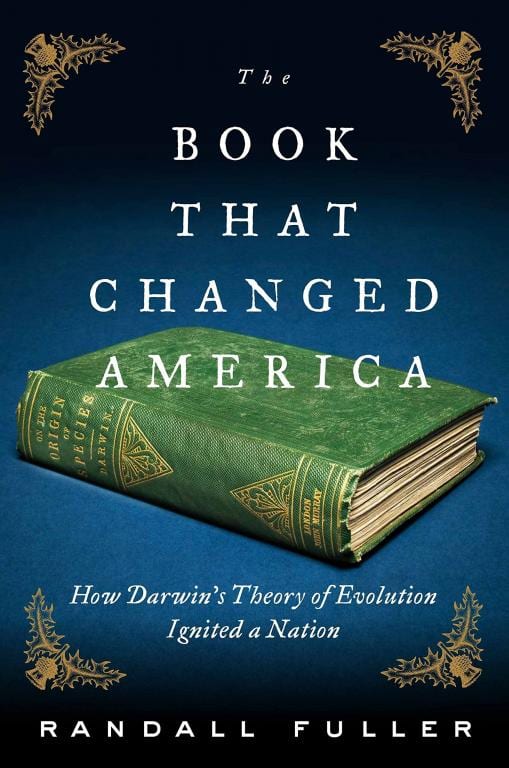 This year’s Darwin Day post is inspired by a book published last year by Randall Fuller, a distinguished professor of American Literature at the University of Kansas, titled The Book That Changed America (Viking 2017). Fuller explores the history of how Darwin’s On the Origin of Species was interpreted by some of its earliest readers, particularly Transcendentalists such as Bronson Alcott, Ralph Waldo Emerson, Henry David Thoreau, the child welfare reformer Charles Brace, and the abolitionist Franklin Sanborn.
But let me first set the stage a little for what was happening around November 24, 1859 when Charles Darwin published his landmark book, On the Origin of Species by Means of Natural Selection. For some points of comparison, 1859 was also the year that Charles Dickens (also a Unitarian) released A Tale of Two Cities in a serialized weekly format, George Eliot’s first novel Adam Bede came out, and John Stuart Mill’s On Liberty was published (8-9).
Politically, in late 1859, keep in mind that the U.S. was only a little more than year away from the opening shots of our Civil War on April 12, 1861 (ix). Part of why that matters for our story today is that all of the Transcendentalists we will be reflecting on today were involved in the abolitionist movement for the end of slavery.
John Brown’s raid happened in mid-October 1859, and Darwin’s book was published in a little more than a month later in late November. Keep those two dates in mind when I tell you soon of a New Year’s Day gathering at Franklin Sanborn’s house. There, a copy of Darwin’s latest book, borrowed by Charles Brace, was introduced to Sanborn and the other two guests, Alcott and Thoreau. All four strongly supported John Brown. Sanborn was both one of the Secret Six and “had introduced Brown to Alcott and Thoreau a year earlier.” Brown had been hanged just less than a month earlier on December 2, 1859. So the struggle for racial justice was at the forefront of their minds, and served as a powerful lens through which they reflected on Darwin’s ideas (6-7).
If you read Origin closely, Darwin focused on plants and animals, which was controversial enough. Only in a single place at the end does he gesture toward the implications for human beings: “In the distant future I see open fields for far more important researches…. Light will be thrown on the origin of man and his history” (38). But for anti-slavery activists, the implications were clear: “By hinting that all humans are biologically related, Darwin’s work seemed to refute once and for all the idea that African American slaves were a separate, inferior species” (x). They embraced this scientific support that we are all part of the same human family. But as they reflected further on Darwin’s work, they also realized a more discomfiting truth that Darwin’s theories “also posed enormous threats to their faith in God and their trust that America was a country divinely chosen for the regeneration of the world” (x).
To consider how radical ideas like Darwin’s begin to spread even today, in this particular case, one copy of Darwin’s book had an unusually large impact on multiple cultural influencers. This copy of Darwin’s book is housed today at Harvard University. And Darwin himself sent it to Asa Gray (1810 – 1888), a Harvard professor who is considered the most important American botanist of the nineteenth century. Dr. Gray lent that copy—which he had immediately read and heavily annotated—to Charles Brace, one of the abolitionists I mentioned earlier, who also happened to be a cousin of Gray’s wife. Brace brought that copy to the New Year’s Day party at Sanborn’s house, where Bronson Alcott and Thoreau were also guests (ix).
Thoreau’s Walden had been published in 1854, almost six years before that night. And one of my favorite anecdotes for why Thoreau attended that evening in 1860 is that, “He came because he had nothing better to do. He came because he liked to banter with Alcott and play the wise counselor to Sanborn. He came because he was hungry” (5).
To share with you some of their reactions to these new ideas, Sanborn was appreciative of Darwin’s ideas—especially the implications for abolitionism—and within hours he had written an enthusiastic letter about Darwin to the renowned Unitarian minister Theodore Parker. Brace responded to the book on a whole other level, “soon claiming to have read the book thirteen times.” He latched on to Darwin’s teachings about the role one’s environment plays and found in it further support for his work with the Children’s Aid Society to improve societal conditions for all (11).
Thoreau was still further impacted. He was already a fan of Darwin’s, stretching back almost two decades earlier to reading Darwin’s travelogue, The Voyage of the Beagle. And in 1860, Thoreau “would grapple with the Origin’s ideas as thoroughly and insightfully as any American of the period. By the end of January, when pirated editions of the book became available in New England, he secured a copy from the Concord Library and began taking copious notes” (11).
Thoreau and Darwin approached nature is similar ways. They both spent hours observing nature closely, as well as recording and tracking those observations over time. “Reading Origin, Thoreau discovered someone else who understood nature as he did: abounding and vibrant, each niche swarming, each interstice filled with life, each living thing a small part of constant change, a participant in struggle and development, brimming with potential and significance” (145).
Along those lines, I should add that as much as Thoreau’s writing overflows with an ebullient celebration of nature’s beauty, Thoreau also appreciated the honesty of Darwin’s observations about nature. Darwin’s insights were transparent—that nature also included an often violent “struggle among species as an engine of creation”—what Tennyson called “Nature, red in tooth and claw.” That truth resonated with Thoreau as being accurate about nature as he observed it, in contrast to the often lofty, one-sidedly romantic, literary ideas about the beauty of nature often emphasized by some Transcendentalists in indoor parlors (137-138).
Emerson, by comparison, did not study Darwin’s writings as thoroughly as Thoreau, nor did he fully accept the full implications of the Darwinian paradigm shift. Instead, Emerson read Darwin as he read most other authors: “dipping into the book…like a bee collecting pollen, flipping pages back and forth, seeking inspiration for his own essays” (147).
I should also add that of the four Unitarians present that first New Year’s evening in 1860, Bronson Alcott was the most negative. As Alcott understood it, Darwin’s proposals “reduced human life to chemistry, to mechanical processes, to vulgar materialism. They portrayed a world destitute of spirit. Darwin began with plants and animals, which in Alcott’s opinion was precisely the wrong approach. All questions of existence were to start from above, with God and the ideal” (10).
But that was not the only way of understanding Darwin, as we have already seen reflected in Thoreau’s writings. To say a bit more, allow me to return full circle to Dr. Asa Gray, the Harvard botany professor to whom Darwin personally mailed a copy of his book—the same book lent to his wife’s cousin Charles Brace, who brought it to that fateful New Year’s Day party. “Gray was almost certainly the first American to read Darwin’s Origin in its entirety” (13). In reviewing Darwin’s book, he emphasized how grateful he was for Darwin’s work. Even as Darwin’s ideas challenged Gray’s Episcopal faith, he appreciated how Darwin “seemed to bring the world to life, to make it pulse with meaning and significance” (129) Darwin demonstrated with scientific rigor that the world was not magically created one day. As we know even more so today, we are part of a 13.7 billion-year-old universe story that is continuing to evolve.
In that spirit, I will conclude with the final paragraph of Darwin’s 1859 book On the Origin of Species. Whereas many scientific texts are often not well written and become obsolete after new discoveries are made, Darwin’s books have been widely praised for both the beauty of his prose and for being well worth revisiting even many years later. So, I invite you to consider anew these words from the conclusion to Origin. Note that Darwin begins by naming things we often perceive to be solely negative—then shows how those things are part of the engine of evolution. In Darwin’s words:
from the war of nature,
from famine and death,
the most exalted object which we are capable of conceiving…
the production of the higher animals,
directly follows.
There is grandeur in this view of life…; and
whilst this planet has gone cycling on
according to the fixed law of gravity,
from so simple a beginning
endless forms
most beautiful and
most wonderful
have been,
and are being,
evolved.
The Rev. Dr. Carl Gregg is a certified spiritual director, a D.Min. graduate of San Francisco Theological Seminary, and the minister of the Unitarian Universalist Congregation of Frederick, Maryland. Follow him on Facebook (facebook.com/carlgregg) and Twitter (@carlgregg).
Learn more about Unitarian Universalism: http://www.uua.org/beliefs/principles
Previous Post

January 31, 2019
"We the Corporations?!"
Next Post
February 21, 2019 From Stigma to Dignity: America’s First Mental Health Court
Browse Our Archives
Select a Category Advent Anti-Racism Archaeology Atheism Baptism Best of the Year List Book Reviews Buddhism Catholicism Christian Education Church and State Church Planting Climate Change Conscientious Objection to War Creation Spirituality Death Penalty Didache Disability Rights Discernment Easter Ecology Emergent Church Movement Empire-Critical Ethics Evolution Feminist Theology Film Reviews Gandhi Gospel of Mark Gun Control Hinduism Immigration Reform Interfaith Islam JFK Judaism Jungian Spirituality Lectionary Commentary Lent Letters to the Editor LGBT Marriage MLK Multiculturalism Mysticism Nonviolent Activism Occupy Paganism (Earth-centered Religions) Parables Paul Pluralism Politics Process Theology Quantum Physics Requiescat In Pace Seminary and Divinity School Sermon Series Retrospective Sermons Spiritual Direction Spiritual Practices Stewardship (Fundraising) The Book of J The Wheel of the Year (Paganism) Theoblogger Challenge Triathlon Uncategorized Unitarian Universalism Worship Resources Youth Ministry
Select a Month July 2026 May 2026 March 2026 November 2025 October 2025 August 2025 February 2025 December 2024 October 2024 March 2024 January 2024 December 2023 November 2023 March 2023 February 2023 January 2023 December 2022 November 2022 August 2022 March 2022 February 2022 January 2022 December 2021 September 2021 August 2021 July 2021 June 2021 May 2021 February 2021 January 2021 December 2020 August 2020 June 2020 May 2020 April 2020 March 2020 February 2020 January 2020 December 2019 November 2019 October 2019 September 2019 July 2019 June 2019 March 2019 February 2019 January 2019 December 2018 November 2018 October 2018 September 2018 June 2018 May 2018 April 2018 March 2018 February 2018 January 2018 December 2017 November 2017 October 2017 September 2017 August 2017 July 2017 June 2017 May 2017 April 2017 March 2017 February 2017 January 2017 December 2016 November 2016 October 2016 September 2016 August 2016 June 2016 May 2016 April 2016 March 2016 February 2016 January 2016 December 2015 November 2015 October 2015 September 2015 August 2015 July 2015 June 2015 May 2015 April 2015 March 2015 February 2015 January 2015 December 2014 November 2014 October 2014 August 2014 July 2014 June 2014 May 2014 April 2014 March 2014 February 2014 January 2014 December 2013 November 2013 October 2013 September 2013 August 2013 July 2013 June 2013 May 2013 April 2013 March 2013 February 2013 January 2013 December 2012 November 2012 October 2012 September 2012 August 2012 July 2012 June 2012 May 2012 April 2012 March 2012 February 2012 January 2012 December 2011 November 2011 October 2011 September 2011 August 2011 July 2011 June 2011 May 2011 April 2011 March 2011 February 2011 January 2011 December 2010 November 2010 October 2010 August 2009 July 2009 May 2009
Follow Us!
TAKE THE
Religious Wisdom Quiz
Which was the day that God ended His creation and rested?
Select your answer to see how you score.
He never rested On the 7th day On the 5th day On the 6th day
Related posts from Carl Gregg

Reading America at 250: A Nation Wrestles With...


Andrew Holocek on the Power of Darkness

The Stories That Shape Us: Myths, Archetypes, &...
TRENDING AT PATHEOS More Voices

Reading America at 250: A Nation Wrestles With...
As part of my own reflection on the 250th anniversary of the...

Whenever I am reading a book or listening to an argument, I...

President Trump Ban Animal Torture Videos on Facebook
Call for Stricter Regulations of Animal Abuse Content on Facebook Although President...

Draft Amendments to Address Ritual Abuse in New...
The proposed changes would make it illegal for individuals in domestic partnerships...

How Bans on LGBTQ+ Student Clubs Threaten Religious...
On June 20, 2025, the State of Texas passed Senate Bill 12....

The Truth About the Gen Z Revival
This past year, there has been a lot of media buzz surrounding...
view all More Voices blogs
Ad-Free & Subscriber Log-In Subscription Support
- About Us
- 2026 Calendar
- Videos
- Podcasts
- Library of World Religions
- Faith In Media Tracker
- Advertise With Us
- Write for Us
- Privacy Policy
- Terms of Service
- Do Not Sell My Data
- Contact Us
- Radiant Digital
- Manage Newsletter Subscriptions
- Unsubscribe From Notifications
- Sitemap
Copyright 2008-2026, Patheos. All rights reserved.
Subscription Support Ad-Free & Subscriber Log-In
Follow Patheos