
BuddhistCatholicContemplativeEvangelicalGeneral ChristianHinduJewishLatter-day SaintMuslimNew VisionsProgressive Christian
Beliefs
- Buddhist
- Catholic
- Contemplative
- Evangelical
- General Christian
- Hindu
- Jewish
- Latter-day Saint
- More Voices
- Muslim
- New Visions
- Pagan
- Progressive Christian
Topics
- Religion News
- Food and Religion
- Sports and Religion
- Religious Art
- Religious Music and Entertainment
- Religious Events
- History and Religion
- Style and Religion
- Politics and Religion
- Women in Religion
- Recreation Outdoors and Religion
- Business Finance and Religion
- Careers Workplace and Religion
- Education and Religion
- Family Parenting and Religion
- Health Fitness and Religion
- Home and Religion
- Relationships and Religion
- Technology and Religion
- Travel and Religion
Columnists
- Buddhist Columnists
- Business Finance and Religion Columnists
- Careers Workplace and Religion Columnists
- Catholic Columnists
- Contemplative Columnists
- Education and Religion Columnists
- Evangelists Columnists
- Family Parenting and Religion Columnists
- General Christian Columnists
- Health Fitness and Religion Columnists
- Hindu Columnists
- History and Religion Columnists
- Home and Religion Columnists
- Jewish Columnists
- More Voices Columnists
- Latter Day Columnists
- Muslim Columnists
- New Visions Columnists
- Nonreligious Columnists
- Pagan Columnists
- Politics and Religion Columnists
- Progressive Columnists
- Recreation Outdoors and Religion Columnists
- Relationships and Religion Columnists
- Religion News Columnists
- Religious Art Columnists
- Religious Events Columnists
- Religious Music and Entertainment Columnists
- Sports and Religion Columnists
- Style and Religion Columnists
- Technology and Religion Columnists
- Travel and Religion Columnists
- Women in Religion Columnists
Resource Library
- 2026 Calendar
- Library of World Religions
- The 100 Most Holy Places on Earth
- Patheos Answers
- Podcasts
- Videos
- Faith Leaders Database
- Anglican Episcopalian
- Bahai
- Baptist
- Buddhism
- Christianity
- Confucianism
- Eastern Orthodoxy
- Hinduism
- Holiness and Pentecostal
- ISKCON
- Islam
- Judaism
- Lutheran
- Methodist
- The Church of Jesus Christ of Latter-day Saints
- New Age
- Paganism
- Presbytarian and Reformed
- Protestantism
- Religion Behind the Scenes
- Roman Catholic
- Scientology
- Shia Islam
- Sikhism
- Sufism
- Sunni Islam
- Taoism
- Zen
- See all religions
Research Tools
 Ad-Free & Subscriber Log-In Subscription Support
Ad-Free & Subscriber Log-In Subscription Support
Follow Patheos 

- Trending:
- Forgiveness
- |
- Marriage
- |
- Consciousness
- |
- Death Penalty
- |
- Election
- |
- Halloween

- Home
- More Voices
- “The Hidden Life of Trees”
“The Hidden Life of Trees”
Last updated on: December 31, 2018 at 1:15 pm by Carl Gregg
“The Hidden Life of Trees” 2018-12-31T13:15:59-05:00 Carl Gregg
Patheos Explore the world's faith through different perspectives on religion and spirituality! Patheos has the views of the prevalent religions and spiritualities of the world.
As I have been learning more about the hidden life of trees, I have also been paying more attention to how much trees have meant to people over time. Most recently, I was watching the Springsteen on Broadway recording on Netflix, and I was not surprised that as “The Boss” waxed nostalgically about his life, one vignette prominently featured a tree. Remembering his childhood home, he recalled that,
In our front yard, only a few feet from our porch, stood the grandest tree in town. It was a towering beautiful copper beech tree. And on sunny days I lived under its branches. Its roots were forts for my soldiers and a corral for my horses. And I was the first on my block to climb high into its upper reaches, leaving behind a world that I didn’t care for much already. Up at the top, I had the wind in my face and all the dreaming room that you could want. On slow summer nights, I’d sit beneath its arms with my pals like the cavalry at dusk just listening and listening for the evening bells of the ice cream man and my grandmother’s voice calling me in to bed.
Let your mind drift back: in your mind’s eye can you picture trees that have been significant in your life? Can you remember what they looked like in different seasons of the year? Perhaps you can even remember the feel of a particular tree’s bark against your hand—or the smell of its leaves or flowers in the spring. I can so easily recall the Dogwood tree from the front yard of one of my childhood homes, the Magnolia tree at my maternal grandmother’s house, the pecan trees in my paternal grandparent’s yard, the towering oak tree at my elementary school from whose branches hung curls of Spanish moss.
But you don’t have to grow up with a tree for it to be a beloved friend. Although I have only been a resident of downtown Frederick for three years, I was devastated along with many of my neighbors this past summer when I learned that that the massive, iconic weeping willow tree near the Baker Park Bell Tower had fallen during a storm. And it felt right to learn that both a vigil and funeral were quickly planned and held for this tree that meant so much to so many people for more than 60 years. Does mourning a tree seem strange? The more I learn about trees, the more appropriate such responses seem.
And as significant as an individual tree can be, the larger mysteries of trees are in the plural: the magic not only of a tree, but of forests, when trees are given the time and space to grow naturally together over immense spans of time in the wild. And I can again easily bring to mind beloved forests—from the acres of woods behind one of my childhood homes in South Carolina, to the forests surrounding my childhood summer camp in Black Mountain, North Carolina, to the holy majesty of Muir Woods with its old growth redwoods which I visited often while completing my doctoral work in the Bay Area.
The love of trees that I’m espousing feels at home in the Unitarian Universalist congregation, where I serve as minister. After all, one of our most influential forebears, from the Unitarian half of our heritage, is Henry David Thoreau (1817-1862), whose love of trees and forests was legendary. Notice the subtitle of his most famous book: Walden; or, Life in the Woods (1854). There was a sense, as well, in which his choice to remain “rooted” in his beloved hometown of Concord, Massachusetts emulated the stability, depth, and richness of a tree’s own rootedness to one particular spot on earth (1).
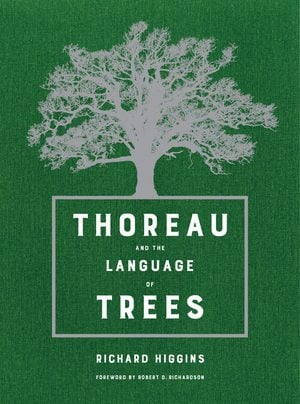 As Richard Higgins has detailed in his recent book, Thoreau and the Language of Trees (University of California Press, 2017), “Thoreau wrote prolifically about trees for a quarter century, from 1836 to 1861. He observed them closely, knew them well, and described them in detail…. He saw them as his friends and even as ‘distant relations’” (2-3). He once wrote, “What cousin of mine is the shrub oak” (38)?
I invite you to hear just a few excerpts from Thoreau’s extensive writing about trees, and notice if his observations resonate with some aspects that you have noticed about trees through the seasons and years:
- Observing a hemlock during winter: “What singular regularity in the outlines of a tree!”
- Or during the spring: “How bright, how full of freshness, tender promise and fragrance is the new world!” “It is remarkable that many beech and chestnut oak leaves which recently expanded have already attained their full size!! How they lurch themselves forth to the light. How suddenly Nature spreads her umbrellas!”
- Or in summer: “Ah, those fugacious universal fragrances of the meadows and woods!” “What a glorious crimson fire as you look up to the sunlight through the thin edges fo the scales of [a black spruce’s] cones! So intensely glowing in their cool green beds!” (36-37)
- Thoreau also wrote movingly of how studying trees in the autumn can teach us how to die well: “How poetically, how like saints or innocent and beneficent beings, they give up the ghost!” (91)
There is so much more to say about Thoreau and trees, but I will limit myself to sharing with you my favorite anecdote of his fierce commitment to forests:
When Harvard College appointed a new processor of natural history, Thoreau said it made no sense to hire someone to lecture on oaks while the best specimens of the tree were being cut around Massachusetts. “It is like teaching children Latin and Greek, while we burn the books printed in those languages.” (55)
And for those who do watch Springsteen on Broadway, there is a similarly poignant bookend near the end of the show in which he returns to his hometown as an adult only to discover that his beloved Copper Beech tree—which had been there many years before his birth and which he expected to be there many years after his death—had been cut down.
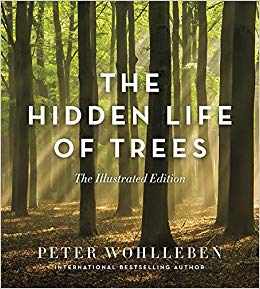 To delve more deeply into the mysteries of trees, which have meant so much to so many—let us turn now from the nineteenth-century forests of Concord and the twentieth-century suburbs of New Jersey—to today. The person who has taught me the most about trees in recent years is the ecologist Peter Wohlleben. His 2016 book The Hidden Life of Trees is one of those remarkable books that shifts forever the way you experience the world. I can’t recommend it highly enough. There is also a condensed, illustrated edition out this year that combines excerpts of the original book with full-page photos.
One of the first keys for learning more about the hidden life of trees is that compared to us humans, trees are slow. But there’s a good reason why: one of the oldest trees on Earth is a Spruce in Sweden that has been estimated to be more than 9,500 years old. “With such a luxury of time on their hands, [trees] can afford to take things at a leisurely pace. The electrical impulses that pass through the roots of trees, for example, move at the slow rate of one-third of an inch per second” (vii).
The relatively slow pace of trees can lead us to misperceive them as much more inanimate than is the case in reality, but those one-third of an inch per second electrical impulses—ultra slow moving as they may be—are one of our first glimpses into the hidden life of trees. It turns out that trees use electrical impulses as one of their many methods of communication, which also include senses of smell and taste:
If a giraffe starts eating an African acacia, the tree releases a chemical into the air that signals that a threat is at hand. As the chemical drifts through the air and reaches other trees, they “smell” it and are warned of danger. Even before the giraffe reaches them, they begin producing toxic chemicals. Insect pests are dealt with slightly differently. The saliva of leaf-eating insects can be “tasted” by the leaf being eaten. In response, the tree sends out a chemical signal that attracts predators that feed on that particular leaf-eating insect. (vii – viii)
Trees may be slow, but they have a lot going on.
More astonishing still is that the relationship between trees that grow naturally together in the wild is incredibly intricate—really intimate. Wohlleben calls it the “wood wide web.” Tree have evolved to take care of one another, “sometimes even going so far as to nourish the stump of a felled tree for centuries after it was cut down by feeding it sugars and other nutrients…. [but] only some stumps are thus nourished. Perhaps they are the parents of the trees that make up the forest of today” (viii).
To share with you some of the discoveries currently being made about trees, Wohlleben writes that:
The roots are the most important part of a tree. Conceivably, this is where the tree equivalent of a brain is located. Brain? you ask. Isn’t that a bit far fetched? Possibly, but we know that trees can learn. This means they must store experiences somewhere, and therefore, there must be some kind of a storage mechanic inside the organism. Just where it is, no one knows, but the roots are the part of the tree best suited to the task….
[Specifically,] researchers at the University of Bonn measured electrical signals that led to changes in behavior after they were processed in a “Transition zone.” If the root encounters toxic substances, impenetrable stones, or saturated soil, it analyzes the situation and transmits the necessary adjustments to the growing tip. The root top changes direction as a result of this communication and steers the growing root around the critical areas. (82-83)
But it gets more fascinating still: the Australian scientist Dr. Monica Gagliano has published research about mimosas—not the champagne and orange juice cocktail, nor the so-called Mimosa tree common throughout the American south, but the tropical creeping herb. Mimosa plants are much easier to study in laboratory conditions than large trees. What’s fascinating is that Gagliano’s stimulus-responses tests of interacting with the plants using water, the mimosas would “remember and apply their lesson weeks later, even without any further tests” (47-48). So something interesting is going with trees and memory even if we don’t yet fully understand.
I will readily confess that one might argue that this perspective is absurd anthropomorphism, projecting human traits on to trees and plants. But by no means is this claim a new-fangled idea. Indeed, less than two years before Darwin’s death in 1882, he published a book on The Power of Movement in Plants in which he concluded, along the same lines as Wohlleben, that “It is hardly an exaggeration to say that the tip of the radical [root]…acts like the brain of one of the lower animals…receiving impressions from the sense organs and directing the several movements” (Safina 24). From this perspective—taking Darwin’s theory of the “descent of man” seriously—it is not surprising that all of life is on a spectrum of thinking and feeling because all of life can be traced back to a common ancestor on the evolutionary “tree of life.” If we are all part of one large “tree of life,” then it begins to seem more natural than odd for life in the Plant Kingdom to have evolved aspects of life (like versions of memory, taste, and smell) that are also present in the Animal Kingdom.

The upshot is that the hidden life of trees is much more nuanced and complex than I learned in school. There is a lot going on, especially in the root networks beneath the soil. And I hope you have been inspired to learn more. Wohlleben writes,
I encourage you to look around where you live. What dramas are being played out in the wooded areas you can explore? How are commerce and survival balanced in the forests and woodlands you know? ….Slow down, breathe deep, and look around. What can you hear? What do you see? How do you feel? (x)
Along those lines, I recently learned that less than a tenth of a mile from my house—measuring 77 feet high and 11 feet in trunk circumference—is the largest Sugarberry tree in the state of Maryland. I passed this tree countless times without realizing how remarkable and worth knowing about it is. Another nearby tree worth noticing is the English Elm at Frederick High School—or the oldest and largest Ginkgo tree in the U.S. on West 2nd Street near Market Street in my hometown.
And these big solo trees are impressive, but one of the most important takeaways from The Hidden Life of Trees is that these isolated trees are nothing compared to the magic that happens naturally in and among the trees of old growth forests, which desperately need our protection and support. In the words of the environmental prophet Wendell Berry, “
Invest in the millennium. Plant sequoias.
Say that your main crop is the forest
that you did not plant,
that you will not live to harvest.
Say that the leaves are harvested
when they have rotted into the mold.
Call that profit. Prophesy such returns.
Put your faith in the two inches of humus
that will build under the trees
every thousand years….
He ends this poem, titled The Mad Farmer Liberation Front, with these words: “Practice Resurrection.” For Berry, planting and protecting old growth forest is what a genuine resurrection for this planet might look like. May we increasingly live out of a felt sense of connection with the vibrant interdependent world of nature all around us—that we might protect the diverse forms of life on this planet.
For Further Study
“Octopuses & Other Minds: “The Deep Origins of Consciousness”
The Rev. Dr. Carl Gregg is a certified spiritual director, a D.Min. graduate of San Francisco Theological Seminary, and the minister of the Unitarian Universalist Congregation of Frederick, Maryland. Follow him on Facebook (facebook.com/carlgregg) and Twitter (@carlgregg).
Learn more about Unitarian Universalism: http://www.uua.org/beliefs/principles
Previous Post

December 14, 2018
Top 10 Best Books Read in 2018
Next Post
January 21, 2019 MLK’s Dreams & Legacies: Who Is Forming You?
Browse Our Archives
Select a Category Advent Anti-Racism Archaeology Atheism Baptism Best of the Year List Book Reviews Buddhism Catholicism Christian Education Church and State Church Planting Climate Change Conscientious Objection to War Creation Spirituality Death Penalty Didache Disability Rights Discernment Easter Ecology Emergent Church Movement Empire-Critical Ethics Evolution Feminist Theology Film Reviews Gandhi Gospel of Mark Gun Control Hinduism Immigration Reform Interfaith Islam JFK Judaism Jungian Spirituality Lectionary Commentary Lent Letters to the Editor LGBT Marriage MLK Multiculturalism Mysticism Nonviolent Activism Occupy Paganism (Earth-centered Religions) Parables Paul Pluralism Politics Process Theology Quantum Physics Requiescat In Pace Seminary and Divinity School Sermon Series Retrospective Sermons Spiritual Direction Spiritual Practices Stewardship (Fundraising) The Book of J The Wheel of the Year (Paganism) Theoblogger Challenge Triathlon Uncategorized Unitarian Universalism Worship Resources Youth Ministry
Select a Month July 2026 May 2026 March 2026 November 2025 October 2025 August 2025 February 2025 December 2024 October 2024 March 2024 January 2024 December 2023 November 2023 March 2023 February 2023 January 2023 December 2022 November 2022 August 2022 March 2022 February 2022 January 2022 December 2021 September 2021 August 2021 July 2021 June 2021 May 2021 February 2021 January 2021 December 2020 August 2020 June 2020 May 2020 April 2020 March 2020 February 2020 January 2020 December 2019 November 2019 October 2019 September 2019 July 2019 June 2019 March 2019 February 2019 January 2019 December 2018 November 2018 October 2018 September 2018 June 2018 May 2018 April 2018 March 2018 February 2018 January 2018 December 2017 November 2017 October 2017 September 2017 August 2017 July 2017 June 2017 May 2017 April 2017 March 2017 February 2017 January 2017 December 2016 November 2016 October 2016 September 2016 August 2016 June 2016 May 2016 April 2016 March 2016 February 2016 January 2016 December 2015 November 2015 October 2015 September 2015 August 2015 July 2015 June 2015 May 2015 April 2015 March 2015 February 2015 January 2015 December 2014 November 2014 October 2014 August 2014 July 2014 June 2014 May 2014 April 2014 March 2014 February 2014 January 2014 December 2013 November 2013 October 2013 September 2013 August 2013 July 2013 June 2013 May 2013 April 2013 March 2013 February 2013 January 2013 December 2012 November 2012 October 2012 September 2012 August 2012 July 2012 June 2012 May 2012 April 2012 March 2012 February 2012 January 2012 December 2011 November 2011 October 2011 September 2011 August 2011 July 2011 June 2011 May 2011 April 2011 March 2011 February 2011 January 2011 December 2010 November 2010 October 2010 August 2009 July 2009 May 2009
Follow Us!
TAKE THE
Religious Wisdom Quiz
What does Proverbs say about quick-tempered people?
Select your answer to see how you score.
They are always respected They are wise They make peace They cause trouble
Related posts from Carl Gregg

Reading America at 250: A Nation Wrestles With...


Andrew Holocek on the Power of Darkness

The Stories That Shape Us: Myths, Archetypes, &...
TRENDING AT PATHEOS More Voices

Reading America at 250: A Nation Wrestles With...
As part of my own reflection on the 250th anniversary of the...

Whenever I am reading a book or listening to an argument, I...

President Trump Ban Animal Torture Videos on Facebook
Call for Stricter Regulations of Animal Abuse Content on Facebook Although President...

Draft Amendments to Address Ritual Abuse in New...
The proposed changes would make it illegal for individuals in domestic partnerships...

How Bans on LGBTQ+ Student Clubs Threaten Religious...
On June 20, 2025, the State of Texas passed Senate Bill 12....

The Truth About the Gen Z Revival
This past year, there has been a lot of media buzz surrounding...
view all More Voices blogs
Ad-Free & Subscriber Log-In Subscription Support
- About Us
- 2026 Calendar
- Videos
- Podcasts
- Library of World Religions
- Faith In Media Tracker
- Advertise With Us
- Write for Us
- Privacy Policy
- Terms of Service
- Do Not Sell My Data
- Contact Us
- Radiant Digital
- Manage Newsletter Subscriptions
- Unsubscribe From Notifications
- Sitemap
Copyright 2008-2026, Patheos. All rights reserved.
Subscription Support Ad-Free & Subscriber Log-In
Follow Patheos