
BuddhistCatholicContemplativeEvangelicalGeneral ChristianHinduJewishLatter-day SaintMuslimNew VisionsProgressive Christian
Beliefs
- Buddhist
- Catholic
- Contemplative
- Evangelical
- General Christian
- Hindu
- Jewish
- Latter-day Saint
- More Voices
- Muslim
- New Visions
- Pagan
- Progressive Christian
Topics
- Religion News
- Food and Religion
- Sports and Religion
- Religious Art
- Religious Music and Entertainment
- Religious Events
- History and Religion
- Style and Religion
- Politics and Religion
- Women in Religion
- Recreation Outdoors and Religion
- Business Finance and Religion
- Careers Workplace and Religion
- Education and Religion
- Family Parenting and Religion
- Health Fitness and Religion
- Home and Religion
- Relationships and Religion
- Technology and Religion
- Travel and Religion
Columnists
- Buddhist Columnists
- Business Finance and Religion Columnists
- Careers Workplace and Religion Columnists
- Catholic Columnists
- Contemplative Columnists
- Education and Religion Columnists
- Evangelists Columnists
- Family Parenting and Religion Columnists
- General Christian Columnists
- Health Fitness and Religion Columnists
- Hindu Columnists
- History and Religion Columnists
- Home and Religion Columnists
- Jewish Columnists
- More Voices Columnists
- Latter Day Columnists
- Muslim Columnists
- New Visions Columnists
- Nonreligious Columnists
- Pagan Columnists
- Politics and Religion Columnists
- Progressive Columnists
- Recreation Outdoors and Religion Columnists
- Relationships and Religion Columnists
- Religion News Columnists
- Religious Art Columnists
- Religious Events Columnists
- Religious Music and Entertainment Columnists
- Sports and Religion Columnists
- Style and Religion Columnists
- Technology and Religion Columnists
- Travel and Religion Columnists
- Women in Religion Columnists
Resource Library
- 2026 Calendar
- Library of World Religions
- The 100 Most Holy Places on Earth
- Patheos Answers
- Podcasts
- Videos
- Faith Leaders Database
- Anglican Episcopalian
- Bahai
- Baptist
- Buddhism
- Christianity
- Confucianism
- Eastern Orthodoxy
- Hinduism
- Holiness and Pentecostal
- ISKCON
- Islam
- Judaism
- Lutheran
- Methodist
- The Church of Jesus Christ of Latter-day Saints
- New Age
- Paganism
- Presbytarian and Reformed
- Protestantism
- Religion Behind the Scenes
- Roman Catholic
- Scientology
- Shia Islam
- Sikhism
- Sufism
- Sunni Islam
- Taoism
- Zen
- See all religions
Research Tools
 Ad-Free & Subscriber Log-In Subscription Support
Ad-Free & Subscriber Log-In Subscription Support
Follow Patheos 

- Trending:
- Forgiveness
- |
- Marriage
- |
- Consciousness
- |
- Death Penalty
- |
- Election
- |
- Halloween

- Home
- More Voices
- “The Color of Money”
“The Color of Money”
Last updated on: December 6, 2018 at 3:26 pm by Carl Gregg
“The Color of Money” 2018-12-06T15:26:55-05:00 Carl Gregg
Patheos Explore the world's faith through different perspectives on religion and spirituality! Patheos has the views of the prevalent religions and spiritualities of the world.
A few months ago I finally had the chance to visit the National Museum of African American History & Culture in D.C. Tickets are free, but they remain in short supply. I have heard many people say that they are waiting to go until the lines to go down. I’m not sure if the lines will go down, so I encourage you not to wait. We were able to get tickets through their same-day timed entry passes, which are available online daily at 6:30 a.m. I was online precisely at 6:30 a.m. and tickets started disappearing immediately. You can also get advance timed entry passes on the first Wednesday of each month. (The current release of passes is for tickets during March 2019.) The museum is open from 10:00am to 5:30pm, and based on the experience of myself and many others, plan to allow yourself at least five to six hours at the museum, which includes time to take a food break at the museum’s incredible Sweet Home Café.
I have a lot to say about the museum, but will limit myself to a few brief comments. Overall, moving from the underground History Galleries up to the highest level of the Cultural Galleries is a devastating, inspiring, and ultimately ecstatic experience. I was reminded anew in an accessible and experiential way of how much I already know—and how much I have to learn—about African American History and Culture.
The biggest tip I would give you is to not miss the Contemplative Court. It is somewhat hidden on the Concourse Level, but be sure to check it out. It’s breathtaking in its power and simplicity.
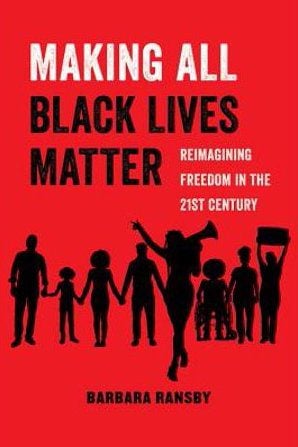 The insight that has lingered with me most is being reminded of the haunting parallels between the deaths and legacies of Emmett Till and Trayvon Martin. The lynching of 14-year old Emmett Till in 1955 helped catalyze many people’s participation in the Civil Rights Movement. The murder of the 17-year-old Trayvon Martin played a similar role in launching of the modern #BlackLivesMatter movement. As the activist scholar Dr. Barbara Ransby has written in her book Making All Black Lives Matter: Reimagining Freedom in the Twenty-First Century (American Studies Now: Critical Histories of the Present; University of California Press, 2018): “If the police murder of Michael Brown in Ferguson in summer 2014 was the fire that signaled the full-blown emergence of the Black Lives Matter movement, then the vigilante murder with impunity of the young Trayvon Martin in Sanford, Florida in February 2012 was the spark” (29). These are only a handful of the ways that the museum is a powerful reminder, call, and challenge to learn more about African American History and Culture.
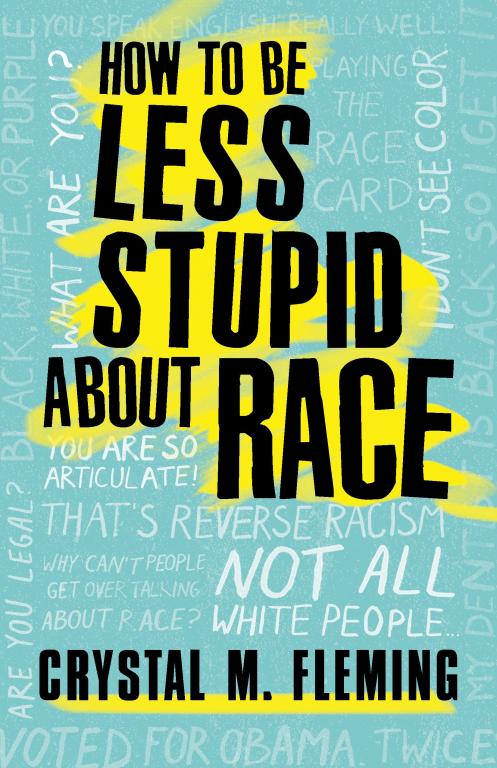
In contrast to that connection between Emmett Till back then and Trayvon Martin today, most of what I learned about racial history while growing up white in South Carolina was about past actions to be looked back on with remorse. But as Dr. Crystal Fleming highlights in her provocative book How To Be Less Stupid about Race (Beacon Press, 2018), “Our nation’s emphasis on racial progress has obscured ‘racist progress’—the evolution of racist ideas and practices alongside anti-racist transformation” (25). I find this framework quite helpful in learning to notice both positive progress in racial justice and negative adaptations in systemic racism.
Let me give you a story of how that happened in my own life. It is, to be honest, a story (to use Dr. Fleming’s words) of learning to be less stupid about race. More than fifteen years ago, I attended my first multi-day intensive workshop on “Dismantling Racism.” One of the parts of that training that I remember most vividly was the facilitator saying, “There has been no progress in working against racism in this country.” Because I had found most of the workshop compelling and challenging, I was incredulous about the claim that “There has been no progress in working against racism in this country.”
 Although I found most of the workshop compelling, I was resistant to the idea that there had been no progress despite landmark achievements such as the adoption of the 13th Amendment in 1865, Brown vs. the Board of Education in 1954, and the Civil Rights Act of 1964 and the Voting Rights Act of 1965. The facilitator’s counterpoint was that despite these instances of apparent progress in racial justice, systemic racism remained unchanged, due to the deliberate and insidious evolution of racist policies.
The truth is that I didn’t really grasp this point until quite a few years later I read Michelle Alexander’s book The New Jim Crow, which wasn’t published until 2010. To limit myself to citing only one of Alexander’s many profound points, “Today there are more African-American adults under correctional control — in prison or jail, on probation or parole — than were enslaved in 1850, a decade before the Civil War began” (Baradaran 218). More than anything else, that piece of data convinced me not only about the limited extent of progress toward racial justice, but also of progress toward dismantling systemic racism: racist laws and institutions far more entrenched and insidious than individual prejudice. (If you don’t have time to read Alexander’s book, the Netflix documentary 13th is a powerful distillation of many similar points.)
As I have continued my journey of striving to be less stupid and less fragile about race—and more curious and more committed to staying at the table to accountably dismantle racism—the most recent aha moment was when I heard Ta-Nehisi Coates say that, “What would prove to him that white supremacy was over in this country would be the closing of the racial wealth gap.” I thought, “That’s interesting! That is a specific, measurable goal that we could keep ourselves accountable to as a society if we wanted to.”
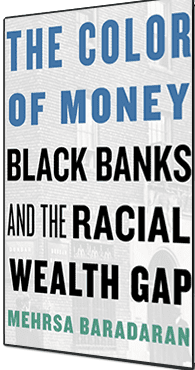 In researching the racial wealth gap, I discovered a book published last year by Harvard University Press titled The Color of Money: Black Banks and the Racial Wealth Gap by Mehrsa Baradaran, a law professor at the University of Georgia. Significantly, recent studies in social science have shown that “both whites and blacks tend to severely underestimate the extent of the racial wealth gap by about 25 percent…expressing ‘unfounded optimism’” about progress in racial justice and ignorance about the corresponding progress in systemic racism (Fleming 18). So what does the data show about the racial wealth gap?
“Today, across every socioeconomic level, blacks have significantly less wealth than whites. Over a third of black families have either negative wealth or no assets at all. The 2008 financial crisis devoured more than half the wealth of the black community, proving once again [in Dr. Baradaran’s words] the adage that, ‘when Wall Street catches a cold, Harlem gets pneumonia” (Baradaran 1). African-Americans were disproportionally targeted for sub-prime loans even when they were eligible for fixed-rates.
Zooming out for a more historical perspective, “When the Emancipation Proclamation was signed in 1863, the black community owned a total of 0.6 percent of the total wealth in the United States…. What is staggering is that more than 150 years later, that number has barely budged—blacks still own only about 1 percent of the wealth in the United States.” This statistic is not new; indeed, in a line often forgotten from The Rev. Dr. Martin Luther King, Jr.’s 1963 “I Have a Dream Speech,” he said that “America has given the Negro people a bad check, and a check which has come back marked ‘insufficient funds” (Baradaran 9). It’s important to remember the full title of the original context for that speech was the March on Washington for Jobs and Freedom.
Or to zoom in closer to home, today only forty miles southeast of here, in our nation’s capital, we find that whereas “Nationwide white families hold thirteen times the wealth of black families, in Washington, D.C., white households are eighty-one times more wealthy than black households” (Fleming 38). So I have come to take Ta-Nehisi Coates’s point quite seriously—that the closing of the racial wealth gap would prove to him that white supremacy was over in this country. (Also, be sure to study his essay, “A Case for Reparations,” available in his important book We Were Eight Years in Power: An American Tragedy.)
Now there is a lot to be said about the history of how the racial wealth gap has been kept in place, and we explored a significant part of that story about this time last year in a post on The Half Has Never Been Told. So for now, I will limit myself to noting one other interesting point from a recent interview with Ta-Nehisi Coates in which he emphasized that as racist as our current president has been—and this is to damn him with faint praise—he is arguably not as racist as our 17th president Andrew Johnson (1808 – 1875), who assumed the presidency in the wake of Lincoln’s assassination.
We were on a path to making progress in dismantling white supremacy during the Reconstruction Period following the Civil War, but Johnson “joined the white southern backlash and rolled back Lincoln’s promises. He thoroughly undermined the Freedmen’s Bureau bill (which promised formed enslaved Americans “forty acres and a mule”), and fought the black rights movement, asserting that America would remain a ‘white man’s government.” After 400 years of slavery in America, literally months after the end of the Civil War—Johnson was already advancing the argument that, “the Freedman’s bill was advantaging blacks over whites and that it was time for blacks to fend for themselves” (Baradaran 16-17).
The more you learn about the history of white supremacy in this country, the more you notice historical echoes. So today when I think of Chief Justice John Roberts saying, “The way to stop discrimination on the basis of race is to stop discriminating on the basis of race,” that statement sounds a lot like President Andrew Johnson’s position on racial justice, and willfully ignorant of what it will take to truly build a beloved community in this country (Baradaran 138). Roberts is operating from a position of white privilege that tries to erase the history of systemic racism in this country and pretend that we have somehow magically instituted an equal playing field.
In contrast, our first African-American Supreme Court Justice Thurgood Marshall (1908 – 1993) famously wrote a dissenting opinion in a 1978 Supreme Country case about Affirmative Action that the “legacy of years of slavery and years of second-class citizenship in the wake of emancipation could not be so easily eliminated.” He continued that, “Bringing [African-Americans] into the mainstream of American life should be a state interest of the highest order…and a failure to do so is to ensure that America will forever remain a divided society” (Baradaran 223). Forty years later, it is Justice Marshall, not Chief Justice Roberts, whose prediction seems prescient.
In Dr. King’s final book, Where Do We Go From Here? Chaos or Community, he said it this way: “A society that has done something special against the Negro from hundreds of years must now do something special for him” (Baradaran 224). This point is related to the insight today that of course, ‘all lives matter, but given the history of racism in this country, there is a special need to be clear that Black Lives Matter. Or as the saying goes, you shouldn’t attend a breast cancer fundraiser and protest, ‘All Cancers Matter’—nor if you broke your arm would you want your doctor to put you in a full body cast because ‘All Bones Matter.’”
But we also know that we must proceed in the work of racial justice strategically, because so many bad faith actors continue to cynically stoke racial resentments for their own political gain. The truth is that racial justice is not a zero-sum game, and the loss of white privilege is not the same as reverse discrimination. We must be clear that failure to act for racial justice and for a more fair, equitable, and integrated society unarguably makes things worse for all concerned. Social scientists have demonstrated that excessive inequality—such as the racial wealth gap—“erodes trust in society, increases illnesses, leads to corruption…and increases crimes” (Baradaran 280). May we each do our part within our spheres of influence not to perpetuate a “dream deferred,” but to turn “dreams into deeds.” May we all be contribute to the work of Collective Liberation in which we all get free.
The Rev. Dr. Carl Gregg is a certified spiritual director, a D.Min. graduate of San Francisco Theological Seminary, and the minister of the Unitarian Universalist Congregation of Frederick, Maryland. Follow him on Facebook (facebook.com/carlgregg) and Twitter (@carlgregg).
Learn more about Unitarian Universalism: http://www.uua.org/beliefs/principles
Previous Post

November 30, 2018
“Privacy, Social Justice, & Survival in a Hyper-connected World"
Next Post
December 10, 2018 Sexy Secrets about Religion
Browse Our Archives
Select a Category Advent Anti-Racism Archaeology Atheism Baptism Best of the Year List Book Reviews Buddhism Catholicism Christian Education Church and State Church Planting Climate Change Conscientious Objection to War Creation Spirituality Death Penalty Didache Disability Rights Discernment Easter Ecology Emergent Church Movement Empire-Critical Ethics Evolution Feminist Theology Film Reviews Gandhi Gospel of Mark Gun Control Hinduism Immigration Reform Interfaith Islam JFK Judaism Jungian Spirituality Lectionary Commentary Lent Letters to the Editor LGBT Marriage MLK Multiculturalism Mysticism Nonviolent Activism Occupy Paganism (Earth-centered Religions) Parables Paul Pluralism Politics Process Theology Quantum Physics Requiescat In Pace Seminary and Divinity School Sermon Series Retrospective Sermons Spiritual Direction Spiritual Practices Stewardship (Fundraising) The Book of J The Wheel of the Year (Paganism) Theoblogger Challenge Triathlon Uncategorized Unitarian Universalism Worship Resources Youth Ministry
Select a Month July 2026 May 2026 March 2026 November 2025 October 2025 August 2025 February 2025 December 2024 October 2024 March 2024 January 2024 December 2023 November 2023 March 2023 February 2023 January 2023 December 2022 November 2022 August 2022 March 2022 February 2022 January 2022 December 2021 September 2021 August 2021 July 2021 June 2021 May 2021 February 2021 January 2021 December 2020 August 2020 June 2020 May 2020 April 2020 March 2020 February 2020 January 2020 December 2019 November 2019 October 2019 September 2019 July 2019 June 2019 March 2019 February 2019 January 2019 December 2018 November 2018 October 2018 September 2018 June 2018 May 2018 April 2018 March 2018 February 2018 January 2018 December 2017 November 2017 October 2017 September 2017 August 2017 July 2017 June 2017 May 2017 April 2017 March 2017 February 2017 January 2017 December 2016 November 2016 October 2016 September 2016 August 2016 June 2016 May 2016 April 2016 March 2016 February 2016 January 2016 December 2015 November 2015 October 2015 September 2015 August 2015 July 2015 June 2015 May 2015 April 2015 March 2015 February 2015 January 2015 December 2014 November 2014 October 2014 August 2014 July 2014 June 2014 May 2014 April 2014 March 2014 February 2014 January 2014 December 2013 November 2013 October 2013 September 2013 August 2013 July 2013 June 2013 May 2013 April 2013 March 2013 February 2013 January 2013 December 2012 November 2012 October 2012 September 2012 August 2012 July 2012 June 2012 May 2012 April 2012 March 2012 February 2012 January 2012 December 2011 November 2011 October 2011 September 2011 August 2011 July 2011 June 2011 May 2011 April 2011 March 2011 February 2011 January 2011 December 2010 November 2010 October 2010 August 2009 July 2009 May 2009
Follow Us!
TAKE THE
Religious Wisdom Quiz
Which New Testament book is written entirely as a letter to an individual?
Select your answer to see how you score.
Jude James Philemon 1 Timothy
Related posts from Carl Gregg

Reading America at 250: A Nation Wrestles With...


Andrew Holocek on the Power of Darkness

The Stories That Shape Us: Myths, Archetypes, &...
TRENDING AT PATHEOS More Voices

Reading America at 250: A Nation Wrestles With...
As part of my own reflection on the 250th anniversary of the...

Whenever I am reading a book or listening to an argument, I...

President Trump Ban Animal Torture Videos on Facebook
Call for Stricter Regulations of Animal Abuse Content on Facebook Although President...

Draft Amendments to Address Ritual Abuse in New...
The proposed changes would make it illegal for individuals in domestic partnerships...

How Bans on LGBTQ+ Student Clubs Threaten Religious...
On June 20, 2025, the State of Texas passed Senate Bill 12....

The Truth About the Gen Z Revival
This past year, there has been a lot of media buzz surrounding...
view all More Voices blogs
Ad-Free & Subscriber Log-In Subscription Support
- About Us
- 2026 Calendar
- Videos
- Podcasts
- Library of World Religions
- Faith In Media Tracker
- Advertise With Us
- Write for Us
- Privacy Policy
- Terms of Service
- Do Not Sell My Data
- Contact Us
- Radiant Digital
- Manage Newsletter Subscriptions
- Unsubscribe From Notifications
- Sitemap
Copyright 2008-2026, Patheos. All rights reserved.
Subscription Support Ad-Free & Subscriber Log-In
Follow Patheos