
BuddhistCatholicContemplativeEvangelicalGeneral ChristianHinduJewishLatter-day SaintMuslimNew VisionsProgressive Christian
Beliefs
- Buddhist
- Catholic
- Contemplative
- Evangelical
- General Christian
- Hindu
- Jewish
- Latter-day Saint
- More Voices
- Muslim
- New Visions
- Pagan
- Progressive Christian
Topics
- Religion News
- Food and Religion
- Sports and Religion
- Religious Art
- Religious Music and Entertainment
- Religious Events
- History and Religion
- Style and Religion
- Politics and Religion
- Women in Religion
- Recreation Outdoors and Religion
- Business Finance and Religion
- Careers Workplace and Religion
- Education and Religion
- Family Parenting and Religion
- Health Fitness and Religion
- Home and Religion
- Relationships and Religion
- Technology and Religion
- Travel and Religion
Columnists
- Buddhist Columnists
- Business Finance and Religion Columnists
- Careers Workplace and Religion Columnists
- Catholic Columnists
- Contemplative Columnists
- Education and Religion Columnists
- Evangelists Columnists
- Family Parenting and Religion Columnists
- General Christian Columnists
- Health Fitness and Religion Columnists
- Hindu Columnists
- History and Religion Columnists
- Home and Religion Columnists
- Jewish Columnists
- More Voices Columnists
- Latter Day Columnists
- Muslim Columnists
- New Visions Columnists
- Nonreligious Columnists
- Pagan Columnists
- Politics and Religion Columnists
- Progressive Columnists
- Recreation Outdoors and Religion Columnists
- Relationships and Religion Columnists
- Religion News Columnists
- Religious Art Columnists
- Religious Events Columnists
- Religious Music and Entertainment Columnists
- Sports and Religion Columnists
- Style and Religion Columnists
- Technology and Religion Columnists
- Travel and Religion Columnists
- Women in Religion Columnists
Resource Library
- 2026 Calendar
- Library of World Religions
- The 100 Most Holy Places on Earth
- Patheos Answers
- Podcasts
- Videos
- Faith Leaders Database
- Anglican Episcopalian
- Bahai
- Baptist
- Buddhism
- Christianity
- Confucianism
- Eastern Orthodoxy
- Hinduism
- Holiness and Pentecostal
- ISKCON
- Islam
- Judaism
- Lutheran
- Methodist
- The Church of Jesus Christ of Latter-day Saints
- New Age
- Paganism
- Presbytarian and Reformed
- Protestantism
- Religion Behind the Scenes
- Roman Catholic
- Scientology
- Shia Islam
- Sikhism
- Sufism
- Sunni Islam
- Taoism
- Zen
- See all religions
Research Tools
 Ad-Free & Subscriber Log-In Subscription Support
Ad-Free & Subscriber Log-In Subscription Support
Follow Patheos 

- Trending:
- Forgiveness
- |
- Marriage
- |
- Consciousness
- |
- Death Penalty
- |
- Election
- |
- Halloween

- Home
- More Voices
- “The People vs. Democracy”
“The People vs. Democracy”
Last updated on: November 6, 2018 at 4:52 pm by Carl Gregg
“The People vs. Democracy” 2018-11-06T16:52:55-05:00 Carl Gregg
Patheos Explore the world's faith through different perspectives on religion and spirituality! Patheos has the views of the prevalent religions and spiritualities of the world.
On the eve of the U.S. midterm elections, it is important to be honest, clear, and direct about the unprecedented level at which our current president has regularly, openly, and unapologetically shown “disdain for basic constitutional norms” (Mounk 2). There is not time for an exhaustive list, but here is one distillation:
- Over the course of his campaign, candidate Trump broke just about every basic rule of democratic politics. He promised to jail his political opponents. He refused to say that he would accept the outcome of the election. He bullied the press…. He invited a foreign power to sabotage his main competitor. He incited hatred against ethnic and religious minorities and promised to take unconstitutional action against them….
- As President-elect, he made baseless claims about widespread voter fraud. He denigrated the neutrality of independent state institutions from courts to the intelligence agencies. He inquired about the status of planning permits for his building projects on official calls with foreign heads of state. He refused to create a blind trust for his private businesses. And he repeatedly complimented the dictatorial leader of a rival power.
- As president, he has refused to resolve his substantial conflicts of interest. He has used the machinery of government to spread outright lies. He has tried to bar permanent residents from reentering the country. He has railed against “so-called judges.” He has dubbed journalists “enemies of the American people.” He has threatened the owners of critical media outlets with higher taxes. He has undermined attempts to investigate his links with Russia by colluding with loyalist legislators, firing the Director of the FBI, and publicly threatening him with secret recordings. (119)
Note that this list is not about the success or failure of partisan political positions. It is about the person occupying the office of the President of the United States having a “reckless disregard” for our democratic traditions and Constitutional norms (119).
To name yet another example from just this past week, when our president wanted to manipulate the media and the public in the days before the midterm election, he threatened to “Void Birthright Citizenship Law By Executive Order,” which would violate the 14th Amendment. As best as I can tell, his motivation is not whether something is Constitutional, but whether ‘the ends justify the means.’ And the painful truth is that such cynical ploys have often proven to be effective.
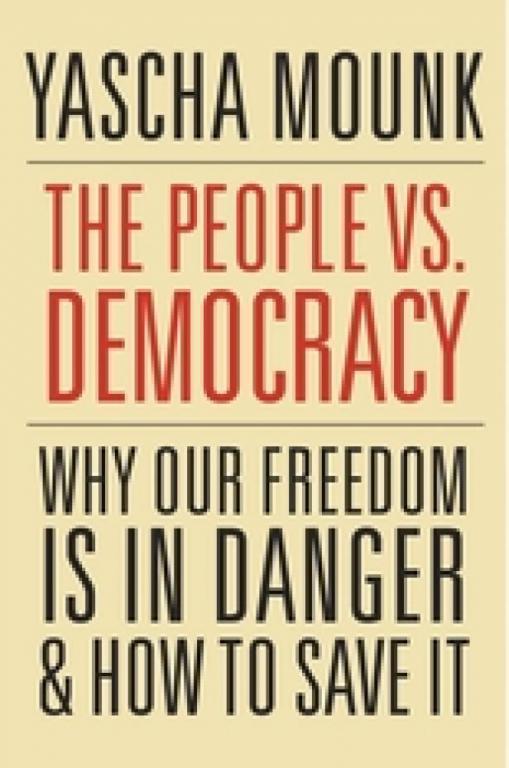 One of the guides that I have found most helpful in thinking through what are merely partisan differences and what differences are a threat to our democratic norms is Yascha Mounk. Mounk was born in 1982 in Germany to parents who immigrated from Poland. His mother is Jewish. He earned a B.A. in History from Cambridge, a Ph.D. in Government from Harvard, and became a U.S. citizen just last year. So he has fascinating perspective on the world for such a time as this. I first learned about him on his regular podcast for Slate, “The Good Fight” — and this post is inspired by his most recent book titled The People vs. Democracy (Harvard University Press, 2018).
Part of what he means with his title—The People vs. Democracy— is that “the people” can ironically pervert democracy by democratic means. Democracy (from the Greek δημοκρατία/dēmokratía) literally means that the “people” (demos) have the “power” (-kratia)—but what if the people democratically vote to cede power to a dictator?
The truth is that democracy is definitionally nothing more than “a set of binding electoral institutions that effectively translate popular views into public policy.” One might add that, “We the People of the United States” have values beyond a commitment to democracy. These additional values “protect the rule of law and guarantee individual rights such as freedom of speech, freedom of religion, freedom of the press, and freedom of association to all citizens (including ethnic and religious minorities)” (27).
But these values are not democratic values; they are liberal values—not liberal like the modern Democratic Party, but classical, 18th-century, Enlightenment Liberalism on which our nation was founded. That classical Liberalism is from the Latin root liber, meaning freedom. It is about protecting essential freedoms for all individuals irrespective of how the people vote in a given election.
Said more directly, sometimes people vote democratically for illiberal values that violate individual rights and liberties. The good news is that “We the people of the United States” have come together to form a more perfect union that is not merely a democracy. We are a liberal democracy. Our founders created “a political system that is both liberal and democratic—one that both protects individual rights and translates popular views into public policy.” In this sense, “George W. Bush is as much a liberal as Barack Obama, and Ronald Regan was as much a liberal as Bill Clinton.” But when any president—irrespective of political party—violates basic liberal values, our democracy is threatened (26-27).
Mounk calls the two common alternatives to liberal democracy “democracy without rights” and “rights without democracy.” “Democracy without rights” is the “Tyranny of the Majority” that our our nation’s founders feared. They thought that core individual freedoms like speech, religion, press, and association must be protected irrespective of what any temporary majority of the voters wanted in the heat of any given electoral moment. “Rights without democracy” is when our human rights and civil rights are maintained, but factors such as big money and voter suppression dominate the political process to the extent that the will of the people is undermined.
We currently have both problems in the U.S. today. I will address the issue of “Rights without democracy” more fully in late January in a post on “We the Corporations?!” For now, I want to keep our focus on a possible future of “Democracy without rights”—that could itself, in turn, devolve into a dictatorship with neither democracy nor rights.
One common path to “democracy without rights”—into manipulating the people into empowering politicians who would undermine individual rights and democratic norms—is populism. I will hasten to add that, of course, not all populism is bad. Indeed, populism that emphasizes the importance of the people against the concerns of the elite few can be quite healthy for the body politic. So it would be more accurate to say that the most common path to “democracy without rights” is a particular form of populism known as demagoguery. Both demagoguery and democracy begin with the same Greek root of demos (meaning “people”). But a demagogue adds in the Greek word ἀγωγός (meaning “leader”). Demagoguery has the sense not of democratic people-power, but of a leader who turns “we the people” into a mob.
We have seen this approach with Donald Trump here in the U.S., with Nigel Farage in the United Kingdom’s vote to #Brexit (to exit from the European Union), with Marine Le Pen in France, with Fraunke Petry in Germany, Jair Bolsonaro in Brazil, and others around the world. Despite important differences, there is a pattern in the rhetoric of these politicians that, “the solutions to the most pressing problems of our time are much more straightforward than the political establishment would have us believe…. And if the pure voice of the people could prevail, the reason for popular discontent would quickly vanish. America (or Great Britain, or Germany, or France) would be great again” (7).
The truth is that politics—and life—are much messier and more complicated than that. So to gain and maintain power, demagogues tend to blame racial, ethic, and religious minorities—as well as any political institutions which inhibit the demagogue’s power. Together, that results in a shift toward democracy without rights—whipping up the passions of an electoral majority to take away the rights of the few. It is often too late when the majority realizes that their individual rights and liberties tend to eventually be targeted as well. This pattern is famously embodied in Martin Niemöller quote that, “First they came for the Jews and I did not speak out because I was not a Jew. Then they came for the Communists and I did not speak out because I was not a Communist. Then they came for the trade unionists and I did not speak out because I was not a trade unionist. Then they came for me and there was no one left to speak out for me.”
History shows us time and again that when rights, liberties, and civilities are disrespected, previously unquestioned norms quickly deteriorate. President Trump has repeated crossed what many people considered “red lines. But as soon as we looked back at them through the rearview mirror, they started to appear…yellow or green” (258).
Nevertheless, I do not think the takeaway is to despair. If the year 2016, the election of Donald Trump, and the passage of Brexit taught us anything, it is that the future is uncertain and the experts don’t always make accurate predictions (260). There remain many reasons to hope, mobilize, and organize to make our society less susceptible to demagoguery. Among the many tasks at hand is to decrease wealth inequality (16), increase funding for universal access to high quality education (157-158), and reform our Internet and social media platforms to be more responsible against misinformation and propaganda (17).
At its core, the issue is not partisanship, but patriotism: defending the norms, rights, and freedoms that are the heart of our liberal democracy. Speaking for myself, I rarely agreed with the political policies of Senator John McCain, but we heard so many moving testimonies at his funeral of the many times that he did courageously put country before party (116).
As I move toward my conclusion, I will give you one more example—this time from the history of my own chosen tradition of Unitarian Universalism—of defending our democracy as much or more as patriots than as partisans. History reminds me as well that as challenging as our current political climate is, it is not as terrible a time in our nation’s history as the Civil War. And I am reminded further that in 1861, at the beginning of the Civil War, Oliver Wendell Holmes, Sr. (1809-1894), a Unitarian, published an unofficial fifth verse to our national anthem that particularly wrestles with threats to our liberal democracy that come not from an external foe but from within.
When our land is illum’d with Liberty’s smile,
If a foe from within strike a blow at her glory,
Down, down, with the traitor that dares to defile
The flag of her stars and the page of her story!
By the millions unchain’d who our birthright have gained
We will keep her bright blazon forever unstained!
And the Star-Spangled Banner in triumph shall wave
While the land of the free is the home of the brave.
We live in challenging times. But even as demagogues seek to dominate and manipulate us with the politics of division, hated, and cruelty, our invitation is to continue to live evermore fully into the original promise of our nation: to build a world in which all people are created equal ”with certain unalienable Rights, that among these are Life, Liberty and the pursuit of Happiness.”
On the struggle to expand these rights over time, let us keep in our hearts the words of African-American poet and activist Langston Hughes (1901-1967):
Sure, call me any ugly name you choose—
The steel of freedom does not stain.
From those who live like leeches on the people’s lives,
We must take back our land again,
America!
O, yes,
I say it plain,
America never was America to me,
And yet I swear this oath—
America will be!
The Rev. Dr. Carl Gregg is a certified spiritual director, a D.Min. graduate of San Francisco Theological Seminary, and the minister of the Unitarian Universalist Congregation of Frederick, Maryland. Follow him on Facebook (facebook.com/carlgregg) and Twitter (@carlgregg).
Learn more about Unitarian Universalism: http://www.uua.org/beliefs/principles
Previous Post

October 31, 2018
What Liberal Fundamentalism Is— and What It Isn't
Next Post
November 16, 2018 “History Teaches Us To Resist”
Browse Our Archives
Select a Category Advent Anti-Racism Archaeology Atheism Baptism Best of the Year List Book Reviews Buddhism Catholicism Christian Education Church and State Church Planting Climate Change Conscientious Objection to War Creation Spirituality Death Penalty Didache Disability Rights Discernment Easter Ecology Emergent Church Movement Empire-Critical Ethics Evolution Feminist Theology Film Reviews Gandhi Gospel of Mark Gun Control Hinduism Immigration Reform Interfaith Islam JFK Judaism Jungian Spirituality Lectionary Commentary Lent Letters to the Editor LGBT Marriage MLK Multiculturalism Mysticism Nonviolent Activism Occupy Paganism (Earth-centered Religions) Parables Paul Pluralism Politics Process Theology Quantum Physics Requiescat In Pace Seminary and Divinity School Sermon Series Retrospective Sermons Spiritual Direction Spiritual Practices Stewardship (Fundraising) The Book of J The Wheel of the Year (Paganism) Theoblogger Challenge Triathlon Uncategorized Unitarian Universalism Worship Resources Youth Ministry
Select a Month July 2026 May 2026 March 2026 November 2025 October 2025 August 2025 February 2025 December 2024 October 2024 March 2024 January 2024 December 2023 November 2023 March 2023 February 2023 January 2023 December 2022 November 2022 August 2022 March 2022 February 2022 January 2022 December 2021 September 2021 August 2021 July 2021 June 2021 May 2021 February 2021 January 2021 December 2020 August 2020 June 2020 May 2020 April 2020 March 2020 February 2020 January 2020 December 2019 November 2019 October 2019 September 2019 July 2019 June 2019 March 2019 February 2019 January 2019 December 2018 November 2018 October 2018 September 2018 June 2018 May 2018 April 2018 March 2018 February 2018 January 2018 December 2017 November 2017 October 2017 September 2017 August 2017 July 2017 June 2017 May 2017 April 2017 March 2017 February 2017 January 2017 December 2016 November 2016 October 2016 September 2016 August 2016 June 2016 May 2016 April 2016 March 2016 February 2016 January 2016 December 2015 November 2015 October 2015 September 2015 August 2015 July 2015 June 2015 May 2015 April 2015 March 2015 February 2015 January 2015 December 2014 November 2014 October 2014 August 2014 July 2014 June 2014 May 2014 April 2014 March 2014 February 2014 January 2014 December 2013 November 2013 October 2013 September 2013 August 2013 July 2013 June 2013 May 2013 April 2013 March 2013 February 2013 January 2013 December 2012 November 2012 October 2012 September 2012 August 2012 July 2012 June 2012 May 2012 April 2012 March 2012 February 2012 January 2012 December 2011 November 2011 October 2011 September 2011 August 2011 July 2011 June 2011 May 2011 April 2011 March 2011 February 2011 January 2011 December 2010 November 2010 October 2010 August 2009 July 2009 May 2009
Follow Us!
TAKE THE
Religious Wisdom Quiz
Which was the day that God ended His creation and rested?
Select your answer to see how you score.
He never rested On the 7th day On the 5th day On the 6th day
Related posts from Carl Gregg

Reading America at 250: A Nation Wrestles With...


Andrew Holocek on the Power of Darkness

The Stories That Shape Us: Myths, Archetypes, &...
TRENDING AT PATHEOS More Voices

Reading America at 250: A Nation Wrestles With...
As part of my own reflection on the 250th anniversary of the...

Whenever I am reading a book or listening to an argument, I...

President Trump Ban Animal Torture Videos on Facebook
Call for Stricter Regulations of Animal Abuse Content on Facebook Although President...

Draft Amendments to Address Ritual Abuse in New...
The proposed changes would make it illegal for individuals in domestic partnerships...

How Bans on LGBTQ+ Student Clubs Threaten Religious...
On June 20, 2025, the State of Texas passed Senate Bill 12....

The Truth About the Gen Z Revival
This past year, there has been a lot of media buzz surrounding...
view all More Voices blogs
Ad-Free & Subscriber Log-In Subscription Support
- About Us
- 2026 Calendar
- Videos
- Podcasts
- Library of World Religions
- Faith In Media Tracker
- Advertise With Us
- Write for Us
- Privacy Policy
- Terms of Service
- Do Not Sell My Data
- Contact Us
- Radiant Digital
- Manage Newsletter Subscriptions
- Unsubscribe From Notifications
- Sitemap
Copyright 2008-2026, Patheos. All rights reserved.
Subscription Support Ad-Free & Subscriber Log-In
Follow Patheos