
BuddhistCatholicContemplativeEvangelicalGeneral ChristianHinduJewishLatter-day SaintMuslimNew VisionsProgressive Christian
Beliefs
- Buddhist
- Catholic
- Contemplative
- Evangelical
- General Christian
- Hindu
- Jewish
- Latter-day Saint
- More Voices
- Muslim
- New Visions
- Pagan
- Progressive Christian
Topics
- Religion News
- Food and Religion
- Sports and Religion
- Religious Art
- Religious Music and Entertainment
- Religious Events
- History and Religion
- Style and Religion
- Politics and Religion
- Women in Religion
- Recreation Outdoors and Religion
- Business Finance and Religion
- Careers Workplace and Religion
- Education and Religion
- Family Parenting and Religion
- Health Fitness and Religion
- Home and Religion
- Relationships and Religion
- Technology and Religion
- Travel and Religion
Columnists
- Buddhist Columnists
- Business Finance and Religion Columnists
- Careers Workplace and Religion Columnists
- Catholic Columnists
- Contemplative Columnists
- Education and Religion Columnists
- Evangelists Columnists
- Family Parenting and Religion Columnists
- General Christian Columnists
- Health Fitness and Religion Columnists
- Hindu Columnists
- History and Religion Columnists
- Home and Religion Columnists
- Jewish Columnists
- More Voices Columnists
- Latter Day Columnists
- Muslim Columnists
- New Visions Columnists
- Nonreligious Columnists
- Pagan Columnists
- Politics and Religion Columnists
- Progressive Columnists
- Recreation Outdoors and Religion Columnists
- Relationships and Religion Columnists
- Religion News Columnists
- Religious Art Columnists
- Religious Events Columnists
- Religious Music and Entertainment Columnists
- Sports and Religion Columnists
- Style and Religion Columnists
- Technology and Religion Columnists
- Travel and Religion Columnists
- Women in Religion Columnists
Resource Library
- 2026 Calendar
- Library of World Religions
- The 100 Most Holy Places on Earth
- Patheos Answers
- Podcasts
- Videos
- Faith Leaders Database
- Anglican Episcopalian
- Bahai
- Baptist
- Buddhism
- Christianity
- Confucianism
- Eastern Orthodoxy
- Hinduism
- Holiness and Pentecostal
- ISKCON
- Islam
- Judaism
- Lutheran
- Methodist
- The Church of Jesus Christ of Latter-day Saints
- New Age
- Paganism
- Presbytarian and Reformed
- Protestantism
- Religion Behind the Scenes
- Roman Catholic
- Scientology
- Shia Islam
- Sikhism
- Sufism
- Sunni Islam
- Taoism
- Zen
- See all religions
Research Tools
 Ad-Free & Subscriber Log-In Subscription Support
Ad-Free & Subscriber Log-In Subscription Support
Follow Patheos 

- Trending:
- Forgiveness
- |
- Marriage
- |
- Consciousness
- |
- Death Penalty
- |
- Election
- |
- Halloween

- Home
- More Voices
- ”We Are Already Saved from Perfection”
”We Are Already Saved from Perfection”
Last updated on: June 8, 2018 at 9:51 am by Carl Gregg
”We Are Already Saved from Perfection” 2018-06-08T09:51:12-04:00 Carl Gregg
Patheos Explore the world's faith through different perspectives on religion and spirituality! Patheos has the views of the prevalent religions and spiritualities of the world.
The first time I remember reflecting on the meaning of utopia was when I was assigned to read Thomas More’s classic sixteenth-century book with that title. In More’s conception, utopia was spelled with the Greek prefix “οὐ” (“not”). That prefix was attached to the root word τόπος (“place”)—which together meant “no place.” I remember thinking, “That’s kind of great.” He admits up front that u-topia is nowhere. No place is “perfect” for everyone or for all conceivable times and situations.
Our modern conception of utopia derives from the prefix “eu” (“good”). So, “good place” instead of “no place.” (A lot of people are familiar with the Greek prefix “eu” in regard to euthanasia, meaning “good death.”) And if we had all day, I would pause and invite us all to sit back and watch the first season of NBC’s surprisingly insightful sit-com The Good Place. That show is a surprisingly good introduction to ethics—and a brilliant example of how a seeming utopia (a “good place”) can end up being a tortuous hellscape.
The Good Place is streaming on Netflix if you are curious to learn more about it. If you prefer a non-fiction example of what I’m talking about, the Netflix documentary Wild, Wild Country is a fascinating case study about how a Hindu guru formed a utopian community in eastern Oregon that went deeply off the rails. It is a riveting example of truth being stranger than fiction, and of how a community that seems utopian in many ways on the surface can be rotting at its core.
And while I am tempted to share at length about both The Good Place and Wild, Wild Country, I will instead use a briefer example: a poem that I encountered recently while attending the annual Association of Writers and Writing Programs conference (known as AWP). I went because my wife is an English professor at Frederick Community College as well as a published writer, and for me it was interesting to attend a professional conference outside my field of expertise.
One of the many things that stood out to me at AWP is that it is a gathering of people to whom practices like writing poetry really matter. And among the many powerful poems that stood out to me over the course of that conference, the one I liked most was “Good Bones” by Maggie Smith. That poem strikes me, in a sense, as conservative in the best sense of the word: hope in what an individual might accomplish—in this case to restore a currently run-down piece of property—but tempered with a realism about limits of human nature, the human capacity for evil, and a basic grasp of the tragic dimension of our existence.
On the one hand, Smith’s poem “Good Bones” is perhaps a bit too pessimistic. On the other hand, one of the reasons her poem resonated with me is that our tradition of Unitarian Universalism has often had the opposite problem. In rightly rejecting overly-pessimistic views like “Original Sin,” our theological forbears sometimes overcompensated by being overly optimistic about both the future and the potential for us humans to perfect ourselves and society.
One influential example of what I’m talking about is from the late-nineteenth century, when the Unitarian minister James Freeman Clarke helped popularize the idea of the “progress of mankind onward and upward forever,” leading to the conviction that progress is essentially inevitable. An even more famous example comes from another nineteenth century Unitarian minister Theodore Parker, who said, “I do not pretend to understand the moral universe; the arc is a long one. . . . But from what I see I am sure it bends toward justice.” (Dr. King later borrowed the quote from Parker.)
But the spirit of that nineteenth-century liberal optimism is much more difficult to defend today. Many of our nineteenth-century progressive forebears did not foresee twentieth-century events like the horrors of World War I or the Holocaust, which starkly reminded us that progress is very much not guaranteed.
Here in the early twenty-first century, we also know more about our place in the universe than our late nineteenth-century predecessors did. In the wake of paradigm-shifting discoveries by Einstein, Hubble, and many other scientists, we know that the universe doesn’t bend toward justice, if anything it bends toward entropy, chaos and “disorder,” toward less organization and structure, toward (if you want to be technical about it) an equilibrium of “inert uniformity.” There is no inevitable progress. The only guarantee science currently offers is the inevitable heat death of the universe.
So that’s the bad news! The good news is that we don’t have to worry about that cosmological horizon for a few trillion years. In the meantime, the question before us, in Dr. King’s words, is whether we will choose “chaos or community.” In the longest term, entropy will win. But in the short term, we can—we can—through cooperation and solidarity choose to bend the universe (at least locally, regionally, and provisionally) toward justice and peace, love and reconciliation.
Along those lines, one of my favorite philosophers is the late American pragmatist Richard Rorty. He was intimately familiar with everything I have been outlining sharing about entropy, and about the fact that progress is not inevitable. Nevertheless, one of the lines from his writing that has always stuck with me is that, “The utopian social hope which sprang up in nineteenth-century Europe is still the noblest imaginative creation of which we have record” (277).
What I understand Rorty is be saying is that although it would be unreasonable for us to have the same naively-assured optimism that our nineteenth-century forbears had about the possibilities of achieving utopia, we would also be foolish to dismiss the nobility of what they invited us to imagine for the future of our species. To use my own tradition of Unitarian Universalist as an example, we shouldn’t give up noble social hopes we have imagined like our 6th Principle (“The goal of world community with peace, liberty, and justice for all”), we should be realistic about human limitations—both real and perceived—when working toward that goal.
Relatedly, I was listening to an interview a few months ago with one of my UU minister colleagues, who said something that stopped me in my tracks. The interview was with The Rev. Elizabeth Nguyen, who is the Senior Strategist for the UUA’s “Side with Love” campaign. Side with Love is the UUA’s public advocacy campaign focusing on LGBTQ equity, immigrant justice, and racial justice; clearly, Rev. Nguyen cares about some form of those nineteenth-century utopian social hopes. And regarding the potential for achieving those social hopes here in the early twenty-first century, I was fascinated to hear her say these words: “We are already saved from perfection.”
When I heard her say that I thought, “Wow. There’s something deeply true about that.” I also found myself exhaling and relaxing. “We are already saved from perfection.” I find that to be an incredibly liberating starting point. We can go ahead and let go of perfection. We are neither going to reach perfection, nor be perfect in the process. I would actually invite you to consider that there neither is, nor can ever be a “perfect” that is right for all people, at all times and places. (In all honesty, I don’t know what that would even mean or look like.)
Here’s a little more context about that quote from Rev. Elizabeth. She said, “We are already saved from perfection. Doing this work is not neat and tidy, it is messy. You can’t get an app for it. Develop the spiritual fortitude to embrace the discomfort and the mistakes.” Since it is impossible for us to achieve our goals perfectly, I hear an invitation to find a middle ground that includes fiercely advocating for justice as well as being compassionate with ourselves and one another, and being realistic about both our human potential and human limitations as a species for understanding and navigating life’s mysteries.
The Process-Relational philosopher Bernard Loomer said it this way: “The passion for perfection is a protest against the unmanageable vitalities of concrete life. It is a yearning for the bloodless existence of clean-cut, orderly abstractions. It is, in short, a yearning for death.” That’s not quite as direct as “We are already saved from perfection.” But I appreciate the point that as long as we are alive, there will be messiness, complexity, change, and imperfection. The only way to a “bloodless, clean-cut, orderly abstraction” is death—which at least from where I’m standing doesn’t feel like too perfect an option.
I plan to revisit this topic of utopia at least annually for a few years on this blog, and for at least some of those future posts, I will likely invite us to reflect on some of the lessons from utopian experiments in the past. I have explored that angle once before in a post about the nineteenth-century utopian community known as Brook Farm. (As you can likely guess, that particular utopian effort didn’t work out exactly as perfectly as planned.)
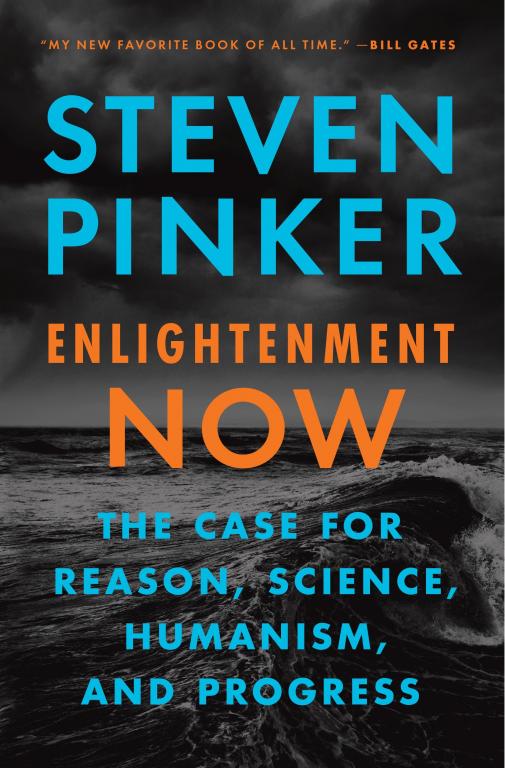 From a different angle, I also wanted to share a few brief reflections about the new book from the Harvard professor Steven Pinker titled Enlightenment Now: The Case for Reason, Science, Humanism, and Progress. Some of you may be familiar with his previous book along the same lines, titled The Better Angels of Our Nature: Why Violence Has Declined. This latest book is an expansion of his argument that, despite some disturbing trends in the current short run (including rising authoritarianism and increasing wealth inequality), Pinker encourages us to not forget the many longer-term trends over the past few centuries which contain a lot of good news about progress made increasing the quality of life for almost every human being on this planet.
Although there are some legitimate criticisms of Pinker’s perspective as “oversimplified, excessively optimistic…and technocratic,” it is also the case that he has compiled compelling evidence about major progress in our world. I cannot replicate in a few minutes what it took Pinker more than 500 pages to detail, but I will offer three of his most-prominent examples, regarding life expectancy, sustenance, and inequality.
- Life expectancy: “In the mid-18th-century, the life expectancy in Europe and the Americas was around 35, where it had been parked for the 225 previous years for which we have data. Life expectancy for the world as a whole was 29….” (So back then, I should have been dead, on average, five years ago.) In contrast, the life expectancy today for the average person in the world is 71.4 years. In less than two centuries of progress, the addition of four decades to the average human life expectancy worldwide is remarkable (53).
- Sustenance: In the past there was a legitimate fear of worldwide hunger, but thanks to technological innovations from the Industrial Revolution, “The world needs less than a third of the land it used to need to produce a given amount of food…. The environmental scientist Jesse Ausubel has estimated that the world has reached Peak Farmland: we may never again need as much as we use today.” Further innovations are on the horizon through genetic engineering technologies like CRISPR (76).
- Inequality: Today “more than 95 percent of American households below the poverty line have electricity, running water, flush toilets, a refrigerator, a stove, and a color TV. (A century and a half before, the Rothchilds, Astors, and Vanderbilts had none of these things.) Almost half of American households below the poverty line have a dishwasher, 60 percent have a computer, around two-thirds have a washing machine and clothes dryer, and more than 80 percent have an air conditioner, a video recorder, and a cell phone…. The rich have gotten richer, but their lives haven’t gotten that much better. [The rich] may have more air conditioners than most people, or better ones, but by historical standards the fact that a majority of poor American even have an air conditioner is astonishing” (117).
Now, don’t get me wrong. I’m on the record about wealth inequality being a major threat to our democracy and for solutions along the lines of a Universal Basic Income. So come the revolution, I’ve got my pitchfork ready. At the same time, I appreciate Pinker’s reminder that even as we continue to work toward our goal of “world community with peace, liberty, and justice”—not merely for some, but for all—let’s also pause periodically along the way to celebrate the progress we have made.
The Rev. Dr. Carl Gregg is a certified spiritual director, a D.Min. graduate of San Francisco Theological Seminary, and the minister of the Unitarian Universalist Congregation of Frederick, Maryland. Follow him on Facebook (facebook.com/carlgregg) and Twitter (@carlgregg).
Learn more about Unitarian Universalism: http://www.uua.org/beliefs/principles
Next Post

June 15, 2018 Spooky Action at a Distance
Browse Our Archives
Select a Category Advent Anti-Racism Archaeology Atheism Baptism Best of the Year List Book Reviews Buddhism Catholicism Christian Education Church and State Church Planting Climate Change Conscientious Objection to War Creation Spirituality Death Penalty Didache Disability Rights Discernment Easter Ecology Emergent Church Movement Empire-Critical Ethics Evolution Feminist Theology Film Reviews Gandhi Gospel of Mark Gun Control Hinduism Immigration Reform Interfaith Islam JFK Judaism Jungian Spirituality Lectionary Commentary Lent Letters to the Editor LGBT Marriage MLK Multiculturalism Mysticism Nonviolent Activism Occupy Paganism (Earth-centered Religions) Parables Paul Pluralism Politics Process Theology Quantum Physics Requiescat In Pace Seminary and Divinity School Sermon Series Retrospective Sermons Spiritual Direction Spiritual Practices Stewardship (Fundraising) The Book of J The Wheel of the Year (Paganism) Theoblogger Challenge Triathlon Uncategorized Unitarian Universalism Worship Resources Youth Ministry
Select a Month July 2026 May 2026 March 2026 November 2025 October 2025 August 2025 February 2025 December 2024 October 2024 March 2024 January 2024 December 2023 November 2023 March 2023 February 2023 January 2023 December 2022 November 2022 August 2022 March 2022 February 2022 January 2022 December 2021 September 2021 August 2021 July 2021 June 2021 May 2021 February 2021 January 2021 December 2020 August 2020 June 2020 May 2020 April 2020 March 2020 February 2020 January 2020 December 2019 November 2019 October 2019 September 2019 July 2019 June 2019 March 2019 February 2019 January 2019 December 2018 November 2018 October 2018 September 2018 June 2018 May 2018 April 2018 March 2018 February 2018 January 2018 December 2017 November 2017 October 2017 September 2017 August 2017 July 2017 June 2017 May 2017 April 2017 March 2017 February 2017 January 2017 December 2016 November 2016 October 2016 September 2016 August 2016 June 2016 May 2016 April 2016 March 2016 February 2016 January 2016 December 2015 November 2015 October 2015 September 2015 August 2015 July 2015 June 2015 May 2015 April 2015 March 2015 February 2015 January 2015 December 2014 November 2014 October 2014 August 2014 July 2014 June 2014 May 2014 April 2014 March 2014 February 2014 January 2014 December 2013 November 2013 October 2013 September 2013 August 2013 July 2013 June 2013 May 2013 April 2013 March 2013 February 2013 January 2013 December 2012 November 2012 October 2012 September 2012 August 2012 July 2012 June 2012 May 2012 April 2012 March 2012 February 2012 January 2012 December 2011 November 2011 October 2011 September 2011 August 2011 July 2011 June 2011 May 2011 April 2011 March 2011 February 2011 January 2011 December 2010 November 2010 October 2010 August 2009 July 2009 May 2009
Follow Us!
TAKE THE
Religious Wisdom Quiz
Who saw a plumb line in a vision, symbolizing judgment?
Select your answer to see how you score.
Micah Obadiah Amos Joel
Related posts from Carl Gregg

Reading America at 250: A Nation Wrestles With...


Andrew Holocek on the Power of Darkness

The Stories That Shape Us: Myths, Archetypes, &...
TRENDING AT PATHEOS More Voices

Reading America at 250: A Nation Wrestles With...
As part of my own reflection on the 250th anniversary of the...

Whenever I am reading a book or listening to an argument, I...

President Trump Ban Animal Torture Videos on Facebook
Call for Stricter Regulations of Animal Abuse Content on Facebook Although President...

Draft Amendments to Address Ritual Abuse in New...
The proposed changes would make it illegal for individuals in domestic partnerships...

How Bans on LGBTQ+ Student Clubs Threaten Religious...
On June 20, 2025, the State of Texas passed Senate Bill 12....

The Truth About the Gen Z Revival
This past year, there has been a lot of media buzz surrounding...
view all More Voices blogs
Ad-Free & Subscriber Log-In Subscription Support
- About Us
- 2026 Calendar
- Videos
- Podcasts
- Library of World Religions
- Faith In Media Tracker
- Advertise With Us
- Write for Us
- Privacy Policy
- Terms of Service
- Do Not Sell My Data
- Contact Us
- Radiant Digital
- Manage Newsletter Subscriptions
- Unsubscribe From Notifications
- Sitemap
Copyright 2008-2026, Patheos. All rights reserved.
Subscription Support Ad-Free & Subscriber Log-In
Follow Patheos