
BuddhistCatholicContemplativeEvangelicalGeneral ChristianHinduJewishLatter-day SaintMuslimNew VisionsProgressive Christian
Beliefs
- Buddhist
- Catholic
- Contemplative
- Evangelical
- General Christian
- Hindu
- Jewish
- Latter-day Saint
- More Voices
- Muslim
- New Visions
- Pagan
- Progressive Christian
Topics
- Religion News
- Food and Religion
- Sports and Religion
- Religious Art
- Religious Music and Entertainment
- Religious Events
- History and Religion
- Style and Religion
- Politics and Religion
- Women in Religion
- Recreation Outdoors and Religion
- Business Finance and Religion
- Careers Workplace and Religion
- Education and Religion
- Family Parenting and Religion
- Health Fitness and Religion
- Home and Religion
- Relationships and Religion
- Technology and Religion
- Travel and Religion
Columnists
- Buddhist Columnists
- Business Finance and Religion Columnists
- Careers Workplace and Religion Columnists
- Catholic Columnists
- Contemplative Columnists
- Education and Religion Columnists
- Evangelists Columnists
- Family Parenting and Religion Columnists
- General Christian Columnists
- Health Fitness and Religion Columnists
- Hindu Columnists
- History and Religion Columnists
- Home and Religion Columnists
- Jewish Columnists
- More Voices Columnists
- Latter Day Columnists
- Muslim Columnists
- New Visions Columnists
- Nonreligious Columnists
- Pagan Columnists
- Politics and Religion Columnists
- Progressive Columnists
- Recreation Outdoors and Religion Columnists
- Relationships and Religion Columnists
- Religion News Columnists
- Religious Art Columnists
- Religious Events Columnists
- Religious Music and Entertainment Columnists
- Sports and Religion Columnists
- Style and Religion Columnists
- Technology and Religion Columnists
- Travel and Religion Columnists
- Women in Religion Columnists
Resource Library
- 2026 Calendar
- Library of World Religions
- The 100 Most Holy Places on Earth
- Patheos Answers
- Podcasts
- Videos
- Faith Leaders Database
- Anglican Episcopalian
- Bahai
- Baptist
- Buddhism
- Christianity
- Confucianism
- Eastern Orthodoxy
- Hinduism
- Holiness and Pentecostal
- ISKCON
- Islam
- Judaism
- Lutheran
- Methodist
- The Church of Jesus Christ of Latter-day Saints
- New Age
- Paganism
- Presbytarian and Reformed
- Protestantism
- Religion Behind the Scenes
- Roman Catholic
- Scientology
- Shia Islam
- Sikhism
- Sufism
- Sunni Islam
- Taoism
- Zen
- See all religions
Research Tools
 Ad-Free & Subscriber Log-In Subscription Support
Ad-Free & Subscriber Log-In Subscription Support
Follow Patheos 

- Trending:
- Forgiveness
- |
- Marriage
- |
- Consciousness
- |
- Death Penalty
- |
- Election
- |
- Halloween

- Home
- More Voices
- Spooky Action at a Distance
Spooky Action at a Distance
Last updated on: June 15, 2018 at 10:48 am by Carl Gregg
Spooky Action at a Distance 2018-06-15T10:48:43-04:00 Carl Gregg
Patheos Explore the world's faith through different perspectives on religion and spirituality! Patheos has the views of the prevalent religions and spiritualities of the world.
Donald Hoffman is a professor of Cognitive Science at the University of California, Irvine. A few years ago,The Atlantic magazine interview with him titled, “The Case Against Reality,” explored the astounding fact of human consciousness: that our species is awake and aware of our surroundings. I invite you to read just one paragraph from that interview:
Not only are [many neuroscientists and philosophers of mind] ignoring the progress in fundamental physics, they are often explicit about it. They’ll say openly that quantum physics is not relevant to the aspects of brain function that are causally involved in consciousness. They are certain that it’s got to be classical properties of neural activity, which exist independent of any observers—spiking rates, connection strengths at synapses, perhaps dynamical properties as well. These are all very classical notions under Newtonian physics, where time is absolute and objects exist absolutely. And then [neuroscientists] are mystified as to why they don’t make progress. They don’t avail themselves of the incredible insights and breakthroughs that physics has made. Those insights are out there for us to use, and yet my field says, “We’ll stick with Newton, thank you. We’ll stay 300 years behind in our physics.”
This quote challenges us to reflect on what we know about physics here in the early twenty-first century—and what the implications may be for our understandings of neuroscience, human consciousness, and our place in the universe.
There’s a lot to say about all of that, so I will invite us to begin reflecting on this area through the lens of Albert Einstein’s famous skepticism about scientific theories that appear to be, in his words, about “spooky action at a distance” (Musser 9). Einstein thought science would eventually find local action that would explain away the spookiness. But here’s the thing: the more scientists have looked into it, the more it appears that there really is “action at a distance.” Whether those distant actions are actually spooky depends on your point of view.
In speaking out against “spooky action at a distance,” Einstein was advocating for a Newtonian perspective sometimes called locality. When you think of the word “locality,” it might strike you as a somewhat fancy or antiquated way of referring to an area, neighborhood, or place where something is. One way of talking about the locality of this building is that it is in Frederick County. The point is that, in our everyday way of thinking, every object in the universe has, by definition, a given locality—that is, a place (3).
If you will stick with me, I will briefly lay out the two important aspects of locality for Einstein—separability and local action. My account is going to seems really basic, that explains why the discovery of actions that seemed to violate previously-accepted scientific laws was so haunting:
- Separability – “says that you can separate any two objects or parts of an object and consider each on its own…” For instance, we could separate a grouping of chairs into various corners of a room and “they will not cease to exist nor lose any of their features”—size, style, cushiness, etc. Not very spooky so far.
- Local Action – “says that objects interact only by banging into one another or recruiting some middleman to bridge the gap between them.” To again use my example of a room, if I want to have an impact on you, I must somehow cross the distance that separates us. Common examples of how I might do that are: walking over to touch you, speaking to you, or sending someone to cross the distance for me to walk over to you or speak to you on my behalf.
It’s important to note that:
Modern technology does not evade this principle; it merely recruits new intermediaries. A phone translates sound waves into electrical signals or radio waves that travel through wires or open space and then get translated back into sound on the other end. At every step of the way, something has to make direct contact with something else…. (5)
So far, still pretty straightforward.
But here’s where it starts to get interesting. Whenever I think about Einstein’s skepticism toward “spooky action at a distance,” I’m reminded of the science fiction writer Arthur C. Clarke’s three laws from his 1962 essay “Hazards of Prophecy: The Failure of Imagination”:
- When a distinguished but elderly scientist states that something is possible, he is almost certainly right. When he states that something is impossible, he is very probably wrong.
- The only way of discovering the limits of the possible is to venture a little way past them into the impossible.
- Any sufficiently advanced technology is indistinguishable from magic.
So how does this apply to “spooky action at a distance”?
Well, part of what seems to make spooky action possible is a phenomenon known as quantum entanglement. In contrast to separability and local action, quantum entanglement says that, **“**Two particles that are entangled with each other are not literally intertwined, like balls of yarn; rather, they have a peculiar bond that transcends space.” They are separate. So, according to Newton, the only way they can impact each other is through some sort of local action—either directly or through some middleman. If, nevertheless, they continue to have an effect on one another “spooky action at a distance!”
Einstein’s view at the time of his death in 1955 was that there must be a significant problem with the current theory of quantum physics. But in 1964, almost a decade after Einstein’s death, a physicists named John Steward Bell came up with a brilliant idea for testing the existence of spooky action. “And when the experiment Bell described was carried out—imperfectly in Berkeley in the 1970s, more decisively in Paris in 1982, and near authoritatively in the Netherlands in 2015—the “spooky” predictions of quantum mechanics were vindicated” (Holt 231-232).
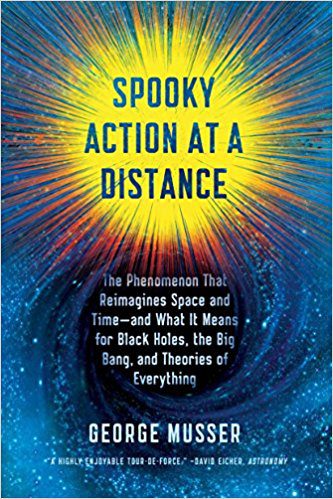 If you are curious to learn more, the most accessible starting point I have found is a book by the award-winning science journalist George Musser titled—you guessed it!—Spooky Action at a Distance, published a few years ago by Scientific American. For science and math nerds out there, a more technical introduction is the 3rd Edition of Quantum Non-Locality and Relativity by the Rutgers University philosophy professor Tim Maudlin (Musser 20). But seriously, unless you’re pretty much into science and math, definitely start with Musser’s book first.
But for now, let me say just a little more about the shift from “separability” and “locality” to “quantum entanglement” and “non-locality.” Here are three strange, weird, and spooky implications of quantum theory that seem to be true about this intriguing universe in which we find ourselves:
- Quantum entanglement is “undiluted by distance—unlike gravity, which falls off in strength” the farther one object is from another.
- Quantum entanglement is “discriminating: an experiment done on one photon in an entangled pair affects only its partner, wherever that partner may be, leaving all other photons, near and far, untouched.”
- Quantum entanglement is instantaneous: a change in the state of one entangled particle makes itself felt on its partner without delay, no matter how vast the gulf that separates them” (Holt 238).
Indeed, one of my favorite parts of quantum entanglement is that it subverts the meaning of space. In our normal way of thinking, space is literally the “in between” that spaces things out from one another (Musser 36). Also in our everyday way of thinking, you must somehow cross intervening space to have an impact on something else. But it turns out that reality is sometimes more complicated that than. Spooky stuff, but also fascinating.
Einstein died in 1955 at age 76 still thinking that there must be something wrong with the theory of Quantum Physics that he helped develop. But as it turns out, the universe actually does have spooky action at a distance! For the latest generation of physicists, the basic attitude about quantum entanglement seems to be a basic acceptance of “That’s just the way it is” (Holt 240).
And although non-locality and quantum entanglement are fascinating in and of themselves, I would be remiss if I didn’t mention some of the practical implications that scientists are beginning to explore:
For instance, physicists at the University of Oxford proved in 1991 that entangled particles can create a communications channel so secure that not even the sneakiest government surveillance program could listen in. Once physicists were clued into the importance of entanglement, they began to see it almost everywhere they looked. It occurs even in living organisms. In photosynthesis, entanglement accounts for the unexpectedly high efficiency with which molecules transfer light energy into chemical energy…. (Musser 23)
And there is little doubt that we are barely on the edge of the frontier of what will eventually become possible in regard to harnessing the potential of quantum entanglement and non-locality.
Along those lines, last year I was fascinated to read an article from the BBC about Chinese scientists “‘teleporting’ a photon particle from the ground to a satellite orbiting 870 miles away.” Part of what they did was create:
4,000 pairs of quantum-entangled photons per second at their laboratory…and fire one of the photons from each pair in a beam of light towards a satellite…which has a sensitive photon receiver that can detect the quantum states of single photons fired from the ground.
Admittedly, the use of the word “teleporting” is a bit inexact and a clear attempt at headline grabbing. At the same time, it’s pretty cool. And while we aren’t ready to teleport human beings or starships anytime soon, in the words of one Oxford professor, “There are significant barriers still to overcome. But this is how transformative change begins.”
For now, I’ll move toward my conclusion with this quote from Musser’s book Spooky Action at a Distance:
Today we know that the universe has more to it than things situated within space. Nonlocal phenomena leap out of space.… They hunt at a level of reality deeper than space, where the concept of distance ceases to apply, where things that appear to lie far apart are actually nearby or perhaps are the same thing manifested in more than one place, like multiple images of a single shard of kaleidoscopic glass. When we think in terms of such a level, the connections between subatomic particles across a lab bench, between the inside and the outside of a black hole, and between opposite sides of the universe don’t seem so spooky anymore…. “If you agree that the fundamental level of physics is not local, everything is natural, because these two particles which are far part from each other explore the same fundamental nonlocal level. For them, time and space don’t matter.” Only when you try to visualize these phenomena in terms of space—which is forgivable because it’s hard for us to think in any other way—do they defy comprehension.” (168)
On this point of comprehensibility, you may be familiar with the new version of Cosmos, hosted by Neil deGrasse Tyson. On this point, I’m reminded of one of his favorite sayings, that “The Universe is under no obligation to make sense to you.” On one level, that is true. On another level, I’m astounded and incredibly grateful for the insights scientists continue to offer us almost every day that make our universe more comprehensible.
The Rev. Dr. Carl Gregg is a certified spiritual director, a D.Min. graduate of San Francisco Theological Seminary, and the minister of the Unitarian Universalist Congregation of Frederick, Maryland. Follow him on Facebook (facebook.com/carlgregg) and Twitter (@carlgregg).
Learn more about Unitarian Universalism: http://www.uua.org/beliefs/principles
Previous Post

June 8, 2018
”We Are Already Saved from Perfection”
Next Post
September 12, 2018 Sharpening Our Pitchforks: How to Decrease the Income Inequality Gap
Browse Our Archives
Select a Category Advent Anti-Racism Archaeology Atheism Baptism Best of the Year List Book Reviews Buddhism Catholicism Christian Education Church and State Church Planting Climate Change Conscientious Objection to War Creation Spirituality Death Penalty Didache Disability Rights Discernment Easter Ecology Emergent Church Movement Empire-Critical Ethics Evolution Feminist Theology Film Reviews Gandhi Gospel of Mark Gun Control Hinduism Immigration Reform Interfaith Islam JFK Judaism Jungian Spirituality Lectionary Commentary Lent Letters to the Editor LGBT Marriage MLK Multiculturalism Mysticism Nonviolent Activism Occupy Paganism (Earth-centered Religions) Parables Paul Pluralism Politics Process Theology Quantum Physics Requiescat In Pace Seminary and Divinity School Sermon Series Retrospective Sermons Spiritual Direction Spiritual Practices Stewardship (Fundraising) The Book of J The Wheel of the Year (Paganism) Theoblogger Challenge Triathlon Uncategorized Unitarian Universalism Worship Resources Youth Ministry
Select a Month July 2026 May 2026 March 2026 November 2025 October 2025 August 2025 February 2025 December 2024 October 2024 March 2024 January 2024 December 2023 November 2023 March 2023 February 2023 January 2023 December 2022 November 2022 August 2022 March 2022 February 2022 January 2022 December 2021 September 2021 August 2021 July 2021 June 2021 May 2021 February 2021 January 2021 December 2020 August 2020 June 2020 May 2020 April 2020 March 2020 February 2020 January 2020 December 2019 November 2019 October 2019 September 2019 July 2019 June 2019 March 2019 February 2019 January 2019 December 2018 November 2018 October 2018 September 2018 June 2018 May 2018 April 2018 March 2018 February 2018 January 2018 December 2017 November 2017 October 2017 September 2017 August 2017 July 2017 June 2017 May 2017 April 2017 March 2017 February 2017 January 2017 December 2016 November 2016 October 2016 September 2016 August 2016 June 2016 May 2016 April 2016 March 2016 February 2016 January 2016 December 2015 November 2015 October 2015 September 2015 August 2015 July 2015 June 2015 May 2015 April 2015 March 2015 February 2015 January 2015 December 2014 November 2014 October 2014 August 2014 July 2014 June 2014 May 2014 April 2014 March 2014 February 2014 January 2014 December 2013 November 2013 October 2013 September 2013 August 2013 July 2013 June 2013 May 2013 April 2013 March 2013 February 2013 January 2013 December 2012 November 2012 October 2012 September 2012 August 2012 July 2012 June 2012 May 2012 April 2012 March 2012 February 2012 January 2012 December 2011 November 2011 October 2011 September 2011 August 2011 July 2011 June 2011 May 2011 April 2011 March 2011 February 2011 January 2011 December 2010 November 2010 October 2010 August 2009 July 2009 May 2009
Follow Us!
TAKE THE
Religious Wisdom Quiz
Jesus drove the merchants and money-changers out of the temple with this.
Select your answer to see how you score.
Stool Stick Scourge Sword
Related posts from Carl Gregg

Reading America at 250: A Nation Wrestles With...


Andrew Holocek on the Power of Darkness

The Stories That Shape Us: Myths, Archetypes, &...
TRENDING AT PATHEOS More Voices

Reading America at 250: A Nation Wrestles With...
As part of my own reflection on the 250th anniversary of the...

Whenever I am reading a book or listening to an argument, I...

President Trump Ban Animal Torture Videos on Facebook
Call for Stricter Regulations of Animal Abuse Content on Facebook Although President...

Draft Amendments to Address Ritual Abuse in New...
The proposed changes would make it illegal for individuals in domestic partnerships...

How Bans on LGBTQ+ Student Clubs Threaten Religious...
On June 20, 2025, the State of Texas passed Senate Bill 12....

The Truth About the Gen Z Revival
This past year, there has been a lot of media buzz surrounding...
view all More Voices blogs
Ad-Free & Subscriber Log-In Subscription Support
- About Us
- 2026 Calendar
- Videos
- Podcasts
- Library of World Religions
- Faith In Media Tracker
- Advertise With Us
- Write for Us
- Privacy Policy
- Terms of Service
- Do Not Sell My Data
- Contact Us
- Radiant Digital
- Manage Newsletter Subscriptions
- Unsubscribe From Notifications
- Sitemap
Copyright 2008-2026, Patheos. All rights reserved.
Subscription Support Ad-Free & Subscriber Log-In
Follow Patheos