
BuddhistCatholicContemplativeEvangelicalGeneral ChristianHinduJewishLatter-day SaintMuslimNew VisionsProgressive Christian
Beliefs
- Buddhist
- Catholic
- Contemplative
- Evangelical
- General Christian
- Hindu
- Jewish
- Latter-day Saint
- More Voices
- Muslim
- New Visions
- Pagan
- Progressive Christian
Topics
- Religion News
- Food and Religion
- Sports and Religion
- Religious Art
- Religious Music and Entertainment
- Religious Events
- History and Religion
- Style and Religion
- Politics and Religion
- Women in Religion
- Recreation Outdoors and Religion
- Business Finance and Religion
- Careers Workplace and Religion
- Education and Religion
- Family Parenting and Religion
- Health Fitness and Religion
- Home and Religion
- Relationships and Religion
- Technology and Religion
- Travel and Religion
Columnists
- Buddhist Columnists
- Business Finance and Religion Columnists
- Careers Workplace and Religion Columnists
- Catholic Columnists
- Contemplative Columnists
- Education and Religion Columnists
- Evangelists Columnists
- Family Parenting and Religion Columnists
- General Christian Columnists
- Health Fitness and Religion Columnists
- Hindu Columnists
- History and Religion Columnists
- Home and Religion Columnists
- Jewish Columnists
- More Voices Columnists
- Latter Day Columnists
- Muslim Columnists
- New Visions Columnists
- Nonreligious Columnists
- Pagan Columnists
- Politics and Religion Columnists
- Progressive Columnists
- Recreation Outdoors and Religion Columnists
- Relationships and Religion Columnists
- Religion News Columnists
- Religious Art Columnists
- Religious Events Columnists
- Religious Music and Entertainment Columnists
- Sports and Religion Columnists
- Style and Religion Columnists
- Technology and Religion Columnists
- Travel and Religion Columnists
- Women in Religion Columnists
Resource Library
- 2026 Calendar
- Library of World Religions
- The 100 Most Holy Places on Earth
- Patheos Answers
- Podcasts
- Videos
- Faith Leaders Database
- Anglican Episcopalian
- Bahai
- Baptist
- Buddhism
- Christianity
- Confucianism
- Eastern Orthodoxy
- Hinduism
- Holiness and Pentecostal
- ISKCON
- Islam
- Judaism
- Lutheran
- Methodist
- The Church of Jesus Christ of Latter-day Saints
- New Age
- Paganism
- Presbytarian and Reformed
- Protestantism
- Religion Behind the Scenes
- Roman Catholic
- Scientology
- Shia Islam
- Sikhism
- Sufism
- Sunni Islam
- Taoism
- Zen
- See all religions
Research Tools
 Ad-Free & Subscriber Log-In Subscription Support
Ad-Free & Subscriber Log-In Subscription Support
Follow Patheos 

- Trending:
- Forgiveness
- |
- Marriage
- |
- Consciousness
- |
- Death Penalty
- |
- Election
- |
- Halloween

- Home
- More Voices
- How Many Earths Would It Take For Everyone To Live Your Lifestyle?
How Many Earths Would It Take For Everyone To Live Your Lifestyle?
Last updated on: May 2, 2018 at 8:43 am by Carl Gregg
How Many Earths Would It Take For Everyone To Live Your Lifestyle? 2018-05-02T08:43:58-04:00 Carl Gregg
Patheos Explore the world's faith through different perspectives on religion and spirituality! Patheos has the views of the prevalent religions and spiritualities of the world.
The number of human beings on this planet has septupled (increased sevenfold) in a mere two centuries, from approximately 1 billion people alive in 1800 to more than 7.6 billion people today. Although there are indications that world population may peak at approximately 10 billion, should we accept 10 billion people as the “new normal?”
We also need to pay attention not only to the number of people alive at any given time, but also to related demographic trends. For instance, we have passed the midpoint of three significant shifts that have never previously been the case in the history of humankind if projected trends continue:
- Before 2000, young people always outnumbered old people. From 2000 forward, old people will outnumber young people. [To oversimplify, part of what this statistic is tracking is the likelihood that “All persons under 15 and those 65 or older are likely to be in some sense dependent on the population in the working ages of 15-64.”]
- Until approximately 2007, rural people always outnumbered urban people. From 2008, forward, urban people will outnumber rural people.
- From 2003 on, the median woman worldwide had, and will continue to have, too few or just enough children during her lifetime to replace herself and the father in the following generation. (Mayhew 217).
These are among the important trends to keep in mind as we seek to “build the world we dream about” with peace, liberty, and justice–not merely for some–but for all.
To help create a more sustainable world, another trend that I hope increasing numbers of people will help popularize is the need for a “triple bottom line**” that accounts for people, planet and profit—**not merely profit alone. Two of my other recent posts (about the rise of robots and the need for human rights) have emphasized the ways human labor is exploited for the sake of corporate profits. But the recent celebration of Earth Day, isa reminder that it is also only fair that we consider the related importance of the environment in that triple formulation of people, planet, and profit.
Whenever I reflect on the relationship of people and planet, I’m often reminded of a New Yorker cartoon published about a decade ago. It shows a view from space with an anthropomorphized Earth (depicted as having a face — two eyes, a nose, and mouth — looking up at another anthropomorphized planet Saturn (whose ring has been adjusted to have a head-mirror as doctors sometimes wear). The caption has Dr. Saturn diagnosing the problem of the ailing patient Earth: “I’m afraid you have humans.”
This cartoon satire visualizes a warning first made years ago by the late Julian Huxley (1887 – 1975), a British evolutionary biologist, who said that humanity: “will turn into the cancer of the planet.” That is a harsh evaluation, but consider the upward sloping line of “population size” in this graph. To Dr. Huxley, the rapid increase in human population looks like metastasizing cells threatening to overwhelm a vulnerable host— in this case the planet on which we find ourselves (Connelly 201).
So I would invite you to consider that, as important as each part of the triple bottom line is, none are singularly important. More humans without end is not an unalloyed good—any more than the planet alone without humans, or profit alone for only a few wealthy elites. Now, in raising the topic of world population, I realize I’m steering into dangerous territory that is littered with the historic landmines of colonialism, eugenics, racism, and more. And I certainly agree that any proposal regarding human population must account for those deeply misguided tragedies of the past (Connelly 48, 50). With that in mind, I ask that you stick with me to let me get a few more points on the table.
For instance, allow me to clarify that when I say, “More humans without end is not an unalloyed good,” I am primarily responding to a theologically conservative worldview that I was raised in and that continues to shape far too much political policy today. In contrast to a triple bottom line which calls us to account for the needs of people, planet, and profit—many conservative theologies say that:
- More people is always better—and that it is a sin to use contraception designed to prevent a sacred human soul from being born (Connelly 50, 365).
- How we treat the planet doesn’t matter because Jesus is coming back and God will magically create a “new heaven and a new Earth.”
- [and] More profit is always better—indeed prosperity is a sign of divine blessing and poverty is due to a lack of faith.
For what it’s worth, my intention is not to be unduly flippant in that summary. I have heard these sentiments expressed many times—sometimes in those exact words.
The ethicist who I have found most helpful on this point is the Princeton University professor Peter Singer, who has written about “Unsanctifying Human Life.” Part of what he means by this provocative formulation is that it is arguably no longer reasonable to maintain the ancient religious worldview that all human life is sacred and inviolable from womb to tomb without exception. (An extreme version of this ancient religious worldview has made it difficult to negotiate a reasonable public policy about reproductive justice and options for death with dignity.)
In contrast, here in the early twenty-first century, our invitation is to embrace the reality that we humans are not unique “children of God,” formed through a special act of creation 6,000 years ago—and rightful lords over both this planet and the other lifeforms on it. Instead, we live more than 150 years after Darwin’s discovery that we humans are not “a little lower than the angels,” but rather a “little higher than the apes.” We are the result of millions of years of evolution—and we are deeply interconnected with the other life forms and ecosystems of this planet.
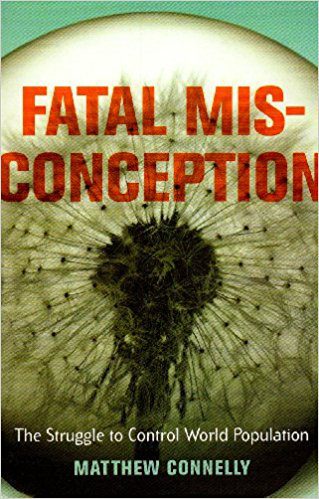 As I have been researching this subject, the best contemporary book I have found so far is Fatal Misconception: The Struggle to Control World Population by Matthew Connelly, published in 2009 by Harvard University Press. And perhaps my most significant takeaway from his historical study is that attempts to curb world population have often been not only ineffective (even when the funding levels were high), but also racist, imperialist, and manipulative. In Connelly’s words, “The great tragedy of population control, the fatal misconception, was to think that one could know other people’s interests better than they knew it themselves (378).
On that point, from discussion and debates I have witnessed, one frequent confusion that sometimes keeps the topic of global population taboo is a category confusion of taking a problem personally that needs to be addressed on the institutional level of systems and structures.
The issue is orders of magnitude larger than whether any given person has no children—or twenty children. Systemic change will come, if at all, by addressing the larger systemic issues. And for those of us committed to reproductive justice, arguably the strongest and most ethical starting point is to move away from the paradigm of “population control” (which has a sordid history of racism, imperialism, and paternalism) to a **paradigm of empowerment and equality—particularly for girls and women.
Systemic change should arguably include universal, worldwide access to comprehensive sexuality eduction, birth control, and child care—as well as equal educational and employment opportunities for girls and women. Indeed, if you consider the “population increment” bar graph segment of the chart linked to earlier, “The worldwide decline in fertility rates corresponds far more closely with the worldwide decline in illiteracy among women than with population control programs” (Connelly 375-6).
So that’s some of the good news: the world population is not predicted to keep increasing forever and we know how to further create positive change—educate, employ, and empower women. The annual rate of growth has peaked and is predicted to continue slowing down. The bad news is that interest in lowering world population has slowed along with it: “There has been no United Nations conference on population since the one in Cairo in 1994, and spending per capita on family planning programs has diminished considerably in most parts of the world—by over 50 percent in the decade 1996-2006,” which roughly coincides with the period when the rate-of-increase began to decline (Mayhew 214).
“The United Nations’ ‘median’ projection for global population now predicts that it will peak at around 10 billion” (Mayhew 3). But is it wise to accept 10 billion people in global population as the new normal? After all, a mere 150,000 years ago, there were only about one million humans alive on planet Earth. And whereas our semi-nomadic, hunter-gatherer ancestors had a relatively negligible impact on this planet, especially since the nineteenth-century Industrial Revolution, the high-impact, consumerist lifestyle of increasing numbers of humans is causing climate change at an unprecedented level.
Indeed, we may be hurtling us toward a potential sixth mass extinction here on Earth. Since we know there have already been five previous mass extinctions on this planet, we ignore the possibilities of a sixth one at our peril. Climate Change deniers may feel like only people and profit matter, but the contemporary environmental prophet Wendell Berry puts it this way: “Whether we and our politicians know it or not, Nature is party to all our deals and decisions, and she has more votes, a longer memory, and a sterner sense of justice than we do.” People and planet—we’re all in this together.
And as we consider how we humans might decrease our impact on this planet, there are a few additional factors to keep in mind. I should be sure, for example, to emphasize that the equation is not a simple division problem, as it is sometimes depicted. Our situation is not so simplistic as a numerator of finite planetary resources divided by a denominator of increasing numbers of humans. If it were that simple, then standards of living would decrease in direct proportion to increases in population. But techno-utopians—who think that technology will save us—remind us that over the past few centuries the “human capacity to innovate” has in many surprising ways been able to keep pace with the increasing number of new mouths to feed (Mayhew 205). Their hope is that technologies of the future will also save us from both poverty and climate change. (I’ve shared some details about those techno-utopia hope before in a previous post on The Earth Challenge.)
From the opposite perspective, techno-utopians sometimes fail to account for the ways that technological advances not only increase standards of living, but also have heavy impacts on our planet. Economists call this failure to weigh all implications an “eternality”—in this case, refusing to factor in impacts on the environment. And it is up to us to elect leaders with the courage to force corporations to internalize environmental impacts into their profits.
Here’s another way of making this point: not all 7.6 billion of us human beings alive today impact the planet at the same level. The issue is not only about the average birth rate of a given society, but also what size houses those children live in, whether they have air conditioning, whether they have a car, how often they fly in airplanes, etc. Each new person living a so-called “Western consumerist” lifestyle will have a much greater impact on the planet “than a billion more subsistence farmers” with multiple generations living together under one roof (Connelly 372).
Have you used the online “Ecological Footprint Calculator”? It is a fascinating—if sobering—interactive website created by a team of scientists which invites you to explore, “How many planet Earths would we need if everyone lived like you?” In the spirit of full disclosure, I’ve been a vegetarian (and occasional vegan) since 1996, I live in an 1,100 square foot row house, commute 7.5 miles to work, and I fly in an airplane at least a few hours a year. Along with a few other data points, that means that there would need to be at least 2 Earths for all 7.6 billion people to live my lifestyle.
For a few points of comparison, it would take:
- 5 Earths for everyone to live the lifestyle of the average American
- 3.2 Earths to support the lifestyle of the average German, and
- and approximately 2 Earths to support the lifestyles of the average citizens of China, S. African, or Brazil.
These are important perspectives to wrestle with if we are to have any hope of achieving our goal of world community with peace, liberty, and justice—not merely for some—but for all.
For anyone curious, I did keep playing with my stats to see what it would take to get down to the “1 Earth” level. One way for me to get there would be to obtain at least 80% of my food locally, get rid of my car, and stop flying anywhere by airplane—most of which is not realistic given Frederick’s current logistics. And the overall challenge will increase with the projected 2.4 (or more!) billion additional people to come.
I don’t want to be unduly harsh on our species. From one perspective, we humans are amazing: we are the only products of the evolutionary process yet who have evolved the capacity of becoming aware of the evolutionary process itself! And our strong evolutionary impulse to reproduce is one reason why any of us are here at all. It is why our species has survived. But for a confluence of reasons—such as the domestication of fire and the increasingly-sophisticated communication potential of human language—we homo sapiens jumped to the top of the food chain with shocking speed—at least from the perspective of evolution.
Although we still must contend with factors such as war, disease, and natural disasters, it is also true that our species has, for a while now, been multiplying rapidly without any external predators to thin our herd (so to speak) and keep the ecosystem in balance—although that is part of what climate change is ultimately threatening to do.
But for quite a while now, people and profit have been rocketing upward, while attempted to count most of the impact on the planet as an externality. May we each do our part individually and collectively—within our spheres of influence—to co-create a sustainable future not only for all human beings alive today and future generations to come, but also for the multitudes of astounding life on this breathtakingly-beautiful planet we call home.
The Rev. Dr. Carl Gregg is a certified spiritual director, a D.Min. graduate of San Francisco Theological Seminary, and the minister of the Unitarian Universalist Congregation of Frederick, Maryland. Follow him on Facebook (facebook.com/carlgregg) and Twitter (@carlgregg).
Learn more about Unitarian Universalism: http://www.uua.org/beliefs/principles

Browse Our Archives
Select a Category Advent Anti-Racism Archaeology Atheism Baptism Best of the Year List Book Reviews Buddhism Catholicism Christian Education Church and State Church Planting Climate Change Conscientious Objection to War Creation Spirituality Death Penalty Didache Disability Rights Discernment Easter Ecology Emergent Church Movement Empire-Critical Ethics Evolution Feminist Theology Film Reviews Gandhi Gospel of Mark Gun Control Hinduism Immigration Reform Interfaith Islam JFK Judaism Jungian Spirituality Lectionary Commentary Lent Letters to the Editor LGBT Marriage MLK Multiculturalism Mysticism Nonviolent Activism Occupy Paganism (Earth-centered Religions) Parables Paul Pluralism Politics Process Theology Quantum Physics Requiescat In Pace Seminary and Divinity School Sermon Series Retrospective Sermons Spiritual Direction Spiritual Practices Stewardship (Fundraising) The Book of J The Wheel of the Year (Paganism) Theoblogger Challenge Triathlon Uncategorized Unitarian Universalism Worship Resources Youth Ministry
Select a Month July 2026 May 2026 March 2026 November 2025 October 2025 August 2025 February 2025 December 2024 October 2024 March 2024 January 2024 December 2023 November 2023 March 2023 February 2023 January 2023 December 2022 November 2022 August 2022 March 2022 February 2022 January 2022 December 2021 September 2021 August 2021 July 2021 June 2021 May 2021 February 2021 January 2021 December 2020 August 2020 June 2020 May 2020 April 2020 March 2020 February 2020 January 2020 December 2019 November 2019 October 2019 September 2019 July 2019 June 2019 March 2019 February 2019 January 2019 December 2018 November 2018 October 2018 September 2018 June 2018 May 2018 April 2018 March 2018 February 2018 January 2018 December 2017 November 2017 October 2017 September 2017 August 2017 July 2017 June 2017 May 2017 April 2017 March 2017 February 2017 January 2017 December 2016 November 2016 October 2016 September 2016 August 2016 June 2016 May 2016 April 2016 March 2016 February 2016 January 2016 December 2015 November 2015 October 2015 September 2015 August 2015 July 2015 June 2015 May 2015 April 2015 March 2015 February 2015 January 2015 December 2014 November 2014 October 2014 August 2014 July 2014 June 2014 May 2014 April 2014 March 2014 February 2014 January 2014 December 2013 November 2013 October 2013 September 2013 August 2013 July 2013 June 2013 May 2013 April 2013 March 2013 February 2013 January 2013 December 2012 November 2012 October 2012 September 2012 August 2012 July 2012 June 2012 May 2012 April 2012 March 2012 February 2012 January 2012 December 2011 November 2011 October 2011 September 2011 August 2011 July 2011 June 2011 May 2011 April 2011 March 2011 February 2011 January 2011 December 2010 November 2010 October 2010 August 2009 July 2009 May 2009
Follow Us!
TAKE THE
Religious Wisdom Quiz
What does Revelation say will wipe away every tear from their eyes?
Select your answer to see how you score.
The river of life An angel God himself The tree of life
Related posts from Carl Gregg

Reading America at 250: A Nation Wrestles With...


Andrew Holocek on the Power of Darkness

The Stories That Shape Us: Myths, Archetypes, &...
TRENDING AT PATHEOS More Voices

Reading America at 250: A Nation Wrestles With...
As part of my own reflection on the 250th anniversary of the...

Whenever I am reading a book or listening to an argument, I...

President Trump Ban Animal Torture Videos on Facebook
Call for Stricter Regulations of Animal Abuse Content on Facebook Although President...

Draft Amendments to Address Ritual Abuse in New...
The proposed changes would make it illegal for individuals in domestic partnerships...

How Bans on LGBTQ+ Student Clubs Threaten Religious...
On June 20, 2025, the State of Texas passed Senate Bill 12....

The Truth About the Gen Z Revival
This past year, there has been a lot of media buzz surrounding...
view all More Voices blogs
Ad-Free & Subscriber Log-In Subscription Support
- About Us
- 2026 Calendar
- Videos
- Podcasts
- Library of World Religions
- Faith In Media Tracker
- Advertise With Us
- Write for Us
- Privacy Policy
- Terms of Service
- Do Not Sell My Data
- Contact Us
- Radiant Digital
- Manage Newsletter Subscriptions
- Unsubscribe From Notifications
- Sitemap
Copyright 2008-2026, Patheos. All rights reserved.
Subscription Support Ad-Free & Subscriber Log-In
Follow Patheos