
BuddhistCatholicContemplativeEvangelicalGeneral ChristianHinduJewishLatter-day SaintMuslimNew VisionsProgressive Christian
Beliefs
- Buddhist
- Catholic
- Contemplative
- Evangelical
- General Christian
- Hindu
- Jewish
- Latter-day Saint
- More Voices
- Muslim
- New Visions
- Pagan
- Progressive Christian
Topics
- Religion News
- Food and Religion
- Sports and Religion
- Religious Art
- Religious Music and Entertainment
- Religious Events
- History and Religion
- Style and Religion
- Politics and Religion
- Women in Religion
- Recreation Outdoors and Religion
- Business Finance and Religion
- Careers Workplace and Religion
- Education and Religion
- Family Parenting and Religion
- Health Fitness and Religion
- Home and Religion
- Relationships and Religion
- Technology and Religion
- Travel and Religion
Columnists
- Buddhist Columnists
- Business Finance and Religion Columnists
- Careers Workplace and Religion Columnists
- Catholic Columnists
- Contemplative Columnists
- Education and Religion Columnists
- Evangelists Columnists
- Family Parenting and Religion Columnists
- General Christian Columnists
- Health Fitness and Religion Columnists
- Hindu Columnists
- History and Religion Columnists
- Home and Religion Columnists
- Jewish Columnists
- More Voices Columnists
- Latter Day Columnists
- Muslim Columnists
- New Visions Columnists
- Nonreligious Columnists
- Pagan Columnists
- Politics and Religion Columnists
- Progressive Columnists
- Recreation Outdoors and Religion Columnists
- Relationships and Religion Columnists
- Religion News Columnists
- Religious Art Columnists
- Religious Events Columnists
- Religious Music and Entertainment Columnists
- Sports and Religion Columnists
- Style and Religion Columnists
- Technology and Religion Columnists
- Travel and Religion Columnists
- Women in Religion Columnists
Resource Library
- 2026 Calendar
- Library of World Religions
- The 100 Most Holy Places on Earth
- Patheos Answers
- Podcasts
- Videos
- Faith Leaders Database
- Anglican Episcopalian
- Bahai
- Baptist
- Buddhism
- Christianity
- Confucianism
- Eastern Orthodoxy
- Hinduism
- Holiness and Pentecostal
- ISKCON
- Islam
- Judaism
- Lutheran
- Methodist
- The Church of Jesus Christ of Latter-day Saints
- New Age
- Paganism
- Presbytarian and Reformed
- Protestantism
- Religion Behind the Scenes
- Roman Catholic
- Scientology
- Shia Islam
- Sikhism
- Sufism
- Sunni Islam
- Taoism
- Zen
- See all religions
Research Tools
 Ad-Free & Subscriber Log-In Subscription Support
Ad-Free & Subscriber Log-In Subscription Support
Follow Patheos 

- Trending:
- Forgiveness
- |
- Marriage
- |
- Consciousness
- |
- Death Penalty
- |
- Election
- |
- Halloween

- Home
- More Voices
- “We Must Save Ourselves from Our Low Ambitions”: Why Human Rights Are Inalienable, Not Inevitable
“We Must Save Ourselves from Our Low Ambitions”: Why Human Rights Are Inalienable, Not Inevitable
Last updated on: April 20, 2018 at 7:39 am by Carl Gregg
“We Must Save Ourselves from Our Low Ambitions”: Why Human Rights Are Inalienable, Not Inevitable 2018-04-20T07:39:23-04:00 Carl Gregg
Patheos Explore the world's faith through different perspectives on religion and spirituality! Patheos has the views of the prevalent religions and spiritualities of the world.
A few weeks ago, I blogged about Artificial Intelligence in the near future in a post titled “Immigrants Aren’t Coming for Your Job, Robots Are.” Next week, I’ll be writing on “Malthus, Earth Day, & Global Population” to wrestle with the implications that the number of human beings here on planet Earth has septupled (increased sevenfold) in a mere two centuries, from approximately 1 billion people alive in 1800 to more than 7.6 billion people today. Today my focus is “Human Rights.”
I planned these three post—in addition to a forthcoming in early June on “Utopianism”—as a series on “building the world we dream about.” In my tradition of Unitarian Universalism, our 6th Principle calls us to work toward “The goal of world community with peace, liberty, and justice for all.” That is a beautiful vision of what is sometimes called “Liberal Internationalism”—and a stark contrast to a reactionary nativism that chants “Build that wall!”
But, beautiful vision or not, I don’t want us to be naive about what it would mean to pursue that high goal of “world community with peace, liberty, and justice”—not merely for some, but for *all—*in a world buffeted by the “rise of robots,” the rise of human population, and the rise of tides and temperatures from global climate change:
- The rise of robots challenges us to ask “If we human beings are worth only the value our labor can provide to corporations, then will most of us be left out when robots displace us?”
- The rise of human population challenges us to ask if increasing numbers of people mean that there is increasing pressure to provide the resources that will allow each person to lead a dignified life.
- The rise of tides and temperatures means that global climate change will make all of this more difficult—and perhaps reach crisis points much sooner.
To pursue world community at such a time as this, I’m reminded of a riposte to the United States moving toward Liberal Internationalism: instead of “Make America Great Again,” Liberal Internationalism might say, “Make America Great (Britain) Again.”
There are at least two major red flags with that prospect. The first red flag is from the past: although there could be some advantages to “Making America Great Britain Again”—such as universal health care and maybe recognition that a parliamentary system isn’t so bad after all—history also reminds us that the specter of British Colonialism didn’t always go so “great” the first time around.
The second red flag, from the present, is the irony of an internationalist slogan of “Make America Great (Britain) Again” in the age of “Brexit”; only months before Donald Trump was to ride a wave of nativist resentment to become the 45th President of the United States, citizens of the United Kingdom voted by a slim margin of 1.9% to withdraw from the European Union in early 2019, a major shift from internationalism to isolationism.
As the Indian essayist Pankaj Mishra has traced in his book Age of Anger, both Brexit and the election of President Trump are signs of how demagogues can use evolving technologies to manipulate increasingly cynical, bored, and discontented populations. In our increasingly globalized world, we misunderstand these events if we see them as isolated aberrations. Instead, we need to consider the ways Trump’s election and Brexit reflect trends similar to the election of the Hindu nationalist Narendra Modi as Prime Minister India, the election of the authoritarian Recep Erdoğan as President of Turkey, and the far right politician Marine Le Pen winning 33% of the vote in France. Mishra writes that we need to be honest about the situation at hand:
China, though increasingly market-friendly, seems further from a western-style democracy than before, and closer to expansionist nationalism. The experiment with free-market capitalism in Russia spawned a kleptocratic regime [under Vladimir Putin]. It has brought to power explicitly anti-Semitic regimes in Poland and Hungary…. Authoritarian leaders, anti-democratic backlashes, and right-wing extremism define the politics of Austria, France and the United States, as well as India, Israel, Thailand, the Philippines, and Turkey. (8-9)
All that being said—and as important as our present moment is—I don’t want to unduly extrapolate our civilization’s likely future from only current negative world trends. Many factors impact cultural changes over time. Let’s consider a few other relatively recent historical moments. A little more than a hundred years ago, in the late nineteenth century, many leading intellectuals were quite optimistic about the hopes of achieving their utopian aspirations quickly—the same dreams many of us share of a “world community” in which there is “enough for everyone’s need, but not enough for everyone’s greed.” Many of my own nineteenth century Unitarian predecessors speculated about the “the progress of mankind onward and upward forever.” But the stark truth is that their utopian social hopes about steady, inevitable progress were dashed in the twentieth century, starting with the horrors of the first World World and continuing through World War II, the Holocaust, the Vietnam War, the Rwandan genocide, the September 11 terrorist attacks, Iraq, Afghanistan, Syria, and more (21).
I don’t want to be unduly depressing. I know some of you are familiar with writers like Steven Pinker, who remind us of the many reasons for hope and the many ways that things have gotten better for many people overall. And I will get to some of that in my June post on “Utopianism, Then & Now.” But my invitation for now is for us to pay attention to the many, often deceptive, oscillations in trends over time.
For instance, I was eleven years old in 1989 when the Berlin Wall fell. At that time, the rising tides of authoritarianism today—almost three decades later—were difficult to predict. In the early 1990s,
With the collapse of Soviet Communism, the universal triumph of liberal capitalism and democracy seemed assured…. The words ‘globalization’ and ‘internet’ inspired…more hope than anxiety as they entered common speech. American advisors rushed to Moscow to facilitate Russia’s makeover into a liberal democracy; China and India began to open up their economics to trade and investment; …the enlarged European Union came into being; peace was declared in Northern Ireland; Nelson Mandela ended his long walk to freedom; the Dalai Lama appeared in Apple’s ‘Think Different’ advertisements; and it seemed only a matter of time before Tibet, too, would be free. (6-7)
The larger point is that none of these various trends—neither movements toward a more open society then, nor movements toward authoritarianism now—are the inevitable, final, “end of history.” Progress and liberty aren’t inevitable, and neither are fascism and global war (38). It is up to us to build the world we dream about, to turn our “dreams into deeds.”
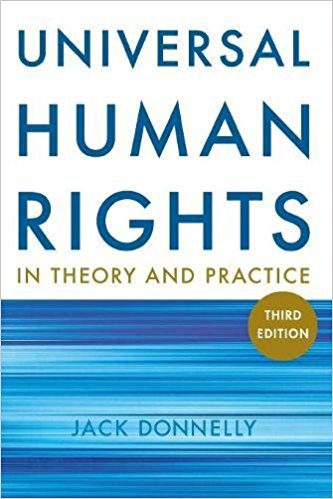 So why have I taken the time to sketch out the lack of inevitability in history in a post about human rights? The main reason is that human rights are also not inevitable. The open secret in the human rights movement is that the concept of human rights is not a transcendental ideal handed down from on high. Like the social construct of inalienable rights long enshrined in the Declaration of Independence—long an American ideal—human rights are a social construct. In the terminology of historian Yuval Harari, human rights are a “fiction.” They are a particularly great piece of fiction, but they are nonetheless something we humans made up. (Of course, another open secret is that all of ethics and morality are socially constructed, as evidenced by the ways societal mores shift over time and among various cultures.)
Here’s the way the political science professor Jack Donnelly puts it in his widely-regarded textbook on Human Rights (Cornell University Press, 2013):
Human rights ultimately rest on a social decision to act as if such “things” existed—and then, through social action directed by these rights, to make real the world that they envision. This does not make human rights “arbitrary,” in the sense that they rest on choices that might just as well have been random. Nor are they “merely conventional,” in roughly the way that driving on the left is required in Britain. Like all social practices, human rights come with, and in an important sense require, justifications. Those justifications, however, appeal to “foundations” that ultimately are a matter of agreement or assumption rather than proof. (22).
So, while there is no guarantee that human rights will be respected, there is immense value in advocating for a world order based on universal human rights.
And although human rights are not inevitable, the power of human rights lies in the fact that human rights are, by definition, inalienable. Nothing anyone can do can make anyone more or less worthy of their human rights (10). Note the word “alien” in the middle of the word “inalienable.” From the perspective of the Human rights movement, your human rights cannot be made “alien” from you; they cannot be separated from who we are are as human beings. They are universal, equal rights for all human beings—without exception. As with the UU First Principle (“the inherent worth and dignity of every person”), at the root of human rights is a belief and a deep value that all human beings—no matter who, no matter what—deserve “minimum conditions for a dignified life” (Donnelly 16).
At the risk of belaboring the point, I want to emphasize that this concept—this value (which may seem incredibly obvious to twenty-first century Western liberals)—has been far from accepted by most human beings who have lived. Historically, the prevailing view has much more frequently been that the ones granted and treated with dignity—the ones perceived as having intrinsic “worth”—were the elite, monied and powerful few: royalty, the aristocracy, those at the top of various political, social, or religious hierarchies (121). The rest of us—the huddled masses, the commoners, the hoi polloi—were more often perceived either paternalistically, “as objects to be provided for, passive recipients of benefits rather than a creative agents with rights to shape his or her life” (35)—or as sub-human fodder for cannons, cogs in the wheels of production, or merely obstacles to the agendas of the powers that be.
Too often, the implication was that we commoners (who lacked intrinsic worth and dignity) should be grateful for anything we received from those who had not only already stolen from us our birthrights to equitable opportunities, but also believed that they owed us nothing. (This worldview continues to underlie debates about whether our various social safety nets are really just “entitlements” exploited by “takers.”)
Indeed, scholars have shown that—although there are various limited precursors— our modern conception of universal, international human rights dates back only seventy years to the passage of the Universal Declaration of Human Rights in 1948, written in response to the horrors of World War II (75ff). Indeed it is helpful to remember that it was precisely the horrors, authoritarianism, and fascism of the Second World War—which so starkly demonstrated that there was no inevitable guarantee that basic human dignity would be respected—that motivated the passage of a Universal Declaration of Human Rights (Donnelly 170-171).
And I find it incredibly significant to be part of a religious movement that draws its First Principle directly from the opening of both the Preamble and the first article of the U.N.’s Universal Declaration of Human Rights. The Preamble reads that, “recognition of the inherent dignity and of the equal and inalienable rights of all members of the human family is the foundation of freedom, justice and peace in the world.” And the opening of Article I says, “All human beings are born free and equal in dignity and rights. They are endowed with reason and conscience and should act towards one another in a spirit of brotherhood.” Sounds pretty UU—or perhaps I should say that UUism sounds pretty “human rights-y.”
So in light of these ideas we have been tracing, how might we best pursue the high bar of the goal of world community with peace, liberty, and justice for all? One proposal is a Global New Deal with at least five main parts:
-
A global “Marshall Plan” (similar to the economic aid given to help rebuild European economies after World War II) that would include blanket forgiveness of all Third World Debt.
-
A tax on international financial transactions that would benefit the global South.
-
Abolition of offshore financial centers that offer tax havens for wealthy individuals and corporations.
-
Implementation of stringent global environmental agreements.
-
Implementation of a more equitable global development agenda. (Steger 118)
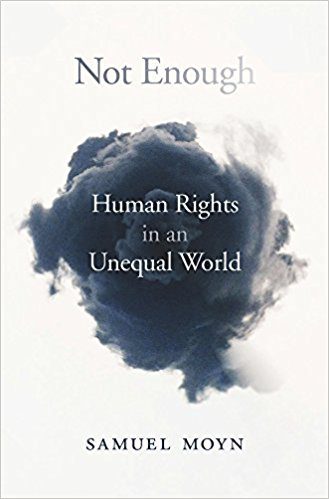
These are high standards. But if we are to have any hope of achieving our goal of “world community with peace, liberty, and justice for all,” I invite you to consider that it will require more than the bumper sticker slogan of “Think globally, act locally.” While acting locally will remain vital (“All politics is local!”), the goal of world community will require us not only to “think globally,” but also to “act globally.” For instance, this goal may require “Global Welfare,” paid for by a “Global Wealth Tax” (Moyn 219).
Along these lines, a Yale University professor of history and law recently published a compelling book titled Not Enough: Human Rights in an Unequal World (Harvard University Press, 2018). Although Moyn admires the “sturdy floor” of the human rights movement (seeking to carve out a basic minimum for everyone), he has come to view this goal as not enough: human rights are necessary, but not sufficient for building the world we dream about (xii).
Moyn highlights that, “Human rights, even perfectly realized human rights, are compatible with inequality, even radical inequality” (213). He challenges us to wrestle with the question of whether we can truly have a “world community with peace, liberty, and justice for all” if we also allow extreme income and wealth inequality. This is not to say that we need to have complete egalitarianism. Profit motive will likely remain a major factor in almost any successful version of world community. But he is saying that extreme inequality is arguably incompatible with “peace, liberty, and justice for all”—because extreme inequality of money and other resources puts too much power in the hands of too few.
Moyn’s argument is that we need, not only the sturdy floor of human rights to ensure a basic minimum of dignity for all, but also a ceiling at some point to protect against extreme inequality. He calls us to “save ourselves from our low ambitions”—to set our sights higher if we are ever to have any chance of building the world we dream about (220).
The Rev. Dr. Carl Gregg is a certified spiritual director, a D.Min. graduate of San Francisco Theological Seminary, and the minister of the Unitarian Universalist Congregation of Frederick, Maryland. Follow him on Facebook (facebook.com/carlgregg) and Twitter (@carlgregg).
Learn more about Unitarian Universalism: http://www.uua.org/beliefs/principles
Previous Post

April 12, 2018
Why You Should Watch "Come Sunday" on Netflix
Next Post
May 1, 2018 How Many Earths Would It Take For Everyone To Live Your Lifestyle?
Browse Our Archives
Select a Category Advent Anti-Racism Archaeology Atheism Baptism Best of the Year List Book Reviews Buddhism Catholicism Christian Education Church and State Church Planting Climate Change Conscientious Objection to War Creation Spirituality Death Penalty Didache Disability Rights Discernment Easter Ecology Emergent Church Movement Empire-Critical Ethics Evolution Feminist Theology Film Reviews Gandhi Gospel of Mark Gun Control Hinduism Immigration Reform Interfaith Islam JFK Judaism Jungian Spirituality Lectionary Commentary Lent Letters to the Editor LGBT Marriage MLK Multiculturalism Mysticism Nonviolent Activism Occupy Paganism (Earth-centered Religions) Parables Paul Pluralism Politics Process Theology Quantum Physics Requiescat In Pace Seminary and Divinity School Sermon Series Retrospective Sermons Spiritual Direction Spiritual Practices Stewardship (Fundraising) The Book of J The Wheel of the Year (Paganism) Theoblogger Challenge Triathlon Uncategorized Unitarian Universalism Worship Resources Youth Ministry
Select a Month July 2026 May 2026 March 2026 November 2025 October 2025 August 2025 February 2025 December 2024 October 2024 March 2024 January 2024 December 2023 November 2023 March 2023 February 2023 January 2023 December 2022 November 2022 August 2022 March 2022 February 2022 January 2022 December 2021 September 2021 August 2021 July 2021 June 2021 May 2021 February 2021 January 2021 December 2020 August 2020 June 2020 May 2020 April 2020 March 2020 February 2020 January 2020 December 2019 November 2019 October 2019 September 2019 July 2019 June 2019 March 2019 February 2019 January 2019 December 2018 November 2018 October 2018 September 2018 June 2018 May 2018 April 2018 March 2018 February 2018 January 2018 December 2017 November 2017 October 2017 September 2017 August 2017 July 2017 June 2017 May 2017 April 2017 March 2017 February 2017 January 2017 December 2016 November 2016 October 2016 September 2016 August 2016 June 2016 May 2016 April 2016 March 2016 February 2016 January 2016 December 2015 November 2015 October 2015 September 2015 August 2015 July 2015 June 2015 May 2015 April 2015 March 2015 February 2015 January 2015 December 2014 November 2014 October 2014 August 2014 July 2014 June 2014 May 2014 April 2014 March 2014 February 2014 January 2014 December 2013 November 2013 October 2013 September 2013 August 2013 July 2013 June 2013 May 2013 April 2013 March 2013 February 2013 January 2013 December 2012 November 2012 October 2012 September 2012 August 2012 July 2012 June 2012 May 2012 April 2012 March 2012 February 2012 January 2012 December 2011 November 2011 October 2011 September 2011 August 2011 July 2011 June 2011 May 2011 April 2011 March 2011 February 2011 January 2011 December 2010 November 2010 October 2010 August 2009 July 2009 May 2009
Follow Us!
TAKE THE
Religious Wisdom Quiz
How many days and nights did it rain during the flood?
Select your answer to see how you score.
7 12 10 40
Related posts from Carl Gregg

Reading America at 250: A Nation Wrestles With...


Andrew Holocek on the Power of Darkness

The Stories That Shape Us: Myths, Archetypes, &...
TRENDING AT PATHEOS More Voices

Reading America at 250: A Nation Wrestles With...
As part of my own reflection on the 250th anniversary of the...

Whenever I am reading a book or listening to an argument, I...

President Trump Ban Animal Torture Videos on Facebook
Call for Stricter Regulations of Animal Abuse Content on Facebook Although President...

Draft Amendments to Address Ritual Abuse in New...
The proposed changes would make it illegal for individuals in domestic partnerships...

How Bans on LGBTQ+ Student Clubs Threaten Religious...
On June 20, 2025, the State of Texas passed Senate Bill 12....

The Truth About the Gen Z Revival
This past year, there has been a lot of media buzz surrounding...
view all More Voices blogs
Ad-Free & Subscriber Log-In Subscription Support
- About Us
- 2026 Calendar
- Videos
- Podcasts
- Library of World Religions
- Faith In Media Tracker
- Advertise With Us
- Write for Us
- Privacy Policy
- Terms of Service
- Do Not Sell My Data
- Contact Us
- Radiant Digital
- Manage Newsletter Subscriptions
- Unsubscribe From Notifications
- Sitemap
Copyright 2008-2026, Patheos. All rights reserved.
Subscription Support Ad-Free & Subscriber Log-In
Follow Patheos