
BuddhistCatholicContemplativeEvangelicalGeneral ChristianHinduJewishLatter-day SaintMuslimNew VisionsProgressive Christian
Beliefs
- Buddhist
- Catholic
- Contemplative
- Evangelical
- General Christian
- Hindu
- Jewish
- Latter-day Saint
- More Voices
- Muslim
- New Visions
- Pagan
- Progressive Christian
Topics
- Religion News
- Food and Religion
- Sports and Religion
- Religious Art
- Religious Music and Entertainment
- Religious Events
- History and Religion
- Style and Religion
- Politics and Religion
- Women in Religion
- Recreation Outdoors and Religion
- Business Finance and Religion
- Careers Workplace and Religion
- Education and Religion
- Family Parenting and Religion
- Health Fitness and Religion
- Home and Religion
- Relationships and Religion
- Technology and Religion
- Travel and Religion
Columnists
- Buddhist Columnists
- Business Finance and Religion Columnists
- Careers Workplace and Religion Columnists
- Catholic Columnists
- Contemplative Columnists
- Education and Religion Columnists
- Evangelists Columnists
- Family Parenting and Religion Columnists
- General Christian Columnists
- Health Fitness and Religion Columnists
- Hindu Columnists
- History and Religion Columnists
- Home and Religion Columnists
- Jewish Columnists
- More Voices Columnists
- Latter Day Columnists
- Muslim Columnists
- New Visions Columnists
- Nonreligious Columnists
- Pagan Columnists
- Politics and Religion Columnists
- Progressive Columnists
- Recreation Outdoors and Religion Columnists
- Relationships and Religion Columnists
- Religion News Columnists
- Religious Art Columnists
- Religious Events Columnists
- Religious Music and Entertainment Columnists
- Sports and Religion Columnists
- Style and Religion Columnists
- Technology and Religion Columnists
- Travel and Religion Columnists
- Women in Religion Columnists
Resource Library
- 2026 Calendar
- Library of World Religions
- The 100 Most Holy Places on Earth
- Patheos Answers
- Podcasts
- Videos
- Faith Leaders Database
- Anglican Episcopalian
- Bahai
- Baptist
- Buddhism
- Christianity
- Confucianism
- Eastern Orthodoxy
- Hinduism
- Holiness and Pentecostal
- ISKCON
- Islam
- Judaism
- Lutheran
- Methodist
- The Church of Jesus Christ of Latter-day Saints
- New Age
- Paganism
- Presbytarian and Reformed
- Protestantism
- Religion Behind the Scenes
- Roman Catholic
- Scientology
- Shia Islam
- Sikhism
- Sufism
- Sunni Islam
- Taoism
- Zen
- See all religions
Research Tools
 Ad-Free & Subscriber Log-In Subscription Support
Ad-Free & Subscriber Log-In Subscription Support
Follow Patheos 

- Trending:
- Forgiveness
- |
- Marriage
- |
- Consciousness
- |
- Death Penalty
- |
- Election
- |
- Halloween

- Home
- More Voices
- Is Your Job Predictable? Immigrants Aren’t Coming for Your Job, *Robots* Are
Is Your Job Predictable? Immigrants Aren’t Coming for Your Job, *Robots* Are
Last updated on: March 29, 2018 at 10:06 am by Carl Gregg
Is Your Job Predictable? Immigrants Aren’t Coming for Your Job, *Robots* Are 2018-03-29T10:06:10-04:00 Carl Gregg
Patheos Explore the world's faith through different perspectives on religion and spirituality! Patheos has the views of the prevalent religions and spiritualities of the world.
There is a lot of xenophobic fearmongering these days about immigration. But as the saying goes, “Immigrants aren’t coming for your jobs, robots are.” Robots, equipped with increasingly sophisticated Artificial Intelligence, are rapidly becoming competent in a widening array of fields.
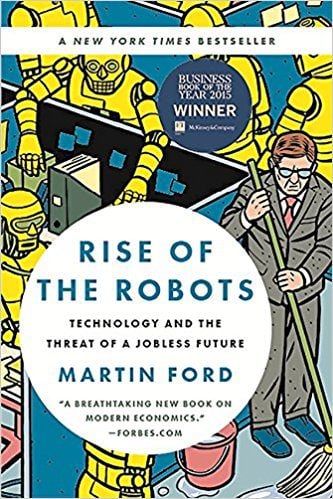 Martin Ford, in his important book Rise of the Robots: Technology and the Threat of a Jobless Future (2015), invites his readers to reflect on a thought experiment in which robots of the near future are reimagined as an alien invasion. Unlike in the movies, these robot aliens “have not come to conquer us, or to extract our resources, or even to meet our leader. The aliens, it turns out, have come to work.” And not only do they want to work, they are also good at it. Each of these alien robots are “highly intelligent and capable of learning language, solving problems, and even exhibiting creativity.” And once they master a skill, they work tirelessly, need little repairs or time-off, and can be replicated at increasingly cheap rates (194-196).
If robots do eventually take over most—or essentially all—of the jobs currently done by humans, then what are we humans going to do for money? One option is some sort of government-sponsored “jobs program” in which jobs that robots could do much more cheaply and efficiently are instead reserved for humans. This possibility was famously skewered in the 1960s by the late Milton Friedman (1912-2006), a Nobel Prize-winning economist who has been called the “second-most popular economist of the twentieth century.” (If you’re curious, number one was John Maynard Keynes.”):
While consulting with the government of a developing Asian nation, Friedman was taken to a large-scale public works project, where he was surprised to see large numbers of workers wielding shovels, but very few bulldozers, tractors, or other heavy earth-moving equipment…. Friedman asked, “So then, why not give the workers spoons instead of shovels?” (ix)
After all, spoons are also a technology that makes work less labor-intensive for humans. If the only reason to not use a bulldozer is a belief that workers must do some sort of labor to give their lives meaning and justify paying them, why not just let them use their hands? For that matter, why not make them “do the Hokey-Pokey and turn themselves around” for eight hours before punching the clock, if a robot can come in behind them and do their job many times faster?
The economy is more complicated than that, of course. As we heard at the end of the spoken meditation, “A worker is also a consumer…. When a worker is replaced by a machine, that machine does not go out and consume.” So if machines take all our jobs, who is going to have enough spare wages or wealth to buy stuff to power the economy? One response worth considering could be to restructure our economy. As the saying goes, “Never let a crisis go to waste.” A crisis can be an opportunity to do things differently (xviii).
And history tells us that similar crises have happened in the pas, although these crises certainly not always resulted in more equitable job access for all:
The mechanization of agriculture vaporized millions of jobs and drove crowds of unemployed farmhands into cities in search of factory work. Later, automation and globalization pushed workers out of the manufacturing sector and into new service jobs…. What’s more, those new jobs were often better than earlier counterparts, requiring upgraded skills and offering better wages. (ix-x)
Describing jobs as “better” is admittedly a subjective evaluation, and there were also many workers displaced and sometimes unable to access one of these new jobs. In light of this history, we need to have a serious reckoning about how hard we should fight to protect the jobs that robots might take away. Would more leisure time be so terrible? To quote another economist, this time the late John Kenneth Galbraith (1908 – 2006): “Leisure is a peculiar thing. Leisure is [often seen as] very good for the rich, quite good for Harvard professors—and very bad for the poor” (48).
As to how much any one of us should be concerned about the “rise of the robots,” there was an article in The New York Times earlier this month that summed up the current situation: “Most Americans See Artificial Intelligence as a Threat to Jobs (Just Not Theirs).” So—almost all of us continue to regularly use early stage Artificial Intelligence devices (navigation apps, streaming services, smartphone personal assistances, and other smart home devices) that are collecting all the data about human behavior that will make the next generation of AI possible. And the possibilities keep growing—or should I say metastasizing?!—exponentially from there.
Indeed, Kevin Kelly (1952-), the founding Executive Editor of Wired magazine, has outlined the Seven Stages of Denial related to having your job replaced by a robot. A little time passes between each stage, during which the robot’s AI rapidly improves its performance capabilities:
-
A robot/computer cannot possibly do the tasks I do. [Time passes]
-
OK, it can do a lot of those tasks, but it can’t do everything I do. [Time passes]
-
Ok, it can do everything I do, except it needs me when it breaks down, which is often. [Time passes]
-
OK, it operates flawlessly on routine stuff, but I need to train it for new tasks. [Time passes]
-
OK, Ok, it can have my old boring job, because it’s obvious that was not a job that humans were meant to do. [Time passes]
-
Wow, now that robots are doing my old job, my new job is much more interesting and pays more! [Time passes]
-
I am so glad a robot/computer cannot possibility do what I do now. (59-60)
At this point you’ve slipped into denial again, so go back to stage one and repeat until enough time passes that a robot can now do your new job too!
One of the biggest misconceptions is that robots are only coming for so-called “blue collar” jobs. But it is not only “routine” and “repetitive” jobs that are in the crosshairs of AI-empowered robots. Increasingly sophisticated algorithms have shown us that the key word for determining whether your job is under threat is whether it is predictable:
Could another person learn to do your job by studying a detailed record of everything you’ve done in the past? Or could someone become proficient by repeating the tasks you’ve already completed, in the way that a student might take a practice test to prepare for an exam? (xiv-xv)
To put myself in the spotlight, what ministerial algorithms might be created by constantly surveilling what all the religious professionals across the world are doing? I suspect we ministers might someday find ourselves among those people experiencing the Seven Stages of Denial about being replaced by a robot.
To give a more high-end example of what I’m talking about, radiologists (physicians who specialize in the interpretation of medical images) are among the highest paid doctors, with an average annual salary of around $340,000. Today, to become a radiologist requires approximately thirteen years of training beyond high school; but each year, computers are getting better at analyzing images. I can already see the appeal of getting a second opinion from a computer that has in its memory bank every interpretation every previous radiologist has ever made.” And the day is likely coming soon when we have only robot radiologists (xv).
The day is also likely coming soon when you will enter a fast food restaurant that is almost 100% automated. You will enter you order through an interface and your food will be prepared precisely to your specifications by a robot. A few years ago, for instance, a company named Momentum Machines designed a machine “capable of producing about 360 hamburgers per hour, that also toasts the bun and then slices and adds fresh ingredients like tomatoes, onion, and pickles only after the order is placed” (12). The company estimates that their machine will pay for itself in less than a year based on not having to pay for human labor (13). There may well not even be a human manager physically present. Rather, there may be a centralized facility remotely monitoring the individual restaurants (15). Heck, it may be that you skip going to the restaurant altogether, order through a smartphone app, and have a drone deliver the food to wherever you are.
To give a few more examples, StatsMonkey is a program being developed to “automate sports reporting by transforming objective data about a particular game into a compelling narrative” (84). Even more shocking are the advances that machines are making in composing music that is emotionally moving to humans—based on inputting data on the history of music and the human response to it. Dishearteningly to we mere mortals, these complex pieces of music take machines mere minutes to compose (111). Similar software is being developed to allow machines to generate new works of art. Using a “database of paintings that had been labeled by humans with adjectives like ‘dark,’ ‘sad,’ or ‘inspiring,’ the software can itself discern “whether or not it is achieving its objectives as it paints” (112-113).
I will continue this topic tomorrow in a post on “Is Artificial Intelligence ‘Progress’ or Programming Human Obsolesce?“
The Rev. Dr. Carl Gregg is a certified spiritual director, a D.Min. graduate of San Francisco Theological Seminary, and the minister of the Unitarian Universalist Congregation of Frederick, Maryland. Follow him on Facebook (facebook.com/carlgregg) and Twitter (@carlgregg).
Learn more about Unitarian Universalism: http://www.uua.org/beliefs/principles
Next Post

March 29, 2018 Is Artificial Intelligence “Progress” or Programming Human Obsolesce?
Browse Our Archives
Select a Category Advent Anti-Racism Archaeology Atheism Baptism Best of the Year List Book Reviews Buddhism Catholicism Christian Education Church and State Church Planting Climate Change Conscientious Objection to War Creation Spirituality Death Penalty Didache Disability Rights Discernment Easter Ecology Emergent Church Movement Empire-Critical Ethics Evolution Feminist Theology Film Reviews Gandhi Gospel of Mark Gun Control Hinduism Immigration Reform Interfaith Islam JFK Judaism Jungian Spirituality Lectionary Commentary Lent Letters to the Editor LGBT Marriage MLK Multiculturalism Mysticism Nonviolent Activism Occupy Paganism (Earth-centered Religions) Parables Paul Pluralism Politics Process Theology Quantum Physics Requiescat In Pace Seminary and Divinity School Sermon Series Retrospective Sermons Spiritual Direction Spiritual Practices Stewardship (Fundraising) The Book of J The Wheel of the Year (Paganism) Theoblogger Challenge Triathlon Uncategorized Unitarian Universalism Worship Resources Youth Ministry
Select a Month July 2026 May 2026 March 2026 November 2025 October 2025 August 2025 February 2025 December 2024 October 2024 March 2024 January 2024 December 2023 November 2023 March 2023 February 2023 January 2023 December 2022 November 2022 August 2022 March 2022 February 2022 January 2022 December 2021 September 2021 August 2021 July 2021 June 2021 May 2021 February 2021 January 2021 December 2020 August 2020 June 2020 May 2020 April 2020 March 2020 February 2020 January 2020 December 2019 November 2019 October 2019 September 2019 July 2019 June 2019 March 2019 February 2019 January 2019 December 2018 November 2018 October 2018 September 2018 June 2018 May 2018 April 2018 March 2018 February 2018 January 2018 December 2017 November 2017 October 2017 September 2017 August 2017 July 2017 June 2017 May 2017 April 2017 March 2017 February 2017 January 2017 December 2016 November 2016 October 2016 September 2016 August 2016 June 2016 May 2016 April 2016 March 2016 February 2016 January 2016 December 2015 November 2015 October 2015 September 2015 August 2015 July 2015 June 2015 May 2015 April 2015 March 2015 February 2015 January 2015 December 2014 November 2014 October 2014 August 2014 July 2014 June 2014 May 2014 April 2014 March 2014 February 2014 January 2014 December 2013 November 2013 October 2013 September 2013 August 2013 July 2013 June 2013 May 2013 April 2013 March 2013 February 2013 January 2013 December 2012 November 2012 October 2012 September 2012 August 2012 July 2012 June 2012 May 2012 April 2012 March 2012 February 2012 January 2012 December 2011 November 2011 October 2011 September 2011 August 2011 July 2011 June 2011 May 2011 April 2011 March 2011 February 2011 January 2011 December 2010 November 2010 October 2010 August 2009 July 2009 May 2009
Follow Us!
TAKE THE
Religious Wisdom Quiz
How many men did Gideon keep from the 32,000?
Select your answer to see how you score.
500 200 400 300
Related posts from Carl Gregg

Reading America at 250: A Nation Wrestles With...


Andrew Holocek on the Power of Darkness

The Stories That Shape Us: Myths, Archetypes, &...
TRENDING AT PATHEOS More Voices

Reading America at 250: A Nation Wrestles With...
As part of my own reflection on the 250th anniversary of the...

Whenever I am reading a book or listening to an argument, I...

President Trump Ban Animal Torture Videos on Facebook
Call for Stricter Regulations of Animal Abuse Content on Facebook Although President...

Draft Amendments to Address Ritual Abuse in New...
The proposed changes would make it illegal for individuals in domestic partnerships...

How Bans on LGBTQ+ Student Clubs Threaten Religious...
On June 20, 2025, the State of Texas passed Senate Bill 12....

The Truth About the Gen Z Revival
This past year, there has been a lot of media buzz surrounding...
view all More Voices blogs
Ad-Free & Subscriber Log-In Subscription Support
- About Us
- 2026 Calendar
- Videos
- Podcasts
- Library of World Religions
- Faith In Media Tracker
- Advertise With Us
- Write for Us
- Privacy Policy
- Terms of Service
- Do Not Sell My Data
- Contact Us
- Radiant Digital
- Manage Newsletter Subscriptions
- Unsubscribe From Notifications
- Sitemap
Copyright 2008-2026, Patheos. All rights reserved.
Subscription Support Ad-Free & Subscriber Log-In
Follow Patheos