
BuddhistCatholicContemplativeEvangelicalGeneral ChristianHinduJewishLatter-day SaintMuslimNew VisionsProgressive Christian
Beliefs
- Buddhist
- Catholic
- Contemplative
- Evangelical
- General Christian
- Hindu
- Jewish
- Latter-day Saint
- More Voices
- Muslim
- New Visions
- Pagan
- Progressive Christian
Topics
- Religion News
- Food and Religion
- Sports and Religion
- Religious Art
- Religious Music and Entertainment
- Religious Events
- History and Religion
- Style and Religion
- Politics and Religion
- Women in Religion
- Recreation Outdoors and Religion
- Business Finance and Religion
- Careers Workplace and Religion
- Education and Religion
- Family Parenting and Religion
- Health Fitness and Religion
- Home and Religion
- Relationships and Religion
- Technology and Religion
- Travel and Religion
Columnists
- Buddhist Columnists
- Business Finance and Religion Columnists
- Careers Workplace and Religion Columnists
- Catholic Columnists
- Contemplative Columnists
- Education and Religion Columnists
- Evangelists Columnists
- Family Parenting and Religion Columnists
- General Christian Columnists
- Health Fitness and Religion Columnists
- Hindu Columnists
- History and Religion Columnists
- Home and Religion Columnists
- Jewish Columnists
- More Voices Columnists
- Latter Day Columnists
- Muslim Columnists
- New Visions Columnists
- Nonreligious Columnists
- Pagan Columnists
- Politics and Religion Columnists
- Progressive Columnists
- Recreation Outdoors and Religion Columnists
- Relationships and Religion Columnists
- Religion News Columnists
- Religious Art Columnists
- Religious Events Columnists
- Religious Music and Entertainment Columnists
- Sports and Religion Columnists
- Style and Religion Columnists
- Technology and Religion Columnists
- Travel and Religion Columnists
- Women in Religion Columnists
Resource Library
- 2026 Calendar
- Library of World Religions
- The 100 Most Holy Places on Earth
- Patheos Answers
- Podcasts
- Videos
- Faith Leaders Database
- Anglican Episcopalian
- Bahai
- Baptist
- Buddhism
- Christianity
- Confucianism
- Eastern Orthodoxy
- Hinduism
- Holiness and Pentecostal
- ISKCON
- Islam
- Judaism
- Lutheran
- Methodist
- The Church of Jesus Christ of Latter-day Saints
- New Age
- Paganism
- Presbytarian and Reformed
- Protestantism
- Religion Behind the Scenes
- Roman Catholic
- Scientology
- Shia Islam
- Sikhism
- Sufism
- Sunni Islam
- Taoism
- Zen
- See all religions
Research Tools
 Ad-Free & Subscriber Log-In Subscription Support
Ad-Free & Subscriber Log-In Subscription Support
Follow Patheos 

- Trending:
- Forgiveness
- |
- Marriage
- |
- Consciousness
- |
- Death Penalty
- |
- Election
- |
- Halloween

- Home
- More Voices
- “The Price of Monotheism”
“The Price of Monotheism”
Last updated on: February 1, 2018 at 2:43 pm by Carl Gregg
“The Price of Monotheism” 2018-02-01T14:43:40-05:00 Carl Gregg
Patheos Explore the world's faith through different perspectives on religion and spirituality! Patheos has the views of the prevalent religions and spiritualities of the world.
A few weeks ago, my wife and I heard a knock on our door around 8 p.m. At that time of night—and given the extremely cold weather—I assumed that the only person who could possibly be outside was someone delivering a package. I was wrong. As I opened the door, I was greeted by two people interested in sharing their religion with me. (It doesn’t matter which flavor of religion. There are actually a few different possibilities it could be—all of which have knocked on my door at various points in the past. And it seems fair to me that if you knock on my door relatively late in the evening, you might end up as a blog post illustration.)
I will readily grant that I was impressed with their level of commitment. They were persevering through below freezing temperatures. But I will also confess that part of me wanted to say: “You have no idea whose door you are knocking on.” However, because I was much more interested in watching television with my wife that evening than having a theological debate, what I said was a polite but firm, “No thank you. We’re not interested.”
Now, on one hand, there was no way these intrepid young evangelists could have known that they were knocking on the door of a religious professional who has been engaged in a serious academic study of religion for longer than—as far as I could tell—either of them had been alive. (Since I’m turning forty this year, I now get to say things like that, right?! You kids get off my lawn!) There is, of course, no exterior sign on our house to warn would-be proselytizers, “Beware: a Unitarian Universalist Minister lives here! Theological debate is unlikely to go well for you.” On the other hand, there is a fairly well-known symbol outside my house that conveys, “We are a Jewish household.” As many of you know, my wife is Jewish.
Attached to the front doorway of our home is a fairly prominent mezuzah. It’s approximately six inches long, colorful, and difficult to miss. Mezuzah means “doorpost” in Hebrew, and it is a decorative case that holds a parchment on which two specific verses from the Torah are written. (Deuteronomy 6:4-9 and 11:13-21 if you are curious.) If you are Jewish, it is a mitzvah (“commandment”) to hang a mezuzah, and you may have noticed them outside many Jewish homes.
It is sadly unsurprising—despite this clear marker of Jewish identity and the history of oppression from various groups trying to convert Jews—that someone would nevertheless brazenly knock on our door with an intention of religious conversion. Presumably the assumption was that—mezuzah or not— there could still be a slim chance that one or more people in this household might want to hear about someone else’s religion at 8 p.m. on a weeknight. (They were wrong. There was no chance.)
All that being said, I don’t want to unduly bag on religions who have what scholars call a “missionary impulse” without turning the mirror on my own tradition at least a little. After all, there’s the old joke that “What do you get when you cross a missionary with a Unitarian Universalist? Someone who goes around knocking on doors for no particular reason.”
Of course, the truth is we UUs do sometimes evangelize. I certainly encourage members of the congregation I serve to invite your friends, family members, and colleagues who might find this religious community to be good news. And although we are sometimes more skilled at asking questions than having answers, we also have a life-saving, transformational message which includes our deep experience with joining together across differences to build a world with peace, liberty, and justice for all.
And when you compare progressive religious movements (like Unitarian Universalism) to more theologically orthodox traditions (most of which have a stronger missionary impulse), one of the distinctions you find is that religious progressives tend to lean toward persuasion instead of coercion. We tend to be open-handedly invitational. If someone finds this congregation to be supportive of their journey during this season of their lives, we celebrate that. If we are not the right fit for you, for any confluence of reasons (either now or in the future), we wish you well. We are a big tent that seeks to be many things to many people, but we are also clear that it is impossible to be “all things to all people.”
We believe that, “You don’t have to believe alike to love alike,” and we aren’t going to threaten you with eternal damnation if you disagree with us—especially since as Universalists, we don’t believe in hell. (As Unitarian Universalists, it’s one of our major things.) But I also understand that most religions with a strong missionary impulse authentically believe that eternal souls are at stake. So they do think they are acting in our best interest, even if it feels paternalistic, judgmental, and imperialistic on the receiving end.
So why bring any of this up? Well, this post is my annual invitation for us to spend a little time reflecting on religion as such. What is this thing called religion? The truth is that it’s hard to say: religion is notoriously difficult to define.
Although there is no simple, uncontested definition of religion, the following is my “Top Five Best Definitions of Religion” list that I have collected over the years:
From a traditional Western perspective, religion can be defined as a: “culturally patterned interaction with culturally postulated superhuman beings” (Melford Spiro).
More generically, religion can be defined as: **“An experience of the holy”—**that is, an encounter “set apart” from the ordinary and mundane (E. B. Tylor)
Another definition that focuses on experience is “mysterium tremendum et fascinans”—religion is about a mystery that is simultaneously terrifying and fascinating, compelling yet repelling (Rudolf Otto). One related metaphor to our UU symbol of the flaming chalice is that religion is like “playing with fire”: it can be an alluring and warm place to gather with friends, but it can also be used to scare—or even literally burn—you and others.
One of my favorite definitions is that something is religious if it is our “ultimate concern” (Paul Tillich).
The definition from one of my favorite religion scholars is that religion is “humanity’s millennia-long encounter and struggle with the anomalous, the powerful, the really, really weird stuff that does not fit in, that does not make sense” (Jeffrey Kripal).
To add in a few more major definitions of religion from a skeptical perspective, religion has been defined as an illness (Freud), a narcotic (Marx), a weakness (Nietzsche), and a projection (Feuerbach) (Tweed 3, 51).
Looking deeper into the word “religion” itself, the most popular etymology of “religion” is that it derives from the Latin word religare (related to the English word ligament), such that religion means “to bind together.” I appreciate the ways this definition points to how religious rituals and spiritual practices can bind us together both internally and as a community.
 The case has also been made that a more correct etymology of “religion” is derived the Latin word religere (“to be careful, mindful”) in the sense of reading the morning newspaper “religiously.” And there is a strong argument that this latter sense more accurately characterizes religion in the ancient world, which often tended to center on a “careful performance of ritual obligation.” In contrast, the modern, Western sense of the word religion is often about “intellectual assent” to certain beliefs or an “inner sentiment” of faith (McCutcheon 109).
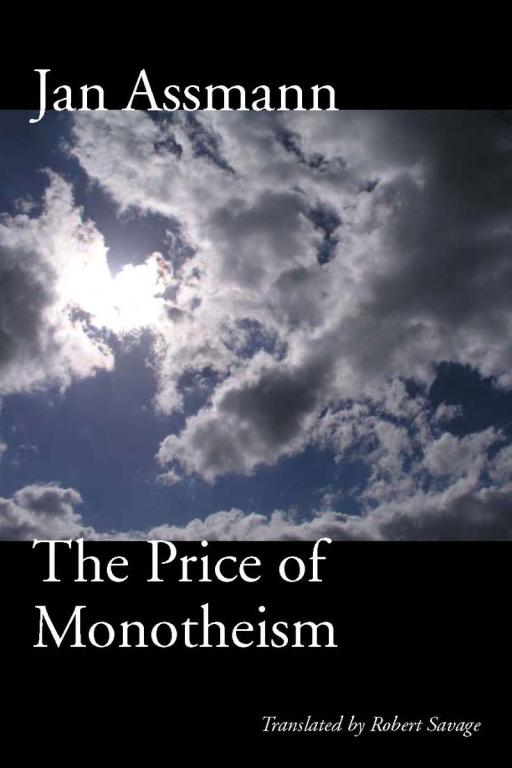
And it is this distinction between the ancient and modern understandings of religion which I would like to invite us to reflect on in particular. One helpful guide is the German Egyptologist Jan Assmann (1938 – ), who is perhaps best known for a book about The Memory of Egypt in Western Monotheism, published more than two decades ago with Harvard University Press. If you are interested in going deeper, however, a much more helpful starting point is his more recent book The Price of Monotheism (Stanford University Press, 2010).
Dr. Assmann’s perspective emerged from decades of living as a citizen of the modern world, with its bias, especially typical in the West, of religion as being about “intellectual belief”—even while spending his career studying ancient Egypt with its very different bias toward religion as being about “careful performance of ritual obligation”. Living in that tension, he became aware of a gradual shift in the historical patterns of religions:
Ancient “Cult Religion”
Modern “World Religions”
Polytheistic (“many gods”)
Monotheistic (“Only One True God”)
Limited by culture & language
Universal to all times & places
Correct ritual observances
Correct belief (or inner sentiment)
Oral tradition
Written scriptures
Along these lines, some of you will recall that last week I posted about the psychoanalyst Carl Jung’s idea of the “shadow”: the repressed, unconscious parts of ourselves which nonetheless still affect us. The shadow functions not only in individuals, but also in communities, systems, cultures. And when Assmann talks about “The Memory of Egypt in Western Monotheism,” he is talking about a repressed shadow (119). Specifically, Assmann notes that most monotheistic traditions perceive themselves to be the “One Right Way”—and all alternatives as wrong—or at most, false deviations from their One Universal Truth. Accordingly, most monotheistic traditions do not typically think of themselves as a “secondary religion” or a “counter religion” that developed in response to the polytheistic traditions that preceded them. But from a historical perspective, that it precisely what happened (112).
To share with you a little more of my own story, I was raised in a theologically conservative Christian congregation. And there is still a lot from the Christian tradition (including much of the wisdom teachings and ethics) that I still value deeply—just not the theologically orthodox part. I bring that background up because, although I do not have anything like the expertise in Egyptology that Dr. Assmann has, during my junior year in college, I did have the opportunity to visit Cairo. At that point, I had spent the two previous years trying to reconcile the conservative theology of my childhood with the new academic insights I was learning as a religion and philosophy double major. One of my particular interests was the study of the historical Jesus: trying to discover who he really was, and what actually happened during his life.
But standing in front of the Great Pyramids at Giza, the oldest of the Seven Wonders of the Ancient World—built a full two millennia prior to the life of the historical Jesus—my interest in the Jesus of Nazareth (although still with me even today) was suddenly and profoundly relativized. Funnily enough, as I sat down in the desert sands and took in this mind-blowing Wonder of the Ancient World, the song lyric that popped into my head was from a Sarah McLachlan album released two years earlier, about a man wearing “a cross from a faith that died before Jesus came.” The song is describing an ankh, which looks like a plain Protestant Christian cross, except there is a loop or handle at the top. In the language of Egyptian hieroglyphics, the ankh symbolizes “eternal life.”
For Assmann, the most significant aspect of the shift he traces in the history of religions is the move from the ancient world of “non-exclusive religions” to the increasing predominance of “exclusive religions” (3). Of course, ancient “non-exclusive religions” also made truth claims, but they were truth claims made within the context of tribal cults and limited to a particular language and culture. These truth claims were distinct from modern truth claims which are often made in a cross-cultural sense that implies conclusive and exclusive authority applicable to all persons, in all times and places.
Another crucial point for Assmann is that these ancient religions were polytheistic (3). And echoing the insights of the philosopher David Hume (1711 – 1776) more than two centuries ago, **polytheism is both “far older than monotheism” and tends toward tolerance—whereas monotheism tends toward intolerance. And it is this intolerance that Assmann suggests is “the price of monotheism.” Because polytheism has many gods, there is a built-in tendency toward tolerance—at least internally within local cultures (14). In a polytheistic culture, you can have an altar in your house to your family’s favorite god within the pantheon, and I can have an altar in my house to my family’s favorite god or goddess—and it is no problem for either of us. But traditional monotheism tends to declare alternative views to be problematic, heretical, and unacceptable. Allow me to be clear that neither I nor Assmann are attempting an undue broadside against all forms of monotheism. A crucial distinction is whether one is monotheist in the spirit of “This is what I think is true, but you are free to disagree with me” as opposed to “I have the only truth, and it is imperative to use all means necessary—including violence—to force as many people as possible to conform to my belief system.”
Part of Assmann’s hope is that highlighting our species’s ancient heritage of polytheism might be helpful for us in navigating the globalized, pluralistic, postmodern world in which we find ourselves. Although we do increasingly live in isolated news bubbles in which we often see only views that reinforce our own pre-existing prejudices, our world remains both deeply diverse and inextricably interconnected. To quote Dr. King: “We must either learn to live together as brothers [and sisters], or we are all going to perish together as fools.”
The Rev. Dr. Carl Gregg is a certified spiritual director, a D.Min. graduate of San Francisco Theological Seminary, and the minister of the Unitarian Universalist Congregation of Frederick, Maryland. Follow him on Facebook (facebook.com/carlgregg) and Twitter (@carlgregg).
Learn more about Unitarian Universalism: http://www.uua.org/beliefs/principles
Next Post

January 31, 2018 “The Dharma of 'The Princess Bride'”
Browse Our Archives
Select a Category Advent Anti-Racism Archaeology Atheism Baptism Best of the Year List Book Reviews Buddhism Catholicism Christian Education Church and State Church Planting Climate Change Conscientious Objection to War Creation Spirituality Death Penalty Didache Disability Rights Discernment Easter Ecology Emergent Church Movement Empire-Critical Ethics Evolution Feminist Theology Film Reviews Gandhi Gospel of Mark Gun Control Hinduism Immigration Reform Interfaith Islam JFK Judaism Jungian Spirituality Lectionary Commentary Lent Letters to the Editor LGBT Marriage MLK Multiculturalism Mysticism Nonviolent Activism Occupy Paganism (Earth-centered Religions) Parables Paul Pluralism Politics Process Theology Quantum Physics Requiescat In Pace Seminary and Divinity School Sermon Series Retrospective Sermons Spiritual Direction Spiritual Practices Stewardship (Fundraising) The Book of J The Wheel of the Year (Paganism) Theoblogger Challenge Triathlon Uncategorized Unitarian Universalism Worship Resources Youth Ministry
Select a Month July 2026 May 2026 March 2026 November 2025 October 2025 August 2025 February 2025 December 2024 October 2024 March 2024 January 2024 December 2023 November 2023 March 2023 February 2023 January 2023 December 2022 November 2022 August 2022 March 2022 February 2022 January 2022 December 2021 September 2021 August 2021 July 2021 June 2021 May 2021 February 2021 January 2021 December 2020 August 2020 June 2020 May 2020 April 2020 March 2020 February 2020 January 2020 December 2019 November 2019 October 2019 September 2019 July 2019 June 2019 March 2019 February 2019 January 2019 December 2018 November 2018 October 2018 September 2018 June 2018 May 2018 April 2018 March 2018 February 2018 January 2018 December 2017 November 2017 October 2017 September 2017 August 2017 July 2017 June 2017 May 2017 April 2017 March 2017 February 2017 January 2017 December 2016 November 2016 October 2016 September 2016 August 2016 June 2016 May 2016 April 2016 March 2016 February 2016 January 2016 December 2015 November 2015 October 2015 September 2015 August 2015 July 2015 June 2015 May 2015 April 2015 March 2015 February 2015 January 2015 December 2014 November 2014 October 2014 August 2014 July 2014 June 2014 May 2014 April 2014 March 2014 February 2014 January 2014 December 2013 November 2013 October 2013 September 2013 August 2013 July 2013 June 2013 May 2013 April 2013 March 2013 February 2013 January 2013 December 2012 November 2012 October 2012 September 2012 August 2012 July 2012 June 2012 May 2012 April 2012 March 2012 February 2012 January 2012 December 2011 November 2011 October 2011 September 2011 August 2011 July 2011 June 2011 May 2011 April 2011 March 2011 February 2011 January 2011 December 2010 November 2010 October 2010 August 2009 July 2009 May 2009
Follow Us!
TAKE THE
Religious Wisdom Quiz
The light shines in the darkness, and the darkness has not ____ it.
Select your answer to see how you score.
Accepted Comprehended Extinguished Understood
Related posts from Carl Gregg

Reading America at 250: A Nation Wrestles With...


Andrew Holocek on the Power of Darkness

The Stories That Shape Us: Myths, Archetypes, &...
TRENDING AT PATHEOS More Voices

Reading America at 250: A Nation Wrestles With...
As part of my own reflection on the 250th anniversary of the...

Whenever I am reading a book or listening to an argument, I...

President Trump Ban Animal Torture Videos on Facebook
Call for Stricter Regulations of Animal Abuse Content on Facebook Although President...

Draft Amendments to Address Ritual Abuse in New...
The proposed changes would make it illegal for individuals in domestic partnerships...

How Bans on LGBTQ+ Student Clubs Threaten Religious...
On June 20, 2025, the State of Texas passed Senate Bill 12....

The Truth About the Gen Z Revival
This past year, there has been a lot of media buzz surrounding...
view all More Voices blogs
Ad-Free & Subscriber Log-In Subscription Support
- About Us
- 2026 Calendar
- Videos
- Podcasts
- Library of World Religions
- Faith In Media Tracker
- Advertise With Us
- Write for Us
- Privacy Policy
- Terms of Service
- Do Not Sell My Data
- Contact Us
- Radiant Digital
- Manage Newsletter Subscriptions
- Unsubscribe From Notifications
- Sitemap
Copyright 2008-2026, Patheos. All rights reserved.
Subscription Support Ad-Free & Subscriber Log-In
Follow Patheos