
BuddhistCatholicContemplativeEvangelicalGeneral ChristianHinduJewishLatter-day SaintMuslimNew VisionsProgressive Christian
Beliefs
- Buddhist
- Catholic
- Contemplative
- Evangelical
- General Christian
- Hindu
- Jewish
- Latter-day Saint
- More Voices
- Muslim
- New Visions
- Pagan
- Progressive Christian
Topics
- Religion News
- Food and Religion
- Sports and Religion
- Religious Art
- Religious Music and Entertainment
- Religious Events
- History and Religion
- Style and Religion
- Politics and Religion
- Women in Religion
- Recreation Outdoors and Religion
- Business Finance and Religion
- Careers Workplace and Religion
- Education and Religion
- Family Parenting and Religion
- Health Fitness and Religion
- Home and Religion
- Relationships and Religion
- Technology and Religion
- Travel and Religion
Columnists
- Buddhist Columnists
- Business Finance and Religion Columnists
- Careers Workplace and Religion Columnists
- Catholic Columnists
- Contemplative Columnists
- Education and Religion Columnists
- Evangelists Columnists
- Family Parenting and Religion Columnists
- General Christian Columnists
- Health Fitness and Religion Columnists
- Hindu Columnists
- History and Religion Columnists
- Home and Religion Columnists
- Jewish Columnists
- More Voices Columnists
- Latter Day Columnists
- Muslim Columnists
- New Visions Columnists
- Nonreligious Columnists
- Pagan Columnists
- Politics and Religion Columnists
- Progressive Columnists
- Recreation Outdoors and Religion Columnists
- Relationships and Religion Columnists
- Religion News Columnists
- Religious Art Columnists
- Religious Events Columnists
- Religious Music and Entertainment Columnists
- Sports and Religion Columnists
- Style and Religion Columnists
- Technology and Religion Columnists
- Travel and Religion Columnists
- Women in Religion Columnists
Resource Library
- 2026 Calendar
- Library of World Religions
- The 100 Most Holy Places on Earth
- Patheos Answers
- Podcasts
- Videos
- Faith Leaders Database
- Anglican Episcopalian
- Bahai
- Baptist
- Buddhism
- Christianity
- Confucianism
- Eastern Orthodoxy
- Hinduism
- Holiness and Pentecostal
- ISKCON
- Islam
- Judaism
- Lutheran
- Methodist
- The Church of Jesus Christ of Latter-day Saints
- New Age
- Paganism
- Presbytarian and Reformed
- Protestantism
- Religion Behind the Scenes
- Roman Catholic
- Scientology
- Shia Islam
- Sikhism
- Sufism
- Sunni Islam
- Taoism
- Zen
- See all religions
Research Tools
 Ad-Free & Subscriber Log-In Subscription Support
Ad-Free & Subscriber Log-In Subscription Support
Follow Patheos 

- Trending:
- Forgiveness
- |
- Marriage
- |
- Consciousness
- |
- Death Penalty
- |
- Election
- |
- Halloween

- Home
- More Voices
- Why “Freedom of Religion” Doesn’t Protect the Right to Discriminate in Public #Torda450
Why “Freedom of Religion” Doesn’t Protect the Right to Discriminate in Public #Torda450
Last updated on: January 12, 2018 at 8:15 am by Carl Gregg
Why “Freedom of Religion” Doesn’t Protect the Right to Discriminate in Public #Torda450 2018-01-12T08:15:13-05:00 Carl Gregg
Patheos Explore the world's faith through different perspectives on religion and spirituality! Patheos has the views of the prevalent religions and spiritualities of the world.
As the saying goes, one of the reasons we study our past is that, although history does not necessarily repeat itself precisely, it does tend to rhyme. And in that spirit, I would like to invite us to reflect on the upcoming 450th anniversary of the Edict of Torda, a landmark“Act of Religious Tolerance and Freedom of Conscience” enacted by history’s only Unitarian king, John Sigismund Zápolya of Transylvania (1540-1571), which is in modern day Romania.
On January 13, 1568 (450 years ago this coming Saturday), at a time when many ruling authorities were persecuting or even killing religious dissenters, Sigismund carved out space for religious pluralism and religious freedom:
- Congregations were declared free to hire a “preacher whose teaching they approve”—as opposed to having a preacher imposed on them by a religious authority figure.
- Ministers were declared free to preach based on their own best understanding of the truth—as opposed to having predetermined assignments or limits.
The Edict continued that, “No one shall be reviled for [their] religion by anyone.”
I will give you a historical comparison to help emphasize how significant the Edict of Torda was. A little more than a decade earlier, in 1531, Michael Servetus had courageously planted one of first strong roots that grew into the Unitarian half of my tradition of Unitarian Universalism when he published a book with the title On the Errors of the Trinity. (Very subtle, right?!) Tragically, rather than seeing this book as one person’s strong opinion, John Calvin is one among a handful of people who led to Servetus being burned at the stake in 1553 for the so-called heresies of anti-Trinitarianism and Anti-Paedobaptism—that is, being against the baptism of infants and for the baptism of adults, who are old enough to choose for themselves what they believe. Servetus become one of our first martyrs. In stark contrast to Calvin’s Geneva, King Sigismund’s Edict of Religious Toleration, a mere fifteen years later in 1568, gave the world a very different example of how to co-exist amidst religious differences.
I don’t, however, want to mischaracterize the ensuing tolerance, however significant as it was at that time. With the Edict of Torda, tolerance was explicitly extended to only four religious groups: Lutherans, Calvinists, Catholics, and Unitarians. But for the mid-1600s, construction of a big enough tent for all four of those different groups was major progress. In contrast, the standard practice in many other places at the time allowed only one flavor of state-sponsored religion.
Significantly, Francis Dávid (c. 1520 – 1588), Sigismund’s Unitarian court preacher both converted Sigismund to Unitarianism and wrote the Edict. There are at least two lessons here. One, you can convert people to Unitarianism! And, two, it can be advantageous to have religious progressives in places of high office. Indeed, Dávid’s authorship of the Edict of Torda reminds me of modern parallels such as Ted Sorensen, President John F. Kennedy’s closest advisor and major speechwriter, who was a Unitarian.
And if we fast forward only a few years, we can see an example from the opposite direction of how much it can matter who is in the highest office in the land. Tragically, Sigismund died three years after he passed the Edict of Torda at the far too young an age of thirty after being severely injured in a hunt. (Is this starting to sound like Game of Thrones to anyone?) In his place, a new Catholic king was crowned who removed all Unitarians from positions of powers.
If you are interested in learning more about religious tolerance during this period of history:
- There’s a wonderful—and quite short book—by the UU historian Susan Ritchie titled Children of the Same God: The Historical Relationship Between Unitarianism, Judaism, and Islam that explores the cross-cultural relationships that emerged due to Unitarianism arising in Eastern Europe in the context of Islamic and Jewish influences within the Ottoman Empire.
- A slightly longer but still accessible book that is more of a historical survey is Charles Howe’s For Faith and Freedom: A Short History of Unitarianism in Europe.
If you want to get the whole story, a good place to start is An Introduction to the Unitarian and Universalist Traditions (Oxford University Press, 2011).
As a result of the cascade of changes that took place, Francis Dávid, the Unitarian author of The Edict of Torda, was found guilty of preaching new innovations in religion. (If we UUs are guilty of anything, it is innovations in religion.) Dávid’s trial took place in 1579, barely a decade after the Edict of Torda was passed. You know the old saw that, “If you were accused in court of being a Unitarian, would there be enough evidence to convict you?” Well, there was plenty of evidence in Dávid’s case. He was convicted of two things in particular: (1) preaching that, instead of worshipping Jesus, Christians should follow his ethics, and (2) advocating that continual reformation in religion—far from being a negative thing to be resisted—was essential for healthy spirituality. Dávid was imprisoned and died later that same year at the age of either 58 or 59. He was truly a martyr for Unitarianism, freedom of conscience, and religious liberty.
Now that’s a fair amount of UU history, but I don’t want to spend our whole time in the past without making connections to how history is repeating itself (or at least “rhyming”) in the present. This 450th anniversary of the Edict of Torda is also an auspicious time to reflect on the state of religious freedom today.
Back in 1568, John Sigismund, history’s only Unitarian king, constructed a big enough tent to peacefully contain four religious groups: Lutherans, Calvinists, Catholics, and Unitarians. Four hundred and fifty years later, the religious diversity of our globalized, pluralistic, postmodern world is much deeper and vaster. We have already traced the way that our Unitarian forebear Francis Dávid was martyred for religious innovation. Nevertheless, even we religious liberals can find ourselves asking today if there are limits. If I claim that something is my sincere religious belief, does that mean that you have to tolerate it? Here are some examples of religious claims:
- “It is my sincere religious belief that I should win the lottery.” (So—I’m sure the State of Maryland will find that fervent belief persuasive, right?)
- How would you respond if a someone approached you and said, “I sincerely believe that God wants us to go out on a date.” (I suspect more than a few people have tried that creepy strategy over the years.)
- Or what about: “I sincerely believe that God wants me to run for president.” (So many failed politicians are on the record with that one that I am not even sure where to start listing them.)
These are not completely satirical questions. This line of inquiry really matters in a country in which the first amendment to our Constitution begins, “Congress shall make no law respecting an establishment of religion, or prohibiting the free exercise thereof.…”
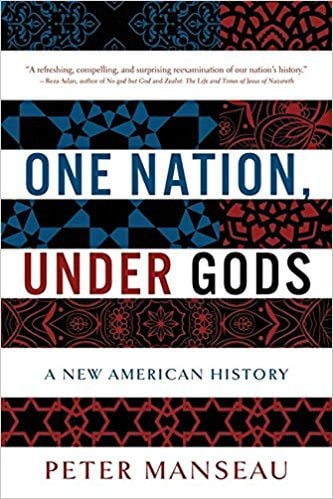 As historian Peter Manseau has explored in his book One Nation, Under Gods (Little, Brown, and Company, 2015), the volume is turned up further on these questions because religions receive tax-exempt status in the U.S. To give one longstanding matter of controversy that continues to this day, should the Church of Scientology be tax free? Some critics, including the Pulitizer Prize winning journalist Lawrence Wright have written about why it should be considered a cult, not a religion (387). But who decides? Who benefits? And who gets to set the criteria for the decision?
Similar dynamics play out in the ginned-up controversy around “Merry Christmas” vs. “Happy Holidays.” So much depends on whether one’s norm is “one religion is superior” or whether one is a pluralist who views many religions as legitimate spiritual paths. Note that being a pluralist (one who believes that there is more than one legitimate spiritual path) is not the same thing as being a relativist (who might think that all self-proclaimed moral paths are equally deserving of protection).
And from a historical perspective, it is ironic to hear conservative Christians today (when Christianity remains, in many ways, a cultural norm) insist that all say “Merry Christmas.” This position forgets that back in the early days of Christianity—when Paganism was still the norm—Jesus followers were sometimes called “atheists because they refused to acknowledge the Roman gods” (182).
As an example of an alternative perspective, our Unitarian forebear Thomas Jefferson (I’ve written previously about the question of whether Jefferson was actually a Unitarian) said, “It does me no injury for my neighbor to say there are twenty gods or no gods; it neither picks my pocket nor breaks my leg” (226). That is a classic liberal position known as the “public/private split”: you are free to think or do whatever you want in private as long as you do not hurt anyone else. As soon as you hurt someone else, you are in public. And in public you have to be tolerant of diversity—or we will end up back with the “wars of religion” that helped birth the liberal religious tolerance in the first place. The risk is ending up back with people being killed or imprisoned for their religious beliefs, as happened to Servetus, Dávid and countless others.
Currently, a significant example of this ongoing controversy is a Supreme Court case argued last month that will presumably be decided in June, known as Masterpiece Cakeshop, Ltd. v. Colorado Civil Rights Commission. This is the case about whether it is constitutional for the owners of a cakeshop to refuse to sell a wedding cake to a gay couple on the grounds that same-sex marriage is against the cakeshop owner’s religious beliefs.
From the perspective of the “public/private split,” this case is not about the cakeshop owner’s “freedom of religion.” The cakeshop owner is free to believe whatever he would like. This case is about “enshrining a freedom to discriminate” in public. That’s why the other side of the case is the Colorado Civil Rights Commission.
In another case of history not exactly repeating itself, but rhyming, it’s fascinating that this same public accommodation cakeshop debate sprang up precisely around food. There are powerful parallels to the lunch counter sit-ins during the Civil Rights movement, which were also about public accommodation: whether it is constitutional to discriminate based on race about who can be served at a given restaurant. Racism is currently considered morally repugnant and treated as such, legally; so is homophobia. But neither were treated so in America’s past. Today, you are legally free to be prejudiced in the privacy of your heart and in the privacy of your home and religious community. But it is a tragic misreading of the Constitution to try to enforce your religious bigotry on others in the public square in the name of religious liberty.
If you don’t want to serve any customer who comes through the door, then don’t open a restaurant. And if you don’t want to sell a cake to anyone who wants one, don’t open a public cakeshop. In contrast, you are free, in the privacy of your own kitchen, to make baked goods only for those you deem worthy. (Along those lines, in one of the many ironic twists of history, just this year the Hungarian Unitarian Church—heirs to the tradition of Francis Dávid, John Sigismund, and so many other religious progressives—voted to bless only those marriages between a man and a woman.)
Returning our focus to the U.S., there are some important precedents to consider. One of my favorite case titles of all time is Newman vs. Piggie Park Enterprises. Piggie Park Enterprises was a drive-in barbecue chain owned by the head of the National Association for the Preservation of White People. (The parallels to today are haunting.) In 1964, the defendant argued that his freedom of religion meant that he could refuse to serve black customers. Similarly, “in the 1970s and 1980s, schools claimed that they should be allowed to pay women less than men based on the [religious] belief that men should be the head of the household. In all these cases, the courts ruled that religious views do not entitle any of us to discriminate [in public].”
Those of you following the Cakeshop case closely know that in addition to the religious freedom argument, they are front loading an argument that cake decorating is artistic free speech; therefore, it is actually the bakeshop owner’s Constitutional right to free speech that is being violated. They are basically trying to do an end run around precedents like Piggie Park Enterprises. That is a halfway clever argument that deserves to be tossed out of court, but there is no guarantee that it will be.
To quote another commentator, the truth is that:
when a law is “generally applicable”—that is, when it doesn’t single out any particular religious group—it is constitutional for such a law to burden some individuals’ religious practices when the government has a compelling interest at stake…. The Colorado anti-discrimination law…doesn’t single out conservative Christians, but rather seeks broadly to prohibit discrimination on the part of any citizen.
From a perspective of progressive religion, the even more significant point comes from a more-positive angle: “Public accommodations laws…generally promote religious liberty, by protecting individuals from discrimination on account of their religion.”—that is, they actually encourage the flourishing a religious diversity. “Such laws also promote human dignity, which is itself a religious value.”
The Rev. Dr. Carl Gregg is a certified spiritual director, a D.Min. graduate of San Francisco Theological Seminary, and the minister of the Unitarian Universalist Congregation of Frederick, Maryland. Follow him on Facebook (facebook.com/carlgregg) and Twitter (@carlgregg).
Learn more about Unitarian Universalism: http://www.uua.org/beliefs/principles
Previous Post

January 4, 2018
What Do You Want To Say "Yes" & "No" to in this New Year?
Browse Our Archives
Select a Category Advent Anti-Racism Archaeology Atheism Baptism Best of the Year List Book Reviews Buddhism Catholicism Christian Education Church and State Church Planting Climate Change Conscientious Objection to War Creation Spirituality Death Penalty Didache Disability Rights Discernment Easter Ecology Emergent Church Movement Empire-Critical Ethics Evolution Feminist Theology Film Reviews Gandhi Gospel of Mark Gun Control Hinduism Immigration Reform Interfaith Islam JFK Judaism Jungian Spirituality Lectionary Commentary Lent Letters to the Editor LGBT Marriage MLK Multiculturalism Mysticism Nonviolent Activism Occupy Paganism (Earth-centered Religions) Parables Paul Pluralism Politics Process Theology Quantum Physics Requiescat In Pace Seminary and Divinity School Sermon Series Retrospective Sermons Spiritual Direction Spiritual Practices Stewardship (Fundraising) The Book of J The Wheel of the Year (Paganism) Theoblogger Challenge Triathlon Uncategorized Unitarian Universalism Worship Resources Youth Ministry
Select a Month July 2026 May 2026 March 2026 November 2025 October 2025 August 2025 February 2025 December 2024 October 2024 March 2024 January 2024 December 2023 November 2023 March 2023 February 2023 January 2023 December 2022 November 2022 August 2022 March 2022 February 2022 January 2022 December 2021 September 2021 August 2021 July 2021 June 2021 May 2021 February 2021 January 2021 December 2020 August 2020 June 2020 May 2020 April 2020 March 2020 February 2020 January 2020 December 2019 November 2019 October 2019 September 2019 July 2019 June 2019 March 2019 February 2019 January 2019 December 2018 November 2018 October 2018 September 2018 June 2018 May 2018 April 2018 March 2018 February 2018 January 2018 December 2017 November 2017 October 2017 September 2017 August 2017 July 2017 June 2017 May 2017 April 2017 March 2017 February 2017 January 2017 December 2016 November 2016 October 2016 September 2016 August 2016 June 2016 May 2016 April 2016 March 2016 February 2016 January 2016 December 2015 November 2015 October 2015 September 2015 August 2015 July 2015 June 2015 May 2015 April 2015 March 2015 February 2015 January 2015 December 2014 November 2014 October 2014 August 2014 July 2014 June 2014 May 2014 April 2014 March 2014 February 2014 January 2014 December 2013 November 2013 October 2013 September 2013 August 2013 July 2013 June 2013 May 2013 April 2013 March 2013 February 2013 January 2013 December 2012 November 2012 October 2012 September 2012 August 2012 July 2012 June 2012 May 2012 April 2012 March 2012 February 2012 January 2012 December 2011 November 2011 October 2011 September 2011 August 2011 July 2011 June 2011 May 2011 April 2011 March 2011 February 2011 January 2011 December 2010 November 2010 October 2010 August 2009 July 2009 May 2009
Follow Us!
TAKE THE
Religious Wisdom Quiz
Which letter of Paul is addressed to a slave owner about a runaway slave?
Select your answer to see how you score.
Philemon Titus Galatians Colossians
Related posts from Carl Gregg

Reading America at 250: A Nation Wrestles With...


Andrew Holocek on the Power of Darkness

The Stories That Shape Us: Myths, Archetypes, &...
TRENDING AT PATHEOS More Voices

Reading America at 250: A Nation Wrestles With...
As part of my own reflection on the 250th anniversary of the...

Whenever I am reading a book or listening to an argument, I...

President Trump Ban Animal Torture Videos on Facebook
Call for Stricter Regulations of Animal Abuse Content on Facebook Although President...

Draft Amendments to Address Ritual Abuse in New...
The proposed changes would make it illegal for individuals in domestic partnerships...

How Bans on LGBTQ+ Student Clubs Threaten Religious...
On June 20, 2025, the State of Texas passed Senate Bill 12....

The Truth About the Gen Z Revival
This past year, there has been a lot of media buzz surrounding...
view all More Voices blogs
Ad-Free & Subscriber Log-In Subscription Support
- About Us
- 2026 Calendar
- Videos
- Podcasts
- Library of World Religions
- Faith In Media Tracker
- Advertise With Us
- Write for Us
- Privacy Policy
- Terms of Service
- Do Not Sell My Data
- Contact Us
- Radiant Digital
- Manage Newsletter Subscriptions
- Unsubscribe From Notifications
- Sitemap
Copyright 2008-2026, Patheos. All rights reserved.
Subscription Support Ad-Free & Subscriber Log-In
Follow Patheos