
BuddhistCatholicContemplativeEvangelicalGeneral ChristianHinduJewishLatter-day SaintMuslimNew VisionsProgressive Christian
Beliefs
- Buddhist
- Catholic
- Contemplative
- Evangelical
- General Christian
- Hindu
- Jewish
- Latter-day Saint
- More Voices
- Muslim
- New Visions
- Pagan
- Progressive Christian
Topics
- Religion News
- Food and Religion
- Sports and Religion
- Religious Art
- Religious Music and Entertainment
- Religious Events
- History and Religion
- Style and Religion
- Politics and Religion
- Women in Religion
- Recreation Outdoors and Religion
- Business Finance and Religion
- Careers Workplace and Religion
- Education and Religion
- Family Parenting and Religion
- Health Fitness and Religion
- Home and Religion
- Relationships and Religion
- Technology and Religion
- Travel and Religion
Columnists
- Buddhist Columnists
- Business Finance and Religion Columnists
- Careers Workplace and Religion Columnists
- Catholic Columnists
- Contemplative Columnists
- Education and Religion Columnists
- Evangelists Columnists
- Family Parenting and Religion Columnists
- General Christian Columnists
- Health Fitness and Religion Columnists
- Hindu Columnists
- History and Religion Columnists
- Home and Religion Columnists
- Jewish Columnists
- More Voices Columnists
- Latter Day Columnists
- Muslim Columnists
- New Visions Columnists
- Nonreligious Columnists
- Pagan Columnists
- Politics and Religion Columnists
- Progressive Columnists
- Recreation Outdoors and Religion Columnists
- Relationships and Religion Columnists
- Religion News Columnists
- Religious Art Columnists
- Religious Events Columnists
- Religious Music and Entertainment Columnists
- Sports and Religion Columnists
- Style and Religion Columnists
- Technology and Religion Columnists
- Travel and Religion Columnists
- Women in Religion Columnists
Resource Library
- 2026 Calendar
- Library of World Religions
- The 100 Most Holy Places on Earth
- Patheos Answers
- Podcasts
- Videos
- Faith Leaders Database
- Anglican Episcopalian
- Bahai
- Baptist
- Buddhism
- Christianity
- Confucianism
- Eastern Orthodoxy
- Hinduism
- Holiness and Pentecostal
- ISKCON
- Islam
- Judaism
- Lutheran
- Methodist
- The Church of Jesus Christ of Latter-day Saints
- New Age
- Paganism
- Presbytarian and Reformed
- Protestantism
- Religion Behind the Scenes
- Roman Catholic
- Scientology
- Shia Islam
- Sikhism
- Sufism
- Sunni Islam
- Taoism
- Zen
- See all religions
Research Tools
 Ad-Free & Subscriber Log-In Subscription Support
Ad-Free & Subscriber Log-In Subscription Support
Follow Patheos 

- Trending:
- Forgiveness
- |
- Marriage
- |
- Consciousness
- |
- Death Penalty
- |
- Election
- |
- Halloween

- Home
- More Voices
- “The Dharma of ‘The Princess Bride’”
“The Dharma of ‘The Princess Bride’”
Last updated on: January 31, 2018 at 2:26 pm by Carl Gregg
“The Dharma of ‘The Princess Bride’” 2018-01-31T14:26:42-05:00 Carl Gregg
Patheos Explore the world's faith through different perspectives on religion and spirituality! Patheos has the views of the prevalent religions and spiritualities of the world.
This past year was the 30th anniversary of The Princess Bride. And although I have seen this movie quite a few times over the years, prior to rewatching it last week, I probably hadn’t seen it in more than a decade. In revisiting the film, I was reminded of how great the cast is. The stars include: Fred Savage at age eleven—a year before the first episode of *The Wonder Years—*as the sick grandson to whom the story of The Princess Bride is being told, Robin Wright as Princess Buttercup, seven years before her role as Jenny in Forrest Gump and many more year before her current role as Claire Underwood in House of Cards), and so many other amazing actors, from André the Giant to Billy Crystal.
Part of the film’s enduring popularity is that the entire script is almost absurdly quotable. After watching The Princess Bride, one of the most difficult parts of being a minister is restraining yourself when officiating at weddings from starting with: “Mawage. Mawage is wot bwings us togeder today…. And wuv, tru wuv.” Along these lines, as Cary Elwes discovers in researching his book As You Wish: Inconceivable Tales from the Making of The Princess Bride, Mandy Patinkin continues to be asked by strangers on a regular basis to say, “Hello. My name is Inigo Montoya. You killed me father. Prepare to die” (5).
The screenplay is based on an earlier novel published in 1973 by William Goldman (1931 – ), who also wrote the screenplays for Butch Cassidy and the Sundance Kid (1969) and All the President’s Men (1976). Fascinatingly, the seed of the idea for The Princess Bride was planted on a road trip that Goldman took with his two daughters when they were young. He told them, “I’ll write you a story; what do you want it to be about?” One of them said, “Princesses!” The other said, “Brides!” And the title of a postmodern classic was born (17).
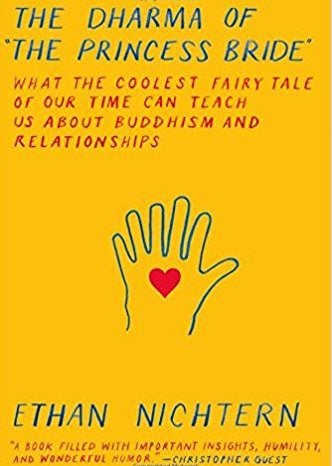 So what significance might be in The Princess Bride other than a great piece of pop culture? Well, I was inspired to revisit the film after reading Ethan Nichtern’s latest book, The Dharma of “The Princess Bride”. I’ve been following Nichtern’s work for quite a few years. He is the founder of The Interdependence Project, a meditation group in New York City dedicated to secular Buddhist practice, transformational activism, and the arts. But I was fascinated to learn recently that Christopher Guest—who plays the Six-Fingered Man in The Princess Bride—was Ethan’s father’s best friend growing up (3-4).
As is the case with many relatively famous people, from the outside, Ethan Nichtern has an impressive resume and could be seen as having lived a charmed life. At a young age, he became a senior teacher in the Shambhala Buddhist community. His 2015 book, The Road Home: A Contemporary Exploration of the Buddhist Path, was selected as one of Library Journal’s Best Books of 2015 and one of Tech Insider’s “9 Books That Define 2015.” He has lectured widely and has been featured on CNN, NPR, The New York Times, and other similar media outlets.
Part of how he came into his celebrity status (again, relatively speaking) within the Buddhist world is that his father David Nichtern was one of the early students of the famous Tibetan Buddhist teacher Chögyam Trungpa Rinpoche. But as is the case with all of us, below the surface, it turns out that even the most seemingly “charmed life” is a lot messier when viewed from the inside.
Here’s an example: in 1987 when The Princess Bride was released in theaters, Nichtern was nine years old and in the fourth grade. On one hand, it’s pretty amazing when your father’s best friend has a major role in a great new film. And it’s pretty cool generally that your dad is a successful musician and well-known Buddhist teacher. But here’s what else happened that year in young Ethan’s life: his parents went through a difficult divorce, two of his grandparents died, and Chögyam Trungpa, the charismatic founder of the Shambhala Buddhist lineage, also died. As if that wasn’t enough, he also had two surgeries that year to help with a mild case of cerebral palsy. He writes, “Surgery left me outcast…and objectively speaking, the second least popular kid in my class” (4-5). From this more informed perspective it seems clear that part of what makes Nichtern a great Buddhist teacher is not merely being born into it, but experiencing the chaotic roller coaster that is all our lives at various points.
And through the ups and downs of life since that fateful year of 1987, one constant companion in Nicthtern’s life has been The Princess Bride. So I was interested in his reflections on the film from a Buddhist perspective. As is true of many great movies, at the heart of The Princess Bride is relationships: the friendship of Inigo Montoya, the giant Fezzik and Westley (the Farmboy turned Man in Black); the romance of Buttercup and Westley; and the frame story of the grandfather telling this tale to his grandson. Within the world of the film, all of these relationship are complicated—and rightly so. As Chögyam Trungpa Rinpoche used to say, “It’s possible that you could become enlightened everywhere except around your family”—that our families are the most difficult relationships to practice an Awakened perspective. Relatedly, the Zen tradition teaches, “If you want to know if a master is truly enlightened, ask their spouse” (12). From a more positive angle, one might also say that our families can be our best teachers.
Accordingly, many of you have heard me say that, “Enlightenment” is not the best translation of the Pali word “Bodhi.” A better translation of what the Buddha probably meant is the word Awakening, a spiritual experience that is said to be quite similar to our everyday experience of waking up from a dream—except that we’re “waking up” from our everyday waking state to an existential realization that reality is profoundly more impermanent and interdependent than typically understood—which recognition, in turn, transforms our relationship with ourselves, with others, and with suffering. Relatedly, since Buddha (also related to that root word “Bodhi”) is a title meaning “Awakened One,” Nichtern proposes pushing this perspective one step further by translating the word “Buddhist” as “Awake-ist.”.
Taking this connection into account, Nichtern invites us to consider the ways in which The Princess Bride can be seen as a “Buddhist/Awake-ist” fairy tale (Nichtern 29). In the same way that the film deconstructs traditional fairy tale tropes, then puts them back together in ways both playful and profound (with healthy doses of irony and meta-commentary added in for good measure)—so too does meditation deconstruct reality, exposing the shifting nature of our “self” and helping us perceive what we my own tradition of Unitarian Universalism calls the “interdependent web of all existence.“
Nichtern is also aware, of course, that The Princess Bride is not only a postmodern romantic fairy tale, but also a quest for revenge—the latter of which does not seem particularly Buddhist (or “Awake-ist”). From an “Awake-ist” perspective, evil is not a person, place, or thing “out there” with its own independent nature that can be ended through revenge. Rather, evil is nothing more than “habitual actions rising from confusion.” And Nichtern writes that:
More than a few reality-challenged, compassion-deficient men like the villains of The Princess Bride have risen to political power in the decades since this movie came into the world…. When a war against Guilder is plotted upon a totally made-up premise, it’s quite funny. When a war against Iraq is plotted upon a totally made-up premise, it’s not funny at all (61-62).
So what are we to do? Laugh, cry, or do both at the same time?!
Well, there are many lessons from this film that Nichtern explores in more than 200 pages. But I will limit myself to the one that might be most useful for us to explore: the hubris of the character known as Vizzini—his “excessive pride and self-confidence” which the Man in Black exploits to defeat him. Vizzini is the arrogant ringleader of the gang who kidnaps Princess Buttercup. Although he presents himself as a self-assured genius who knows everything, this fake confidence is a desperate attempt to mask his “insecurity about his own knowledge” (67).
At multiple points, his certainty that he knows everything proves to be dangerously incorrect. Instead of accepting new evidence that is right in front of his eyes—or being curious about the ways that new information can open the door for previously unforeseen possibilities—his default response is to say, “Inconceivable!” (Basically, it’s the late 80s equivalent of declaring that anything you disagree with is Fake News.) Eventually, Inigo Montoya says the following about Vizzini’s repeated use of inconceivable: “You keep using that word. I do not think it means what you think it means.” The invitation is for all of us to “get a little more curious, ask a few more questions, and consider a few more possibilities outside the frames we are caught within, before the thing we are so sure we know ends up causing harm” (68).
Fascinatingly, a little more than two years ago—twenty-years after the film was released—there was a real-life parallel to this famous cinematic exchange. As reported in many media outlets, including The New York Times, in 2015, the real life actor Mandy Patinkin, who played the character Inigo Mantoya, began to receive the same email forward from many of his friends. The email contained a series of pictures from The Princess Bride with the face of Senator Ted Cruz superimposed over the faces of various characters from the film—including over the face of Patinkin’s character Inigo Mantoya.
The back story is that Senator Cruz had publicly proclaimed The Princess Bride to be his favorite film—and a new Internet meme was born. It didn’t stop there. Soon Patinkin’s “inbox became cluttered with videos of Mr. Cruz acting out scenes” from the film—including many of Patinkin’s scenes. Patinkin, as you can perhaps guess, does not agree with Senator Cruz’s politics. But the more he thought about it, the more he became convinced that this was more than a case of someone you disagree with politically liking the same piece of pop culture as you—which is more distasteful than dangerous. Senator Cruz was accurately quoting the lines from the film, but echoing his character’s famous line, Patinkin thought, “You keep quoting this film. But I do not think it means what you think it means.”
Eventually, Patinkin wrote an essay about it that was published in Time Magazine. After watching many clips of Senator Cruz quoting The Princess Bride, it was clear that Senator Cruz had memorized extensive sections of the film. So Patinkin invited Cruz to consider that he had not quoted the most important line in the film. Now, Patinkin may be a bit biased in claiming that the most important line is one his character said. But he’s not wrong that it is a profound bit of dialogue. His character has dedicated his entire life up to that point to training as a sword fighter in a single-minded determination to kill the person who killed his father. But—spoiler alert (which I don’t feel bad about after 30 years)—after he kills the Six-Fingered Man, he is shocked to find himself discovering something unexpected. He confesses: “You know, it’s very strange. I have been in the revenge business so long, now that it’s over, I don’t know what to do with the rest of my life.”
Patinkin says:
Too often we think that when we have a problem with our lives or our country that the way to fix it is to take an eye for an eye…. [But] violence only perpetrates more violence, and it becomes a vicious cycle…. [Politicians] who use phrases like “carpet-bombing” the people of ISIS and who say, after the incidents in Paris, that we need a war president, is using fear mongering and hate speech…. It only brings more pain and suffering…. We must learn from this day forward what to do with the rest of our lives. Let it be an act of humanity, not revenge.
I don’t think it is a coincidence that Patinkin has arrived at this compassionate worldview. It turns out that Patinkin has cultivated a practice of meditating for twenty minutes a day. “That’s right, Inigo Montoya meditates every day. No pressure, though” (72).
But I don’t want to end there without naming one more potential pitfall. In a level of irony appropriate for a postmodern fairy tale like The Princess Bride, it is also the case that even the compassionate worldview that Patinkin admirably espouses can itself harden into a new limiting framework that can inhibit our ability to respond to reality as it really is—in all of its fullness, messiness, and complexity. If we aren’t careful, we can stumble into the same trap that caught Vizzini: we can find ourselves asserting in advance, about the ideas of those we disagree with, “Inconceivable!” In contrast, the invitation is to stay curious about what we might unexpectedly learn from anyone or anything.
The Rev. Dr. Carl Gregg is a certified spiritual director, a D.Min. graduate of San Francisco Theological Seminary, and the minister of the Unitarian Universalist Congregation of Frederick, Maryland. Follow him on Facebook (facebook.com/carlgregg) and Twitter (@carlgregg).
Learn more about Unitarian Universalism: http://www.uua.org/beliefs/principles
Previous Post
January 25, 2018
"The Price of Monotheism"
Next Post

February 16, 2018 “Live Your Life as a Work of Art”: The Spiritual Practice of Creativity
Browse Our Archives
Select a Category Advent Anti-Racism Archaeology Atheism Baptism Best of the Year List Book Reviews Buddhism Catholicism Christian Education Church and State Church Planting Climate Change Conscientious Objection to War Creation Spirituality Death Penalty Didache Disability Rights Discernment Easter Ecology Emergent Church Movement Empire-Critical Ethics Evolution Feminist Theology Film Reviews Gandhi Gospel of Mark Gun Control Hinduism Immigration Reform Interfaith Islam JFK Judaism Jungian Spirituality Lectionary Commentary Lent Letters to the Editor LGBT Marriage MLK Multiculturalism Mysticism Nonviolent Activism Occupy Paganism (Earth-centered Religions) Parables Paul Pluralism Politics Process Theology Quantum Physics Requiescat In Pace Seminary and Divinity School Sermon Series Retrospective Sermons Spiritual Direction Spiritual Practices Stewardship (Fundraising) The Book of J The Wheel of the Year (Paganism) Theoblogger Challenge Triathlon Uncategorized Unitarian Universalism Worship Resources Youth Ministry
Select a Month July 2026 May 2026 March 2026 November 2025 October 2025 August 2025 February 2025 December 2024 October 2024 March 2024 January 2024 December 2023 November 2023 March 2023 February 2023 January 2023 December 2022 November 2022 August 2022 March 2022 February 2022 January 2022 December 2021 September 2021 August 2021 July 2021 June 2021 May 2021 February 2021 January 2021 December 2020 August 2020 June 2020 May 2020 April 2020 March 2020 February 2020 January 2020 December 2019 November 2019 October 2019 September 2019 July 2019 June 2019 March 2019 February 2019 January 2019 December 2018 November 2018 October 2018 September 2018 June 2018 May 2018 April 2018 March 2018 February 2018 January 2018 December 2017 November 2017 October 2017 September 2017 August 2017 July 2017 June 2017 May 2017 April 2017 March 2017 February 2017 January 2017 December 2016 November 2016 October 2016 September 2016 August 2016 June 2016 May 2016 April 2016 March 2016 February 2016 January 2016 December 2015 November 2015 October 2015 September 2015 August 2015 July 2015 June 2015 May 2015 April 2015 March 2015 February 2015 January 2015 December 2014 November 2014 October 2014 August 2014 July 2014 June 2014 May 2014 April 2014 March 2014 February 2014 January 2014 December 2013 November 2013 October 2013 September 2013 August 2013 July 2013 June 2013 May 2013 April 2013 March 2013 February 2013 January 2013 December 2012 November 2012 October 2012 September 2012 August 2012 July 2012 June 2012 May 2012 April 2012 March 2012 February 2012 January 2012 December 2011 November 2011 October 2011 September 2011 August 2011 July 2011 June 2011 May 2011 April 2011 March 2011 February 2011 January 2011 December 2010 November 2010 October 2010 August 2009 July 2009 May 2009
Follow Us!
TAKE THE
Religious Wisdom Quiz
Where did Elijah confront the prophets of Baal?
Select your answer to see how you score.
Mount Sinai Mount Carmel Mount Horeb Mount Zion
Related posts from Carl Gregg

Reading America at 250: A Nation Wrestles With...


Andrew Holocek on the Power of Darkness

The Stories That Shape Us: Myths, Archetypes, &...
TRENDING AT PATHEOS More Voices

Reading America at 250: A Nation Wrestles With...
As part of my own reflection on the 250th anniversary of the...

Whenever I am reading a book or listening to an argument, I...

President Trump Ban Animal Torture Videos on Facebook
Call for Stricter Regulations of Animal Abuse Content on Facebook Although President...

Draft Amendments to Address Ritual Abuse in New...
The proposed changes would make it illegal for individuals in domestic partnerships...

How Bans on LGBTQ+ Student Clubs Threaten Religious...
On June 20, 2025, the State of Texas passed Senate Bill 12....

The Truth About the Gen Z Revival
This past year, there has been a lot of media buzz surrounding...
view all More Voices blogs
Ad-Free & Subscriber Log-In Subscription Support
- About Us
- 2026 Calendar
- Videos
- Podcasts
- Library of World Religions
- Faith In Media Tracker
- Advertise With Us
- Write for Us
- Privacy Policy
- Terms of Service
- Do Not Sell My Data
- Contact Us
- Radiant Digital
- Manage Newsletter Subscriptions
- Unsubscribe From Notifications
- Sitemap
Copyright 2008-2026, Patheos. All rights reserved.
Subscription Support Ad-Free & Subscriber Log-In
Follow Patheos