
BuddhistCatholicContemplativeEvangelicalGeneral ChristianHinduJewishLatter-day SaintMuslimNew VisionsProgressive Christian
Beliefs
- Buddhist
- Catholic
- Contemplative
- Evangelical
- General Christian
- Hindu
- Jewish
- Latter-day Saint
- More Voices
- Muslim
- New Visions
- Pagan
- Progressive Christian
Topics
- Religion News
- Food and Religion
- Sports and Religion
- Religious Art
- Religious Music and Entertainment
- Religious Events
- History and Religion
- Style and Religion
- Politics and Religion
- Women in Religion
- Recreation Outdoors and Religion
- Business Finance and Religion
- Careers Workplace and Religion
- Education and Religion
- Family Parenting and Religion
- Health Fitness and Religion
- Home and Religion
- Relationships and Religion
- Technology and Religion
- Travel and Religion
Columnists
- Buddhist Columnists
- Business Finance and Religion Columnists
- Careers Workplace and Religion Columnists
- Catholic Columnists
- Contemplative Columnists
- Education and Religion Columnists
- Evangelists Columnists
- Family Parenting and Religion Columnists
- General Christian Columnists
- Health Fitness and Religion Columnists
- Hindu Columnists
- History and Religion Columnists
- Home and Religion Columnists
- Jewish Columnists
- More Voices Columnists
- Latter Day Columnists
- Muslim Columnists
- New Visions Columnists
- Nonreligious Columnists
- Pagan Columnists
- Politics and Religion Columnists
- Progressive Columnists
- Recreation Outdoors and Religion Columnists
- Relationships and Religion Columnists
- Religion News Columnists
- Religious Art Columnists
- Religious Events Columnists
- Religious Music and Entertainment Columnists
- Sports and Religion Columnists
- Style and Religion Columnists
- Technology and Religion Columnists
- Travel and Religion Columnists
- Women in Religion Columnists
Resource Library
- 2026 Calendar
- Library of World Religions
- The 100 Most Holy Places on Earth
- Patheos Answers
- Podcasts
- Videos
- Faith Leaders Database
- Anglican Episcopalian
- Bahai
- Baptist
- Buddhism
- Christianity
- Confucianism
- Eastern Orthodoxy
- Hinduism
- Holiness and Pentecostal
- ISKCON
- Islam
- Judaism
- Lutheran
- Methodist
- The Church of Jesus Christ of Latter-day Saints
- New Age
- Paganism
- Presbytarian and Reformed
- Protestantism
- Religion Behind the Scenes
- Roman Catholic
- Scientology
- Shia Islam
- Sikhism
- Sufism
- Sunni Islam
- Taoism
- Zen
- See all religions
Research Tools
 Ad-Free & Subscriber Log-In Subscription Support
Ad-Free & Subscriber Log-In Subscription Support
Follow Patheos 

- Trending:
- Forgiveness
- |
- Marriage
- |
- Consciousness
- |
- Death Penalty
- |
- Election
- |
- Halloween

- Home
- More Voices
- Contemplative-Curious: What Happens on an 8-Day Meditation Retreat?
Contemplative-Curious: What Happens on an 8-Day Meditation Retreat?
Last updated on: December 14, 2017 at 9:08 am by Carl Gregg
Contemplative-Curious: What Happens on an 8-Day Meditation Retreat? 2017-12-14T09:08:44-05:00 Carl Gregg
Patheos Explore the world's faith through different perspectives on religion and spirituality! Patheos has the views of the prevalent religions and spiritualities of the world.
 Carrie Newcomer is a Quaker singer-songwriter. And there is a line from one of her songs that has lingered with me since I first heard it a few years ago. She laments—or maybe she confesses—that we’ve “Been traveling faster than our souls can go.” Can you relate? In our globalized, always-connected, Internet Age, I suspect that at some point most of us have found ourselves “traveling faster than our souls can go.”
Don’t get me wrong. I like to move fast, be efficient, and get things done. But maintaining a rapid pace without regular breaks for rest, renewal, and reconnection risks burnout. On one level, we know that. But there are many competing forces in our culture constantly trying to convince us that we must work hard, to buy ever more stuff, and always have the latest, newest version of everything. Combined with our human inclination to seek instant gratification, we can end up with a recipe—despite our best intentions—for “traveling faster than our souls can go.”
In contrast, when I consider what it might feel like to travel, so to speak, at “speed of soul,” I’m reminded of one of the main tenets of the three-year Spiritual Director training program I completed almost a decade ago. They used to say, “We’re going to start slowly so that later we can slow down.” This counter-cultural approach requires giving ourselves permission to experience the value in contemplation, spiritual practices, and reconnecting to who we really are.
Last week, I had the opportunity to experiment with slowing down on an 8-day Meditation Retreat in North Carolina. I attended a similar 8-day retreat with the same group in summer 2016. There’s a lot to say about the experience, but don’t worry, I’m not going to bore you with minutiae of my inner life. And some of you may already be quite clear that spending a week meditating is not on your bucket list. But for those of you who are even a little bit, what I like to call, “contemplative-curious” it may be helpful to lift the veil about what is required to survive and thrive on a meditation retreat.
By far the most common question I have received over the years in regard to long retreats is, “Do you really just sit on a meditation cushion all day?!” The answer is: not quite. For the data-driven among us, there were four hours of formal sitting practice each day, three hours of moving meditation, and three hours of other related activities—such as guided meditation, social meditation, and teaching sessions. In total, that is ten hours of structured contemplative activity, but that leaves another fourteen hours in the day, including at least an hourlong break after each meal, and more than enough time for eight or more hours of sleep.
That schedule may sound like heaven to some of you—and to others it may sound like a contemplative hellscape. Either way, I’ll let you in on the “open secret” about a meditation retreat schedule. I can’t speak for all retreats, but the fairly widespread practice is that no single sitting meditation session is lasts longer than 45 minutes. Now, that may still seem like way too long to some of you—and if so, fair enough.
But here’s the good news for those of you who are potentially interested in going deeper in your meditation practice: if you have built up the capacity to meditate for 45 minutes, then you already have the primary building block used in constructing the schedule of a long retreat—whether it is one day, three days, three weeks, or longer. For example, on the retreat I just returned from, the four hours of formal sitting practice is divided into 30-45 minute chunks—interspersed with 30-45 minutes of moving meditation and longer breaks for meals. Along these lines, I was glad to hear that on Wednesday nine of you attended our new Wednesday midday meditation group, which includes 45 minutes of silent meditation. (I love talking about Buddhism. It’s important to study and discuss the tradition; indeed that’s essentially what I’m doing right now. But to make progress, practicing meditation is also vital.)
All that being said, I wouldn’t recommend jumping straight from a 45 minutes/day practice to an 8-day retreat. Work your way up by adding a second 45 minute session at the end of the day—or attend one of the monthly, three-hour mini-retreats that Irene Glasse and I co-lead here at UUCF, or sign-up for a daylong retreat or weekend retreat. If you need some basic meditation instructions on how to get started, I recommend the resources on the Buddhist page of our website, frederickuu.org/Buddhism.
To widen our focus, I invite you to consider that training spiritually for an experience like a meditation retreat isn’t so “out there,” esoteric, and foreign as some might imagine. Rather, it is quite similar in many ways to training physically for a competition, or training mentally to complete a degree. If you work your way up incrementally, you can often build a surprisingly high capacity over a relatively short period of time.
There are a lot of related stories I could tell you about my own successes and failures in this regard, and I encourage you to think of parallels in your own life. Physically, I could tell you about how I have successfully followed incremental training programs to complete both a half-marathon and a Sprint Triathlon. From the other direction, I could tell you about my repeated failures to complete a similar training program for an Olympic-distance Triathlon. Both times, approximately halfway through the four-month regimen, the training became too much of a time commitment for that time in my life.
Or intellectually, I could tell you about the major ah-ha moment I had in successfully completing my doctoral dissertation. One day I realized that I didn’t have to approach this requirement as the (at least to me) imposing task of writing a 200-page paper. Instead, I could think of it as writing five thematically linked 30-page chapters, then adding an introduction and conclusion. That bite-sized approach made all the difference for me. But, again, from the other direction I could tell you about how I have, to date, failed to carve out the time to publish my dissertation as a book.
Overall, each of us always has the opportunity to discern what area(s) we might be called (and able) to focus on in this season of our life. What is possible to do with this mind, body, and spirit that we each have? Along those lines, let me tell you a little more about why I felt drawn to attend a second 8-day meditation retreat last week, why I may attend a two-week retreat this summer, and why I have been taking the time since June to co-lead monthly three-hour mini-retreats at the congregation where I serve as minister.
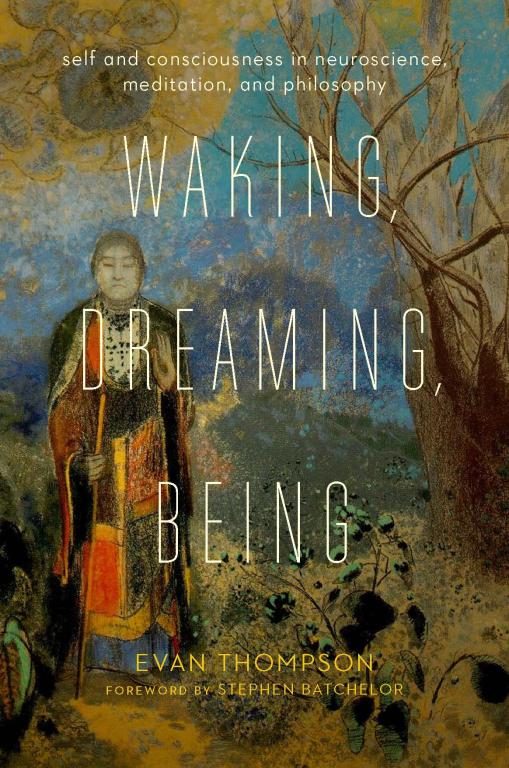
For whatever confluence of reasons, I have always been interested in learning about other people’s experiences of spiritual growth. One of the books I read recently that explores just that is Waking, Dreaming, Being: Self and Consciousness in Neuroscience, Meditation, and Philosophy by Evan Thompson (Columbia University Press, 2015). But over the years I have not been satisfied to stop with learning secondhand about other people’s reports about their (alleged) spiritual experiences. I am interested in the ways that meditation helps me explore what I can confirm in my own firsthand experience about some of the “core existential questions” of being human: “Who am I? What is the self? How is it related to being conscious?” (xiv)
Indeed, one of the most interesting religion scholars alive today, Jeffrey Kripal of Rice University, has traced the ways that the history of religions can be fruitfully viewed as the “history of consciousness”—starting with the truly remarkable fact that any of us even finds ourselves here and self-aware at all, on this fragile blue marble we call Earth amidst more than two trillion galaxies and a continually evolving 13.7-billion-year-old universe story. (Secret Body, 409). And as Kripal seek to extrapolate further, based on all that we humans have discovered and experienced both historically and now in the twenty-first century, he invites us to consider that, “Consciousness as such is the new sacred” (430).
There’s a lot to unpack about what Kripal means, and for now I will share just a little more about what a focus on consciousness can yield. As Thompson’s book title, Being, Waking, Dreaming alludes to, both dreamwork and meditation are two (among many) spiritual practices for exploring the existential questions of self and consciousness.
Buddhism challenges us to consider the ways that our sense of “self” is more of an “experiential process that is subject to constant change” than a “thing or an entity” (xxxi). Two of the traditional terms for this perspective are “impermanence” and “no-self.”
To say more about what I mean, I invite you on a brief journey through some of our common human states of consciousness. (Stick with me, and I think you may be interested where we end up.) If we pay increasingly close attention to the subtleties of our ever-shifting experience, the following are a few of many trends we can begin to notice about our sense of “self”:
- First, when was the last time you were fully engaged with an activity? As we enter into the “flow,” we can begin to notice the ways our “bodily sense of self recedes from our experience.”
- Next, think about the last time you were really bored. When we are not engaged with an activity, our mind tends to wander, and a “mentally-imagined self of the past or future” becomes predominant.
- Now, think about each time you begin to feel tired and sleepy: “the sense of self also slackens. Images float by, and our awareness becomes progressively absorbed in them” (xxxi).
- Here’s one more: if you become aware that you are dreaming without waking up—and quite a few of you in this room have likely experienced a lucid dream in which you are no longer simply the “I” of the dream ego (experiencing the dream directly), but are also “witnessing the dream state.” (There are scientific sleep studies of lucid dreams; it’s definitely a thing.)
Having traced how our sense of “self” shifts in different ways when we are engaged, daydreaming, sleeping, and lucid dreaming, we can come full circle to meditation, because an early threshold in practicing meditating is cultivating the capacity to witness our waking self. Instead of being caught up in our experience, we can increasingly witness ourselves “thinking,” “feeling,” “breathing,” etc. We can begin to see that we don’t have to always believe our thoughts (xxxii).
And as we begin to take a step back, we can reflect on the ways that our various states of consciousness overlap at various points. Witnessing our waking self is not so simple, for example, as being in either one state of consciousness or another—being asleep or awake. The two clearest examples are: (a) If your mind is wandering in a daydream, there is a sense in which you are dreaming in the waking state and (b) If you are having a lucid dream, there is a sense in which you are awake within the dream state (11). One reason why these distinctions are significant is that according to parts of the classical wisdom traditions, there are significant parallels between the physical experience of waking up from a dream (as we do each day) and the spiritual experience of being awake and then “waking up” into Enlightenment (which only a small percentage of people experience).
There is, however a lot of confusion around what Enlightenment means. As many of you have heard me say before, “Buddha” is not the Buddha’s name. (Just like “Christ” isn’t Jesus’s last name—it’s a title meaning “Anointed One”—but that’s another sermon.) Within Buddhism, the historical founder was Siddhārtha Gautama (c. 480 – c. 400 BCE). Buddha is a title given to him meaning “Awakened One.” Relatedly, Enlightenment is not the best translation of the Pali word “Bodhi.” A better translation of what the Buddha meant is the word Awakening, a spiritual experience that is said to be quite similar to our everyday experience of waking up from a dream—except that we’re “waking up” further from our everyday waking state (vii). If you think back to the old-school SAT analogy questions, the claim being made is that dreaming:waking::waking:Awakening, as in Enlightenment. But at this point, we’re above my pay grade, so I will conclude that if you do feel inclined to explore meditation further, I encourage you to take the leap and explore one of the various paths for going deeper on the journey of spiritual growth.
The Rev. Dr. Carl Gregg is a certified spiritual director, a D.Min. graduate of San Francisco Theological Seminary, and the minister of the Unitarian Universalist Congregation of Frederick, Maryland. Follow him on Facebook (facebook.com/carlgregg) and Twitter (@carlgregg).
Learn more about Unitarian Universalism: http://www.uua.org/beliefs/principles


Browse Our Archives
Select a Category Advent Anti-Racism Archaeology Atheism Baptism Best of the Year List Book Reviews Buddhism Catholicism Christian Education Church and State Church Planting Climate Change Conscientious Objection to War Creation Spirituality Death Penalty Didache Disability Rights Discernment Easter Ecology Emergent Church Movement Empire-Critical Ethics Evolution Feminist Theology Film Reviews Gandhi Gospel of Mark Gun Control Hinduism Immigration Reform Interfaith Islam JFK Judaism Jungian Spirituality Lectionary Commentary Lent Letters to the Editor LGBT Marriage MLK Multiculturalism Mysticism Nonviolent Activism Occupy Paganism (Earth-centered Religions) Parables Paul Pluralism Politics Process Theology Quantum Physics Requiescat In Pace Seminary and Divinity School Sermon Series Retrospective Sermons Spiritual Direction Spiritual Practices Stewardship (Fundraising) The Book of J The Wheel of the Year (Paganism) Theoblogger Challenge Triathlon Uncategorized Unitarian Universalism Worship Resources Youth Ministry
Select a Month July 2026 May 2026 March 2026 November 2025 October 2025 August 2025 February 2025 December 2024 October 2024 March 2024 January 2024 December 2023 November 2023 March 2023 February 2023 January 2023 December 2022 November 2022 August 2022 March 2022 February 2022 January 2022 December 2021 September 2021 August 2021 July 2021 June 2021 May 2021 February 2021 January 2021 December 2020 August 2020 June 2020 May 2020 April 2020 March 2020 February 2020 January 2020 December 2019 November 2019 October 2019 September 2019 July 2019 June 2019 March 2019 February 2019 January 2019 December 2018 November 2018 October 2018 September 2018 June 2018 May 2018 April 2018 March 2018 February 2018 January 2018 December 2017 November 2017 October 2017 September 2017 August 2017 July 2017 June 2017 May 2017 April 2017 March 2017 February 2017 January 2017 December 2016 November 2016 October 2016 September 2016 August 2016 June 2016 May 2016 April 2016 March 2016 February 2016 January 2016 December 2015 November 2015 October 2015 September 2015 August 2015 July 2015 June 2015 May 2015 April 2015 March 2015 February 2015 January 2015 December 2014 November 2014 October 2014 August 2014 July 2014 June 2014 May 2014 April 2014 March 2014 February 2014 January 2014 December 2013 November 2013 October 2013 September 2013 August 2013 July 2013 June 2013 May 2013 April 2013 March 2013 February 2013 January 2013 December 2012 November 2012 October 2012 September 2012 August 2012 July 2012 June 2012 May 2012 April 2012 March 2012 February 2012 January 2012 December 2011 November 2011 October 2011 September 2011 August 2011 July 2011 June 2011 May 2011 April 2011 March 2011 February 2011 January 2011 December 2010 November 2010 October 2010 August 2009 July 2009 May 2009
Follow Us!
TAKE THE
Religious Wisdom Quiz
Who was the first woman?
Select your answer to see how you score.
Mary Eve Deborah Sarah
Related posts from Carl Gregg

Reading America at 250: A Nation Wrestles With...


Andrew Holocek on the Power of Darkness

The Stories That Shape Us: Myths, Archetypes, &...
TRENDING AT PATHEOS More Voices

Reading America at 250: A Nation Wrestles With...
As part of my own reflection on the 250th anniversary of the...

Whenever I am reading a book or listening to an argument, I...

President Trump Ban Animal Torture Videos on Facebook
Call for Stricter Regulations of Animal Abuse Content on Facebook Although President...

Draft Amendments to Address Ritual Abuse in New...
The proposed changes would make it illegal for individuals in domestic partnerships...

How Bans on LGBTQ+ Student Clubs Threaten Religious...
On June 20, 2025, the State of Texas passed Senate Bill 12....

The Truth About the Gen Z Revival
This past year, there has been a lot of media buzz surrounding...
view all More Voices blogs
Ad-Free & Subscriber Log-In Subscription Support
- About Us
- 2026 Calendar
- Videos
- Podcasts
- Library of World Religions
- Faith In Media Tracker
- Advertise With Us
- Write for Us
- Privacy Policy
- Terms of Service
- Do Not Sell My Data
- Contact Us
- Radiant Digital
- Manage Newsletter Subscriptions
- Unsubscribe From Notifications
- Sitemap
Copyright 2008-2026, Patheos. All rights reserved.
Subscription Support Ad-Free & Subscriber Log-In
Follow Patheos