
BuddhistCatholicContemplativeEvangelicalGeneral ChristianHinduJewishLatter-day SaintMuslimNew VisionsProgressive Christian
Beliefs
- Buddhist
- Catholic
- Contemplative
- Evangelical
- General Christian
- Hindu
- Jewish
- Latter-day Saint
- More Voices
- Muslim
- New Visions
- Pagan
- Progressive Christian
Topics
- Religion News
- Food and Religion
- Sports and Religion
- Religious Art
- Religious Music and Entertainment
- Religious Events
- History and Religion
- Style and Religion
- Politics and Religion
- Women in Religion
- Recreation Outdoors and Religion
- Business Finance and Religion
- Careers Workplace and Religion
- Education and Religion
- Family Parenting and Religion
- Health Fitness and Religion
- Home and Religion
- Relationships and Religion
- Technology and Religion
- Travel and Religion
Columnists
- Buddhist Columnists
- Business Finance and Religion Columnists
- Careers Workplace and Religion Columnists
- Catholic Columnists
- Contemplative Columnists
- Education and Religion Columnists
- Evangelists Columnists
- Family Parenting and Religion Columnists
- General Christian Columnists
- Health Fitness and Religion Columnists
- Hindu Columnists
- History and Religion Columnists
- Home and Religion Columnists
- Jewish Columnists
- More Voices Columnists
- Latter Day Columnists
- Muslim Columnists
- New Visions Columnists
- Nonreligious Columnists
- Pagan Columnists
- Politics and Religion Columnists
- Progressive Columnists
- Recreation Outdoors and Religion Columnists
- Relationships and Religion Columnists
- Religion News Columnists
- Religious Art Columnists
- Religious Events Columnists
- Religious Music and Entertainment Columnists
- Sports and Religion Columnists
- Style and Religion Columnists
- Technology and Religion Columnists
- Travel and Religion Columnists
- Women in Religion Columnists
Resource Library
- 2026 Calendar
- Library of World Religions
- The 100 Most Holy Places on Earth
- Patheos Answers
- Podcasts
- Videos
- Faith Leaders Database
- Anglican Episcopalian
- Bahai
- Baptist
- Buddhism
- Christianity
- Confucianism
- Eastern Orthodoxy
- Hinduism
- Holiness and Pentecostal
- ISKCON
- Islam
- Judaism
- Lutheran
- Methodist
- The Church of Jesus Christ of Latter-day Saints
- New Age
- Paganism
- Presbytarian and Reformed
- Protestantism
- Religion Behind the Scenes
- Roman Catholic
- Scientology
- Shia Islam
- Sikhism
- Sufism
- Sunni Islam
- Taoism
- Zen
- See all religions
Research Tools
 Ad-Free & Subscriber Log-In Subscription Support
Ad-Free & Subscriber Log-In Subscription Support
Follow Patheos 

- Trending:
- Forgiveness
- |
- Marriage
- |
- Consciousness
- |
- Death Penalty
- |
- Election
- |
- Halloween

- Home
- More Voices
- “Our Grandchildren Redesigned: Navigating the Bioethics of the Near Future”
“Our Grandchildren Redesigned: Navigating the Bioethics of the Near Future”
Last updated on: November 21, 2017 at 10:39 am by Carl Gregg
“Our Grandchildren Redesigned: Navigating the Bioethics of the Near Future” 2017-11-21T10:39:50-05:00 Carl Gregg
Patheos Explore the world's faith through different perspectives on religion and spirituality! Patheos has the views of the prevalent religions and spiritualities of the world.
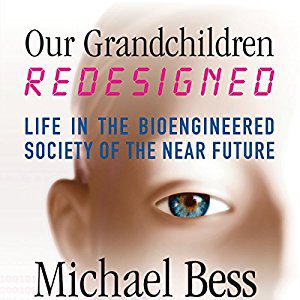 The best guide I have found recently for glimpsing into forthcoming bioethical challenges to come is Our Grandchildren Redesigned: Life in the Bioengineered Society of the Near Future (Beacon Press, 2016) by Michael Bess, a professor at Vanderbilt University who specialized in the history of technological change.
Bess also helpfully points beyond the pages of his writing to some of the best science fiction films and TV shows, which are among the more fun ways of opening our minds to the ethical implications of forthcoming technology. I’ll limit myself to five quick examples for now:
- Avatar, a few years ago, was the “first film to gross more than $2 billion” and sequels are scheduled for release in 2020, 2021, 2024 and 2025. The title refers to remotely-located humans controlling genetically engineered bodies.
- Battlestar Galactica (four seasons, 2003-2009) – this twenty-first century reimagining of a classic show depicts humans “at war with an android race of their own creation, known as the Cylons.”
- Ex Machina (2016) – about whether an android is “genuinely capable of thought and consciousness, and whether a human can relate to her despite knowing she is artificial.
- Her (2013) has similar themes about a man developing a relationship with an “intelligent computer operating system personified through a female voice.”
- Westworld (2016 – ) about a technologically advanced Wild West-themed amusement park populated by android hosts.
There are so many other great examples to explore.
If you do watch (or revisit) some of our culture’s best sci-fi, Bess has some suggestions for two common pitfalls to be aware of. It’s not that you should avoid shows that make one of these errors. Rather, it’s about equipping yourself to be aware of which aspects of sci-fi are likely forthcoming science (“future reality”) and which are simply entertaining aspects of fiction.
The first common pitfall is what Bess called the “Jetsons Fallacy.” Some of you will recall the Hanna-Barbera cartoon The Jetsons, which premiered in 1962 and imagined a technological utopia a century into the future in the year 2062. For those of you who can picture images of The Jetsons in your head, here’s a fundamental flaw: The Jetsons shows us a future world in which technology has evolved “dramatically and even radically,” but in which humans “stay fundamentally the same” (4).
Among many other examples that are guilty, at least in some aspects, of the Jetsons fallacy are Star Wars, Star Trek, Blade Runner, AI, and Gattaca. In each of these instances, “Intelligent robots coexist alongside unmodified humans no different from today.” There are related issues with works like The Six Million Dollar Man, The Bionic Woman, Inspector Gadget, Iron Man, or Limitless in which “modifications are uniquely confined to a single individual.” Although our actual future will almost inevitably include wealthy individuals who can afford the high-end of biotechnologies, changes will also be much more widespread (4).
Relatedly, when reading or watching sci-fi, Bess also recommends keeping an eye out for the “Terminator Fallacy,” affectionately known as the “Paranoid cousin of the Jetsons Fallacy.” The Terminator Fallacy, named after the series of Arnold Schwarzenegger movies about a cyborg assassin from the future, imagines that machines will be our enemies. Bess cautions that the much more insidious truth is that “machines” will increasingly be us (37).
For example, today most of us can tell the difference between ourselves and our vehicles. That may seem stupidly obvious. But with forthcoming bio-enhancements, machines will increasingly be integral to ourselves. Especially with advances in nanotechnology—through the ability to increasingly manipulate matter on a super-tiny, atomic scale—the line will blur between ourselves and our technology.
To give an example of what I mean, if you are an avid smartphone user, think about how you feel if you lose your smartphone. At least some of you likely feel disoriented, lost, or like part of yourself is missing. Smart phones are an example of a technology that changes how we exist in the world. Similarly, think about how you feel when you lose electricity in your house (37). This effect—of feeling like our fundamental relationship to the world is altered when technology is absent—will be vastly augmented through biotechnology. And whereas the Terminator Fallacy imagines that machines “out there” will one day come and get us, the truth is likely that biotechnology related to ourselves will more insidiously alter our understanding of what it means to be human. Indeed, there is a burgeoning field of study of what that might mean, called Transhumanism (8).
I should also hasten to add a few examples of how I am very much not talking hypothetically. When you have a chance, google, “Paralyzed woman moves robot with her mind.” This YouTube video from 2012 shows Cathy Hutchinson, who has been a quadriplegic since having a stroke, feeding herself for the first time in fifteen years using a robotic arm controlled solely through her thoughts, using an interface sensor implanted in her brain. Watching this video it is easy to imagine that it will not be long before we humans can similarly control an exoskeleton, robot, or drone through our thoughts alone. Extrapolating further, “Wired and connect to each other through a computer interface, how long before you and I can directly share our thoughts, memories, or feelings—brain to brain (25)?
There are a lot more examples I would like to give you, but to paint in broad strokes, Bess traces the ways that the near future will increasingly include:
- Pills to make us stronger and faster
- Devices which will interface with the human brain
- Genetic modifications that will allow people to increasingly reshape their own physical and mental identities at will.
We already have versions of these technologies, but they will each be increasingly more potent and finely calibrated (100).
If we do not get ahead of the curve and help co-create a future that is fair for all (and not merely for some), the implications will likely be:
- A growing rift between the biologically enhanced and those who cannot afford such modifications
- A constant cycle of upgrades and boosts as the bar of “normal” rises ever higher—“Humans 95, Humans XP, Humans 8”
- A gradual blurring of the boundaries between “person” & “product”
- Extreme forms of self-modification, with some individuals no longer recognized as unambiguously human.
Again, there’s so much more to be said about all of this—and I have a sermon in the works for this spring about the forthcoming promises and perils of Artificial Intelligence—but for now, I will limit myself to highlighting two major considerations for navigating the bioethics of the near future.
The first is that the parallels are strong between future bioethical dilemmas and two major debates in our society here in the present: healthcare reform and tax reform, which are both related to the underlying issue of wealth inequality. A fundamental question (that will only be exacerbated by biotechnology) is whether we are going to allow a society of peace, liberty, and justice only for an elite few—or are we building a world with at least a minimum “floor” of benefits for all.
At the heart of the healthcare debate is whether we will create a world with universal access to healthcare? Or will we continue to allow the cost of healthcare to unnecessarily devastate some people’s families and lives? The fundamental issue of equality is similar for biotechnology. Will we tolerate the creation of a “Biostratified Caste System” in which the “most effective enhancement technology will be prohibitively expensive and accessible only to rich?” Or will we create a system of universal access to at least a “basic package” of enhancement technologies (87)?
In addition to the question of universal access, another major point for navigating the bioethics of the near future is privacy (193). It is no coincidence that companies like Google and Facebook offer their products seemingly for free. If you scratch the surface, you discover that the platform is free because you are the product. You are paying Google and Facebook by sharing details (“data”) about your private life that these corporations can then sell to advertisers and other interested entities. This dynamic will increase many times over as biotechnology—instead of just being in our pocket—is integrated ever more fully into our selves.
Now, we have spent a fair amount of time trying to project ourselves into what the future might be like. And there is wisdom in that practice. In my tradition of Unitarian Universalism, one of our classic hymns attests that we tend to be a people who “revere the past, but trust the dawning future more.” We are a theologically liberal religious tradition, giving us a natural inclination to hope in the ways that forthcoming technology can improve our lives and lessen suffering, but there are shadow sides to everything as well.
So, I want to end on a different note by inviting us to hear the prophetic caution from an author like Wendell Berry, who is conservative in the best sense of the word: caring about conserving nature, upholding the beauty of traditions and rituals, reminding us of the importance of community, authority, sanctity, and loyalty. I want to amplify Berry’s words because I have no doubt that techno-optimists such as the “big four” tech companies known as GAFA (“Google, Apple, Facebook, and Amazon”) will do everything in their power to sell us on the advantages of forthcoming biotechnology. Although I agree with them in part, techno-pessimists like Berry offer a vital counterbalance that the GAFA companies do not want you to hear. Berry writes: **“**I knew a man who, in the age of chainsaws, went right on cutting his wood with a handsaw and axe. He was a healthier and a saner man than I am. I shall let his memory trouble my thoughts.”
Bess warns us that creators of all these new products want us to ask, “What does this allow me to do that I couldn’t do before?” But the more important question may be “How does this new capability contribute to my overall quality of life?” Marketers want us to ask, “What shall I do next with my newfound powers?” But more important questions may be, “Do I really need these, and what are their indirect or hidden drawbacks?” (196)
There is a real risk of biotechnology turning each of us human beings into “just another product struggling to keep up the pace of performance amid a seething market of rival products.” But more humanist perspectives such as the UU First Principle (which echos the UN Declaration of Human Rights) calls us to a different worldview: remembering that each of us in this present moment is already a human being with “inherent worth and dignity.” As radical as the coming biotechnology will be, I promise you that embracing your own inherent worth and dignity will remain the even more radical choice.
Can you feel that tension within yourself?
On one hand, the dissatisfaction advertisers are constantly trying to make us feel? (Take a moment to remember that latest new device or product you have been tempted to buy.)
On the other hand, take a deep breath in—and breathe out the advertising propaganda!—and open your heart to the many ways—in this present moment*,* right here, right now*—*that you are already enough.
You already have what you need.
You are already a blessing.
The Rev. Dr. Carl Gregg is a certified spiritual director, a D.Min. graduate of San Francisco Theological Seminary, and the minister of the Unitarian Universalist Congregation of Frederick, Maryland. Follow him on Facebook (facebook.com/carlgregg) and Twitter (@carlgregg).
Learn more about Unitarian Universalism: http://www.uua.org/beliefs/principles


Browse Our Archives
Select a Category Advent Anti-Racism Archaeology Atheism Baptism Best of the Year List Book Reviews Buddhism Catholicism Christian Education Church and State Church Planting Climate Change Conscientious Objection to War Creation Spirituality Death Penalty Didache Disability Rights Discernment Easter Ecology Emergent Church Movement Empire-Critical Ethics Evolution Feminist Theology Film Reviews Gandhi Gospel of Mark Gun Control Hinduism Immigration Reform Interfaith Islam JFK Judaism Jungian Spirituality Lectionary Commentary Lent Letters to the Editor LGBT Marriage MLK Multiculturalism Mysticism Nonviolent Activism Occupy Paganism (Earth-centered Religions) Parables Paul Pluralism Politics Process Theology Quantum Physics Requiescat In Pace Seminary and Divinity School Sermon Series Retrospective Sermons Spiritual Direction Spiritual Practices Stewardship (Fundraising) The Book of J The Wheel of the Year (Paganism) Theoblogger Challenge Triathlon Uncategorized Unitarian Universalism Worship Resources Youth Ministry
Select a Month July 2026 May 2026 March 2026 November 2025 October 2025 August 2025 February 2025 December 2024 October 2024 March 2024 January 2024 December 2023 November 2023 March 2023 February 2023 January 2023 December 2022 November 2022 August 2022 March 2022 February 2022 January 2022 December 2021 September 2021 August 2021 July 2021 June 2021 May 2021 February 2021 January 2021 December 2020 August 2020 June 2020 May 2020 April 2020 March 2020 February 2020 January 2020 December 2019 November 2019 October 2019 September 2019 July 2019 June 2019 March 2019 February 2019 January 2019 December 2018 November 2018 October 2018 September 2018 June 2018 May 2018 April 2018 March 2018 February 2018 January 2018 December 2017 November 2017 October 2017 September 2017 August 2017 July 2017 June 2017 May 2017 April 2017 March 2017 February 2017 January 2017 December 2016 November 2016 October 2016 September 2016 August 2016 June 2016 May 2016 April 2016 March 2016 February 2016 January 2016 December 2015 November 2015 October 2015 September 2015 August 2015 July 2015 June 2015 May 2015 April 2015 March 2015 February 2015 January 2015 December 2014 November 2014 October 2014 August 2014 July 2014 June 2014 May 2014 April 2014 March 2014 February 2014 January 2014 December 2013 November 2013 October 2013 September 2013 August 2013 July 2013 June 2013 May 2013 April 2013 March 2013 February 2013 January 2013 December 2012 November 2012 October 2012 September 2012 August 2012 July 2012 June 2012 May 2012 April 2012 March 2012 February 2012 January 2012 December 2011 November 2011 October 2011 September 2011 August 2011 July 2011 June 2011 May 2011 April 2011 March 2011 February 2011 January 2011 December 2010 November 2010 October 2010 August 2009 July 2009 May 2009
Follow Us!
TAKE THE
Religious Wisdom Quiz
What river did Jesus get baptized in?
Select your answer to see how you score.
Euphrates Nile Tigris Jordan
Related posts from Carl Gregg

Reading America at 250: A Nation Wrestles With...


Andrew Holocek on the Power of Darkness

The Stories That Shape Us: Myths, Archetypes, &...
TRENDING AT PATHEOS More Voices

Reading America at 250: A Nation Wrestles With...
As part of my own reflection on the 250th anniversary of the...

Whenever I am reading a book or listening to an argument, I...

President Trump Ban Animal Torture Videos on Facebook
Call for Stricter Regulations of Animal Abuse Content on Facebook Although President...

Draft Amendments to Address Ritual Abuse in New...
The proposed changes would make it illegal for individuals in domestic partnerships...

How Bans on LGBTQ+ Student Clubs Threaten Religious...
On June 20, 2025, the State of Texas passed Senate Bill 12....

The Truth About the Gen Z Revival
This past year, there has been a lot of media buzz surrounding...
view all More Voices blogs
Ad-Free & Subscriber Log-In Subscription Support
- About Us
- 2026 Calendar
- Videos
- Podcasts
- Library of World Religions
- Faith In Media Tracker
- Advertise With Us
- Write for Us
- Privacy Policy
- Terms of Service
- Do Not Sell My Data
- Contact Us
- Radiant Digital
- Manage Newsletter Subscriptions
- Unsubscribe From Notifications
- Sitemap
Copyright 2008-2026, Patheos. All rights reserved.
Subscription Support Ad-Free & Subscriber Log-In
Follow Patheos