
BuddhistCatholicContemplativeEvangelicalGeneral ChristianHinduJewishLatter-day SaintMuslimNew VisionsProgressive Christian
Beliefs
- Buddhist
- Catholic
- Contemplative
- Evangelical
- General Christian
- Hindu
- Jewish
- Latter-day Saint
- More Voices
- Muslim
- New Visions
- Pagan
- Progressive Christian
Topics
- Religion News
- Food and Religion
- Sports and Religion
- Religious Art
- Religious Music and Entertainment
- Religious Events
- History and Religion
- Style and Religion
- Politics and Religion
- Women in Religion
- Recreation Outdoors and Religion
- Business Finance and Religion
- Careers Workplace and Religion
- Education and Religion
- Family Parenting and Religion
- Health Fitness and Religion
- Home and Religion
- Relationships and Religion
- Technology and Religion
- Travel and Religion
Columnists
- Buddhist Columnists
- Business Finance and Religion Columnists
- Careers Workplace and Religion Columnists
- Catholic Columnists
- Contemplative Columnists
- Education and Religion Columnists
- Evangelists Columnists
- Family Parenting and Religion Columnists
- General Christian Columnists
- Health Fitness and Religion Columnists
- Hindu Columnists
- History and Religion Columnists
- Home and Religion Columnists
- Jewish Columnists
- More Voices Columnists
- Latter Day Columnists
- Muslim Columnists
- New Visions Columnists
- Nonreligious Columnists
- Pagan Columnists
- Politics and Religion Columnists
- Progressive Columnists
- Recreation Outdoors and Religion Columnists
- Relationships and Religion Columnists
- Religion News Columnists
- Religious Art Columnists
- Religious Events Columnists
- Religious Music and Entertainment Columnists
- Sports and Religion Columnists
- Style and Religion Columnists
- Technology and Religion Columnists
- Travel and Religion Columnists
- Women in Religion Columnists
Resource Library
- 2026 Calendar
- Library of World Religions
- The 100 Most Holy Places on Earth
- Patheos Answers
- Podcasts
- Videos
- Faith Leaders Database
- Anglican Episcopalian
- Bahai
- Baptist
- Buddhism
- Christianity
- Confucianism
- Eastern Orthodoxy
- Hinduism
- Holiness and Pentecostal
- ISKCON
- Islam
- Judaism
- Lutheran
- Methodist
- The Church of Jesus Christ of Latter-day Saints
- New Age
- Paganism
- Presbytarian and Reformed
- Protestantism
- Religion Behind the Scenes
- Roman Catholic
- Scientology
- Shia Islam
- Sikhism
- Sufism
- Sunni Islam
- Taoism
- Zen
- See all religions
Research Tools
 Ad-Free & Subscriber Log-In Subscription Support
Ad-Free & Subscriber Log-In Subscription Support
Follow Patheos 

- Trending:
- Forgiveness
- |
- Marriage
- |
- Consciousness
- |
- Death Penalty
- |
- Election
- |
- Halloween

- Home
- More Voices
- Universalism, Then & Now: Insights from the Life of Orestes Brownson
Universalism, Then & Now: Insights from the Life of Orestes Brownson
Last updated on: October 4, 2017 at 9:04 am by Carl Gregg
Universalism, Then & Now: Insights from the Life of Orestes Brownson 2017-10-04T09:04:49-04:00 Carl Gregg
Patheos Explore the world's faith through different perspectives on religion and spirituality! Patheos has the views of the prevalent religions and spiritualities of the world.
Patrick Carey, a theology professor, who has written the best modern biography of Orestes Brownson (1803-187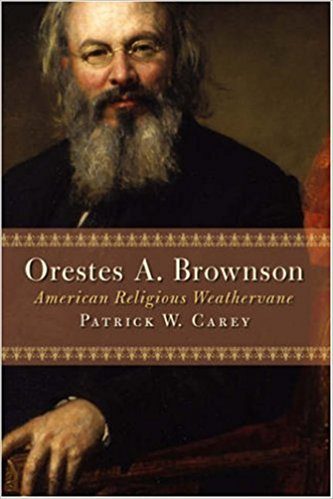 6), calls him, with affection, an “American Religious Weathervane” because his theological orientation changed so many times. More charitably, we might call Brownson a maverick. And in contrast to the many politicians who like to call themselves “mavericks”—but whose behavior is often more conformist than independent-minded—Brownson was a maverick to a head-spinning degree:
- During his time as a Unitarian minister, he joined the rebellious wing of Transcendentalists.
- But among those Transcendentalist rebels who emphasized individualism, he championed a “social understanding of the human person.”
- Although he championed working class causes, he did not always support the labor rights movement on its own terms, believing that “no lasting reform in society could be achieved without the aid of genuine Christianity.”
- And “although he opposed slavery on moral grounds…he rejected immediate emancipation as an unworkable solution and thereby alienated himself from many of the leading abolitionists (95-96)
His sojourns included deep (if not always long lasting) immersions into Presbyterianism, Universalism, skepticism, Unitarianism, Transcendentalism, and Catholicism (viii). And while I will confess that I can sometimes be a bit theologically promiscuous, Brownson takes theological promiscuity to a whole other level. Although his life was a “restless search for balance between freedom and communion” (xii), and despite his many shifts in loyalties, he was not merely a dilettante sampling one option after another without any real commitment or thoughtfulness. Instead, Brownson was sincerely hardcore about each of his religious commitments in turn.
And we know a fair amount about him because he wrote—and published—a lot. There’s the seven-volume The Early Works of Orestes A. Brownson, which collects his writings up to 1844; the twenty-volume The Works of Orestes A. Brownson, which contains Brownson’s post-Catholic conversion publications; and the five-volume Orestes Brownson: Works in Political Philosophy. So for anyone considering a career as a Brownson scholar, think carefully about what you would be getting yourself into with primary sources alone!
His father’s family were Presbyterians, but his father died of pneumonia when Brownson was young (2). His mother’s parents were Universalists. Orestes and his twin sister Daphne were born in 1803, becoming the fourth and fifth children in the family (3). After the death of Brownson’s father, his mother, finding herself at age twenty-nine with five children under the age of eight, made the wrenching decision to send three of the children, including Orestes, to three different families to be cared for.
Orestes was about six years old when he was sent 17 miles north to live away from his birth family for more than seven years. One psychological reading of his life is that, “These youthful experiences of separation created in him a strong sense of personal independence, initiative, and self-reliance, but they also put him in a constant search for the communion, continuity, order, and stability that he did not” experience as a child (4).
Tracing the turning points in his life can feel a bit like whiplash:
- At age thirteen, he experienced a conversion experience during a revival that was part of the Second Great Awakening (6-7).
- Next, from ages fifteen to nineteen, “he experienced a period of skepticism, rational critique of all revealed religion, and atheism” (9).
- In 1822 at age nineteen, he briefly became Presbyterian for a few intense months (9-11).
- Then, he became a Universalist minister for four years (13-15, 29).
- Following that, after a brief flirtation with his previous religious skepticism, he became a Unitarian minister (30).
- He later was caught up in the Transcendentalist reform movement within Unitarianism, becoming a charter member of the Transcendentalist Club, which included so many of our famous nineteenth-century Unitarian ancestors (56).
- In 1844, at age forty-one, Brownson made his final conversion to what ended up being a quite orthodox and conservative version of Roman Catholicism that would dominate the final decades of his life until his death at age seventy-two in 1876 (382).
One sacrifice is that despite how passionate and knowledgable he was about religion, since Brownson was married with children, his conversion meant that he could not serve as a member of the clergy within Catholicism (155). Nevertheless, Brownson maintained the zeal of a convert, and did not hold back in criticizing his former colleagues—just as he had criticized Catholicism (and other perspectives) during his sojourn within various versions of Protestantism.
Of course, some of his former colleagues returned the favor. In the book-length poem A Fable for Critics (1848), the Unitarian and poet James Russell Lowell included a stanza explicitly skewering Brownson:
He shifts quite about, then proceeds to expound
That ’tis merely the earth, not himself, that turns round,
And wishes it clearly impressed on your mind
That the weather[vane] rules and not follows the wind;
Proving first, then as deftly confuting each side,
With no doctrine pleased that’s not somewhere denied,
He lays the denier away on the shelf,
And then — down beside him lies gravely himself….
The worst of it is, that his logic’s so strong,
That of two sides he commonly chooses the wrong;
If there is only one, why, he’ll split it in two,
And first pummel this half, then that, black and blue.
That white’s white needs no proof, but it takes a deep fellow
To prove it jet-black, and that jet-black is yellow.
He offers the true faith to drink in a sieve, —
When it reaches your lips there’s naught left to believe…. (xiii-xiv)
In a similar vein, the Unitarian minister James Freeman Clarke delivered a famous prose critique of Brownson:
No one has ever equalled Mr. Brownson in the ability with which he has [over time] refuted his own arguments. He has made the most elaborate and plausible plea for eclecticism, and [later] the most elaborate and plausible plea against it. He has said the best things for transcendentalism, and the best things against it…. He has satisfactorily shown the truth of socialism, and its necessity in order to bring about a golden age, and he has, by the most convincing arguments, demonstrated that the whole system is from the pit, and can lead to nothing but anarchy and ruin. (xiv-xv).
There is much more to say about Brownson, but given the outline we have explored of his major turning points, what lessons might there be for us today?
In reflecting on Brownson, the first quote that always comes to my mind is from Emerson’s 1841 essay “Self-Reliance”: “A foolish consistency is the hobgoblin of little minds.” Brownson was willing to risk “what he himself called a ‘glorious inconsistency’ that exhibited the mind’s flexibility and its openness to grow” in light of new information and insights (xv).
Brownson ultimately passed through Universalism—with its challenge to include ever-more beings within our circles of care and compassion—into a more narrow sectarianism. But for those of us who do remain within the big tent of Unitarian Universalism–or some related progressive tradition–the challenge of being a Universalist is leaning into what that word Universalism can mean at its best. In the words of the General Superintendent of the Universalists at the 1943 annual General Assembly:
Universalism cannot be limited either to Protestantism or to Christianity, not without denying its very name. Ours is a world fellowship, not just a Christian sect. For, so long as Universalism is universalism and not partialism, the fellowship bearing its name must succeed in making it unmistakably clear that all are welcome: theist and humanist, unitarian and trinitarian, colored and color-less. A circumscribed Universalism in unthinkable (Howe 109).
The Rev. Dr. Carl Gregg is a certified spiritual director, a D.Min. graduate of San Francisco Theological Seminary, and the minister of the Unitarian Universalist Congregation of Frederick, Maryland. Follow him on Facebook (facebook.com/carlgregg) and Twitter (@carlgregg).
Learn more about Unitarian Universalism: http://www.uua.org/beliefs/principles
Next Post

October 12, 2017 Cynic or Fool? How to Not "Go Low" When We Can’t Agree on Facts
Browse Our Archives
Select a Category Advent Anti-Racism Archaeology Atheism Baptism Best of the Year List Book Reviews Buddhism Catholicism Christian Education Church and State Church Planting Climate Change Conscientious Objection to War Creation Spirituality Death Penalty Didache Disability Rights Discernment Easter Ecology Emergent Church Movement Empire-Critical Ethics Evolution Feminist Theology Film Reviews Gandhi Gospel of Mark Gun Control Hinduism Immigration Reform Interfaith Islam JFK Judaism Jungian Spirituality Lectionary Commentary Lent Letters to the Editor LGBT Marriage MLK Multiculturalism Mysticism Nonviolent Activism Occupy Paganism (Earth-centered Religions) Parables Paul Pluralism Politics Process Theology Quantum Physics Requiescat In Pace Seminary and Divinity School Sermon Series Retrospective Sermons Spiritual Direction Spiritual Practices Stewardship (Fundraising) The Book of J The Wheel of the Year (Paganism) Theoblogger Challenge Triathlon Uncategorized Unitarian Universalism Worship Resources Youth Ministry
Select a Month July 2026 May 2026 March 2026 November 2025 October 2025 August 2025 February 2025 December 2024 October 2024 March 2024 January 2024 December 2023 November 2023 March 2023 February 2023 January 2023 December 2022 November 2022 August 2022 March 2022 February 2022 January 2022 December 2021 September 2021 August 2021 July 2021 June 2021 May 2021 February 2021 January 2021 December 2020 August 2020 June 2020 May 2020 April 2020 March 2020 February 2020 January 2020 December 2019 November 2019 October 2019 September 2019 July 2019 June 2019 March 2019 February 2019 January 2019 December 2018 November 2018 October 2018 September 2018 June 2018 May 2018 April 2018 March 2018 February 2018 January 2018 December 2017 November 2017 October 2017 September 2017 August 2017 July 2017 June 2017 May 2017 April 2017 March 2017 February 2017 January 2017 December 2016 November 2016 October 2016 September 2016 August 2016 June 2016 May 2016 April 2016 March 2016 February 2016 January 2016 December 2015 November 2015 October 2015 September 2015 August 2015 July 2015 June 2015 May 2015 April 2015 March 2015 February 2015 January 2015 December 2014 November 2014 October 2014 August 2014 July 2014 June 2014 May 2014 April 2014 March 2014 February 2014 January 2014 December 2013 November 2013 October 2013 September 2013 August 2013 July 2013 June 2013 May 2013 April 2013 March 2013 February 2013 January 2013 December 2012 November 2012 October 2012 September 2012 August 2012 July 2012 June 2012 May 2012 April 2012 March 2012 February 2012 January 2012 December 2011 November 2011 October 2011 September 2011 August 2011 July 2011 June 2011 May 2011 April 2011 March 2011 February 2011 January 2011 December 2010 November 2010 October 2010 August 2009 July 2009 May 2009
Follow Us!
TAKE THE
Religious Wisdom Quiz
Who lamented Saul and Jonathan's death with a song?
Select your answer to see how you score.
Nathan Abiathar David Samuel
Related posts from Carl Gregg

Reading America at 250: A Nation Wrestles With...


Andrew Holocek on the Power of Darkness

The Stories That Shape Us: Myths, Archetypes, &...
TRENDING AT PATHEOS More Voices

Reading America at 250: A Nation Wrestles With...
As part of my own reflection on the 250th anniversary of the...

Whenever I am reading a book or listening to an argument, I...

President Trump Ban Animal Torture Videos on Facebook
Call for Stricter Regulations of Animal Abuse Content on Facebook Although President...

Draft Amendments to Address Ritual Abuse in New...
The proposed changes would make it illegal for individuals in domestic partnerships...

How Bans on LGBTQ+ Student Clubs Threaten Religious...
On June 20, 2025, the State of Texas passed Senate Bill 12....

The Truth About the Gen Z Revival
This past year, there has been a lot of media buzz surrounding...
view all More Voices blogs
Ad-Free & Subscriber Log-In Subscription Support
- About Us
- 2026 Calendar
- Videos
- Podcasts
- Library of World Religions
- Faith In Media Tracker
- Advertise With Us
- Write for Us
- Privacy Policy
- Terms of Service
- Do Not Sell My Data
- Contact Us
- Radiant Digital
- Manage Newsletter Subscriptions
- Unsubscribe From Notifications
- Sitemap
Copyright 2008-2026, Patheos. All rights reserved.
Subscription Support Ad-Free & Subscriber Log-In
Follow Patheos