
BuddhistCatholicContemplativeEvangelicalGeneral ChristianHinduJewishLatter-day SaintMuslimNew VisionsProgressive Christian
Beliefs
- Buddhist
- Catholic
- Contemplative
- Evangelical
- General Christian
- Hindu
- Jewish
- Latter-day Saint
- More Voices
- Muslim
- New Visions
- Pagan
- Progressive Christian
Topics
- Religion News
- Food and Religion
- Sports and Religion
- Religious Art
- Religious Music and Entertainment
- Religious Events
- History and Religion
- Style and Religion
- Politics and Religion
- Women in Religion
- Recreation Outdoors and Religion
- Business Finance and Religion
- Careers Workplace and Religion
- Education and Religion
- Family Parenting and Religion
- Health Fitness and Religion
- Home and Religion
- Relationships and Religion
- Technology and Religion
- Travel and Religion
Columnists
- Buddhist Columnists
- Business Finance and Religion Columnists
- Careers Workplace and Religion Columnists
- Catholic Columnists
- Contemplative Columnists
- Education and Religion Columnists
- Evangelists Columnists
- Family Parenting and Religion Columnists
- General Christian Columnists
- Health Fitness and Religion Columnists
- Hindu Columnists
- History and Religion Columnists
- Home and Religion Columnists
- Jewish Columnists
- More Voices Columnists
- Latter Day Columnists
- Muslim Columnists
- New Visions Columnists
- Nonreligious Columnists
- Pagan Columnists
- Politics and Religion Columnists
- Progressive Columnists
- Recreation Outdoors and Religion Columnists
- Relationships and Religion Columnists
- Religion News Columnists
- Religious Art Columnists
- Religious Events Columnists
- Religious Music and Entertainment Columnists
- Sports and Religion Columnists
- Style and Religion Columnists
- Technology and Religion Columnists
- Travel and Religion Columnists
- Women in Religion Columnists
Resource Library
- 2026 Calendar
- Library of World Religions
- The 100 Most Holy Places on Earth
- Patheos Answers
- Podcasts
- Videos
- Faith Leaders Database
- Anglican Episcopalian
- Bahai
- Baptist
- Buddhism
- Christianity
- Confucianism
- Eastern Orthodoxy
- Hinduism
- Holiness and Pentecostal
- ISKCON
- Islam
- Judaism
- Lutheran
- Methodist
- The Church of Jesus Christ of Latter-day Saints
- New Age
- Paganism
- Presbytarian and Reformed
- Protestantism
- Religion Behind the Scenes
- Roman Catholic
- Scientology
- Shia Islam
- Sikhism
- Sufism
- Sunni Islam
- Taoism
- Zen
- See all religions
Research Tools
 Ad-Free & Subscriber Log-In Subscription Support
Ad-Free & Subscriber Log-In Subscription Support
Follow Patheos 

- Trending:
- Forgiveness
- |
- Marriage
- |
- Consciousness
- |
- Death Penalty
- |
- Election
- |
- Halloween

- Home
- More Voices
- “You Say You Want a Revolution”: Insights for Today on the 100th Anniversary of the Russian Revolution
“You Say You Want a Revolution”: Insights for Today on the 100th Anniversary of the Russian Revolution
Last updated on: November 22, 2017 at 1:18 pm by Carl Gregg
“You Say You Want a Revolution”: Insights for Today on the 100th Anniversary of the Russian Revolution 2017-11-22T13:18:46-05:00 Carl Gregg
Patheos Explore the world's faith through different perspectives on religion and spirituality! Patheos has the views of the prevalent religions and spiritualities of the world.
This month marks both the 100th anniversary of the Russian Revolution in 1917 and the 500th anniversary of the Protestant Reformation in 1517. And I would like to reflect on these two events, in turn, in this post and next week’s post. What lessons are there for us today from looking back on these two historic events?
To begin responding to that question, I invite you to consider one of my favorite quotes from the late American Pragmatist philosopher Richard Rorty:
When I was 12, the most salient books on my parents’ shelves were two red-bound volumes, The Case of Leon Trotsky and Not Guilty. These made up the report of the Dewey Commission of Inquiry into the Moscow Trials. I never read them with the wide-eyed fascination I brought to books like Krafft-Ebing’s Psychopathia Sexualis, but I thought of them in the way in which other children thought of their family’s Bible: they were books that radiated redemptive truth and moral splendor. If I were a really good boy, I would say to myself, I should have read not only the Dewey Commission reports, but also Trotsky’s History of the Russian Revolution, a book I started many times but never managed to finish. For in the 1940s, the Russian Revolution and its betrayal by Stalin were, for me, what the Incarnation and its betrayal by the Catholics had been to precocious little Lutherans 400 years before….
I grew up knowing that all decent people were, if not Trotskyites, at least socialists…. Working as an unpaid office boy during my twelfth winter, I carried drafts of press releases from the Workers’ Defense League office…. On the subway, I would read the documents I was carrying. They told me a lot about what factory owners did to union organizers, plantation owners to sharecroppers, and the white locomotive engineers’ union to the colored firemen (whose jobs white men wanted, now that diesel engines were replacing coal-fired steam engines). So, at 12, I knew that the point of being human was to spend one’s life fighting social injustice.
That is one among many possible lessons one might glean from studying the Protestant Reformation and Russian Revolution.
Turning our attention for now to the Russian Revolution, it is impossible for me to consider this world-changing historical episode without recalling the ways that it impacted my own family. My wife’s great-grandfather immigrated to this country around 1905 in the wake of the Kiev pogram, a massacre of Jewish people in Ukraine, then part of the Russian Empire. And my brother-in-law (who is married to my wife’s identical twin sister) came to this country with his parents and two sisters in the early eighties, a few years prior to the Soviet Union dissolving in 1991.
From a larger perspective, why are we bothering to talk about the 100th Anniversary of the Russian Revolution? One answer is that in 1917, the February Revolution in Russia overthrew a dynasty that had lasted more than 300 years. (Smith 2017: 374). That same year, **during the October Revolution, the Bolsheviks seized power, establishing “the world’s first Communist state on a territory covering one-sixth of the globe…**from the Arctic to the Black Sea, from the Baltic to the Far East…and inspiring communist movements and revolutions across the world” (Smith 2002: 1).
Now, for any of my fellow calendar nerds out there, yes, it is true that Russia was still using the older Julian calendar in 1917, so technically, the February Revolution happened in March according to the current Gregorian calendar—and the October Revolution happened in what we call November. But these events remain commonly known as the February and October Revolutions.
On major anniversaries, questions arise not only about what happened a century ago this month, but also, “What was their significance, both then and now?” Responding to the question of “significance” requires us to wrestle with the ways that historical memory is constructed. How are we taught to tell about our history? And why? Who decides? Who benefits from the choices made about how history is told? And who is harmed?
As Jack Goldstone has explored in his helpful book Revolutions: A Very Short Introduction, even with the benefit of a century to think about it—and countless pages of scholarship written about the legacy of that revolution—the answers to these questions are not immediately clear:
- Is the major outcome of the Russian Revolution of 1917 the millions killed by Stalin’s collectivization campaigns in the 1930s?
- Or should we focus on the remarkable survival of the Soviet Union after the Nazi onslaught and its rise to become one of the world’s two superpowers by the 1960s?
- Should the collapse of the Soviet Union in 1989-1991 be viewed as the inevitable outcome of the Russian Revolution seventy-two years earlier?
- Or instead, as the result of the poor choices of Gorbachev and other Soviet leaders in the 1980s? (Goldstone 35)
I am a child of the ‘80s. And as I was coming of age in South Carolina in the middle of the Reagan Revolution, this country was in a terrifying Cold War nuclear arms race with the Russians, who were frequently depicted as “those bad guys.” I was almost six in 1983 when President Reagan called the Soviet Union an “evil empire.” So my earliest notions of the Russian Revolution were of that event as the poisonous root that grew into our nation’s greatest enemy.
But that is only one historical perspective. I invite you to also consider two more perspectives as points of comparison. First, let’s turn back the clock four decades to the end of the Second World War. I****n 1945, “many would have defended” the 1917 October Revolution in Russia, “seeing it as giving rise to a state which, despite its faults, had made a massive contribution to the defeat of fascism” (Smith 2017: 2). After all, in World World II the Soviet Union was part of the Allied Powers, fighting in coalition with us against the Axis powers of Germany, Japan, and Italy.
Next, let’s fast-forward to the present, to weigh the complex factors behind the various ways the American public views Russia today. To list only a few headlines from The New York Times during this month alone:
- Senate Intelligence Heads Warn That Russian Election Meddling Continues
- Google Finds Accounts Connected to Russia Bought Election Ads
- Putin Says Russia Has ‘Many Friends’ in U.S. Who Can Mend Relations
I am tempted to go off on a tangent about contemporary U.S.-Russia relations; instead, suffice it to say that the significance of the same events of the 1917 Russian Revolution can look very different, depending on who you are talking to, their motivations, and your vantage point from 1945, 1985, or today.
One angle on contemporary Russia that is important to name for current purposes is the way Vladimir Putin (1952 – ), the current President of Russia, is attempting to shape the historical memory during the centenary of the Russian Revolution. Putin, in office since 2012, is eligible for re-election to a second consecutive term in March. Previously, he was “Prime Minister from 1999 to 2000, President from 2000 to 2008, and again Prime Minister from 2008 to 2012.” While in power, Putin has consistently moved Russia toward authoritarianism. And when examined through the archetypes of Russian history, Putin’s tendencies toward dictatorship, coupled with his long tenure, make him look a lot like a tsar.
That fact is not lost on him. Whereas Putin eagerly draws from most aspects of Russian culture and history—he “has been a fervent devotee of the Russian Orthodox Church, Soviet military might…and the occasional tsar—Lenin and the Bolsheviks are out of bounds….” In contemporary Russia, “The word ‘revolution’ itself is practically taboo” (Dissent 36). If you ask the Kremlin why they have not scheduled any major commemorations to mark the 100th anniversary of the Russian Revolution, they will give you the official party line: “Russia remains too divided over the consequences of that fateful year.” The truth is that, **“**Putin loathes the very idea of revolution, not to mention the thought of Russians dancing in the streets to celebrate the overthrow of any ruler.” (Remember our guiding questions: how are we taught to tell our history? Who decides? And who benefits?)
We’ve seen how Putin is trying to control the narrative. But what if we could turn the clock back one hundred years and hear the story from Tsar Nicholas II, the last Emperor of Russia, who in 1917 was forced to abdicate his throne. He would say that he was the only legitimate heir to a dynasty that reigned for more than three centuries. The last tsar “sincerely believed that, as God’s appointed representative, he did not have the right to compromise his power” (Smith 2002: 12).
What about the 1917 revolutionaries? What would they tell us? First of all, we can see a lot from their name for themselves. Bolshevik is derived from the Russian word for “majority” or “one of the majority.” Sounds a lot like #OccupyWallStreet and “We are the 99%,” right?! As the saying goes, “History does not exactly repeat itself, but it does tend to rhyme.”
But allow me to be clear that just because historical themes tend to recapitulate themselves does not mean that studying history can allow us to predict the future with any certainty. If you will indulge me in another quick glance in the mirror at our own country today, there’s a strong argument that until election night, the vast majority of people around the world—including Donald Trump himself—did not think he would be elected president of the United States. Yet, here we find ourselves a mere two-and-a-half weeks away from the one-year anniversary of that fateful night. I say that less from a place of hope or despair and more in the spirit of seeking appropriate humility in the face of history’s often unpredictable changes. What I have in mind from the Russian Revolution is that, “Lenin famously remarked in January 1917, just months before the tsar’s regime collapsed that, ‘We of the older generation may not live to see the decisive battles of this coming revolution’” (Goldstone: 20). He sure got that one wrong!
But the tsar’s calculations were wrong in a more costly way, and in 1917 the tides of history seemed to be turning inexorably toward the Bolshevik vision. Consider the soaring aspirations inscribed into the constitution of July 1918: “abolition of all exploitation of man by man, the complete elimination of the division of society into classes, the ruthless suppression of the exploiters, the establishment of a socialist organization of society, and the victory of socialism in all countries” (Smith 2002: 40). But soon the victorious revolutionaries found themselves facing the dynamic that has stymied the hopes of countless politicians: in the words of former New York Governor Mario Cuomo, “You can campaign in poetry, but you have to govern in prose.”
And in the years following the revolution:
The collapse of industry together with grave food shortages led to the near breakdown of urban life…. Against a background of perishing cold, poor diet, unsanitary conditions, and health facilities at breaking point, epidemic disease erupted on a devastating scale. (Smith 2017: 217-218)
And although Lenin was wrong in January 1917 about his generation likely not living long enough to see revolution, he did die almost exactly seven years later at age 53 from complications following a stroke (Smith 2002: 109). Trotsky was exiled almost exactly four years later, and ultimately assassinated by Stalin’s henchmen (112). Here we can recall the line from Rorty earlier that, “In the 1940s, the Russian Revolution and its betrayal by Stalin were, for me, what the Incarnation and its betrayal by the Catholics had been to precocious little Lutherans 400 years before.”
To be fair, there are also ways in which Lenin erred in laying the groundwork for someone like Stalin. Lenin, for instance, famously said that, “The will of the proletariat [that is, the working-class] ‘may sometimes be carried out by a dictator.’ In other words, Lenin bears considerable responsibility for the institutions and culture that allowed Stalin to come to power. Crucially, he bequeathed a structure of power that favored a single leader” instead of a more democratic polity, accountable to the “consent of the governed” (Smith 2017: 388).
Moreover, “If Trotsky has become general secretary the horror of Stalinism would not have come to pass, [but] economic backwardness and international isolation would still have critically constrained” his ability to govern successfully (388). And therein lies another of the crucial lessons of the Russian Revolution: changing the warm body at the top of the pyramid does not necessarily change the underlying structures of society:
As the Bolshevik regime began to stabilize, the deeper structuring forces of Russian history began to reassert themselves: those of geography (huge distances, scattered populations, inadequate communications), climate (the vulnerability of agriculture to severe winters and drought), geopolitics (the difficulty of defending frontiers and the costs of maintaining a huge army over such a huge area), the constraints of the market and the paucity of capital, the ingrained patterns of a religious and patriarchal peasant culture, the traditions of bureaucratic government. (375)
 Obama promised “Change we can believe in.” Trump promised to “Make America great again.” “The Bolsheviks promised that the Revolution would elevate working people to the status of a ruling class, but…even with respect to basic working and living conditions, the Revolution brought about only limited improvements” (384).
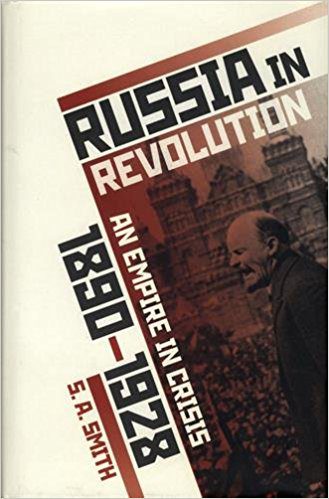
For now, regarding the lessons we might learn from looking back from the vantage of the 100th anniversary of the Russian Revolution, I will conclude by inviting you to consider the final paragraph from Russia in Revolution: An Empire in Crisis, 1890 to 1928, written for the century of the Russian Revolution by the great Oxford historian S.A. Smith:
The Russian Revolution of 1917 ended in tyranny. Yet it raised fundamental questions about how justice, equality, and freedom can be reconciled which have not gone away. Its answers were flawed, but it opened up certain progressive possibilities that the dismal record of Stalinism and Maoism should not blind us to…. [So much] conspires to make us acquiesce to the world as it is, to discourage belief that it can be organized in a more just and rational fashion. Yet that is what the Bolsheviks tried to do. Their revolution wrought calamity on a scale commensurate with the transformation in the human condition that they sought to achieve. And a hundred years on, it is easier to appreciate the illusions under which they labored than the ideal that inspired them. Yet we shall not understand the Russian Revolution unless we see that for all their many faults, the Bolsheviks were fired by outrage at the exploitation that lay at the heart of capitalism and at the raging nationalism that had led Europe into the carnage of the First World War. Nor will we understand the year 1917 if we do not make an imaginative effort to recapture the hope, idealism, heroism, anger, fear, and despair that motivated it: the burning desire for peace, the deep resentment of a social order riven between the haves and the have-nots, the anger at the injustices that ran through Russian society. That is why millions across the world, who could not anticipate the horrors to come, embraced the 1917 Revolution as a chance to create a new world of justice, equality, and freedom. (293)
The Rev. Dr. Carl Gregg is a certified spiritual director, a D.Min. graduate of San Francisco Theological Seminary, and the minister of the Unitarian Universalist Congregation of Frederick, Maryland. Follow him on Facebook (facebook.com/carlgregg) and Twitter (@carlgregg).
Learn more about Unitarian Universalism: http://www.uua.org/beliefs/principles
Previous Post

October 19, 2017
Immigrants Make America Great
Next Post
October 31, 2017 Martin Luther & the Law of Unintended Consequences #Reformation500
Browse Our Archives
Select a Category Advent Anti-Racism Archaeology Atheism Baptism Best of the Year List Book Reviews Buddhism Catholicism Christian Education Church and State Church Planting Climate Change Conscientious Objection to War Creation Spirituality Death Penalty Didache Disability Rights Discernment Easter Ecology Emergent Church Movement Empire-Critical Ethics Evolution Feminist Theology Film Reviews Gandhi Gospel of Mark Gun Control Hinduism Immigration Reform Interfaith Islam JFK Judaism Jungian Spirituality Lectionary Commentary Lent Letters to the Editor LGBT Marriage MLK Multiculturalism Mysticism Nonviolent Activism Occupy Paganism (Earth-centered Religions) Parables Paul Pluralism Politics Process Theology Quantum Physics Requiescat In Pace Seminary and Divinity School Sermon Series Retrospective Sermons Spiritual Direction Spiritual Practices Stewardship (Fundraising) The Book of J The Wheel of the Year (Paganism) Theoblogger Challenge Triathlon Uncategorized Unitarian Universalism Worship Resources Youth Ministry
Select a Month July 2026 May 2026 March 2026 November 2025 October 2025 August 2025 February 2025 December 2024 October 2024 March 2024 January 2024 December 2023 November 2023 March 2023 February 2023 January 2023 December 2022 November 2022 August 2022 March 2022 February 2022 January 2022 December 2021 September 2021 August 2021 July 2021 June 2021 May 2021 February 2021 January 2021 December 2020 August 2020 June 2020 May 2020 April 2020 March 2020 February 2020 January 2020 December 2019 November 2019 October 2019 September 2019 July 2019 June 2019 March 2019 February 2019 January 2019 December 2018 November 2018 October 2018 September 2018 June 2018 May 2018 April 2018 March 2018 February 2018 January 2018 December 2017 November 2017 October 2017 September 2017 August 2017 July 2017 June 2017 May 2017 April 2017 March 2017 February 2017 January 2017 December 2016 November 2016 October 2016 September 2016 August 2016 June 2016 May 2016 April 2016 March 2016 February 2016 January 2016 December 2015 November 2015 October 2015 September 2015 August 2015 July 2015 June 2015 May 2015 April 2015 March 2015 February 2015 January 2015 December 2014 November 2014 October 2014 August 2014 July 2014 June 2014 May 2014 April 2014 March 2014 February 2014 January 2014 December 2013 November 2013 October 2013 September 2013 August 2013 July 2013 June 2013 May 2013 April 2013 March 2013 February 2013 January 2013 December 2012 November 2012 October 2012 September 2012 August 2012 July 2012 June 2012 May 2012 April 2012 March 2012 February 2012 January 2012 December 2011 November 2011 October 2011 September 2011 August 2011 July 2011 June 2011 May 2011 April 2011 March 2011 February 2011 January 2011 December 2010 November 2010 October 2010 August 2009 July 2009 May 2009
Follow Us!
TAKE THE
Religious Wisdom Quiz
What does "Pentecost" mean?
Select your answer to see how you score.
Twentieth Fiftieth Twelfth First
Related posts from Carl Gregg

Reading America at 250: A Nation Wrestles With...


Andrew Holocek on the Power of Darkness

The Stories That Shape Us: Myths, Archetypes, &...
TRENDING AT PATHEOS More Voices

Reading America at 250: A Nation Wrestles With...
As part of my own reflection on the 250th anniversary of the...

Whenever I am reading a book or listening to an argument, I...

President Trump Ban Animal Torture Videos on Facebook
Call for Stricter Regulations of Animal Abuse Content on Facebook Although President...

Draft Amendments to Address Ritual Abuse in New...
The proposed changes would make it illegal for individuals in domestic partnerships...

How Bans on LGBTQ+ Student Clubs Threaten Religious...
On June 20, 2025, the State of Texas passed Senate Bill 12....

The Truth About the Gen Z Revival
This past year, there has been a lot of media buzz surrounding...
view all More Voices blogs
Ad-Free & Subscriber Log-In Subscription Support
- About Us
- 2026 Calendar
- Videos
- Podcasts
- Library of World Religions
- Faith In Media Tracker
- Advertise With Us
- Write for Us
- Privacy Policy
- Terms of Service
- Do Not Sell My Data
- Contact Us
- Radiant Digital
- Manage Newsletter Subscriptions
- Unsubscribe From Notifications
- Sitemap
Copyright 2008-2026, Patheos. All rights reserved.
Subscription Support Ad-Free & Subscriber Log-In
Follow Patheos