
BuddhistCatholicContemplativeEvangelicalGeneral ChristianHinduJewishLatter-day SaintMuslimNew VisionsProgressive Christian
Beliefs
- Buddhist
- Catholic
- Contemplative
- Evangelical
- General Christian
- Hindu
- Jewish
- Latter-day Saint
- More Voices
- Muslim
- New Visions
- Pagan
- Progressive Christian
Topics
- Religion News
- Food and Religion
- Sports and Religion
- Religious Art
- Religious Music and Entertainment
- Religious Events
- History and Religion
- Style and Religion
- Politics and Religion
- Women in Religion
- Recreation Outdoors and Religion
- Business Finance and Religion
- Careers Workplace and Religion
- Education and Religion
- Family Parenting and Religion
- Health Fitness and Religion
- Home and Religion
- Relationships and Religion
- Technology and Religion
- Travel and Religion
Columnists
- Buddhist Columnists
- Business Finance and Religion Columnists
- Careers Workplace and Religion Columnists
- Catholic Columnists
- Contemplative Columnists
- Education and Religion Columnists
- Evangelists Columnists
- Family Parenting and Religion Columnists
- General Christian Columnists
- Health Fitness and Religion Columnists
- Hindu Columnists
- History and Religion Columnists
- Home and Religion Columnists
- Jewish Columnists
- More Voices Columnists
- Latter Day Columnists
- Muslim Columnists
- New Visions Columnists
- Nonreligious Columnists
- Pagan Columnists
- Politics and Religion Columnists
- Progressive Columnists
- Recreation Outdoors and Religion Columnists
- Relationships and Religion Columnists
- Religion News Columnists
- Religious Art Columnists
- Religious Events Columnists
- Religious Music and Entertainment Columnists
- Sports and Religion Columnists
- Style and Religion Columnists
- Technology and Religion Columnists
- Travel and Religion Columnists
- Women in Religion Columnists
Resource Library
- 2026 Calendar
- Library of World Religions
- The 100 Most Holy Places on Earth
- Patheos Answers
- Podcasts
- Videos
- Faith Leaders Database
- Anglican Episcopalian
- Bahai
- Baptist
- Buddhism
- Christianity
- Confucianism
- Eastern Orthodoxy
- Hinduism
- Holiness and Pentecostal
- ISKCON
- Islam
- Judaism
- Lutheran
- Methodist
- The Church of Jesus Christ of Latter-day Saints
- New Age
- Paganism
- Presbytarian and Reformed
- Protestantism
- Religion Behind the Scenes
- Roman Catholic
- Scientology
- Shia Islam
- Sikhism
- Sufism
- Sunni Islam
- Taoism
- Zen
- See all religions
Research Tools
 Ad-Free & Subscriber Log-In Subscription Support
Ad-Free & Subscriber Log-In Subscription Support
Follow Patheos 

- Trending:
- Forgiveness
- |
- Marriage
- |
- Consciousness
- |
- Death Penalty
- |
- Election
- |
- Halloween

- Home
- More Voices
- Martin Luther & the Law of Unintended Consequences #Reformation500
Martin Luther & the Law of Unintended Consequences #Reformation500
Last updated on: October 31, 2017 at 10:28 am by Carl Gregg
Martin Luther & the Law of Unintended Consequences #Reformation500 2017-10-31T10:28:30-04:00 Carl Gregg
Patheos Explore the world's faith through different perspectives on religion and spirituality! Patheos has the views of the prevalent religions and spiritualities of the world.
Today, the celebration on most people’s minds is Halloween. Don’t get me wrong: I’m all for trick-or-treating! But today is also: the 500th Anniversary of the Reformation. On October 31, 1517, a thirty-four year-old monk nailed a large parchment with Ninety-Five Theses to the door of the Castle Church in Wittenberg, Germany. Typically, a list of propositions for debate would find a limited audience within the ivory tower of academia. But in this case, Luther’s ideas spread quickly, sparking a controversy that grew out of Luther’s control (Roper xvii – xviii).
You have your monk robes ready to dress up as Martin Luther for Halloween, right?! In all seriousness, Luther could indeed be a scary guy, unafraid to boldly criticize his opponents. Have you seen the Luther Insulter webpage, which generates random insults from his writings? Here’s some examples of what you’ll get if you click on the “Insult me again” button:
- You are like swine who indiscriminately devour everything. (p. 363 of Luther’s Works, Vol. 40)
- “You have a priesthood of Satan.” (p. 34 of Luther’s Works, Vol. 40)
- You forgot to purge yourself with hellebore while you were preparing to fabricate this lie. (p. 290 of Luther’s Works, Vol. 31)
- We despise your whorish impudence. (p. 205 of Luther’s Works, Vol. 32).
Seriously, Luther died a few centuries too early because his insults would have been amazing on Twitter (Hendrix xvii).
But even without social media on his side, Luther’s ideas went viral. His success in spreading his ideas is even more impressive since, five hundred years ago, Wittenberg was a backwater town of “muddy houses, unclean lanes, every path, step and street full of mud….” Luther’s nailing of Ninety-five Theses into the church door makes for a dramatic story, but it was a different but equally paradigm-shifting innovation from 77 years earlier that made it possible for Luther to be more than just a voice crying in the wilderness.
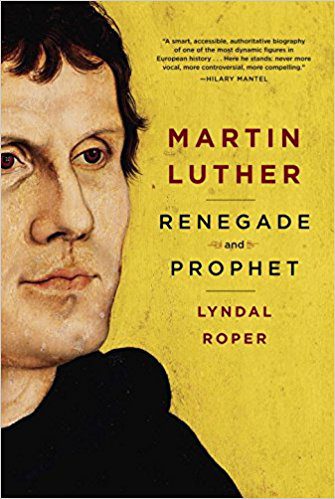 In 1440, Johannes Gutenberg developed a printing process using moveable type. So while Church authorities were dragging their feet in response to Luther, copies of his Ninety-five Theses were spreading like wildfire. As the renowned Oxford University historian Lyndal Roper details in her excellent new biography Martin Luther: Renegade and Prophet **(**Random House, 2017), “There was a huge readership for them, lay as well as clerical. In just two months they were known all over Germany, and soon beyond it” (Roper xviii).
Similarly, as historian Brad Gregory summarizes in his helpful overview Rebel in the Ranks: Martin Luther, the Reformation, and the Conflicts That Continue to Shape Our World (HarperOne, 2017), Luther was a significant catalyst for change, but what is often unappreciated is that the actual changes he caused were in many ways “inadvertent, improbable, and unintentional.” And “he never had control” of the Reformation he unleashed (Gregory 85). Luther was an obscure, unknown figure who intended to make a courageous stand for reforming the Roman Catholic Church—but his impact was far beyond and far different from anything he wanted. He ended up “sundering the unity of the Catholic Church forever, and can even be credited with starting the process of secularization in the West,” a result that would have horrified him if he could have glimpsed the state of religion five hundred years later (Roper xviii).
The gap between Luther’s intent and his impact has been compared to “a man in the darkness climbing a winding staircase in the steeple of an ancient cathedral. In the blackness he reaches out to steady himself and his hand lays hold of a rope. He is startled to hear the clanging of a bell.” The reverberations of that bell awakened people and initiated movements Luther opposed—and that bell still continues to echo today, including through my own tradition of Unitarian Universalism, whose roots are in the Radical wing of the Reformation.
So what was Luther upset about in the first place? One of the main triggers of his ire was the “indulgence scandal.” According to medieval Roman Catholic theology, one could buy an indulgence to reduce divine punishment for sins. It was said that, “As soon as the coin in the coffer rings, the soul from Purgatory springs” (Roper xxi). Luther did not believe the church had the authority to buy and sell salvation; rather, he held that salvation is granted by God’s grace—irrespective of human action.
That may might seem like an obscure theological debate today, but it really mattered then, both economically (indulgences were a huge income stream for the Church) and psycho-spiritually: it would be difficult to overemphasize the amount of “religious despair and overwhelming sinfulness that Luther felt as a monk” (62). Luther’s religious conviction, which arose through studying a line from Paul’s Letter to the Romans in the Bible—that salvation comes by God’s grace, not human merit—was profoundly liberating for him. And from this perspective, the selling of indulgences appeared wrongheaded, abusive, and offensive.
To briefly consider the larger context of those times, it’s not shocking for Luther to come to this insight. He was an Augustinian monk, from an order named after the 4th century saint Augustine of Hippo (354–430), who had himself, a thousand years before Luther was born, strongly emphasized God’s grace over human merit. A turning point for Luther was deeply and repeatedly meditating on Romans 1:17, which says, “For in it the righteousness of God is revealed through faith for faith; as it is written, ‘The one who is righteous will live by faith.’”
Now, don’t go tell Luther, but if you turn to the very next chapter in Romans 2:13, you’ll find, “For it is not the hearers of the law who are righteous in God’s sight, but the doers of the law who will be justified” (Eisenbaum 29, 50). That sounds a lot like what Luther would have called “works righteousness.” (But if you tell him, he’ll just get upset and insult you!)
Now, from our vantage point five hundred years later, we get to ask odd questions, like whether old debates that many people were killed over still matter. So I was fascinated to discover that the Pew Research Center did a survey a few months ago to investigate the state of this argument today. On the question of whether humans are saved by “grace alone” or by “human merit,” it turns out that: “About half of U.S. Protestants (52%) say both good deeds and faith in God are needed to get into heaven.” That is, of course, a fine thing for Protestants to believe; the trick is, however, that this is “an historically Catholic position” and precisely the critical point of faith which Luther fought so hard to oppose. He believed strongly in sola fide, salvation by “faith alone.”
That Pew survey also showed that, among U.S. Protestants, “52% say Christians should look for guidance from church teachings and traditions as well as from the Bible, the position held by the Catholic Church.” Again, most Christians today believe that there’s nothing wrong with looking to multiple sources of authority. But it is ironic that so many Protestants embrace religious authority, considering that Luther struggled so mightily on behalf of the sole authority of scripture (sola scriptura—“scripture alone”).
Here in the early twenty-first century, as heirs to the insights of modern science, we tend to neither share Luther’s conclusions nor even necessarily to feel the burden of asking the questions that felt so vital to him and his fellow reformers five hundred years ago. For instance, in my tradition of Unitarian Universalism, we tend to shift the paradigm altogether from theology to ethics. As the sayings go, “We believe in deeds not creeds”—and “We don’t have to believe alike to love alike.” Nevertheless, we can at least in some senses respect that he had the courage of his convictions.
In 1521, four years after he nailed his Ninety-Five Theses to the door in Wittenberg, Luther was called to stand before the Holy Roman Emperor Charles V (1500 – 1558). And before the emperor’s throne—with a cardinal shouting at him, “Recant! Acknowledge your error, this is what the Pope wants!”—Luther would not be cowed (Roper 104-105). He said, “As long as these Scripture passages stand, I cannot do otherwise, for I know that one must obey God rather than men…. I do not want to be compelled to affirm something contrary to my conscience” (Roper 103):
For a commoner to stand up to the emperor and the most powerful princes in the empire, and to resist the might of the Church, was as extraordinary as it was unforgettable. A defining event, it probably did more to win people over to the Reformation, and shape their hopes and expectations, than did his theology…. (xxiv)
Most famously, his stance was distilled into the famous line attributed to him: “Here I stand, I can do no other” (240).
Today, even if intolerance to religious pluralism remains alive and well in parts of our country, it is still relatively easy here in the U.S. to “build your own theology.” But the consequences for independent religious inquiry—and choices—were much more dire in Luther’s day. The emperor decided that, “It hardly seemed likely that one monk could be right and centuries of learned theologians could be wrong,” so he declared Luther an outlaw, forbade anyone to house him or eat with him, and banned the sale, reading, possession, or printing of his works” (175, 182).
Since Luther risked so much to reform perceived corruptions, it is a cautionary tale for all of us to realize how much the longterm results of his actions where impacted by The Law of Unintended Consequences. Sometimes your actions produce the precise result you anticipate; sometimes one very different, or even, an opposite result Other times the outcome can be significantly better or worse than you expect. The truth is that five hundred years later, “Martin Luther would be horrified by most of the long-term outcomes of the Reformation” (Gregory 1)
Luther’s intent was to make the church, “society, and culture more thoroughly Christian, not less” (Gregory 214). And he meant his particular understanding of Christianity, which he honestly thought was the one, true, correct understanding. He hoped that claiming the freedom to interpret scripture and tradition according to the best of his ability—over against the teachings of the Church authorities—would lead to everyone agreeing with him. He did not foresee the actual result: a proliferation of other individuals claiming the same freedom as he—and arriving at different conclusions.
On that point, Luther is often deeply mischaracterized as an advocate for every individual having freedom of conscience:
Luther was not “modern”…. What he meant by “freedom” and by “conscience” were not what we mean by these words now…. It meant our capacity to know with God, a knowledge he believed to be objective truth. (Roper 411)
Because he thought he had the one true interpretation, he was willing to risk everything many times over—including being martyred—to convince others to join that position which he viewed as most righteous. But instead of everyone jumping on his bandwagon, he opened a “Pandora’s box of competing biblical interpretations” and “rival versions of Protestantism” (Gregory 215).
The word Protestant was coined in 1529, and buried within it is the word “protest” (Gregory 88). Unitarian Universalism is one of the results you get when you keep pushing the boundaries of protest—away from the control of “tradition,” “community,” and “hierarchy” and toward both reason and individual experience.
To briefly touch on what early Unitarian forebears were up to during this time, I’ll limit myself to only one exemplar today: Michael Servetus (1511 – 1553)—then revisit a second, Francis Dávid (c. 1520 – 1588), in January, on the occasion of the 450th Anniversary of an historic act of religious tolerance from history’s only Unitarian king. Both Servetus and Dávid were born within a few years of Luther nailing his Ninety-Five Theses to the Wittenberg church door.
As Luther had done, Servetus read the Bible for himself. But in contrast to what Luther thought would happen—that everyone would become convinced of the same conclusions Luther reached—what stood out most to Servetus was that the word “Trinity” was not even in the Bible. He was shocked to learn that Trinitarianism—a major source of what was keeping Christians divided from Jews and Muslims—could be viewed as a non-essential, post-biblical doctrine.
However, in the same way that Luther naively thought that people would agree with his interpretation, Servetus thought that people would celebrate learning that belief in the Trinity might be viewed as optional. In 1533, he published a book with the not-very-subtle title of On the Errors of the Trinity. His intent was to tear down a wall needlessly separating the Abrahamic faiths of Christianity, Judaism, and Islam. Tragically, his views led him to be burned at the stake by John Calvin for the heresies of anti-Trinitarianism and anti-paedobaptism (Bainton 140).
That word heresy comes from the Greek word for “choice.” A heretic is nothing more than one who chooses for themselves what to believe instead of accepting what others tell them. Ironically, many of the Reformers, including Luther and Calvin, did not emphasize the doctrine of the Trinity. Nevertheless, they were unwilling to grant the same freedom to the proto-Unitarians that they themselves sought from Rome (Howe 2). That same unwillingness to grant the freedom of innovation to others than you want for yourself also led to Francis Dávid’s imprisonment and martyrdom, but I’ll say more about him in January.
For now, five hundred years after that fateful day of October 31, 1517, when one individual dared resist the religious powers that be, “We find ourselves in our present situation of hyperpluralism because individualism and liberalism have succeeded so well.” And here is the truly perverse result from Luther’s perspective: his seeking of an “individual freedom of religion” is precisely what helped created the possibility for an individual to choose secularism or atheism, that is, “freedom from religion.”
In Luther’s Day, Christendom dominated the Western world. Today, despite lingering effects of what is sometimes called “Christian Supremacy,” an individual can for the most part:
believe whatever you want and live however you wish within the laws of the state, and so can everyone else. That’s both a great blessing and a big problem. So here we are: so very free and so very far away from Marin Luther and what he started in a small town in Germany five hundred years ago. (Gregory 269)
The Rev. Dr. Carl Gregg is a certified spiritual director, a D.Min. graduate of San Francisco Theological Seminary, and the minister of the Unitarian Universalist Congregation of Frederick, Maryland. Follow him on Facebook (facebook.com/carlgregg) and Twitter (@carlgregg).
Learn more about Unitarian Universalism: http://www.uua.org/beliefs/principles
Next Post

November 7, 2017 “Daring Democracy”
Browse Our Archives
Select a Category Advent Anti-Racism Archaeology Atheism Baptism Best of the Year List Book Reviews Buddhism Catholicism Christian Education Church and State Church Planting Climate Change Conscientious Objection to War Creation Spirituality Death Penalty Didache Disability Rights Discernment Easter Ecology Emergent Church Movement Empire-Critical Ethics Evolution Feminist Theology Film Reviews Gandhi Gospel of Mark Gun Control Hinduism Immigration Reform Interfaith Islam JFK Judaism Jungian Spirituality Lectionary Commentary Lent Letters to the Editor LGBT Marriage MLK Multiculturalism Mysticism Nonviolent Activism Occupy Paganism (Earth-centered Religions) Parables Paul Pluralism Politics Process Theology Quantum Physics Requiescat In Pace Seminary and Divinity School Sermon Series Retrospective Sermons Spiritual Direction Spiritual Practices Stewardship (Fundraising) The Book of J The Wheel of the Year (Paganism) Theoblogger Challenge Triathlon Uncategorized Unitarian Universalism Worship Resources Youth Ministry
Select a Month July 2026 May 2026 March 2026 November 2025 October 2025 August 2025 February 2025 December 2024 October 2024 March 2024 January 2024 December 2023 November 2023 March 2023 February 2023 January 2023 December 2022 November 2022 August 2022 March 2022 February 2022 January 2022 December 2021 September 2021 August 2021 July 2021 June 2021 May 2021 February 2021 January 2021 December 2020 August 2020 June 2020 May 2020 April 2020 March 2020 February 2020 January 2020 December 2019 November 2019 October 2019 September 2019 July 2019 June 2019 March 2019 February 2019 January 2019 December 2018 November 2018 October 2018 September 2018 June 2018 May 2018 April 2018 March 2018 February 2018 January 2018 December 2017 November 2017 October 2017 September 2017 August 2017 July 2017 June 2017 May 2017 April 2017 March 2017 February 2017 January 2017 December 2016 November 2016 October 2016 September 2016 August 2016 June 2016 May 2016 April 2016 March 2016 February 2016 January 2016 December 2015 November 2015 October 2015 September 2015 August 2015 July 2015 June 2015 May 2015 April 2015 March 2015 February 2015 January 2015 December 2014 November 2014 October 2014 August 2014 July 2014 June 2014 May 2014 April 2014 March 2014 February 2014 January 2014 December 2013 November 2013 October 2013 September 2013 August 2013 July 2013 June 2013 May 2013 April 2013 March 2013 February 2013 January 2013 December 2012 November 2012 October 2012 September 2012 August 2012 July 2012 June 2012 May 2012 April 2012 March 2012 February 2012 January 2012 December 2011 November 2011 October 2011 September 2011 August 2011 July 2011 June 2011 May 2011 April 2011 March 2011 February 2011 January 2011 December 2010 November 2010 October 2010 August 2009 July 2009 May 2009
Follow Us!
TAKE THE
Religious Wisdom Quiz
Which Christian group is known for large-scale missionary work headquartered in Salt Lake City, Utah?
Select your answer to see how you score.
Latter-day Saints Anglican Catholic United Church of Christ
Related posts from Carl Gregg

Reading America at 250: A Nation Wrestles With...


Andrew Holocek on the Power of Darkness

The Stories That Shape Us: Myths, Archetypes, &...
TRENDING AT PATHEOS More Voices

Reading America at 250: A Nation Wrestles With...
As part of my own reflection on the 250th anniversary of the...

Whenever I am reading a book or listening to an argument, I...

President Trump Ban Animal Torture Videos on Facebook
Call for Stricter Regulations of Animal Abuse Content on Facebook Although President...

Draft Amendments to Address Ritual Abuse in New...
The proposed changes would make it illegal for individuals in domestic partnerships...

How Bans on LGBTQ+ Student Clubs Threaten Religious...
On June 20, 2025, the State of Texas passed Senate Bill 12....

The Truth About the Gen Z Revival
This past year, there has been a lot of media buzz surrounding...
view all More Voices blogs
Ad-Free & Subscriber Log-In Subscription Support
- About Us
- 2026 Calendar
- Videos
- Podcasts
- Library of World Religions
- Faith In Media Tracker
- Advertise With Us
- Write for Us
- Privacy Policy
- Terms of Service
- Do Not Sell My Data
- Contact Us
- Radiant Digital
- Manage Newsletter Subscriptions
- Unsubscribe From Notifications
- Sitemap
Copyright 2008-2026, Patheos. All rights reserved.
Subscription Support Ad-Free & Subscriber Log-In
Follow Patheos