
BuddhistCatholicContemplativeEvangelicalGeneral ChristianHinduJewishLatter-day SaintMuslimNew VisionsProgressive Christian
Beliefs
- Buddhist
- Catholic
- Contemplative
- Evangelical
- General Christian
- Hindu
- Jewish
- Latter-day Saint
- More Voices
- Muslim
- New Visions
- Pagan
- Progressive Christian
Topics
- Religion News
- Food and Religion
- Sports and Religion
- Religious Art
- Religious Music and Entertainment
- Religious Events
- History and Religion
- Style and Religion
- Politics and Religion
- Women in Religion
- Recreation Outdoors and Religion
- Business Finance and Religion
- Careers Workplace and Religion
- Education and Religion
- Family Parenting and Religion
- Health Fitness and Religion
- Home and Religion
- Relationships and Religion
- Technology and Religion
- Travel and Religion
Columnists
- Buddhist Columnists
- Business Finance and Religion Columnists
- Careers Workplace and Religion Columnists
- Catholic Columnists
- Contemplative Columnists
- Education and Religion Columnists
- Evangelists Columnists
- Family Parenting and Religion Columnists
- General Christian Columnists
- Health Fitness and Religion Columnists
- Hindu Columnists
- History and Religion Columnists
- Home and Religion Columnists
- Jewish Columnists
- More Voices Columnists
- Latter Day Columnists
- Muslim Columnists
- New Visions Columnists
- Nonreligious Columnists
- Pagan Columnists
- Politics and Religion Columnists
- Progressive Columnists
- Recreation Outdoors and Religion Columnists
- Relationships and Religion Columnists
- Religion News Columnists
- Religious Art Columnists
- Religious Events Columnists
- Religious Music and Entertainment Columnists
- Sports and Religion Columnists
- Style and Religion Columnists
- Technology and Religion Columnists
- Travel and Religion Columnists
- Women in Religion Columnists
Resource Library
- 2026 Calendar
- Library of World Religions
- The 100 Most Holy Places on Earth
- Patheos Answers
- Podcasts
- Videos
- Faith Leaders Database
- Anglican Episcopalian
- Bahai
- Baptist
- Buddhism
- Christianity
- Confucianism
- Eastern Orthodoxy
- Hinduism
- Holiness and Pentecostal
- ISKCON
- Islam
- Judaism
- Lutheran
- Methodist
- The Church of Jesus Christ of Latter-day Saints
- New Age
- Paganism
- Presbytarian and Reformed
- Protestantism
- Religion Behind the Scenes
- Roman Catholic
- Scientology
- Shia Islam
- Sikhism
- Sufism
- Sunni Islam
- Taoism
- Zen
- See all religions
Research Tools
 Ad-Free & Subscriber Log-In Subscription Support
Ad-Free & Subscriber Log-In Subscription Support
Follow Patheos 

- Trending:
- Forgiveness
- |
- Marriage
- |
- Consciousness
- |
- Death Penalty
- |
- Election
- |
- Halloween

- Home
- More Voices
- Immigrants Make America Great
Immigrants Make America Great
Last updated on: February 1, 2018 at 5:51 pm by Carl Gregg
Immigrants Make America Great 2018-02-01T17:51:15-05:00 Carl Gregg
Patheos Explore the world's faith through different perspectives on religion and spirituality! Patheos has the views of the prevalent religions and spiritualities of the world.
“I remember standing in the hallways of that same CNN where Lou Dobbs worked, and meeting the Nobel Peace Prize winner, Elie Wiesel, who survived the Holocaust. This person, who is the most unlike me, was the one who taught me to question the use of the term ‘illegal immigrant.’ Those who accuse me of having an agenda might believe that I chose as a journalist to question that because of some radical Latino, Chicano Studies professor in college. But in fact, it didn’t happen that way. It was Elie Wiesel who said to me, do not use that term ‘illegal’ to refer to immigrants. Why, I asked? And Elie Wiesel said, because there’s no such thing as an illegal human being. You may have broken an immigration law, in this case, actually, a misdemeanor. But that does not make you an illegal person. That’s as if you’ve ever been stopped for speeding and given a ticket—does that make you an illegal driver forever? Right. Wiesel said there’s no such thing as an illegal human being, and it’s a dangerous term to use. Why, I asked? He said, the Nazis declared the Jews to be an illegal people. That was the beginning of the Holocaust.” – Maria Hinojosa
My calendar reminded me recently that my passport is due to expire in April. I set the reminder more than seven months early because it turns out that some countries require that “your passport be valid at least six months beyond the dates of your trip.” So I took a few minutes last week to visit the public library downtown, take a new passport photo, and complete the renewal application. Presumably, the U.S. State Department will issue me a new passport within a few weeks. And if there are times in the coming decade when I need to travel internationally, that passport will certify that I am a citizen of the United States, not only for entering another country, but also for crossing back over the U.S. border to return home.
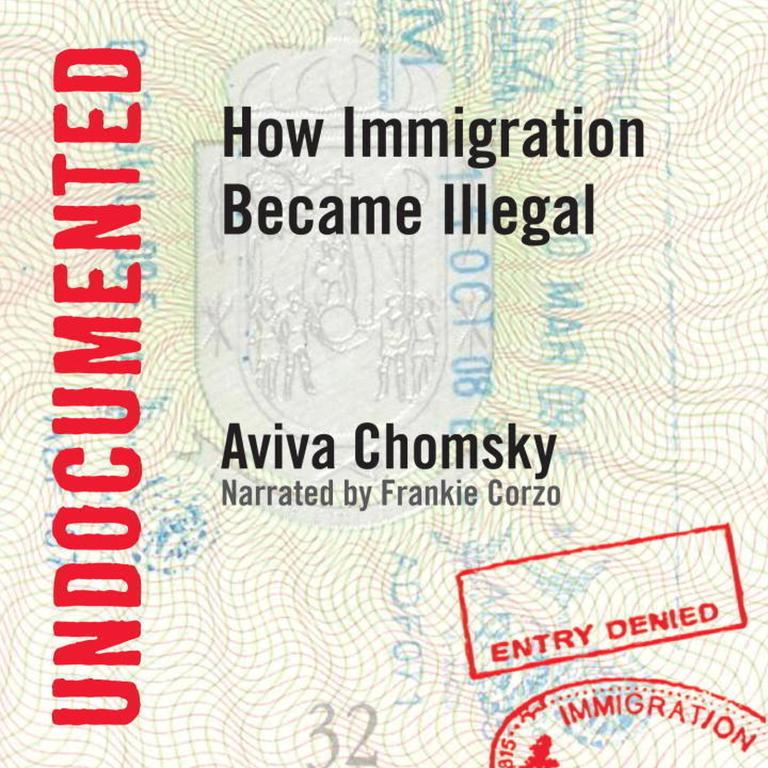 According to the official literature, “With Your U.S. Passport, the World Is Yours!” The intention is not to be ironic, but I couldn’t help think #Imperialism. That being said, it is true that if you can afford the airfare—and perhaps a small visa fee—then almost any U.S. citizen can leave this country to travel almost anywhere in the world. But most of our fellow human beings on this planet cannot travel so easily. As the Salem State University history professor Aviva Chomsky has written about in her powerful book Undocumented: How Immigration Become Illegal (Beacon Press, 2014), it is helpful to remember that:
For most of the world’s population, freedom to travel is a distant dream. They can’t leave the country of their birth…because no other country will let them in. Least of all, the United States. Today, whole countries—almost all of them in the [so-called] First World—shut themselves off to travelers, while assuming that their own citizens have the right to travel anywhere they choose. (40)
Why do we allow freedom of travel for some but not for all?
Far too frequently, the ethics of immigration are oversimplified: “Why don’t ‘they’ get in line and come to this country like my ancestors did?” Such questions ignore both how much immigration requirements have changed over time, and the ugly history of racial bias in our country’s immigration laws.
When my ancestors came to this country from Scotland and England, U.S. borders were relatively open, especially if you were considered “white.” Or consider that our government “excluded a mere 1% of the 25 million immigrants who landed at Ellis Island before World War I.” Most of that 1% were excluded for health reasons. The exception to those statistics is the major discrimination at that time against Chinese immigrants (45).
Also, before 1924, there were immigration statutes of limitations of one to five years, meaning that people who came here without official approval “did not live forever with the specter of deportation.” However, less than a century ago, in 1924, a new immigration law both created a quota system and eliminated the statutes of limitations, making the threat of deportation permanent (45). That is only one among many examples of how the situation in which some people’s ancestors entered this county was different from what is currently possible today.
An even more honest accounting of immigration would require us to turn back the clock even further. If a European-American feels entitled to chant “Go back to Mexico!” or “Go back to Africa!” then an American Indian could just as easily hold up a mirror to that protester and say, “Go back to Europe!” As a classic political cartoon suggests, if “It’s time to reclaim America from the illegal immigrants!” then many American Indians might tell white people, “I’ll help you pack.”
Cultivating more nuanced understandings of immigration is crucial at this moment in our country’s history as various politicians debate building a wall on the Mexican-American border, and argue about the future of the approximately 800,000 people who entered this country as minors. Their fate turns on passing legislation along the lines of the DREAM Act (“Development, Relief, and Education for Alien Minors”). The other acronym for legislation related to this group is DACA, which stands for “Deferred Action for Childhood Arrivals.”
The good news is that most of the American public is in favor of ‘standing on the side of love‘ for immigration justice: “67% of Americans favor allowing immigrants brought to the U.S. illegally as children to gain legal resident status if they join the military or go to college.… Since 2011, support for this policy has increased significantly, from 57%.” Tragically the popular consensus around sensible immigration reform (which was supported by both President George W. Bush and President Obama) has not yet created sufficient political will to pass the desperately needed congregational legislation.
The fear-mongering around immigration becomes even more tragic when you recall how much immigrants have contributed to this country. Many conservatives and liberals share this perspective. The recent example I have seen is from conservative columnist Bret Stephens, who recently highlighted the fact that, “Americans have won 40 percent of all Nobel Prizes ever awarded — and [recent] immigrants accounted for 35 percent of those winners…. Google. Comcast. eBay. Kraft. Pfizer. AT&T. They all had immigrants as founders.” As Lin-Manuel Miranda says in Hamilton, “Immigrants (We Get The Job Done).”
And when I think about the long-term struggle for immigration justice in this country, I am reminded of Dr. Daisy Machado, one of my best professors in seminary, who taught history from a Latina Feminist perspective. I will never forget her asking us to first imagine the Earth as we have seen it in pictures taken from space. Can you see it in your mind’s eye—the breathtakingly beautiful blue-green marble on which we find ourselves floating through the inky blackness of space? Then, picture a globe or almost any map you’ve ever seen. What’s the difference? Maps and globes almost always have human-created lines dividing up the natural world of our planet—often with various colors and labels reflecting which groups of humans claim given territories.
Beyond that comparison, what she said next resonated with me the most. She said: “Borders are wounds.” I’ve never forgotten that: a border is a wound—“an injury, a tear, a cut, a trauma”—that we have chosen (for various historically-contingent reasons) to inflict on ourselves as a society and as a species—or that others have inflicted upon us.
Dr. Machado came to see borders this way as a Latina feminist historian living in Texas. Borders have capriciously been moved back and forth over the lands and homes of familie with ancestors living in the lands now known as Texas and Mexico—for generations. First, there were the indigenous inhabitants, who suddenly found themselves declared part of the “Kingdom of New Spain,” followed by long periods of significant political instability . Texas even declared independence for a few years at one point. Then a few years later, the U.S. annexed Texas as part of it’s proclaimed ideology of Manifest Destiny. Meanwhile, most families simply kept trying to live their lives, even as border wounds kept getting carved out—above them, below them, around them, and sometimes, through them.
Recalling the more cosmic and global view of our planet from space can remind us that we humans created our current borders for historically contingent reasons. And if we choose to do so, we can “tear down these walls,” and build the more humane and compassionate world that we dream about.
The Rev. Dr. Carl Gregg is a certified spiritual director, a D.Min. graduate of San Francisco Theological Seminary, and the minister of the Unitarian Universalist Congregation of Frederick, Maryland. Follow him on Facebook (facebook.com/carlgregg) and Twitter (@carlgregg).
Learn more about Unitarian Universalism: http://www.uua.org/beliefs/principles
Previous Post

October 12, 2017
Cynic or Fool? How to Not "Go Low" When We Can’t Agree on Facts
Browse Our Archives
Select a Category Advent Anti-Racism Archaeology Atheism Baptism Best of the Year List Book Reviews Buddhism Catholicism Christian Education Church and State Church Planting Climate Change Conscientious Objection to War Creation Spirituality Death Penalty Didache Disability Rights Discernment Easter Ecology Emergent Church Movement Empire-Critical Ethics Evolution Feminist Theology Film Reviews Gandhi Gospel of Mark Gun Control Hinduism Immigration Reform Interfaith Islam JFK Judaism Jungian Spirituality Lectionary Commentary Lent Letters to the Editor LGBT Marriage MLK Multiculturalism Mysticism Nonviolent Activism Occupy Paganism (Earth-centered Religions) Parables Paul Pluralism Politics Process Theology Quantum Physics Requiescat In Pace Seminary and Divinity School Sermon Series Retrospective Sermons Spiritual Direction Spiritual Practices Stewardship (Fundraising) The Book of J The Wheel of the Year (Paganism) Theoblogger Challenge Triathlon Uncategorized Unitarian Universalism Worship Resources Youth Ministry
Select a Month July 2026 May 2026 March 2026 November 2025 October 2025 August 2025 February 2025 December 2024 October 2024 March 2024 January 2024 December 2023 November 2023 March 2023 February 2023 January 2023 December 2022 November 2022 August 2022 March 2022 February 2022 January 2022 December 2021 September 2021 August 2021 July 2021 June 2021 May 2021 February 2021 January 2021 December 2020 August 2020 June 2020 May 2020 April 2020 March 2020 February 2020 January 2020 December 2019 November 2019 October 2019 September 2019 July 2019 June 2019 March 2019 February 2019 January 2019 December 2018 November 2018 October 2018 September 2018 June 2018 May 2018 April 2018 March 2018 February 2018 January 2018 December 2017 November 2017 October 2017 September 2017 August 2017 July 2017 June 2017 May 2017 April 2017 March 2017 February 2017 January 2017 December 2016 November 2016 October 2016 September 2016 August 2016 June 2016 May 2016 April 2016 March 2016 February 2016 January 2016 December 2015 November 2015 October 2015 September 2015 August 2015 July 2015 June 2015 May 2015 April 2015 March 2015 February 2015 January 2015 December 2014 November 2014 October 2014 August 2014 July 2014 June 2014 May 2014 April 2014 March 2014 February 2014 January 2014 December 2013 November 2013 October 2013 September 2013 August 2013 July 2013 June 2013 May 2013 April 2013 March 2013 February 2013 January 2013 December 2012 November 2012 October 2012 September 2012 August 2012 July 2012 June 2012 May 2012 April 2012 March 2012 February 2012 January 2012 December 2011 November 2011 October 2011 September 2011 August 2011 July 2011 June 2011 May 2011 April 2011 March 2011 February 2011 January 2011 December 2010 November 2010 October 2010 August 2009 July 2009 May 2009
Follow Us!
TAKE THE
Religious Wisdom Quiz
What did God create on the first day according to Genesis?
Select your answer to see how you score.
Animals Man Light Plants
Related posts from Carl Gregg

Reading America at 250: A Nation Wrestles With...


Andrew Holocek on the Power of Darkness

The Stories That Shape Us: Myths, Archetypes, &...
TRENDING AT PATHEOS More Voices

Reading America at 250: A Nation Wrestles With...
As part of my own reflection on the 250th anniversary of the...

Whenever I am reading a book or listening to an argument, I...

President Trump Ban Animal Torture Videos on Facebook
Call for Stricter Regulations of Animal Abuse Content on Facebook Although President...

Draft Amendments to Address Ritual Abuse in New...
The proposed changes would make it illegal for individuals in domestic partnerships...

How Bans on LGBTQ+ Student Clubs Threaten Religious...
On June 20, 2025, the State of Texas passed Senate Bill 12....

The Truth About the Gen Z Revival
This past year, there has been a lot of media buzz surrounding...
view all More Voices blogs
Ad-Free & Subscriber Log-In Subscription Support
- About Us
- 2026 Calendar
- Videos
- Podcasts
- Library of World Religions
- Faith In Media Tracker
- Advertise With Us
- Write for Us
- Privacy Policy
- Terms of Service
- Do Not Sell My Data
- Contact Us
- Radiant Digital
- Manage Newsletter Subscriptions
- Unsubscribe From Notifications
- Sitemap
Copyright 2008-2026, Patheos. All rights reserved.
Subscription Support Ad-Free & Subscriber Log-In
Follow Patheos