
BuddhistCatholicContemplativeEvangelicalGeneral ChristianHinduJewishLatter-day SaintMuslimNew VisionsProgressive Christian
Beliefs
- Buddhist
- Catholic
- Contemplative
- Evangelical
- General Christian
- Hindu
- Jewish
- Latter-day Saint
- More Voices
- Muslim
- New Visions
- Pagan
- Progressive Christian
Topics
- Religion News
- Food and Religion
- Sports and Religion
- Religious Art
- Religious Music and Entertainment
- Religious Events
- History and Religion
- Style and Religion
- Politics and Religion
- Women in Religion
- Recreation Outdoors and Religion
- Business Finance and Religion
- Careers Workplace and Religion
- Education and Religion
- Family Parenting and Religion
- Health Fitness and Religion
- Home and Religion
- Relationships and Religion
- Technology and Religion
- Travel and Religion
Columnists
- Buddhist Columnists
- Business Finance and Religion Columnists
- Careers Workplace and Religion Columnists
- Catholic Columnists
- Contemplative Columnists
- Education and Religion Columnists
- Evangelists Columnists
- Family Parenting and Religion Columnists
- General Christian Columnists
- Health Fitness and Religion Columnists
- Hindu Columnists
- History and Religion Columnists
- Home and Religion Columnists
- Jewish Columnists
- More Voices Columnists
- Latter Day Columnists
- Muslim Columnists
- New Visions Columnists
- Nonreligious Columnists
- Pagan Columnists
- Politics and Religion Columnists
- Progressive Columnists
- Recreation Outdoors and Religion Columnists
- Relationships and Religion Columnists
- Religion News Columnists
- Religious Art Columnists
- Religious Events Columnists
- Religious Music and Entertainment Columnists
- Sports and Religion Columnists
- Style and Religion Columnists
- Technology and Religion Columnists
- Travel and Religion Columnists
- Women in Religion Columnists
Resource Library
- 2026 Calendar
- Library of World Religions
- The 100 Most Holy Places on Earth
- Patheos Answers
- Podcasts
- Videos
- Faith Leaders Database
- Anglican Episcopalian
- Bahai
- Baptist
- Buddhism
- Christianity
- Confucianism
- Eastern Orthodoxy
- Hinduism
- Holiness and Pentecostal
- ISKCON
- Islam
- Judaism
- Lutheran
- Methodist
- The Church of Jesus Christ of Latter-day Saints
- New Age
- Paganism
- Presbytarian and Reformed
- Protestantism
- Religion Behind the Scenes
- Roman Catholic
- Scientology
- Shia Islam
- Sikhism
- Sufism
- Sunni Islam
- Taoism
- Zen
- See all religions
Research Tools
 Ad-Free & Subscriber Log-In Subscription Support
Ad-Free & Subscriber Log-In Subscription Support
Follow Patheos 

- Trending:
- Forgiveness
- |
- Marriage
- |
- Consciousness
- |
- Death Penalty
- |
- Election
- |
- Halloween

- Home
- More Voices
- Bioethics, CRISPR, & “Our Children Redesigned”
Bioethics, CRISPR, & “Our Children Redesigned”
Last updated on: September 14, 2017 at 10:01 am by Carl Gregg
Bioethics, CRISPR, & “Our Children Redesigned” 2017-09-14T10:01:58-04:00 Carl Gregg
Patheos Explore the world's faith through different perspectives on religion and spirituality! Patheos has the views of the prevalent religions and spiritualities of the world.
Have you been following the breaking news about the revolutionary new gene-editing technology CRISPR? Not “crisper” with an “e”—like a refrigerator drawer for keeping your lettuce fresh—but the acronym for Clustered Regularly Interspaced Short Palindromic Repeats. (That clears it up, right?! No worries. More clarity forthcoming.)
Consider these headlines in The New York Times from just the past six weeks. The first headline is from July 27: “In U.S. First, Scientists Edit Genes of Human Embryos.” It says “In U.S. First” because Chinese scientists were the first to experiment with this breakthrough two years ago in mid-2015 (xix). That highlights a crucial factor in bioethical debates: not only should something be tried, but also, what happens if others move forward and we do not? The headline continues, “Scientists Edit Genes of Human Embryos,” but it is important to add that “the embryos were not allowed to develop for more than a few days and were never intended to be implanted into a womb.” In other words, we are currently holding ourselves back. Perhaps rightly so, but it depends on whom you ask.
The second headline is from August 30: “F.D.A. Approves First Gene-Altering Leukemia Treatment, Costing $475,000.” The U.S. Food and Drug Administration has “approved the first-ever treatment that genetically alters a patient’s own cells to fight cancer, a milestone that is expected to transform treatment in the coming years.” This particular treatment is for an especially aggressive type of leukemia, but many similar gene therapies are in the pipeline. The half million dollar price tag is because a single-dose must be tailored for each individual, which can make the treatment both effective and expensive. “The first child to receive the therapy was Emily Whitehead, who was 6 and near death from leukemia in 2012 when she was treated…. Now 12, she has been free of leukemia for more than five years.” Such possibilities open a whole new world beyond today’s typical regimen of “surgery, radiation, and chemotherapy” (175). Additionally, two days ago, the below-the-fold cover story was “New Gene-Therapy Treatments Will Carry Whopping Price Tags.”
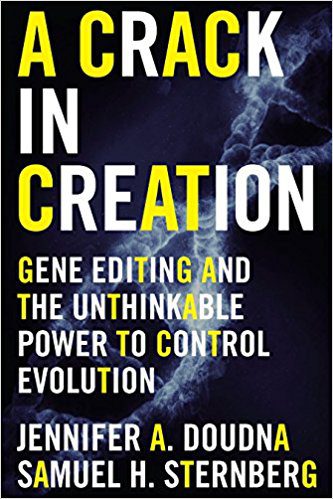 A helpful guide to this cutting-edge world of possibilities is a book titled A Crack in Creation: Gene Editing and the Unthinkable Power to Control Evolution by Jennifer Doudna and Samuel Sternberg (Houghton Mifflin Harcourt, 2017). To name one among her many appointments, Doudna is a professor in the Chemistry and the Molecular and Cell Biology Departments at the University of California, Berkeley. Sternberg is a fellow researcher and doctoral-level biochemist.
While I mainly want to focus on the technology and its potential implications, I can’t resist sharing the story that first launched Dr. Doudna on a trajectory toward become an expert on genome engineering. When she was twelve, she returned home from school to find on her bed a “tattered copy of James Watson’s The Double Helix”:
My dad would occasionally pick up books for me at used bookstores to see if they sparked any interest. Thinking this book was a detective novel —which it was!—I set it aside for some weeks before diving into its pages one rainy Saturday afternoon…. I felt the first tugs of interest that would eventually guide me onto a similar path. (10)
I love that story. I find it fascinating to trace the difficult-to-predict sparks that can grow into a lifelong passion. And that passion for discovery, ignited by reading about the mid-twentieth-century discovery of DNA’s molecular structure, led to the innovation of CRISPR.
But perhaps appropriately for an invention whose full implications are far from clear, neither of these scientists set out to turn biotechnology and bioethics on their respective heads. Rather, their intention was to research “the way that bacteria defend themselves against viral infection.” In so doing, they stumbled backward into the “workings of an incredible molecular machine that could slice apart viral DNA with exquisite precision. The utility of this same machine to perform DNA manipulations in other kinds of cells, including human cells, was immediately clear” (xvii).
It is at this point that bioethicists diverge. In politics, the saying goes that, “One person’s terrorist is another person’s freedom fighter.” Likewise, in bioethics, one person’s sacrilege is another person’s sacred responsibility (xviii):
Some people view any form of genetic manipulation as heinous, a perverse violation of the sacred laws of nature and the dignity of life. Others see the genome simply as software—something we can fix, clean, update, and upgrade—and argue that leaving humans beings at the mercy of faulty genetics is not only irrational, but immoral. Considerations like these have led some to call for an outright ban on editing the genomes of unborn humans, and others to call for scientists to forge ahead without restraint.
One side argues that we must beware the “Law of Unintended Consequences.” The other side urges that, “Someday we may consider it unethical not to use germline editing to alleviate human suffering” (xix).
Speculation aside, let me tell you about what has already happened—because a few newspaper headlines notwithstanding, it seems evident that scientific research is significantly outpacing public awareness of bioethical breakthroughs (200-201):
-
Scientists have harnessed CRISPR to generate a genetically enhanced version of the beagle, creating dogs with Schwarzenegger-like super-muscular physiques by making single-letter DNA changes to a gene that controls muscle formation.
-
In another case, by inactivating a gene in the pig genome that responds to growth hormone, researchers have created micro-pigs, swine no bigger than large cats, which can be sold as pets….
-
Meanwhile in the plant world…gene-editing experiments have produced disease-resistant rice, tomatoes that ripen more slowly, and soybeans with healthier polyunsaturated fat content….by fine-tuned genetic upgrades involving changes to just a few letters of the organism’s own DNA….
-
In recent experiments, CRISPR has been used to “humanize” the DNA of pigs, giving rise to hopes that these animals might someday serve as organ donors for humans….
-
In laboratory-grown human cells, this new gene-editing technology was used to correct the mutations responsible for cystic fibrosis and sickle cell disease, among many other disorders. (xiv-xv)
So much more is quickly becoming possible—or is already possible—that we’re not yet sure, collectively, whether it’s a good idea to try. Some of you will recall the tale of Prometheus: “the deity in Greek mythology who was the creator of humanity and its greatest benefactor, who stole fire from Mount Olympus and gave it to humankind.” With CRISPR, we are playing with fire with great potential for promise and peril.
I will continue this theme in tomorrow’s post on “Revolutionary Bioethics: from “Gene-editing” to “Genome Engineering.”
Learn more about Unitarian Universalism: http://www.uua.org/beliefs/principles

Browse Our Archives
Select a Category Advent Anti-Racism Archaeology Atheism Baptism Best of the Year List Book Reviews Buddhism Catholicism Christian Education Church and State Church Planting Climate Change Conscientious Objection to War Creation Spirituality Death Penalty Didache Disability Rights Discernment Easter Ecology Emergent Church Movement Empire-Critical Ethics Evolution Feminist Theology Film Reviews Gandhi Gospel of Mark Gun Control Hinduism Immigration Reform Interfaith Islam JFK Judaism Jungian Spirituality Lectionary Commentary Lent Letters to the Editor LGBT Marriage MLK Multiculturalism Mysticism Nonviolent Activism Occupy Paganism (Earth-centered Religions) Parables Paul Pluralism Politics Process Theology Quantum Physics Requiescat In Pace Seminary and Divinity School Sermon Series Retrospective Sermons Spiritual Direction Spiritual Practices Stewardship (Fundraising) The Book of J The Wheel of the Year (Paganism) Theoblogger Challenge Triathlon Uncategorized Unitarian Universalism Worship Resources Youth Ministry
Select a Month July 2026 May 2026 March 2026 November 2025 October 2025 August 2025 February 2025 December 2024 October 2024 March 2024 January 2024 December 2023 November 2023 March 2023 February 2023 January 2023 December 2022 November 2022 August 2022 March 2022 February 2022 January 2022 December 2021 September 2021 August 2021 July 2021 June 2021 May 2021 February 2021 January 2021 December 2020 August 2020 June 2020 May 2020 April 2020 March 2020 February 2020 January 2020 December 2019 November 2019 October 2019 September 2019 July 2019 June 2019 March 2019 February 2019 January 2019 December 2018 November 2018 October 2018 September 2018 June 2018 May 2018 April 2018 March 2018 February 2018 January 2018 December 2017 November 2017 October 2017 September 2017 August 2017 July 2017 June 2017 May 2017 April 2017 March 2017 February 2017 January 2017 December 2016 November 2016 October 2016 September 2016 August 2016 June 2016 May 2016 April 2016 March 2016 February 2016 January 2016 December 2015 November 2015 October 2015 September 2015 August 2015 July 2015 June 2015 May 2015 April 2015 March 2015 February 2015 January 2015 December 2014 November 2014 October 2014 August 2014 July 2014 June 2014 May 2014 April 2014 March 2014 February 2014 January 2014 December 2013 November 2013 October 2013 September 2013 August 2013 July 2013 June 2013 May 2013 April 2013 March 2013 February 2013 January 2013 December 2012 November 2012 October 2012 September 2012 August 2012 July 2012 June 2012 May 2012 April 2012 March 2012 February 2012 January 2012 December 2011 November 2011 October 2011 September 2011 August 2011 July 2011 June 2011 May 2011 April 2011 March 2011 February 2011 January 2011 December 2010 November 2010 October 2010 August 2009 July 2009 May 2009
Follow Us!
TAKE THE
Religious Wisdom Quiz
Who said, "Lord, to whom shall we go? You have the words of eternal life"?
Select your answer to see how you score.
Judas John Peter James
Related posts from Carl Gregg

Reading America at 250: A Nation Wrestles With...


Andrew Holocek on the Power of Darkness

The Stories That Shape Us: Myths, Archetypes, &...
TRENDING AT PATHEOS More Voices

Reading America at 250: A Nation Wrestles With...
As part of my own reflection on the 250th anniversary of the...

Whenever I am reading a book or listening to an argument, I...

President Trump Ban Animal Torture Videos on Facebook
Call for Stricter Regulations of Animal Abuse Content on Facebook Although President...

Draft Amendments to Address Ritual Abuse in New...
The proposed changes would make it illegal for individuals in domestic partnerships...

How Bans on LGBTQ+ Student Clubs Threaten Religious...
On June 20, 2025, the State of Texas passed Senate Bill 12....

The Truth About the Gen Z Revival
This past year, there has been a lot of media buzz surrounding...
view all More Voices blogs
Ad-Free & Subscriber Log-In Subscription Support
- About Us
- 2026 Calendar
- Videos
- Podcasts
- Library of World Religions
- Faith In Media Tracker
- Advertise With Us
- Write for Us
- Privacy Policy
- Terms of Service
- Do Not Sell My Data
- Contact Us
- Radiant Digital
- Manage Newsletter Subscriptions
- Unsubscribe From Notifications
- Sitemap
Copyright 2008-2026, Patheos. All rights reserved.
Subscription Support Ad-Free & Subscriber Log-In
Follow Patheos