
BuddhistCatholicContemplativeEvangelicalGeneral ChristianHinduJewishLatter-day SaintMuslimNew VisionsProgressive Christian
Beliefs
- Buddhist
- Catholic
- Contemplative
- Evangelical
- General Christian
- Hindu
- Jewish
- Latter-day Saint
- More Voices
- Muslim
- New Visions
- Pagan
- Progressive Christian
Topics
- Religion News
- Food and Religion
- Sports and Religion
- Religious Art
- Religious Music and Entertainment
- Religious Events
- History and Religion
- Style and Religion
- Politics and Religion
- Women in Religion
- Recreation Outdoors and Religion
- Business Finance and Religion
- Careers Workplace and Religion
- Education and Religion
- Family Parenting and Religion
- Health Fitness and Religion
- Home and Religion
- Relationships and Religion
- Technology and Religion
- Travel and Religion
Columnists
- Buddhist Columnists
- Business Finance and Religion Columnists
- Careers Workplace and Religion Columnists
- Catholic Columnists
- Contemplative Columnists
- Education and Religion Columnists
- Evangelists Columnists
- Family Parenting and Religion Columnists
- General Christian Columnists
- Health Fitness and Religion Columnists
- Hindu Columnists
- History and Religion Columnists
- Home and Religion Columnists
- Jewish Columnists
- More Voices Columnists
- Latter Day Columnists
- Muslim Columnists
- New Visions Columnists
- Nonreligious Columnists
- Pagan Columnists
- Politics and Religion Columnists
- Progressive Columnists
- Recreation Outdoors and Religion Columnists
- Relationships and Religion Columnists
- Religion News Columnists
- Religious Art Columnists
- Religious Events Columnists
- Religious Music and Entertainment Columnists
- Sports and Religion Columnists
- Style and Religion Columnists
- Technology and Religion Columnists
- Travel and Religion Columnists
- Women in Religion Columnists
Resource Library
- 2026 Calendar
- Library of World Religions
- The 100 Most Holy Places on Earth
- Patheos Answers
- Podcasts
- Videos
- Faith Leaders Database
- Anglican Episcopalian
- Bahai
- Baptist
- Buddhism
- Christianity
- Confucianism
- Eastern Orthodoxy
- Hinduism
- Holiness and Pentecostal
- ISKCON
- Islam
- Judaism
- Lutheran
- Methodist
- The Church of Jesus Christ of Latter-day Saints
- New Age
- Paganism
- Presbytarian and Reformed
- Protestantism
- Religion Behind the Scenes
- Roman Catholic
- Scientology
- Shia Islam
- Sikhism
- Sufism
- Sunni Islam
- Taoism
- Zen
- See all religions
Research Tools
 Ad-Free & Subscriber Log-In Subscription Support
Ad-Free & Subscriber Log-In Subscription Support
Follow Patheos 

- Trending:
- Forgiveness
- |
- Marriage
- |
- Consciousness
- |
- Death Penalty
- |
- Election
- |
- Halloween

- Home
- More Voices
- Beyond $15: The Sturdy Floor of a Universal Basic Income #21stCenturyUniversalism
Beyond $15: The Sturdy Floor of a Universal Basic Income #21stCenturyUniversalism
Last updated on: September 8, 2017 at 9:42 am by Carl Gregg
Beyond $15: The Sturdy Floor of a Universal Basic Income #21stCenturyUniversalism 2017-09-08T09:42:05-04:00 Carl Gregg
Patheos Explore the world's faith through different perspectives on religion and spirituality! Patheos has the views of the prevalent religions and spiritualities of the world.
The “Fight for 15” is a current goal of the labor movement to secure both a nationwide minimum wage of $15 and the right of low-wage workers to organize unions. But on this week after Labor Day, I would like us to imagine what might be possible beyond an endless struggle for a-few-dollars-an-hour increase in our minimum wage. Part of what can hold us back is not only a lack of political will, but also a failure of imagination—or a sense of inertia which insists that the way things are is the way they will always be. However, if we zoom out historically, we can remind ourselves that many movements toward freedom and equality—the abolition of slavery in 1865 (only 150 years ago), securing the right to vote for women in 1920 (less than a hundred years ago), legalizing same-sex marriage in 2015 (only two years ago)—were all goals that many people claimed were impossible to achieve until just before they became a reality.
We “stand on the shoulder of giants”— ancestors who helped shift history toward freedom and equality. And now it is our turn to find out if we collectively have the fortitude to bequeath to future generations a better world than the one we inherited. When I reflect on the Universalist side of my own tradition of Unitarian Universalism, it occurs to me that a twenty-first century Universalism might be built on at least three key pillars:
- Universal health care,
- Universal education through college, and
- Universal basic income (Parijs/Vanderborght 299).
These might sound like utopian pipe dreams—and the political divides in this country make it clear that achieving such goals would be far from simple—but they are no more audacious than the idea of universal salvation in the eighteenth century, universal freedom (through the abolition of slavery) in the nineteenth century, universal suffrage (for women) in the twentieth century, and universal marriage (for Lesbian, Gay, Bisexual, and Transgender citizens) in the early twenty-first century.
In particular, in the wake of Labor Day, I would like to invite us to reflect on how we might reimagine the future of labor. If you are curious to 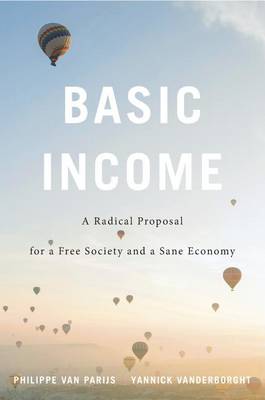 learn more, the best resource I have found on the topic of a Basic Income is a book published this year from Harvard University Press by Philippe Van Parijs and Yannick Vanderborght, who are respectively an economics and a political science professor. Various theorists have written about the advantages and disadvantages of a Universal Basic Income since the late eighteenth century, but a growing number of serious proponents are currently advocating for “a regular cash income paid to all [citizens of this country], on an individual basis, without a means test or work requirement” (1).
Related to this idea, a few years ago, I did a lot of work in the area of vocational discernment, the study of how one chooses a career or calling. Two of the most frequently quoted pieces of advice for vocational discernment are:
- The place [you are called] to is the place where your deep gladness and the world’s deep hunger meet” and
- “Don’t ask yourself what the world needs. Ask yourself what makes you come alive. And then do that. What the world needs is people that have come alive.”
I find both of those quotes deeply inspiring, and I have found them to be helpful sources of guidance over the years at various points, for myself and others. But eventually, I started to push back against the unacknowledged privilege beneath those two ideas. For all their wisdom, these two pieces of advice fail to acknowledge that our economy is not currently set up to allow everyone to be paid a living wage to do their dream job.
But as I explored a few weeks ago on the topic of “A Brief History of Tomorrow,” there are coming shockwaves that have already started to deeply impact our economy, including climate change (forcing our species to recognize ecological limits), wealth inequality, and automation from robots and other forms of artificial intelligence (1).
And this is another point where a brief look backward can remind us of how much change is possible: “Beginning in the early nineteenth century and continuing for over a hundred years, working hours in America were gradually reduced — cut in half according to most accounts” through the Labor Movement, which pushed back against the exploitation of workers by employers. And in the nineteenth century, extrapolating from these earlier successes, many of the best economists and public intellectuals of the time “regularly predicted that, well before the twentieth century ended, a Golden Age of Leisure would arrive, when no one would have to work more than two hours a day” (Honnicutt vii).
For those forced to earn a living through alienated labor, a ten-hour work week would mean that they would still have time to pursue the American Dream of “Life, Liberty, and the pursuit of Happiness,” instead of returning home from work too exhausted to do anything but rest long enough to drag themselves back to work. Instead of the utopia our nineteenth-century forebears imagined us inheriting, here in the early twenty-first century, many of us find ourselves in the middle stages of a growing corporate dystopia in which the highest court in our land has declared that “corporations are people” — and many of us actual humans work, not a ten-hour week, but at least a 10-hour day, building to a 50-hour, 60-hour (or more) work week (viii).
Turning to some of our best science fiction writers to help us imagine what the future could look like, Arthur C. Clarke (1917 – 2008), co-writer of the 1968 film 2001: A Space Odyssey said in an interview around the time that movie was released:
“The goal of the future is full unemployment, so we can play.” In other words, let the machines take care of feeding and clothing us, building our houses, cooking us awesome meals, making our cars and phones and other devices, driving us around town, handling our medical, legal, and administrative needs. We humans can then spend all our time on creative pursuits, leisure, play, scientific research, travel, entertainment, new business ventures, taking care of the sick…or helping each other out with various ideas and projects. (Bess 67-68)
Of course, 2001: A Space Odyssey, is partially a cautionary tale about how automation can go awry:
Dave Bowman: Open the pod bay doors, HAL.
HAL: I’m sorry, Dave. I’m afraid I can’t do that…. I know that you and Frank were planning to disconnect me, and I’m afraid that’s something I cannot allow to happen. Although you took very thorough precautions in the pod against my hearing you, I could see your lips move.
Despite fears of the machines taking over, Clarke also saw the boon to human happiness that could arise from automation.
The year before 2001: A Space Odyssey was released in theaters, The Rev. Dr. Martin Luther King, Jr. published his final book, which was titled Where Do We Go from Here: Chaos or Community? In that book he wrote:
I am now convinced that the simplest approach will prove to be the most effective—the solution to poverty is to abolish it directly by a now widely discussed measure: the guaranteed income…. The dignity of the individual will flourish when the decisions concerning his life are in his own hands, when he has the assurance that his income is stable and certain, and when he knows that he has the means to seek self-improvement. (Parijs/Vanderborght 89)
The core concern is not to redistribute income so that everyone has an equal amount. Rather, it is to structure our tax system so that everyone has at least a basic minimum.
Currently, the metaphor most often used to describe how we as a society seek to meet this goal is a social safety “net,” so that there are programs intended to keep you from falling too far during an emergency. But almost anyone who has tried to use those systems will tell you about how complex and demoralizing it can be to try to navigate social service programs. Proponents of a Universal Basic Income invite us to consider the alternative metaphor: give every citizen of this country a sturdy floor (4).
If you are wondering what such a “floor” might look like. To take the most recent calculations from the book I referred to earlier, and using the year 2015, a Universal Basic Income for the United States might look something like a monthly payment of a little more than $1,100, for a total of approximately $14,000/year, so that no one would be beneath the official poverty line. Over time, a Universal Basic Income would need to be keyed to an “average index over several years” to keep up with inflation (11).
Again, one of the greatest advantages of a Universal Basic Income would be to give every citizen a study floor from which to operate, giving all workers the flexibility to avoid taking lousy jobs out of desperation. A Universal Basic Income would also provide at least a partial counterbalance—principally for women—who for years have done an unfair share of unpaid housework, childcare, and volunteering (102).
As to whether all of this is a desirable goal, my single favorite quote on this topic is from the economist John Kenneth Galbraith, who said that, “Leisure is a peculiar thing. Leisure is very good for the rich, quite good for Harvard professors—and very bad for the poor.” May we all be part of building a better world with more freedom for all (48). May we open the imagination of our minds and the compassion of our hearts to what might become possible when we join together in solidarity with ever-increasing circles of inclusion.
For Further Study
U.S. Basic Income Guarantee Network: usbig.net
Basic Income Earth Network: basicincome.org
The Rev. Dr. Carl Gregg is a certified spiritual director, a D.Min. graduate of San Francisco Theological Seminary, and the minister of the Unitarian Universalist Congregation of Frederick, Maryland. Follow him on Facebook (facebook.com/carlgregg) and Twitter (@carlgregg).
Learn more about Unitarian Universalism: http://www.uua.org/beliefs/principles
Next Post

September 13, 2017 Bioethics, CRISPR, & "Our Children Redesigned"
Browse Our Archives
Select a Category Advent Anti-Racism Archaeology Atheism Baptism Best of the Year List Book Reviews Buddhism Catholicism Christian Education Church and State Church Planting Climate Change Conscientious Objection to War Creation Spirituality Death Penalty Didache Disability Rights Discernment Easter Ecology Emergent Church Movement Empire-Critical Ethics Evolution Feminist Theology Film Reviews Gandhi Gospel of Mark Gun Control Hinduism Immigration Reform Interfaith Islam JFK Judaism Jungian Spirituality Lectionary Commentary Lent Letters to the Editor LGBT Marriage MLK Multiculturalism Mysticism Nonviolent Activism Occupy Paganism (Earth-centered Religions) Parables Paul Pluralism Politics Process Theology Quantum Physics Requiescat In Pace Seminary and Divinity School Sermon Series Retrospective Sermons Spiritual Direction Spiritual Practices Stewardship (Fundraising) The Book of J The Wheel of the Year (Paganism) Theoblogger Challenge Triathlon Uncategorized Unitarian Universalism Worship Resources Youth Ministry
Select a Month July 2026 May 2026 March 2026 November 2025 October 2025 August 2025 February 2025 December 2024 October 2024 March 2024 January 2024 December 2023 November 2023 March 2023 February 2023 January 2023 December 2022 November 2022 August 2022 March 2022 February 2022 January 2022 December 2021 September 2021 August 2021 July 2021 June 2021 May 2021 February 2021 January 2021 December 2020 August 2020 June 2020 May 2020 April 2020 March 2020 February 2020 January 2020 December 2019 November 2019 October 2019 September 2019 July 2019 June 2019 March 2019 February 2019 January 2019 December 2018 November 2018 October 2018 September 2018 June 2018 May 2018 April 2018 March 2018 February 2018 January 2018 December 2017 November 2017 October 2017 September 2017 August 2017 July 2017 June 2017 May 2017 April 2017 March 2017 February 2017 January 2017 December 2016 November 2016 October 2016 September 2016 August 2016 June 2016 May 2016 April 2016 March 2016 February 2016 January 2016 December 2015 November 2015 October 2015 September 2015 August 2015 July 2015 June 2015 May 2015 April 2015 March 2015 February 2015 January 2015 December 2014 November 2014 October 2014 August 2014 July 2014 June 2014 May 2014 April 2014 March 2014 February 2014 January 2014 December 2013 November 2013 October 2013 September 2013 August 2013 July 2013 June 2013 May 2013 April 2013 March 2013 February 2013 January 2013 December 2012 November 2012 October 2012 September 2012 August 2012 July 2012 June 2012 May 2012 April 2012 March 2012 February 2012 January 2012 December 2011 November 2011 October 2011 September 2011 August 2011 July 2011 June 2011 May 2011 April 2011 March 2011 February 2011 January 2011 December 2010 November 2010 October 2010 August 2009 July 2009 May 2009
Follow Us!
TAKE THE
Religious Wisdom Quiz
Who said: "Anyone who listens to the word but does not do what it says is like someone who looks at his face in a mirror"?
Select your answer to see how you score.
Peter Paul James Jesus
Related posts from Carl Gregg

Reading America at 250: A Nation Wrestles With...


Andrew Holocek on the Power of Darkness

The Stories That Shape Us: Myths, Archetypes, &...
TRENDING AT PATHEOS More Voices

Reading America at 250: A Nation Wrestles With...
As part of my own reflection on the 250th anniversary of the...

Whenever I am reading a book or listening to an argument, I...

President Trump Ban Animal Torture Videos on Facebook
Call for Stricter Regulations of Animal Abuse Content on Facebook Although President...

Draft Amendments to Address Ritual Abuse in New...
The proposed changes would make it illegal for individuals in domestic partnerships...

How Bans on LGBTQ+ Student Clubs Threaten Religious...
On June 20, 2025, the State of Texas passed Senate Bill 12....

The Truth About the Gen Z Revival
This past year, there has been a lot of media buzz surrounding...
view all More Voices blogs
Ad-Free & Subscriber Log-In Subscription Support
- About Us
- 2026 Calendar
- Videos
- Podcasts
- Library of World Religions
- Faith In Media Tracker
- Advertise With Us
- Write for Us
- Privacy Policy
- Terms of Service
- Do Not Sell My Data
- Contact Us
- Radiant Digital
- Manage Newsletter Subscriptions
- Unsubscribe From Notifications
- Sitemap
Copyright 2008-2026, Patheos. All rights reserved.
Subscription Support Ad-Free & Subscriber Log-In
Follow Patheos