
BuddhistCatholicContemplativeEvangelicalGeneral ChristianHinduJewishLatter-day SaintMuslimNew VisionsProgressive Christian
Beliefs
- Buddhist
- Catholic
- Contemplative
- Evangelical
- General Christian
- Hindu
- Jewish
- Latter-day Saint
- More Voices
- Muslim
- New Visions
- Pagan
- Progressive Christian
Topics
- Religion News
- Food and Religion
- Sports and Religion
- Religious Art
- Religious Music and Entertainment
- Religious Events
- History and Religion
- Style and Religion
- Politics and Religion
- Women in Religion
- Recreation Outdoors and Religion
- Business Finance and Religion
- Careers Workplace and Religion
- Education and Religion
- Family Parenting and Religion
- Health Fitness and Religion
- Home and Religion
- Relationships and Religion
- Technology and Religion
- Travel and Religion
Columnists
- Buddhist Columnists
- Business Finance and Religion Columnists
- Careers Workplace and Religion Columnists
- Catholic Columnists
- Contemplative Columnists
- Education and Religion Columnists
- Evangelists Columnists
- Family Parenting and Religion Columnists
- General Christian Columnists
- Health Fitness and Religion Columnists
- Hindu Columnists
- History and Religion Columnists
- Home and Religion Columnists
- Jewish Columnists
- More Voices Columnists
- Latter Day Columnists
- Muslim Columnists
- New Visions Columnists
- Nonreligious Columnists
- Pagan Columnists
- Politics and Religion Columnists
- Progressive Columnists
- Recreation Outdoors and Religion Columnists
- Relationships and Religion Columnists
- Religion News Columnists
- Religious Art Columnists
- Religious Events Columnists
- Religious Music and Entertainment Columnists
- Sports and Religion Columnists
- Style and Religion Columnists
- Technology and Religion Columnists
- Travel and Religion Columnists
- Women in Religion Columnists
Resource Library
- 2026 Calendar
- Library of World Religions
- The 100 Most Holy Places on Earth
- Patheos Answers
- Podcasts
- Videos
- Faith Leaders Database
- Anglican Episcopalian
- Bahai
- Baptist
- Buddhism
- Christianity
- Confucianism
- Eastern Orthodoxy
- Hinduism
- Holiness and Pentecostal
- ISKCON
- Islam
- Judaism
- Lutheran
- Methodist
- The Church of Jesus Christ of Latter-day Saints
- New Age
- Paganism
- Presbytarian and Reformed
- Protestantism
- Religion Behind the Scenes
- Roman Catholic
- Scientology
- Shia Islam
- Sikhism
- Sufism
- Sunni Islam
- Taoism
- Zen
- See all religions
Research Tools
 Ad-Free & Subscriber Log-In Subscription Support
Ad-Free & Subscriber Log-In Subscription Support
Follow Patheos 

- Trending:
- Forgiveness
- |
- Marriage
- |
- Consciousness
- |
- Death Penalty
- |
- Election
- |
- Halloween

- Home
- More Voices
- Orwell, Atwood, Butler: Reading for Resistance & Resilience in the Age of Trump
Orwell, Atwood, Butler: Reading for Resistance & Resilience in the Age of Trump
Last updated on: September 13, 2017 at 10:02 am by Carl Gregg
Orwell, Atwood, Butler: Reading for Resistance & Resilience in the Age of Trump 2017-09-13T10:02:40-04:00 Carl Gregg
Patheos Explore the world's faith through different perspectives on religion and spirituality! Patheos has the views of the prevalent religions and spiritualities of the world.
This summer at the congregation where I serve as minister, we hosted a three-part book discussion series on “Reading for Resistance & Resilience.” When I first mentioned this idea in the spring to my wife Magin, who is an English professor, she was intrigued. But she also cautioned that George Orwell’s 1984, Margaret Atwood’s The Handmaid’s Tale, and Octavia Butler’s Parable of the Talents “might be the most depressing list of beach reading I’ve ever heard.” In retrospect, from the insights that have emerged from these book discussions, it seems clear to me that hosting these three Congregational Conversations on dystopian fiction was a good decision.
To quote the contemporary author Ben Winter about the potential insights that can come from reading and discussing novels:
Fiction has a power to clarify, to galvanize, to prophesy, and warn. Fiction allows us to take big picture questions, big issues, big moral and socio-political changes and see how they play out on real people’s lives, with real individuals.
In that spirit, I would like to share some highlights from this series.
But before I plunge in fully, a caveat may be in order. In these trying times in our nation’s history, allow me to be clear that my intent is not politically partisan. The underlying motivation is not about resisting one or another political party. Rather, it is about wrestling with novels that show us what our present and future can look like if we allow our democratic and constitutional norms to be undermined. And that is very much at the heart of my tradition of Unitarian Universalism tradition in which our 5th Principle is “The right of conscience and the use of the democratic process within our congregations and in society at large.”
That being said, when we describe Unitarian Universalism as a “liberal religious movement,” that is a reference not to a political party, but to the much older philosophical tradition of Liberalism, from the Latin root liber, meaning free. Unitarian Universalism cherishes the freedom for individuals to choose for themselves, based on the dictates of their conscience. We seek to be liberal in the best sense of the word: open to new ideas, generous, openhanded, open-hearted, and open-minded. And that means there is room within our big tent for those who are conservative in the best sense of the word: caring about the conservation of nature, upholding the beauty of traditions and rituals which have accrued deep meaning through time—reminding us of the importance of individual responsibility, community, authority, sanctity, and loyalty.
The other side of that coin is that there are morally repugnant points of view—anti-Semitism, racism, xenophobia, Islamophobia—which are beyond the pale even of the UU big tent. And this summer book discussion series has precisely been about resistance and resilience in the face of movements which are anti-democratic, authoritarian, and opposed to the freedom, diversity, and tolerance that are core values in an open society.
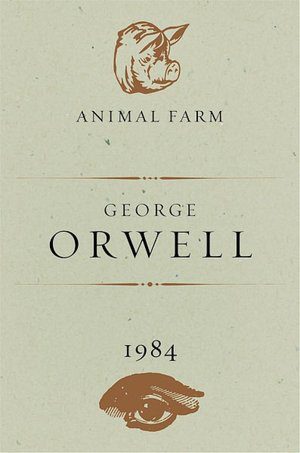 For part 1, our central discussion question for George Orwell’s 1984 was “How is resistance and resilience cultivated in response to gaslighting, Big Brother and the Thought Police?” Gaslighting attempts to make someone question their own sanity by telling them that they are wrong—despite all evidence to the contrary. It is a form of lying that is particularly manipulative and abusive. One of the ways this dynamic plays out in Orwell’s 1984 world of “Alternative Facts” is through the structure of the totalitarian regime in which the “Ministry of Truth” produces propaganda, the “Ministry of Peace” wages war, and the “Ministry of Love” imprisons dissidents. The regime’s gaslighting slogan is that:
WAR IS PEACE
FREEDOM IS SLAVERY
IGNORANCE IS STRENGTH (91-92).
Along these lines, the single quote that has stuck with me the most from Orwell’s 1984 is: “The heresy of heresies was common sense…. The Party told you to reject the evidence of your eyes and ears. It was their final, most essential command.” (162-3).
But here’s the twist. In the end, these books are not about hopelessness and despair. They are cautionary tales, but they also expose paths of resistance and resilience. If we read Orwell’s 1984 against the grain, we can begin to see that if the party’s “final most essential command” is to “ reject the evidence of your eyes and ears,” then we should redouble our efforts to do precisely the opposite: Don’t believe the dictator’s propaganda about “fake news” and against science. Trust the evidence of your eyes and ears about what is actually going on; trust the facts from the overwhelming consensus of scientists.
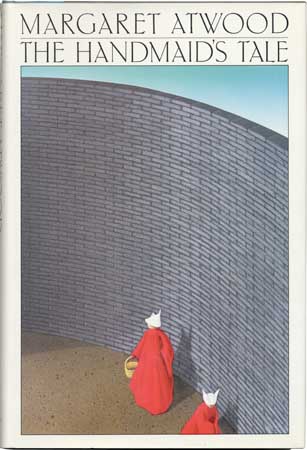 Our second book was Margaret Atwood, The Handmaid’s Tale. If you haven’t watched the television series on Hulu, I recommended it. (It stars Elisabeth Moss, who also played Peggy Olson on Mad Men—as well as Zoey Bartlet on West Wing. I found myself occasionally thinking, “Don’t do that to Peggy/Zoey!”) It is not an easy watch, but it is powerful and ultimately hopeful. Our central discussion question for Atwood’s classic novel was, “How can the lenses of patriarchy and feminism inform and empower movements of resistance and resilience?” I am probably most haunted by Atwood’s own reflection that her novel is “An imagined account of what happens when not uncommon pronouncements about women are taken to their logical conclusions.”
From the novel itself, the line that has stuck with me the most is from the protagonist Offred’s observation about Serena Joy, the wife of the couple who hold her captive. Serena’s character is based on real life figures like Phyllis Schafly, who during the movement to pass the Equal Rights Amendment, made an incredibly ironic argument in public that women should not participate in public life outside the home. In the book, Offred thinks to herself, “How furious she must be, now that she’s been taken at her word.” Again, reading against the grain, we can see the vital importance of denouncing sexism and helping build a world of gender equality.
And if there were but “world enough and time,” there are so many other relevant dystopian novels. If you want to continue reading on your own, other top contenders I considered were:
-
Philip Roth’s The Plot Against America,
-
Robert Graves’s I Claudius, and
-
Starhawk’s The Fifth Sacred Thing.
Related to the upcoming class on Bioethics I’ll be teaching this fall (blog posts forthcoming over the next few months), the best supplemental novel to read would likely be Aldous Huxley’s Brave New World. But in preparing for the third and final part of our summer discussion series, I was interested to see that last month, The New Yorker joined a growing chorus of voices declaring that, “In the ongoing contest over which dystopian classic is most applicable to our time, Octavia Butler’s ‘Parable’ books may be unmatched.” My post tomorrow will focus on Butler’s powerful novel.
The Rev. Dr. Carl Gregg is a certified spiritual director, a D.Min. graduate of San Francisco Theological Seminary, and the minister of the Unitarian Universalist Congregation of Frederick, Maryland. Follow him on Facebook (facebook.com/carlgregg) and Twitter (@carlgregg).
Learn more about Unitarian Universalism: http://www.uua.org/beliefs/principles
Previous Post

August 23, 2017
Jungian Reflections on Jesus from the “Second Half of Life”
Browse Our Archives
Select a Category Advent Anti-Racism Archaeology Atheism Baptism Best of the Year List Book Reviews Buddhism Catholicism Christian Education Church and State Church Planting Climate Change Conscientious Objection to War Creation Spirituality Death Penalty Didache Disability Rights Discernment Easter Ecology Emergent Church Movement Empire-Critical Ethics Evolution Feminist Theology Film Reviews Gandhi Gospel of Mark Gun Control Hinduism Immigration Reform Interfaith Islam JFK Judaism Jungian Spirituality Lectionary Commentary Lent Letters to the Editor LGBT Marriage MLK Multiculturalism Mysticism Nonviolent Activism Occupy Paganism (Earth-centered Religions) Parables Paul Pluralism Politics Process Theology Quantum Physics Requiescat In Pace Seminary and Divinity School Sermon Series Retrospective Sermons Spiritual Direction Spiritual Practices Stewardship (Fundraising) The Book of J The Wheel of the Year (Paganism) Theoblogger Challenge Triathlon Uncategorized Unitarian Universalism Worship Resources Youth Ministry
Select a Month July 2026 May 2026 March 2026 November 2025 October 2025 August 2025 February 2025 December 2024 October 2024 March 2024 January 2024 December 2023 November 2023 March 2023 February 2023 January 2023 December 2022 November 2022 August 2022 March 2022 February 2022 January 2022 December 2021 September 2021 August 2021 July 2021 June 2021 May 2021 February 2021 January 2021 December 2020 August 2020 June 2020 May 2020 April 2020 March 2020 February 2020 January 2020 December 2019 November 2019 October 2019 September 2019 July 2019 June 2019 March 2019 February 2019 January 2019 December 2018 November 2018 October 2018 September 2018 June 2018 May 2018 April 2018 March 2018 February 2018 January 2018 December 2017 November 2017 October 2017 September 2017 August 2017 July 2017 June 2017 May 2017 April 2017 March 2017 February 2017 January 2017 December 2016 November 2016 October 2016 September 2016 August 2016 June 2016 May 2016 April 2016 March 2016 February 2016 January 2016 December 2015 November 2015 October 2015 September 2015 August 2015 July 2015 June 2015 May 2015 April 2015 March 2015 February 2015 January 2015 December 2014 November 2014 October 2014 August 2014 July 2014 June 2014 May 2014 April 2014 March 2014 February 2014 January 2014 December 2013 November 2013 October 2013 September 2013 August 2013 July 2013 June 2013 May 2013 April 2013 March 2013 February 2013 January 2013 December 2012 November 2012 October 2012 September 2012 August 2012 July 2012 June 2012 May 2012 April 2012 March 2012 February 2012 January 2012 December 2011 November 2011 October 2011 September 2011 August 2011 July 2011 June 2011 May 2011 April 2011 March 2011 February 2011 January 2011 December 2010 November 2010 October 2010 August 2009 July 2009 May 2009
Follow Us!
TAKE THE
Religious Wisdom Quiz
Which book of the Bible contains the phrase "Vanity of vanities"?
Select your answer to see how you score.
Job Proverbs Ecclesiastes Psalms
Related posts from Carl Gregg

Reading America at 250: A Nation Wrestles With...


Andrew Holocek on the Power of Darkness

The Stories That Shape Us: Myths, Archetypes, &...
TRENDING AT PATHEOS More Voices

Reading America at 250: A Nation Wrestles With...
As part of my own reflection on the 250th anniversary of the...

Whenever I am reading a book or listening to an argument, I...

President Trump Ban Animal Torture Videos on Facebook
Call for Stricter Regulations of Animal Abuse Content on Facebook Although President...

Draft Amendments to Address Ritual Abuse in New...
The proposed changes would make it illegal for individuals in domestic partnerships...

How Bans on LGBTQ+ Student Clubs Threaten Religious...
On June 20, 2025, the State of Texas passed Senate Bill 12....

The Truth About the Gen Z Revival
This past year, there has been a lot of media buzz surrounding...
view all More Voices blogs
Ad-Free & Subscriber Log-In Subscription Support
- About Us
- 2026 Calendar
- Videos
- Podcasts
- Library of World Religions
- Faith In Media Tracker
- Advertise With Us
- Write for Us
- Privacy Policy
- Terms of Service
- Do Not Sell My Data
- Contact Us
- Radiant Digital
- Manage Newsletter Subscriptions
- Unsubscribe From Notifications
- Sitemap
Copyright 2008-2026, Patheos. All rights reserved.
Subscription Support Ad-Free & Subscriber Log-In
Follow Patheos