
BuddhistCatholicContemplativeEvangelicalGeneral ChristianHinduJewishLatter-day SaintMuslimNew VisionsProgressive Christian
Beliefs
- Buddhist
- Catholic
- Contemplative
- Evangelical
- General Christian
- Hindu
- Jewish
- Latter-day Saint
- More Voices
- Muslim
- New Visions
- Pagan
- Progressive Christian
Topics
- Religion News
- Food and Religion
- Sports and Religion
- Religious Art
- Religious Music and Entertainment
- Religious Events
- History and Religion
- Style and Religion
- Politics and Religion
- Women in Religion
- Recreation Outdoors and Religion
- Business Finance and Religion
- Careers Workplace and Religion
- Education and Religion
- Family Parenting and Religion
- Health Fitness and Religion
- Home and Religion
- Relationships and Religion
- Technology and Religion
- Travel and Religion
Columnists
- Buddhist Columnists
- Business Finance and Religion Columnists
- Careers Workplace and Religion Columnists
- Catholic Columnists
- Contemplative Columnists
- Education and Religion Columnists
- Evangelists Columnists
- Family Parenting and Religion Columnists
- General Christian Columnists
- Health Fitness and Religion Columnists
- Hindu Columnists
- History and Religion Columnists
- Home and Religion Columnists
- Jewish Columnists
- More Voices Columnists
- Latter Day Columnists
- Muslim Columnists
- New Visions Columnists
- Nonreligious Columnists
- Pagan Columnists
- Politics and Religion Columnists
- Progressive Columnists
- Recreation Outdoors and Religion Columnists
- Relationships and Religion Columnists
- Religion News Columnists
- Religious Art Columnists
- Religious Events Columnists
- Religious Music and Entertainment Columnists
- Sports and Religion Columnists
- Style and Religion Columnists
- Technology and Religion Columnists
- Travel and Religion Columnists
- Women in Religion Columnists
Resource Library
- 2026 Calendar
- Library of World Religions
- The 100 Most Holy Places on Earth
- Patheos Answers
- Podcasts
- Videos
- Faith Leaders Database
- Anglican Episcopalian
- Bahai
- Baptist
- Buddhism
- Christianity
- Confucianism
- Eastern Orthodoxy
- Hinduism
- Holiness and Pentecostal
- ISKCON
- Islam
- Judaism
- Lutheran
- Methodist
- The Church of Jesus Christ of Latter-day Saints
- New Age
- Paganism
- Presbytarian and Reformed
- Protestantism
- Religion Behind the Scenes
- Roman Catholic
- Scientology
- Shia Islam
- Sikhism
- Sufism
- Sunni Islam
- Taoism
- Zen
- See all religions
Research Tools
 Ad-Free & Subscriber Log-In Subscription Support
Ad-Free & Subscriber Log-In Subscription Support
Follow Patheos 

- Trending:
- Forgiveness
- |
- Marriage
- |
- Consciousness
- |
- Death Penalty
- |
- Election
- |
- Halloween

- Home
- More Voices
- Octopuses & Other Minds: “The Deep Origins of Consciousness”
Octopuses & Other Minds: “The Deep Origins of Consciousness”
Last updated on: August 18, 2017 at 11:45 am by Carl Gregg
Octopuses & Other Minds: “The Deep Origins of Consciousness” 2017-08-18T11:45:54-04:00 Carl Gregg
Patheos Explore the world's faith through different perspectives on religion and spirituality! Patheos has the views of the prevalent religions and spiritualities of the world.
This post is a continuation of my topic yesterday on “What Do Animals Think & Feel?“
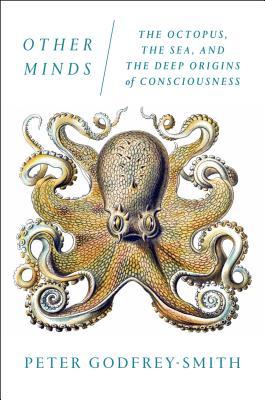 Regarding the implications of common ancestry and the tree of life, the best book I have read recently is Other Minds: The Octopus, the Sea, and the Deep Origins of Consciousness (Farrar, Straus and Giroux: 2016) by Peter Godfrey-Smith, a philosophy professor at the City University of New York. Although we only have to go back six million years to find the common ancestor of a human and a chimpanzee, we have to go back 600 million years to find the last common ancestors of humans and octopuses. As best we can tell, that last common ancestor of humans and octopuses looked something like a “small, flattened worm….just millimeters long” swimming in the ocean with “simple eyes, or at least light-sensitive patches…” (Godfrey-Smith 5). And over time, as members of this common ancestor reproduced, evolution happened
through an accumulation of happenstance changes…. And before long we are looking not at two collections of worms, but at two enormous branches of the evolutionary tree. One path forward…leads to vertebrates…and within vertebrates, to mammals and eventually humans. The other path leads to a great range of invertebrate species, including crabs and bees and their relatives, many kinds of worms, and also the mollusks, the group that includes clams, oysters, and snails (Godfrey-Smith 9).
And here’s where it gets really interesting. On that branch that leads not to us humans, but to octopuses, “most of the animals are fairly small…except for cephalopods.” Of particular interest are octopuses, cuttlefish, and squid, who all have “large and complex nervous systems” (Godfrey-Smith 4-5). “Cephalopods are an island of mental complexity in the sea of invertebrate animals.” And from the perspective of the tree of life in which we split from them 600 million years ago, the most recent common ancestor of humans and octopuses was so simple and lies so far back [those “small, flattened worms….just millimeters long” swimming in the ocean with “simple eyes, or at least light-sensitive patches…”] that
cephalopods are an independent experiment in the evolution of large brains and complex behavior. If we can make contact with cephalopods as sentient beings, it is not because of a shared history, not because of kinship, but because evolution built minds twice over. This is probably the closest we will come to meeting an intelligent alien (Godfrey-Smith 9).
All these claims, of course, raise a lot of questions about definitions.
When we talk about what animals think and feel, the word consciousness is about awareness. As far as I know, my dining room table is not conscious. I could chop it down or burn it, and it would make no difference to the table. If you remember the earlier Darwin quote about plants, then maybe the tree it came from was aware in some extremely basic sense of the word—but let’s set that aside for a future exploration about trees, since our current focus is on animals. One helpful definition of consciousness comes from Christof Koch, head of the Allen Institute for Brain Science in Seattle:
-
Consciousness is the thing that feels like something…. Cut your leg, that’s physical. If the cut hurts, you’re conscious.
-
The part of you that knows that the cut hurts, that feels and thinks, is your mind.
-
The ability to feel sensations is called sentience…. Under general anesthesia we remain very much alive though not conscious. And during sleep our unconscious brains are working hard, cleansing, sorting, rejuvenating. (Safina 21)
So how do we begin to map out the spectrum of sentience about what animals think and feel?
We still have a lot to learn, but science has also learned an incredible amount in the past century alone:
- “The simple fact that chickens establish a ‘pecking order’ was not formally recognized until the 1920s.”
- “Also in the 1920s, Margaret Morse Nice first discovered that songbirds defend territories—and that’s one of the most basic reasons they sing.”
- In 1973, three scientists shared a Nobel Prize for their studies of “honeybee dance-language, fish courtship, and how baby geese ‘imprint’ on the first moving object they see.” (Safina 25-26)
- “Conventional wisdom holds that only humans can consciously plan. But when jays [the name of several species of medium-sized birds] store perishable foods, they use up the perishable food stashes first.” (Safina 260)
- And generally “The most startling finding in recent work on animal intelligence is how smart some birds are, especially parrots and crows.” (Godfrey-Smith 50)
- Similarly, “Chickens exist in stable social groups. They can recognize each other by their facial features. They have 24 distinct cries that communicate information to one another, including separate alarm calls” (Bekoff and Pierce 34-35).
- Gorillas are one among many examples of animals who use forms of tools. Gorillas “test the depth of marsh water with sticks, use staves to lean out over water, and move logs to make bridges over swampy places…. Capuchin monkeys transport heavy stones to nut-tracking sites, choosing those of appropriate size as anvils and as hammers” (Safina 194-198).
- Octopuses “can learn to navigate simple mazes. They can use visual cues to determine which of two possible environments they have been placed in, and then take the correct route to a goal for that environment. They can learn to unscrew jars to obtain the food inside.” (Godfrey-Smith 52).
- Octopuses can also “recognize and behave differently toward individual human keepers “even when the humans are wearing identical uniforms. Similarly, a cuttlefish at Dalhousie University “reliably squirted streams of water at all new visitors to the lab, and not at people who were often around” (Godfrey-Smith 56).
- There are many recorded instances of grief behavior among elephants (Safina 68-69).
These are only a few among many other examples of what science is showing us about the spectrum of thinking and feeling within the Animal Kingdom of which we are a part.
And to make connections about how capacities to think and feel relate to the universal tree of life and evolution through common ancestry,
Brain scans show that core emotions of sadness, happiness, rate, fear, and motivational feeling of hunger and thirst, are generated in deep and very ancient circuits of the brain…. The genes that direct our own bodies to create the mood-making brain hormones oxytocin and vasopressin, for instance, date back at least seven hundred million years… [which is older than the last common ancestor of humans and octopuses]. Oxytocin drives bonding…and it makes animal species act social or sexual. Block the hormone; many mammals and birds lose interest in socializing, pairing, nesting, and contact…. Given a sniff of oxytocin, human fathers get more playful with their babies, increase eye-to-eye gazing, and show greater interest in the child.
So what does all that mean for how animals think and feel? The ecologist Carl Safina likes to sum it up this way: “Your dog really does love you. Part of the reason is: because you are kind. If you were abusive, your dog would fear you. And they might still love you, out of duty or need—not so different from many people trapped in abusive relationships” (Safina 238). For me, this evolutionary, tree of life, universal common ancestor view of the world makes me feel deeply connected to what the Unitarian Universalist Seventh Principle calls the “interdependent web of all existence.”
Along these lines, I invite you to hear a final quote from Safina about how he has come to think about the tree of life:
The different species are like people who knew each other in high school but have since gone on to different lives and livelihoods. Lots in common. Common roots. A bond, perhaps neglected…. Lots of shared history. And between first breath and final gasp, we endeavor toward a common quest: to love, to raise our young, to find space enough for our lives, to survive the confronting dangers, to do what it takes, to the best of our abilities, to live out the mystery and opportunity of finding ourselves somehow in existence.
We are not all equal. There are real differences, but these differences are on a spectrum of degree rather than kind. So may we each do what we can within our spheres of influence to decrease suffering and cruelty and to increase freedom and compassion for all sentient beings. In the words of the Buddhist “loving-kindness” meditation:
May all sentient beings be filled with loving-kindness
May all sentient beings be well.
May all sentient beings be peaceful and at ease.
May all sentient beings be free.
The Rev. Dr. Carl Gregg is a certified spiritual director, a D.Min. graduate of San Francisco Theological Seminary, and the minister of the Unitarian Universalist Congregation of Frederick, Maryland. Follow him on Facebook (facebook.com/carlgregg) and Twitter (@carlgregg).
Learn more about Unitarian Universalism: http://www.uua.org/beliefs/principles
Previous Post

August 17, 2017
What Do Animals Think & Feel?
Next Post
August 23, 2017 Jungian Reflections on Jesus from the “Second Half of Life”
Browse Our Archives
Select a Category Advent Anti-Racism Archaeology Atheism Baptism Best of the Year List Book Reviews Buddhism Catholicism Christian Education Church and State Church Planting Climate Change Conscientious Objection to War Creation Spirituality Death Penalty Didache Disability Rights Discernment Easter Ecology Emergent Church Movement Empire-Critical Ethics Evolution Feminist Theology Film Reviews Gandhi Gospel of Mark Gun Control Hinduism Immigration Reform Interfaith Islam JFK Judaism Jungian Spirituality Lectionary Commentary Lent Letters to the Editor LGBT Marriage MLK Multiculturalism Mysticism Nonviolent Activism Occupy Paganism (Earth-centered Religions) Parables Paul Pluralism Politics Process Theology Quantum Physics Requiescat In Pace Seminary and Divinity School Sermon Series Retrospective Sermons Spiritual Direction Spiritual Practices Stewardship (Fundraising) The Book of J The Wheel of the Year (Paganism) Theoblogger Challenge Triathlon Uncategorized Unitarian Universalism Worship Resources Youth Ministry
Select a Month July 2026 May 2026 March 2026 November 2025 October 2025 August 2025 February 2025 December 2024 October 2024 March 2024 January 2024 December 2023 November 2023 March 2023 February 2023 January 2023 December 2022 November 2022 August 2022 March 2022 February 2022 January 2022 December 2021 September 2021 August 2021 July 2021 June 2021 May 2021 February 2021 January 2021 December 2020 August 2020 June 2020 May 2020 April 2020 March 2020 February 2020 January 2020 December 2019 November 2019 October 2019 September 2019 July 2019 June 2019 March 2019 February 2019 January 2019 December 2018 November 2018 October 2018 September 2018 June 2018 May 2018 April 2018 March 2018 February 2018 January 2018 December 2017 November 2017 October 2017 September 2017 August 2017 July 2017 June 2017 May 2017 April 2017 March 2017 February 2017 January 2017 December 2016 November 2016 October 2016 September 2016 August 2016 June 2016 May 2016 April 2016 March 2016 February 2016 January 2016 December 2015 November 2015 October 2015 September 2015 August 2015 July 2015 June 2015 May 2015 April 2015 March 2015 February 2015 January 2015 December 2014 November 2014 October 2014 August 2014 July 2014 June 2014 May 2014 April 2014 March 2014 February 2014 January 2014 December 2013 November 2013 October 2013 September 2013 August 2013 July 2013 June 2013 May 2013 April 2013 March 2013 February 2013 January 2013 December 2012 November 2012 October 2012 September 2012 August 2012 July 2012 June 2012 May 2012 April 2012 March 2012 February 2012 January 2012 December 2011 November 2011 October 2011 September 2011 August 2011 July 2011 June 2011 May 2011 April 2011 March 2011 February 2011 January 2011 December 2010 November 2010 October 2010 August 2009 July 2009 May 2009
Follow Us!
TAKE THE
Religious Wisdom Quiz
What was the rider of the Red Horse in Revelation given?
Select your answer to see how you score.
A balance scale A large sword A crown A bow
Related posts from Carl Gregg

Reading America at 250: A Nation Wrestles With...


Andrew Holocek on the Power of Darkness

The Stories That Shape Us: Myths, Archetypes, &...
TRENDING AT PATHEOS More Voices

Reading America at 250: A Nation Wrestles With...
As part of my own reflection on the 250th anniversary of the...

Whenever I am reading a book or listening to an argument, I...

President Trump Ban Animal Torture Videos on Facebook
Call for Stricter Regulations of Animal Abuse Content on Facebook Although President...

Draft Amendments to Address Ritual Abuse in New...
The proposed changes would make it illegal for individuals in domestic partnerships...

How Bans on LGBTQ+ Student Clubs Threaten Religious...
On June 20, 2025, the State of Texas passed Senate Bill 12....

The Truth About the Gen Z Revival
This past year, there has been a lot of media buzz surrounding...
view all More Voices blogs
Ad-Free & Subscriber Log-In Subscription Support
- About Us
- 2026 Calendar
- Videos
- Podcasts
- Library of World Religions
- Faith In Media Tracker
- Advertise With Us
- Write for Us
- Privacy Policy
- Terms of Service
- Do Not Sell My Data
- Contact Us
- Radiant Digital
- Manage Newsletter Subscriptions
- Unsubscribe From Notifications
- Sitemap
Copyright 2008-2026, Patheos. All rights reserved.
Subscription Support Ad-Free & Subscriber Log-In
Follow Patheos