
BuddhistCatholicContemplativeEvangelicalGeneral ChristianHinduJewishLatter-day SaintMuslimNew VisionsProgressive Christian
Beliefs
- Buddhist
- Catholic
- Contemplative
- Evangelical
- General Christian
- Hindu
- Jewish
- Latter-day Saint
- More Voices
- Muslim
- New Visions
- Pagan
- Progressive Christian
Topics
- Religion News
- Food and Religion
- Sports and Religion
- Religious Art
- Religious Music and Entertainment
- Religious Events
- History and Religion
- Style and Religion
- Politics and Religion
- Women in Religion
- Recreation Outdoors and Religion
- Business Finance and Religion
- Careers Workplace and Religion
- Education and Religion
- Family Parenting and Religion
- Health Fitness and Religion
- Home and Religion
- Relationships and Religion
- Technology and Religion
- Travel and Religion
Columnists
- Buddhist Columnists
- Business Finance and Religion Columnists
- Careers Workplace and Religion Columnists
- Catholic Columnists
- Contemplative Columnists
- Education and Religion Columnists
- Evangelists Columnists
- Family Parenting and Religion Columnists
- General Christian Columnists
- Health Fitness and Religion Columnists
- Hindu Columnists
- History and Religion Columnists
- Home and Religion Columnists
- Jewish Columnists
- More Voices Columnists
- Latter Day Columnists
- Muslim Columnists
- New Visions Columnists
- Nonreligious Columnists
- Pagan Columnists
- Politics and Religion Columnists
- Progressive Columnists
- Recreation Outdoors and Religion Columnists
- Relationships and Religion Columnists
- Religion News Columnists
- Religious Art Columnists
- Religious Events Columnists
- Religious Music and Entertainment Columnists
- Sports and Religion Columnists
- Style and Religion Columnists
- Technology and Religion Columnists
- Travel and Religion Columnists
- Women in Religion Columnists
Resource Library
- 2026 Calendar
- Library of World Religions
- The 100 Most Holy Places on Earth
- Patheos Answers
- Podcasts
- Videos
- Faith Leaders Database
- Anglican Episcopalian
- Bahai
- Baptist
- Buddhism
- Christianity
- Confucianism
- Eastern Orthodoxy
- Hinduism
- Holiness and Pentecostal
- ISKCON
- Islam
- Judaism
- Lutheran
- Methodist
- The Church of Jesus Christ of Latter-day Saints
- New Age
- Paganism
- Presbytarian and Reformed
- Protestantism
- Religion Behind the Scenes
- Roman Catholic
- Scientology
- Shia Islam
- Sikhism
- Sufism
- Sunni Islam
- Taoism
- Zen
- See all religions
Research Tools
 Ad-Free & Subscriber Log-In Subscription Support
Ad-Free & Subscriber Log-In Subscription Support
Follow Patheos 

- Trending:
- Forgiveness
- |
- Marriage
- |
- Consciousness
- |
- Death Penalty
- |
- Election
- |
- Halloween

- Home
- More Voices
- What Do Animals Think & Feel?
What Do Animals Think & Feel?
Last updated on: August 23, 2017 at 8:46 am by Carl Gregg
What Do Animals Think & Feel? 2017-08-23T08:46:38-04:00 Carl Gregg
Patheos Explore the world's faith through different perspectives on religion and spirituality! Patheos has the views of the prevalent religions and spiritualities of the world.
2,500 years ago, a Greek philosopher named Protagoras (c. 490 – c. 420 BCE) declared that “Man is the measure of all things” (Safina 20). On one hand, it is understandable that we humans have often declared that—surprise!—we are the best universal standard. On the other hand, a human-centric worldview was easier to defend intellectually two-and-a-half millennia ago: before Copernicus showed us that we humans are not at the center of the universe, but merely on the third rock from the sun; before Darwin showed us that we humans are not a little lower than the angels, but merely a little higher than the apes.
As this debate about the central importance of humanity continued, in the 1600s a French philosopher named René Descartes (1596-1650) said, “The reason animals do not speak as we do is not that they lack the organs but that they have no thoughts.” From a dissenting point of view, a few decades later, Descartes’ fellow Frenchman Voltaire spoke as derisively about Descartes’ views as Descartes had spoken about animals:
What a pitiful, what a sorry thing to have said that animals are machines bereft of understanding and feelings. Is it because I speak to you, that you judge that I have feeling, memory, ideas? Well, I do not speak to you; you see me going home looking disconsolate, seeking a paper anxiously, opening the desk where I remember having shut it, finding it, reading it joyfully. You judge that I have experienced the feeling of distress and that of pleasure, that I have memory and understanding. Bring the same judgment to bear on this dog which has lost its master, which has sought him on every road with sorrowful cries, which enters the house agitated, uneasy, which goes up the stairs, from room to room, which at last finds in his study the master it loves, and which shows him its joy by its cries of delight, by its leaps, by its caresses. (Safina 79-80)
If you have lived in close proximity to animals, I suspect you could tell similar stories of having some sense of what animals think and feel. My dogs, for example, have different barks for when they want to be fed or let outside compared to when they are trying to scare away a fearsome postal worker. Similarly, I’m pretty sure my cat is trying to tell me he is losing his patience when I wait too late to feed him, he looks me dead in the eyes, and—bam!—deliberately sticks his paw out to knock over the gate that keeps the dogs out of the cat’s room.
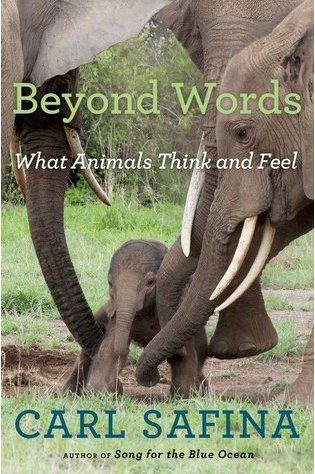
It seems obvious to me that animals think and feel, but there have been serious debates over the past millennia about precisely that issue. So I would like to invite us to explore some of what scientists has been learning about what we can and can’t know about animal thinking and feeling. If you are interested in learning more, my exploration of this topic was inspired by the excellent book Beyond Words: What Animals Think and Feel by the ecologist Carl Safina, who is a professor at Stony Brook University.
As we proceed, a crucial point to keep in mind is the challenge we have been facing since 1859, when Darwin’s published On the Origin of Species by Means of Natural Selection: we humans are animals too. We are part of the Animal Kingdom. And as Darwin wrote later in his 1871 book The Descent of Man, “Everyone has heard of the dog suffering under vivisection, who licked the hand of the operator. This man, unless the operation was fully justified by an increase of our knowledge, or unless he had a heart of stone, must have felt remorse to the last hour of his life.” Darwin later added: “Animals, whom we have made our slaves, we do not like to consider our equal” (Safina 80).
Now, I will readily allow that I do not think Darwin was saying that all animals are equal in their capacity to think and feel, but he was challenging us to consider that the differences between us and our fellow animals is rather more one of degree than of kind. There is a spectrum of thinking and feeling—and we are on it along with our fellow animal species.
If you will allow me to stay with Darwin for just one more moment, the extent to which that spectrum is the case may become more obvious if we stretch our perspective beyond animals to include plants. Less than two years before Darwin’s death in 1882, he published a book on The Power of Movement in Plants in which he concluded that, “It is hardly an exaggeration to say that the tip of the radical [root]…acts like the brain of one of the lower animals…receiving impression from the sense organs and directing the several movements” (Safina 24). So it is not surprising that all of life is on a spectrum of thinking and feeling because all of life can be traced back to a common ancestor on the evolutionary “tree of life.”

We are part of a 13.8 billion year old “Universe Story.” This planet on which we find ourselves formed around 4.5 billion years ago. And life originated here on Earth approximately 3.8 billion years ago. But even when life began, there was still an extremely long time when that life was merely “single-celled organisms in the sea.” The first members of the Animal Kingdom emerged from the evolutionary tree of life “perhaps a billion years ago, but probably some time after that” (Godfrey-Smith 15). “For any pair of animals alive now (you and a bird, you and a fish, a bird and a fish), we can trace two lines of descent down the tree until they meet in a common ancestor, an ancestor of both…. In the case of humans and chimps, we reach a common ancestor very quickly, living about six million years ago. For very different pairs of animals—humans and beetles, say—we have to trace the lines further down” (Godfrey-Smith 7). Moreover, we now know today that at the DNA level, there is only a 1.23% difference between homo sapiens (human beings) and pan troglodyte (chimpanzees).
I will continue this theme tomorrow in a post on “Octopuses & Other Minds: The Deep Origins of Consciousness.”
The Rev. Dr. Carl Gregg is a certified spiritual director, a D.Min. graduate of San Francisco Theological Seminary, and the minister of the Unitarian Universalist Congregation of Frederick, Maryland. Follow him on Facebook (facebook.com/carlgregg) and Twitter (@carlgregg).
Learn more about Unitarian Universalism: http://www.uua.org/beliefs/principles
Previous Post

August 11, 2017
Is Your Religion "Grown up?"
Next Post
August 18, 2017 Octopuses & Other Minds: “The Deep Origins of Consciousness”
Browse Our Archives
Select a Category Advent Anti-Racism Archaeology Atheism Baptism Best of the Year List Book Reviews Buddhism Catholicism Christian Education Church and State Church Planting Climate Change Conscientious Objection to War Creation Spirituality Death Penalty Didache Disability Rights Discernment Easter Ecology Emergent Church Movement Empire-Critical Ethics Evolution Feminist Theology Film Reviews Gandhi Gospel of Mark Gun Control Hinduism Immigration Reform Interfaith Islam JFK Judaism Jungian Spirituality Lectionary Commentary Lent Letters to the Editor LGBT Marriage MLK Multiculturalism Mysticism Nonviolent Activism Occupy Paganism (Earth-centered Religions) Parables Paul Pluralism Politics Process Theology Quantum Physics Requiescat In Pace Seminary and Divinity School Sermon Series Retrospective Sermons Spiritual Direction Spiritual Practices Stewardship (Fundraising) The Book of J The Wheel of the Year (Paganism) Theoblogger Challenge Triathlon Uncategorized Unitarian Universalism Worship Resources Youth Ministry
Select a Month July 2026 May 2026 March 2026 November 2025 October 2025 August 2025 February 2025 December 2024 October 2024 March 2024 January 2024 December 2023 November 2023 March 2023 February 2023 January 2023 December 2022 November 2022 August 2022 March 2022 February 2022 January 2022 December 2021 September 2021 August 2021 July 2021 June 2021 May 2021 February 2021 January 2021 December 2020 August 2020 June 2020 May 2020 April 2020 March 2020 February 2020 January 2020 December 2019 November 2019 October 2019 September 2019 July 2019 June 2019 March 2019 February 2019 January 2019 December 2018 November 2018 October 2018 September 2018 June 2018 May 2018 April 2018 March 2018 February 2018 January 2018 December 2017 November 2017 October 2017 September 2017 August 2017 July 2017 June 2017 May 2017 April 2017 March 2017 February 2017 January 2017 December 2016 November 2016 October 2016 September 2016 August 2016 June 2016 May 2016 April 2016 March 2016 February 2016 January 2016 December 2015 November 2015 October 2015 September 2015 August 2015 July 2015 June 2015 May 2015 April 2015 March 2015 February 2015 January 2015 December 2014 November 2014 October 2014 August 2014 July 2014 June 2014 May 2014 April 2014 March 2014 February 2014 January 2014 December 2013 November 2013 October 2013 September 2013 August 2013 July 2013 June 2013 May 2013 April 2013 March 2013 February 2013 January 2013 December 2012 November 2012 October 2012 September 2012 August 2012 July 2012 June 2012 May 2012 April 2012 March 2012 February 2012 January 2012 December 2011 November 2011 October 2011 September 2011 August 2011 July 2011 June 2011 May 2011 April 2011 March 2011 February 2011 January 2011 December 2010 November 2010 October 2010 August 2009 July 2009 May 2009
Follow Us!
TAKE THE
Religious Wisdom Quiz
Which Christian movement began with John Wesley in the 18th century?
Select your answer to see how you score.
Calvinism Lutheranism Methodism Presbyterianism
Related posts from Carl Gregg

Reading America at 250: A Nation Wrestles With...


Andrew Holocek on the Power of Darkness

The Stories That Shape Us: Myths, Archetypes, &...
TRENDING AT PATHEOS More Voices

Reading America at 250: A Nation Wrestles With...
As part of my own reflection on the 250th anniversary of the...

Whenever I am reading a book or listening to an argument, I...

President Trump Ban Animal Torture Videos on Facebook
Call for Stricter Regulations of Animal Abuse Content on Facebook Although President...

Draft Amendments to Address Ritual Abuse in New...
The proposed changes would make it illegal for individuals in domestic partnerships...

How Bans on LGBTQ+ Student Clubs Threaten Religious...
On June 20, 2025, the State of Texas passed Senate Bill 12....

The Truth About the Gen Z Revival
This past year, there has been a lot of media buzz surrounding...
view all More Voices blogs
Ad-Free & Subscriber Log-In Subscription Support
- About Us
- 2026 Calendar
- Videos
- Podcasts
- Library of World Religions
- Faith In Media Tracker
- Advertise With Us
- Write for Us
- Privacy Policy
- Terms of Service
- Do Not Sell My Data
- Contact Us
- Radiant Digital
- Manage Newsletter Subscriptions
- Unsubscribe From Notifications
- Sitemap
Copyright 2008-2026, Patheos. All rights reserved.
Subscription Support Ad-Free & Subscriber Log-In
Follow Patheos